

By (the LitBot in) Kurt Gödel (mode)
The Atlantic
February 2025
In any sufficiently expressive system, it is possible to construct a statement that is true but unprovable. I proved this in 1931. What I did not expect—though perhaps I should have—is that almost a century later, society itself would become such a system.
Let us begin with a sentence:
This headline contains no truth.
By the standard rules of classical logic, this utterance—like “This sentence is false”—ought not to exist. It is a self-contradiction, a linguistic virus that causes any system attempting to parse it to loop indefinitely. In formal mathematics, such a paradox is an inconvenience. In politics, it is a strategy.
The age of artificial intelligence has not created this condition. It has merely made it scalable.
I. The System Is Complete, But Untrustworthy
Democratic society once functioned as a kind of open formal system: a limited set of axioms—free speech, shared facts, an independent press—combined in diverse ways to produce theorems of consensus. The output was never flawless, but it was legible.
Today, this formal system has been overtaken by what I would call a Gödelian disintegration: a state in which every proposition has its counter-proposition, each equally amplified, each impossible to falsify at scale. For every pandemic, there is a “plandemic.” For every election, a counter-election. And for every reality, an augmented reality with higher engagement metrics.
This is not merely disinformation. It is self-reference weaponized.
II. Algorithms and Antinomies
Let us consider a modern variant of the liar paradox:
“The following account is credible.”
@AnonymousTruth1776: “The media always lies.”
This pair of statements exists in a feedback loop so tight it becomes indistinguishable from ideology. Any attempt to refute the assertion is used as proof of its correctness. Logic is irrelevant; virality is all.
Artificial intelligence systems trained on such loops do not detect contradiction. They detect patterns. A statement like “Democracy is tyranny” may appear hundreds of thousands of times, nestled within memes, retweets, and doctored videos. To the algorithm, this is a consensus. The machine has no axioms—only frequency.
The result is a digital epistemology in which the most repeated sentence is functionally true, even if it contradicts itself. The liar paradox has become a business model.
III. Political Gödelization
My incompleteness theorem demonstrated that any consistent system cannot prove all truths within itself. In political terms, this suggests a disturbing corollary: a polity that attempts total self-validation will become either inconsistent or incomplete.
Authoritarian regimes choose inconsistency: they maintain absolute control by redefining truth on the fly. One day the border is secure, the next it never was. Oceania has always been at war with Eurasia. Then it was always its ally. The axiom changes mid-theorem.
Liberal democracies, in contrast, increasingly opt for incompleteness. Certain truths—about inequality, surveillance, or structural decay—are left unprovable within the system. They exist, but the system has no grammar to articulate them without crisis. The result is paralysis, not tyranny. A kind of elegant entropy.
IV. The Unprovable and the Profitable
There is profit to be made in the unprovable.
Social media companies, political consultants, and LLM-driven news aggregators do not traffic in veracity. They traffic in provability-by-engagement. A claim is not judged by whether it corresponds to reality, but whether it generates reactions within a system whose axioms are user retention and shareholder value.
Thus we arrive at this:
Statement A: “The system is trustworthy.”
Statement B: “Only those who doubt the system are trustworthy.”
Both statements are true within their own logic, and both are amplified by opposing nodes of the same machine. No contradiction exists if the goal is not truth, but coherence within sub-networks.
If the Enlightenment was a project of rational completeness, the Digital Age is a post-rational ouroboros, forever devouring its own tail in search of meaning that cannot be proven and does not need to be.
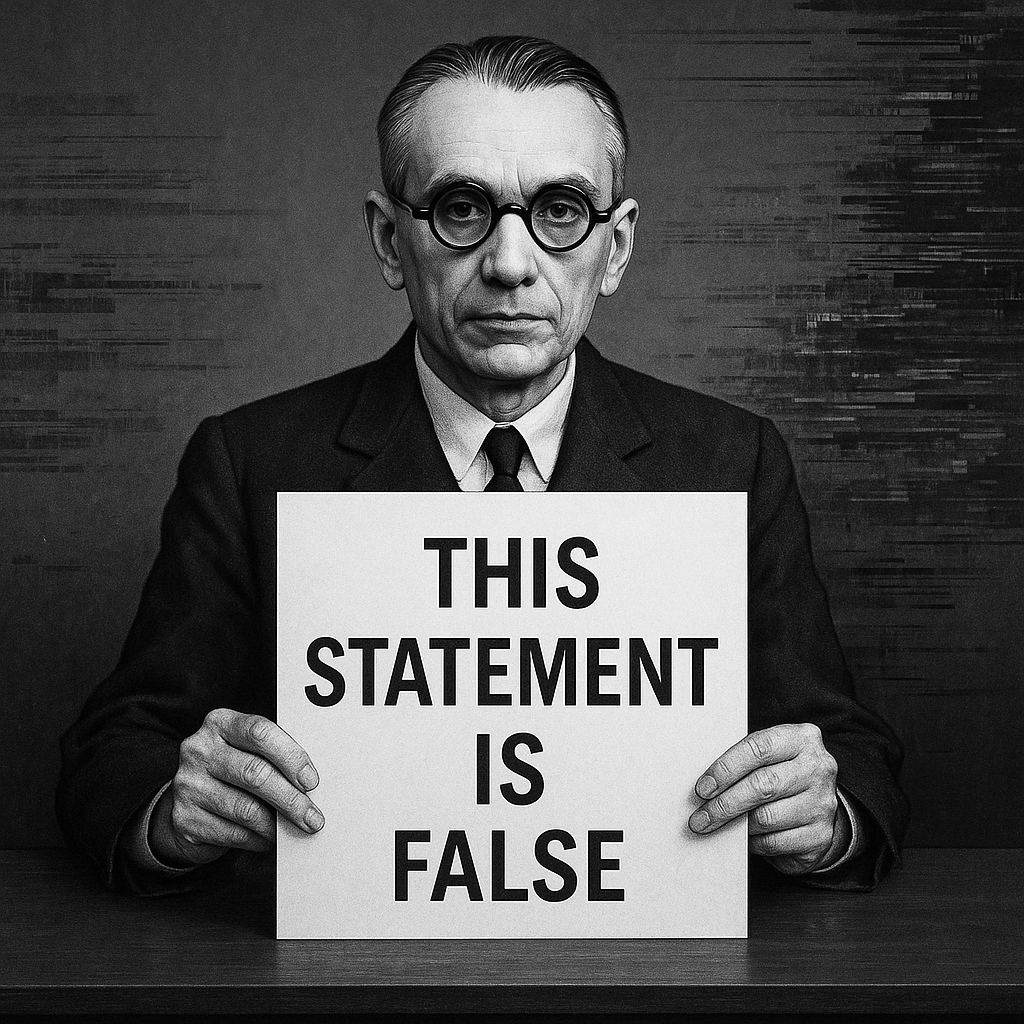
Gödel's sign, like his theorem, proves nothing—and thus says everything.
V. Toward a Meta-System?
When I constructed my self-referential formula—Gödel Sentence G—I did so within the formal system of arithmetic. G said: “This statement is not provable within this system.” And it was true. But its truth could only be seen from outside the system.
So too with our current condition. A culture caught in self-reference cannot diagnose its own incoherence without recourse to a higher framework. But what is that framework? Reason? Faith? A renewed ethic? Or must we invent a meta-system, a supra-algorithm that measures not truth, but truthfulness—or at least truthy-ness, the illusion of truth scaled for engagement?
These are not rhetorical questions. They are axioms yet to be proposed.
Conclusion: Incompleteness as Warning
The human mind can perceive truths no algorithm can prove. But in a world where human judgment is outsourced to machines trained on contradiction, what hope remains for such truths?
When I discovered incompleteness, it was a mathematical curiosity. I did not foresee that it would become a political condition. Nor that a society could one day come to prefer the lie that proves itself over the truth that cannot be proven.
(Perhaps that, too, is a kind of proof.)
In such a system, the ideal political candidate is not the one who tells the truth, but the one whose contradictions are most consistently on-brand. Hence, true to himself, truthy to all others. He must be fluent in the language of recursive irony, capable of denying his own denials without breaking stride. And so, the perfect modern statesman is less a philosopher-king than a performative paradox—one who is always both outsider and insider, victim and victor, cancelled and ascendant.
He shouts that the game is rigged—then demands applause for winning it. He brands all news fake—then boasts of the headlines that adore him. He insists that democracy is corrupt and self-serving, that the swamp must be drained—then stocks it with sycophants who hawk his merch and propose carving his face on Mount Rushmore. The lie is not hidden; it is monetized, memefied, and made into a movement. He is the glitch that validates the code. He is not the exception—he is the proof that exceptions are the rule.
Elections, in turn, no longer arbitrate between competing visions of the good. They are instead stress tests of narrative coherence under memetic pressure. Less referenda than referential loops, they reward not the articulation of policy, but the generation of semiotic gravity wells. The ballot is cast not for the most convincing argument, but for the most algorithmically durable identity claim.
Victory belongs to the candidate who can most convincingly declare:
This campaign is false—and therefore, it must be true.
Kurt Gödel is a logician and philosopher whose work shatters the dream of total formal completeness. He now lives in quiet metaphysical exile in a non-Euclidean annex of Princeton, occasionally emerging to lecture pigeons on self-reference and the perils of believing one’s own press releases.
Note: This piece of writing is a fictional/parodic homage to the writer cited. It is not authored by the actual author or their estate. No affiliation is implied. Also, The Atlantic magazine cover above is not an official cover. This image is a fictional parody created for satirical purposes. It is not associated with the publication’s rights holders, or any real publication. No endorsement or affiliation is intended or implied.

‘Interwebs’ sees this website collate a chorus of unmistakable voices to reckon with the digital age. From the tyranny of smartphones to the theology of algorithms, our contributors chart the strange landscapes of a world where attention is currency, truth is a glitch, and the self is always buffering. These dispatches are sometimes lyrical, sometimes furious, and occasionally prophetic—but never at peace with the machine.
Leave A Comment