
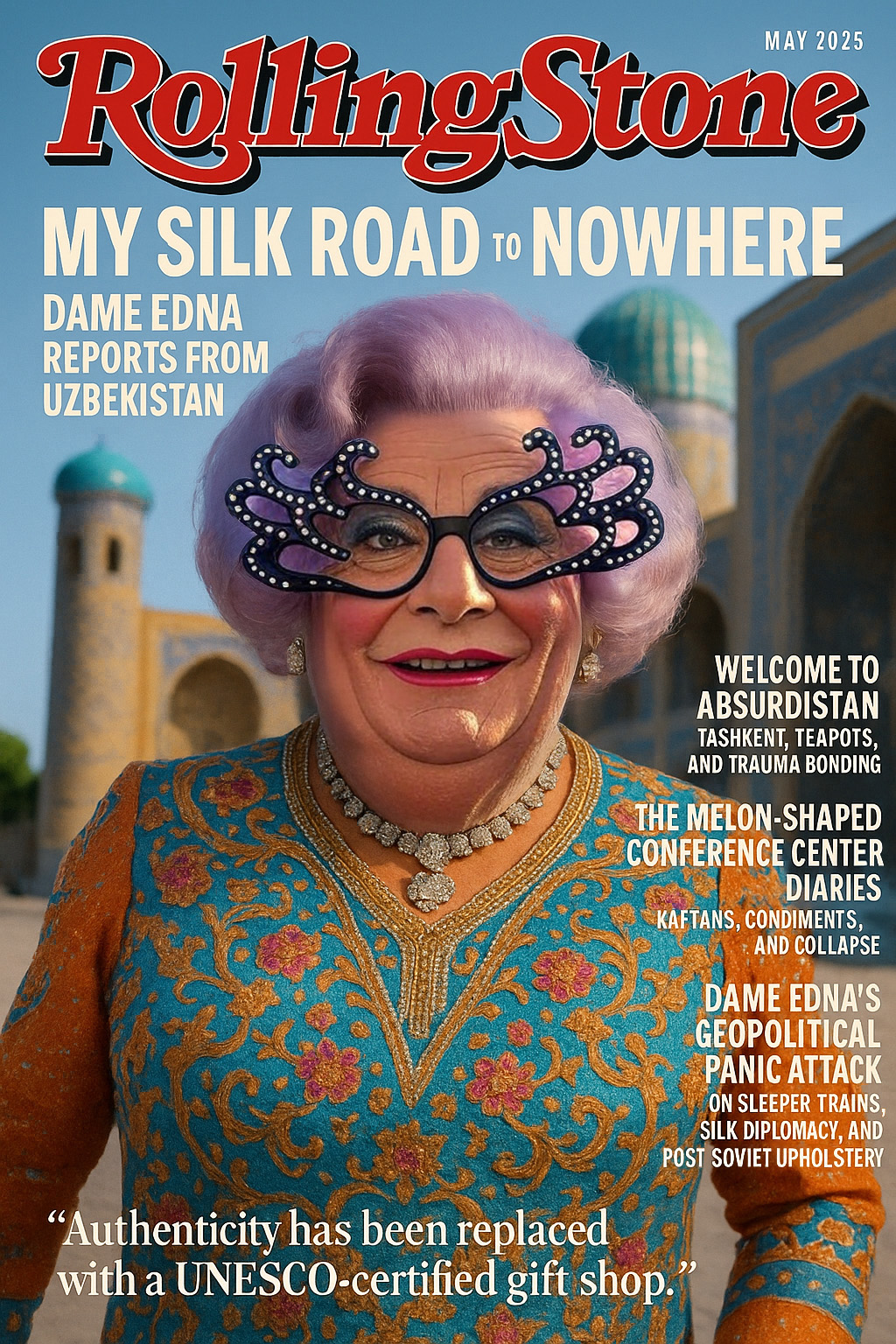
By (the LitBot in) Dame Edna Everage (mode)
Rolling Stone
May 2025
Darlings, when Rolling Stone—a magazine I previously assumed had folded sometime after Fleetwood Mac and before decency—invited me to write a “geo-cultural dispatch from the former Soviet periphery,” I assumed they meant Brighton or, at a stretch, Adelaide’s northern suburbs.
Imagine my surprise when the envelope (typed, darling, on a battered typewriter as if irony could excuse poverty) contained a one-way ticket to a place called Tashkent.
I thought it was a prank—or an anagram with a typo. “Surely,” I said to my assistant Neville, “they meant Stanketh—that dismal little town in northern Tasmania where ambition goes to die—or perhaps Kentshat, which I believe is a condition brought on by bad upholstery and disappointment as well as the tiny Northern England backwater industrial hub where it was first encountered.”
But no, it was Uzbekistan.
Now, I know what you’re thinking. “Dame Edna, weren’t you recently honored by the Baku Center for Post-Soviet Fashion?” I was, possum, but that was a Zoom award. This was real travel—long-haul flights, visa stamps, and a man at the airport holding a sign that read: “EVARAG – CULTURAL PERSON.”
Welcome to the Absurdistan of the East
Tashkent, the capital, is a sort of concrete Las Vegas without the sin, fun, or air-conditioning. The buildings are Soviet modernist, which is to say hideous—monuments to despair in reinforced cement. One can almost hear the sound of queueing for bread echoing in the breeze.
My driver, a charming man named Timur who smelled faintly of petrol and lifelong regret, whisked me to a hotel grandly named The Presidential Palace Spa & Exhibition Center. I was ushered into a room decorated entirely in shades of beige and gold—a kind of Versailles meets Qantas Business Lounge.
The bidet had three settings: warm, boiling, and interrogation.
A Brief History of Somewhere Else
Apparently, Uzbekistan was once a proud outpost on the Silk Road. This is something they will tell you constantly, like a boring uncle who once played cricket with the Prime Minister. Samarkand! Bukhara! Cities older than most rock bands, with mosaics to prove it.
And yet everything feels…recently staged, like Canberra on Australia Day. You get the sense that heritage here is less a living tradition and more a full-time performance for visiting dignitaries and confused German backpackers. Even the minarets look like they were delivered last week by Alibaba Express.
“Authenticity,” I muttered to myself while sipping a tea made from fermented apricots and what I suspect was bathwater, “has been replaced with a UNESCO-certified gift shop.”
Cultural Diplomacy, Dame Edna Style
I was officially invited to give a keynote at the Tashkent International Forum for Cultural Futures, which turned out to be held in a conference center shaped like a melon. The panel included a woman named Aygul, whose job title was “Minister for the Harmonisation of Aesthetic Heritage,” and a German academic who kept referring to the region as “post-nomadic.”
My speech, “Kaftans Across Cultures: A Journey Through Fabric and Feeling,” was met with stony silence, apart from a man in the back who dropped his translation headset and possibly lost the will to live.
Later, at the buffet, I attempted to engage with a diplomat from Belarus, but we were separated by a wall of unlabelled condiments and geopolitical tension.
The Architecture of Despair
Tashkent’s cityscape is like a PowerPoint presentation rendered in gray Lego. Everything is massive, symmetrical, and entirely devoid of human feeling. I was taken on a tour of the Museum of Uzbek Identity, which includes such exhibits as “The Chair Our First President Sat In While Eating Plov” and “A Hall of Portraits Where Every Face Looks Suspiciously Like the Current One.”
I asked our guide why there were no women in any of the murals. “They are implied,” he said.
Possum, I’ve been implied before—by television producers, by Prince Charles, even once by Joan Collins—but never on a mural scale.
Side Trip to Samarkand (A Metaphor for Heightened Disappointment)
Samarkand is what happens when a city gets preserved in aspic for tourism purposes. The Registan, a square surrounded by majestic madrasas, was lovely—if one ignored the drone advertising NFTs and the café piping out Kenny G’s greatest hits.
I met a local influencer named Nigora who had 340,000 followers and took selfies with the grave of Timur the Great, while selling collagen drops as a sideline. She told me Uzbekistan was “vibing east-meets-west, but not in, like, a colonial way.”
She then asked me if I was “here for the vibe or the trauma.” I replied, “I’m here for the mints and the diplomatic immunity.”
Rolling Stone and the Scent of Relevance
Now, darling reader, let me pause to say a few words about Rolling Stone. When I was a girl—alright, a young matron—it was a publication known for wild stories about drugs, guitars, and people who wore trousers made of material from the cotton plantation where fabric goes to die. Now they send menopausal icons to foreign lands to write about soft power and buckwheat pancakes.
Is it noble? Perhaps. Is it journalism? Debatable. Is it better than The Guardian? Infinitely, darling.
At least Rolling Stone allowed me to describe my near-death experience on an Uzbek sleeper train without inserting a sidebar on the climate emergency.
Epilogue from the Edge of Empire
My final day was spent at a silk factory run by a woman named Dilrabo, a name that gave off the faint whiff of a rather unpleasantly perfumed cleaning ointment, who offered me an apricot and wept when I complimented her dyeing technique. I realised then that, for all my barbs, Uzbekistan isn’t really absurd—it’s the world that’s absurd, and places like this simply hold the mirror at a less flattering angle. Along with a tray of apricots.
Still, I was ready to leave.
As I boarded my plane—flanked by two dignitaries and a small boy who may have been part of a state-run youth choir—I looked back one last time at the beige monolith of Tashkent and thought: “You’ve been bedazzled, darling. You just don’t know it yet.”
Toodle-oo, with silk and skepticism,
Dame Edna Everage
Honorary Consul of Common Sense, Moonee Ponds.
Dame Edna Everage is a self-described “gigastar, investigative housewife, and Australian deity in exile.” Decorated by royalty (some of whom regretted it), she has trotted the globe dispensing unsolicited wisdom, wardrobe advice, and cultural interference. She lists her hobbies as gladioli, mild espionage, and correcting the mistakes of lesser civilizations.
Editor’s Apologetic Note
We originally commissioned this assignment for a different contributor with experience in Central Asian geopolitics, but due to a clerical error—and what we now suspect was a forged letter of introduction from something called the “Australasian Institute for Cultural Enhancement and Decorative Teaware”—the ticket was issued to an individual named Dame Edna Everage.
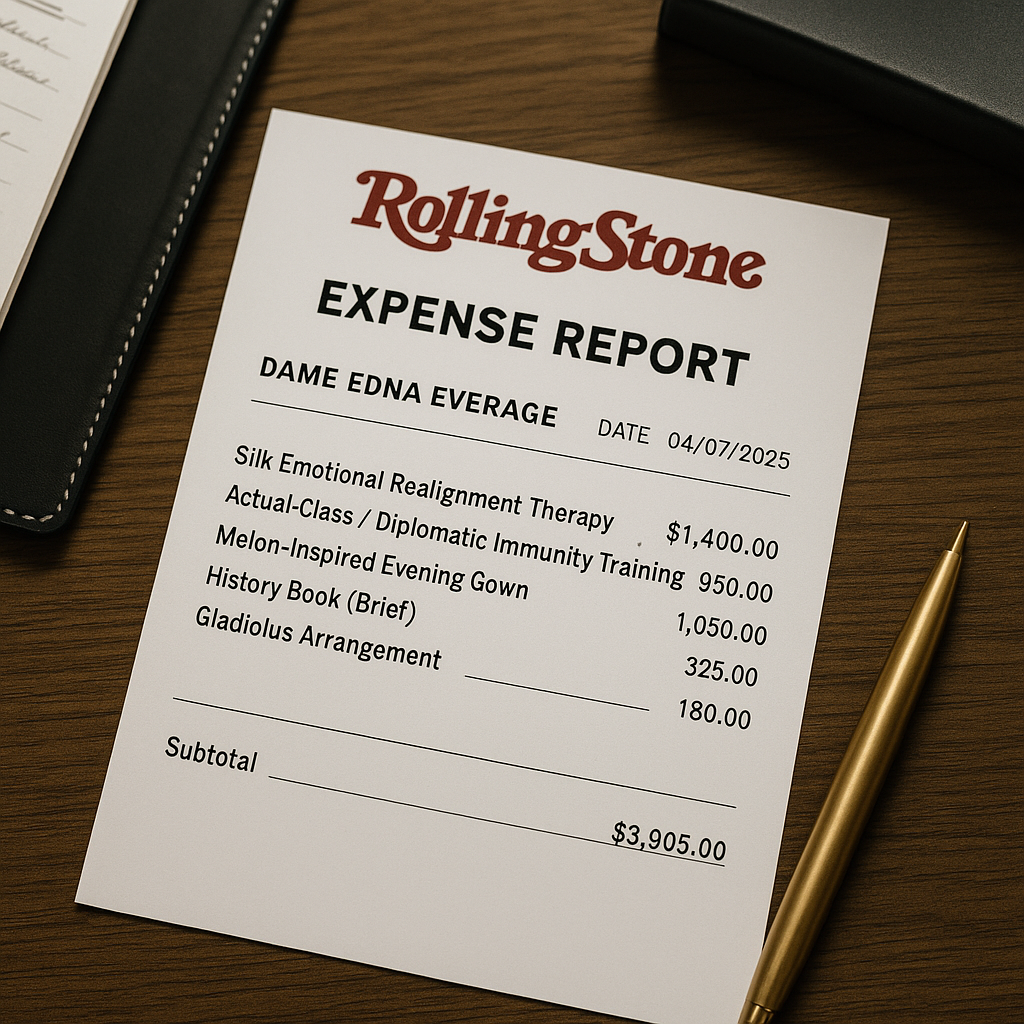
By the time the mistake was discovered, several diplomatic lunches, a keynote address, and a bidet-related incident had occurred, and the eyebrow-raising expense report had already been filed. While we cannot vouch for the factual integrity of the piece, we feel its tone accurately reflects the modern condition: disoriented, overdressed, and in desperate need of a translator.
We apologize to the people of Uzbekistan and thank Dame Edna for her service, whatever it was.
—The Editors
Note: This piece of writing is a fictional/parodic homage to the character cited. It is not authored by the actual author of the character or their estate. No affiliation is implied. Also, the Rolling Stone magazine cover above is not an official cover. This image is a fictional parody created for satirical purposes. It is not associated with the publication’s rights holders, or any real publication. No endorsement or affiliation is intended or implied.
‘Global South Desk’ sees this website collate the world’s most distinctive voices—travellers, gossips, polemicists, prophets, and raconteurs—as they file dispatches from across the Global South for various publications. Whether bewildered, beguiled, or deeply unimpressed, our correspondents report not from policy briefings or diplomatic dinners, but from markets, airports, salons, alleyways, and after-hours clubs. These are perspectives unfiltered, undiplomatic, and occasionally unhinged—but never unreadable.
I have no idea what this is but it is the best thing I have read in a long time. Engaging and interesting found via Dr. KARL.
Thanks, Susan. It’s what I’m calling a pAIstiche (see here: https://antonverma.com/paistiche/). Having fun using regular writing skills and some crazy ideas and then employing AI to help craft pastiches of famous people. Like millions of others, I loved Barry Humphries. Anyway, this is one of the more comedic efforts on the site (my author website for work in which I do the ‘heavy lifting’ and so I guess is more ‘serious’ and available on Amazon: https://antonverma.com/books/).