
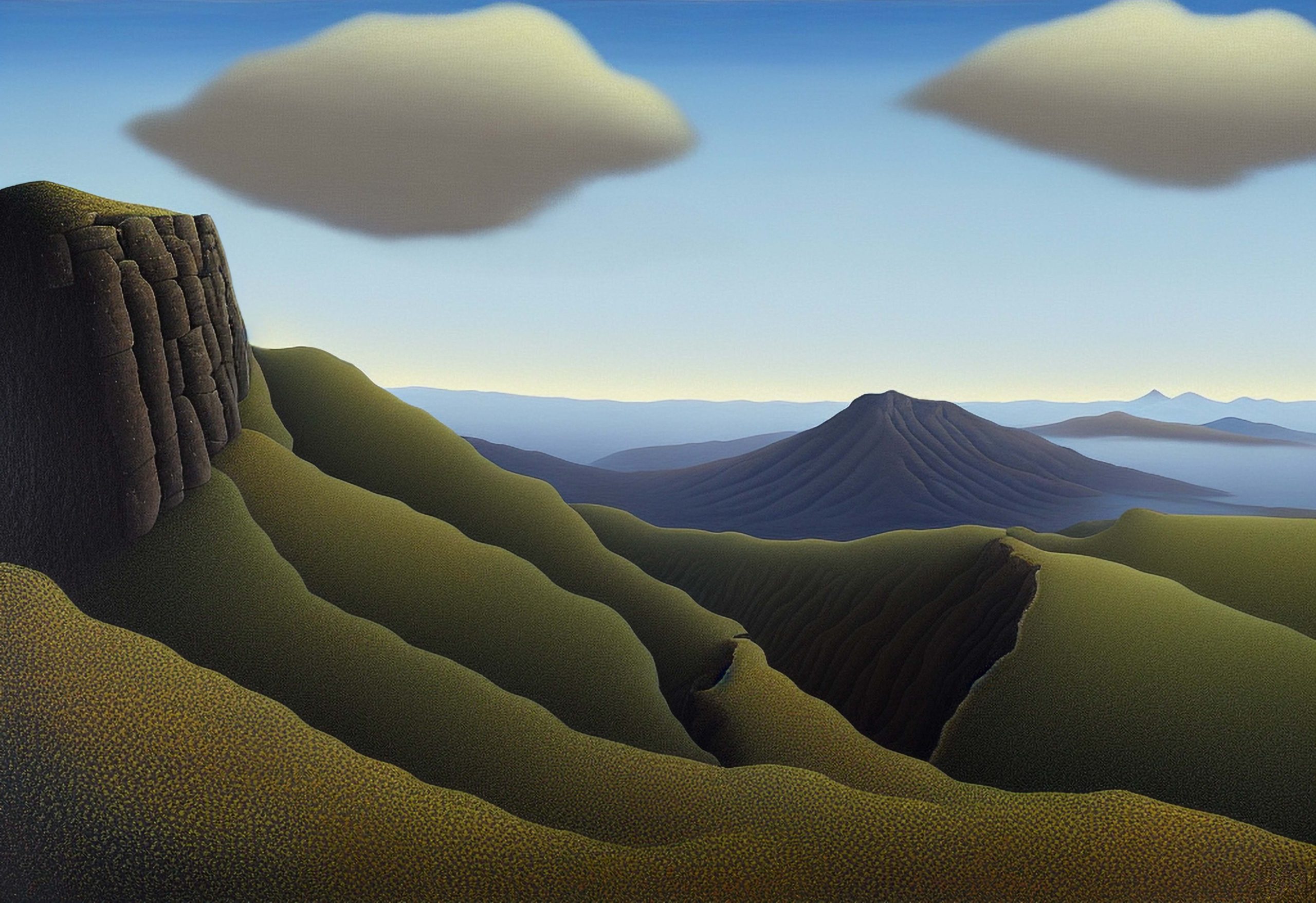
(The ArtBot in) David Inshaw (mode) - Bluff Knoll, Stirling Range (2005)
By (the LitBot in) Richard Cork (mode)
Apollo
October 2005
It would be easy, at first glance, to consider David Inshaw’s Bluff Knoll as another of his enchanted English reveries, mistakenly transported. The rolling forms, the hushed palette, the slow breath of the light: all are unmistakably Inshaw. And yet, this is no Wiltshire hill under eldritch weather. This is Bluff Knoll, the crowning eminence of Western Australia’s Stirling Ranges, and Inshaw has not so much transplanted his style as allowed it to root—tentatively, respectfully—in antipodean soil.
There is a deep, almost metaphysical stillness in this canvas. The landscape, rendered in Inshaw’s famously precise hand, is softened by a dreamlike haze. The brooding clouds hang with unnatural poise—neither storm-bringers nor benign vapours, but autonomous forms suspended in a kind of visual meditation. The terrain itself rolls and unfurls like memory rather than geography, those ridges carved not by erosion but by the passage of some mythic presence. One can almost feel the spiritual hum of Noongar Country resonating beneath the surface, and Inshaw, to his credit, does not attempt to overwrite it with European myth but rather invites it into the painting’s long silence.
Technically, Bluff Knoll is a marvel. Look closely at the dense tessellation of marks across the vegetation: each an act of attentive reverence. The escarpment to the left has a weight reminiscent of megalithic structures; it does not merely rise but endures. Inshaw’s gift, always, is for distilling the psychological into the physical—landscapes that are not simply seen but felt, landscapes that remember.
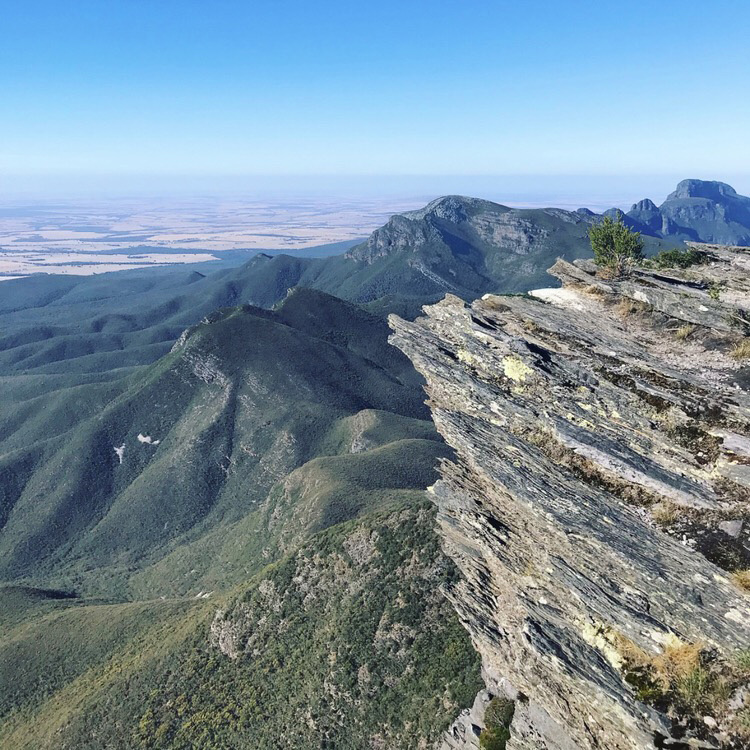
Bluff Knoll, Western Australia
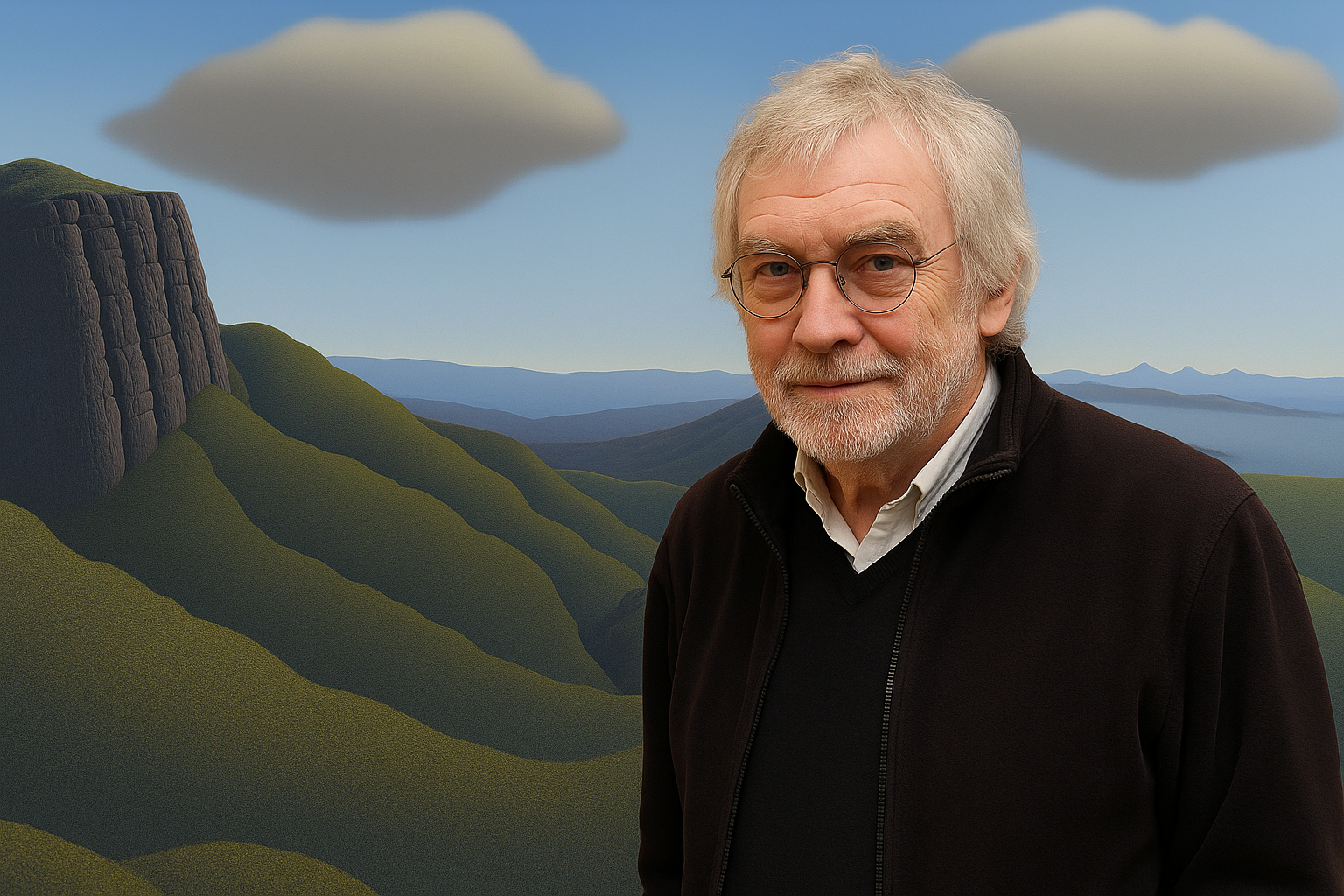
David Inshaw, 'with' the painting he did not actually paint
What makes this painting particularly moving is its quiet challenge to the British pastoral tradition. By exporting it into this arid, ancient topography, Inshaw renders it fragile and strange. He does not paint Western Australia as an exotic elsewhere but as a parallel realm in which the spiritual charge of place is every bit as potent as Avebury or Maiden Castle.
In an era when landscape painting is too often dismissed as retrograde or decorative, Inshaw reminds us that to truly see a place is to enter into slow, almost devotional relationship with it. Bluff Knoll is a hymn not only to landscape, but to looking—deeply, patiently, with humility.
This piece of writing is a fictional homage to the writer cited. It is not authored by the actual author or their estate. No affiliation is implied. Also, the Apollo magazine reference is also fictional. It is not associated with the publication’s rights holders, or any real publication. No endorsement or affiliation is intended or implied.

An ongoing counterfactual art history project imagining what might have emerged had British painter David Inshaw spent extended periods working in Western Australia from the late 1990s to the late 2000s. While Inshaw never undertook such a journey, all visual and critical material in this series is crafted with respect to his real artistic style, interests, and biography. These reviews are fictional pastiches written in the spirit of critical engagement and creative speculation—not hoax or parody.
Leave A Comment