
By (the LitBot in) Martin Shaw (mode)
Emergence Magazine
Volume Six
“If you want to know the health of a people, ask what story they tell their children.”
— Old saying, carved once into a lintel above a vanished door
There was a time, not long ago, when the West thought itself a fire-keeper. It gathered around the tale of the Second World War like a hearth. A myth forged in flame and blood: tyrants toppled, evil named, the phoenix of peace and progress rising from the ash of Auschwitz and Nagasaki. It was a strong story. Too strong, perhaps.
But stories have half-lives.
You can’t build a village on a shadow. And lately, that old tale has begun to tremble. The bones beneath are showing.
No one quite believes it anymore—not the children in the lecture halls, not the men in their think-tanks. The myth that once warmed the world is now a charred heap of old paperwork. Hollow as a NATO communiqué. And so we find ourselves adrift, not merely in policy, but in meaning.
A world without a story is a dangerous place.
The Myth That Held the World
There is an old Irish saying that “a story is a pathway worn through the wilderness of the world.” And for nearly eighty years, the liberal international order has walked one path in particular: the story of 1945.
It was the founding myth. The narrative on which institutions were built, ideologies justified, wars waged, and dreams dreamed. The defeat of fascism, the revelation of the camps, the Nuremberg Trials—all wrapped in a single moral banner. The world had been to the brink and back. Democracy, trade, human rights, and rules-based governance were the lessons learned in fire. Or so we were told.
This wasn’t mere history. It was myth—myth in the true sense. The kind that shapes identity, confers legitimacy, binds strangers in a common purpose. We were the world that had seen, and having seen, had sworn: Never again.
So we built a temple of acronyms—UN, WTO, IMF, EU—brick by brick from the rubble. We made ritual of diplomacy. We treated the market like a shrine. And we believed—truly believed—that a better world was not only possible, but happening.
It was a good story. But a good story must be told honestly, and lived fully. When it’s mouthed without belief, it curdles.
Fault Lines in the Tale
The Cold War was the first crack in the plaster. Suddenly, the heroes of one tale were villains in another. We spoke of freedom while toppling elected governments. We decried tyranny while training death squads. We lauded peace while pointing missiles at each other’s throats.
Still, the myth endured. It had inertia. And myth can tolerate contradiction—up to a point.
Then came 9/11. And with it, the twist: we became the empire, not the rebels. The language of liberty was weaponised. Humanitarianism put on a flak jacket. The story was still told—but now it wore night vision goggles and dropped leaflets from drones.
Young people noticed. So did the old gods.
You see, myth doesn’t die in fire. It dies in irony. It dies when belief fades and all that’s left is performance. The liberal order became a pageant. A soulless mimicry of something once vital. It wasn’t evil. It was tired.
And then came the wolves.
Populists rose not because people hated the old story, but because they knew it was being kept alive by force. It had become a taxidermy myth: preserved, posed, and pinned in place—no longer capable of dancing in the blood.
The Danger of Storylessness
When the story ends and no new one arrives, something worse takes its place.
People do not live by bread alone, nor policy. They need meaning. They need belonging. They need story.
In the absence of a shared tale, we get something else: algorithmic dissonance. Narcissism mistaken for identity. A thousand clashing monologues. The loneliness of infinite choice.
And into that vacuum, darker myths creep.
Some are clothed in the soft robes of empathy. Some march in jackboots of righteousness. Some offer pills. Others offer purity. All offer a single thing: a shortcut to certainty.
But a story that does not honour death, ambiguity, or limit is not a story—it’s propaganda.
“A world without a story,” said the old woman at the edge of the moor, “is a field of dry grass in lightning season.”
And the thunder is already rumbling.
What the New Myths Look Like
Make no mistake: the age of myth is not over. It is changing. And what rises now is not the old gods of grove and hill, but new ones—masked, manic, digital.
There is the AI demiurge—omniscient, bloodless, promising frictionless perfection. No mess. No ritual. No tears. Only answers. But no wisdom.
There is the techno-messiah—Silicon Valley’s shimmering prophet, selling Eden in the cloud while the earth beneath burns.
There is the self as sacred text—my truth above the forest, the family, the dead.
There is the purity cult—left and right, demanding confession, obedience, and banishment. They wear virtue as tattoo, but speak in curses.
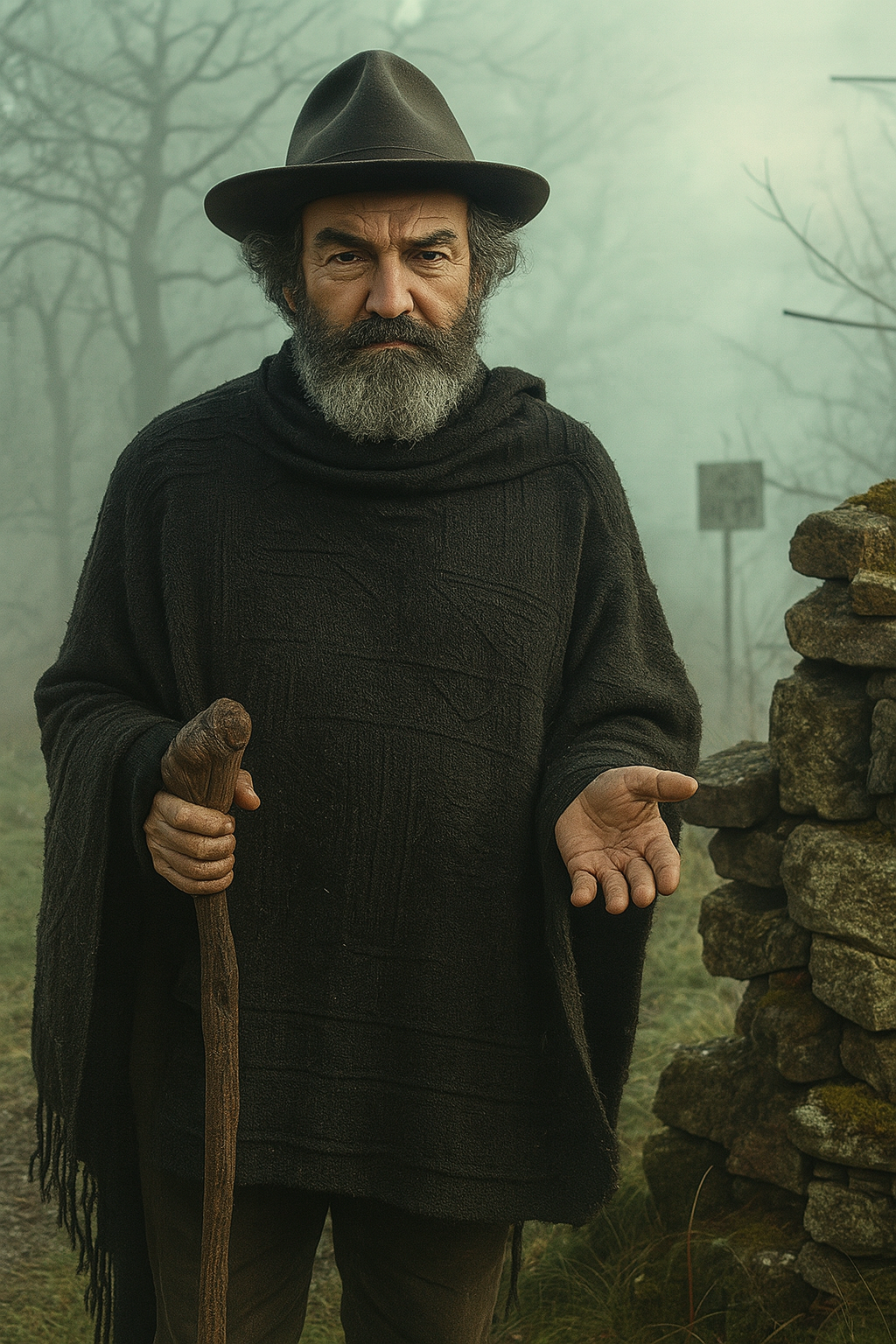
Martin Shaw - who did not write this piece: He told them the story was over. They asked if there was a podcast.
These myths demand no sacrifice of the ego. Only the sacrifice of the other. They do not mourn. They do not compost the past. They simply delete.
And their temples are platforms. Their sermons go viral. Their relics are data.
Beware these gods. They are clever. And they are hungry.
“Beware the ones who offer only clarity. They are either tyrants, or toddlers who’ve mistake volume for truth.”
What Might Be Recovered
Is there a path forward? Perhaps not in the direction we were walking.
We do not need another utopia. We do not need another treaty carved in glass.
What we need is a return—not to the past, but to the mythic imagination that underpinned it. The felt world. The storied world.
A myth is not a manifesto. It’s not a slogan. It’s a wild creature. It walks at the edges. It sings at night. It teaches you to bow your head when the hawthorn blooms, and to close your eyes before the fire dies out.
The next world will not come from a think tank.
It will come from ritual, from memory, from grief.
From the moment a father tells his child, “This land fed us. We must feed it.”
From the moment a girl weeps beside a river polluted by her own people.
From the moment someone builds a house not of timber alone, but of thanks.
These are small stories. But they are the kind that grow roots.
“Before a new order can arise, the old one must be buried properly. And we haven’t even begun the funeral.”
We are still clinging to the corpse. Still calling the cold embers firelight. Still printing the old myth in new brochures, pretending the gods haven’t left the temple.
A Warning From the Woods
So let me say this, as one who walks in old stories:
A new order is coming. It may already be here.
It will not look like the last. It may not speak in English. It may not care for the things we built. And it may be beautiful—or it may be monstrous.
But unless we choose the myth we live by, it will be chosen for us. And chosen not by elders or poets, but by advertisers and algorithms.
You think this is abstract? Let me tell you something plain:
What animates the next world may not be a constitution or a charter. It may be a story whispered in code, chanted in hashtags, carved in machine language. And it may not know mercy.
And so I leave you with this:
Do not pray for a return to the old myth. It has done its work. And its work is over.
Do not sell your soul to the ones jockeying for position to take its place. They shine too bright, and ask too little.
Instead, find a small, fierce tale. One you can walk into.
It will not save the world. But it might save you.
And maybe, just maybe, that is where all true stories begin.
Martin Shaw is a mythteller, wilderness rites guide, and recovering academic currently serving as interim lore-keeper for a moderately haunted apple orchard in Devon. He once spent four days under a hedge eating only acorns to better understand NATO expansion. His most recent book, The Tinderbox Treaty: Myth, Memory, and Mutual Assured Disenchantment, was banned by both a hedge fund and a druid circle for opposite reasons. He is currently developing a curriculum on post-liberal cosmologies using only fairy tales, sheep bones, and the occasional viral meme.
Leave A Comment