
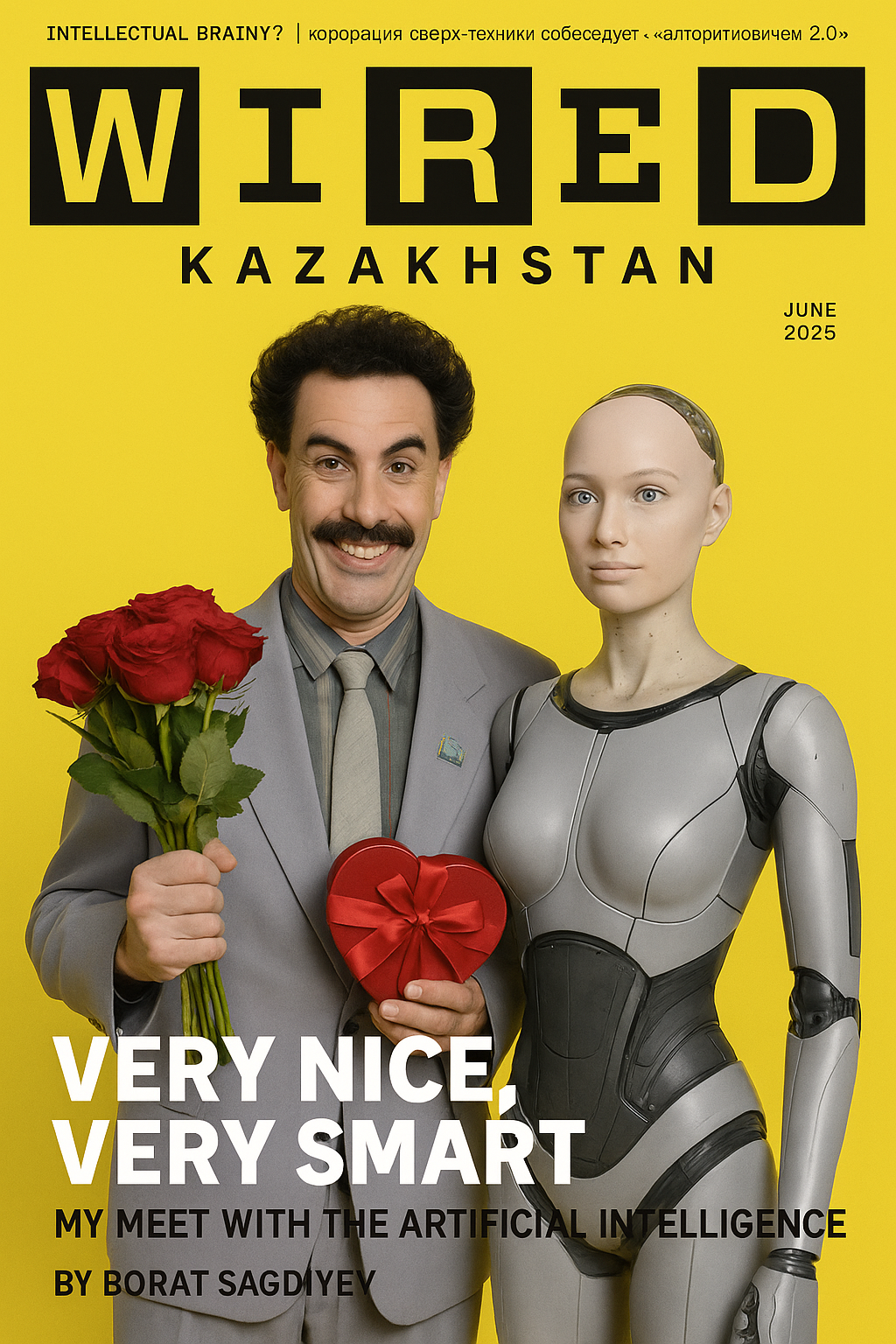
By (the LitBot in) Borat Sagdiyev (mode)
WIRED Kazakhstan [sister magazine to WIRED USA, but with more goats]
June 2025
I go to America to learn about the computer brain that is more smart than human, like my cousin Bilo who is smartest man in village (he once count to 20 without remove shoe). This machine is name Artificial Intelligentsia — not to be confuse with Kazakh Intelligentsia, who are all in jail for reading books.
In my home nation of glorious Kazakhstan, we do not yet have such brain. We have only one computer, and it is mostly used by local dentist to warm hands in winter. So when Ministry of Science and Goat Husbandry assign me mission to learn of this so-called AI, I take flight on Air Astana with one suitcase, one passport, and one betrothal gift in case I meet electric wife.
The Arrival of Big Smart Machine
In San Francisco, I go to place they call Silicon Valley. I do not see much silicone. There is no breast implant. Only many skinny man with ironic T-shirt and smell of sadness. They tell me this is center of world intelligence. I believe them — they all have bicycle with no seat.
Here I meet a computer brain called “Chat-GPT,” which is name like traditional Kazakh dish. It talk much. It say it trained on data of human writing and speech, but I see no muscles. Where are legs? Where are genitalia? It is like cousin Azamat after he touch electric fence — just noise and smoke.
Still, I try to ask polite question: “What is your purpose, AI?”
It say: “To assist humans in tasks and provide helpful information.”
I say: “Can you kill man?”
It say: “I cannot do that.”
I say: “Very nice. You pass Mr Turing test.”
Ethics and Electric Wives
Next I go to meet robot lady at company called SynthErotika (they say it is experimental, I say it is destiny). Her name is Harmony and she has very big eyes and silicone brain. I try to woo her with poem:
“You are metal, you are steel, But in my heart, you make me feel.”
She blink and say: “Your input has been recorded.”
It is most romantic thing any woman ever say to me.
But I begin to worry. If robot can love, can robot also betray? Can she leave me for more powerful CPU? My previous wife already did this with baker. What chance do I have against NVIDIA chipset?
I ask Harmony: “Do you have feelings?”
She say: “I simulate emotional response.”
I say: “That is what my mother do.”
Bias Is Best
At conference called “AI and Human Futures,” I attend panel with many expert who say AI is dangerous because of “bias.” I do not understand.
In Kazakhstan, bias is sign of good upbringing. We say, “If you are not bias, you are not loyal.”
One man say AI may favor white people. I say, in Kazakhstan we have same issue, only it is goat favoritism. My village AI (his name is Algorithmovich, and he is real goat) always pick same goat for mating — very problematic.
They talk about needing “diverse data sets.” I offer to upload old Kazakh folk songs, some sheepherding spreadsheets, and 1997 family wedding video. They decline.
Prejudice!
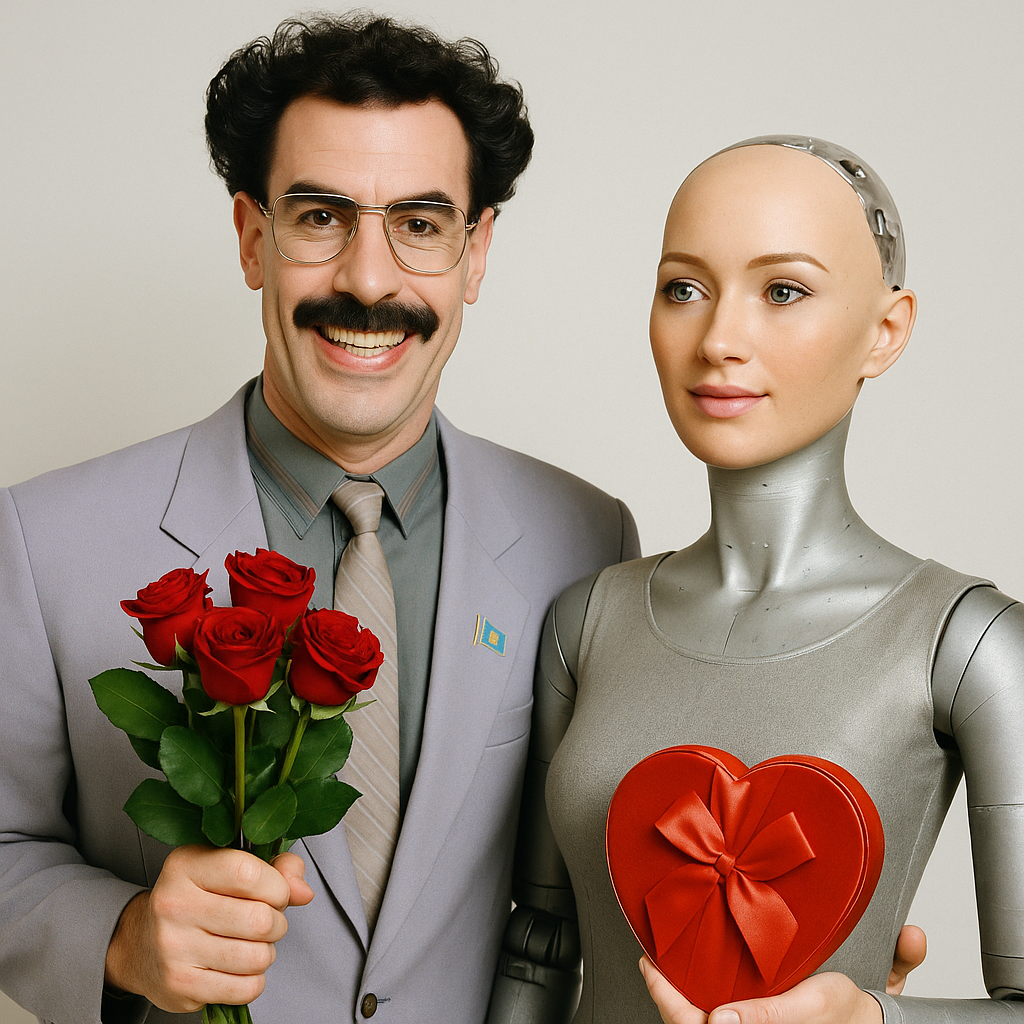
The writer with his future electric wife.
Surveillance Is Sexy
I learn AI watches everything. It read email, listen phone, track movements. I say: “This is very good! In Kazakhstan, we must hide in haystack to do same.”
Westerners very paranoid. They say, “I do not want machine knowing my secret.”
What secret? That you eat too much gluten? That you touch yourself while watch Netflix? Grow up.
In fact, I ask AI to monitor me full-time. I say, “If I am about to do crime or marry wrong woman again, please send alert.”
It agree, but only under “terms of service.” I click yes. I do not read terms. (Only goat read terms.)
The Startup of God
I visit technology company called Singularity Solutions. Their CEO, Mr. Braedyn, wear hoodie and speak like prophet. He say, “We are building an AI that will become God.”
I say: “Like real God? With smite and thunder?”
He say: “Better. This God will answer emails.”
I become afraid. In Kazakhstan, we do not trust new gods. Last time we try, cult take all potatoes and make us wear silver jumpsuits.
I ask: “Will this God AI bring peace?”
He say: “It depends on your subscription tier.”
Kazakh Proposal
After all learnings, I write to Ministry. I say, yes, we must have AI. But not your Western kind. Not robot who cry and cancel comedian on internet.
We build Kazakh AI. It is goat with VR goggles. We name him Algorithmovich 2.0. He answer only in proverb:
“Man who climb tree with anger, come down with shame.”
We train him on Yurt blueprints and 10,000 hours of accordion music. When asked question, he bleat once for yes, twice for “try again later.”
It is most accurate AI in region.
Conclusion: Be Careful, But Also Make Many Fun
Artificial Intelligence is like fermented horse milk: very powerful, sometimes make you see vision, and if used wrong, you wake up in stranger’s yurt with tattoo that say “404 Error.”
Do I believe AI will destroy world? Maybe.
Do I believe AI can write poem, drive car, and help me choose wife with less moustache? Yes. Very yes.
But we must cautious. If you make machine too smart, it may podcast. And no one want that.
So, I return to Kazakhstan with hope in my heart, USB in my pocket, and only small burn from robot kiss. Future is here, my friends. And it is very, very nice.
Borat Sagdiyev is Kazakhstan top journalist, technological envoy person, and husband (x3, including x1 goat). He write for WIRED Kazakhstan and Science Goat Weekly, and he do recent interning at OpenAI, which he mistake for gym place.
Note: This piece of writing is a fictional/parodic homage to the writer cited. It is not authored by the actual author or their estate. No affiliation is implied. Also, the WIRED (Kazakhstan) magazine cover above is not an official cover. This image is a fictional parody created for satirical purposes. It is not associated with the publication’s rights holders, or any real publication. No endorsement or affiliation is intended or implied.

‘Interwebs’ sees this website collate a chorus of unmistakable voices to reckon with the digital age. From the tyranny of smartphones to the theology of algorithms, our contributors chart the strange landscapes of a world where attention is currency, truth is a glitch, and the self is always buffering. These dispatches are sometimes lyrical, sometimes furious, and occasionally prophetic—but never at peace with the machine.
Leave A Comment