
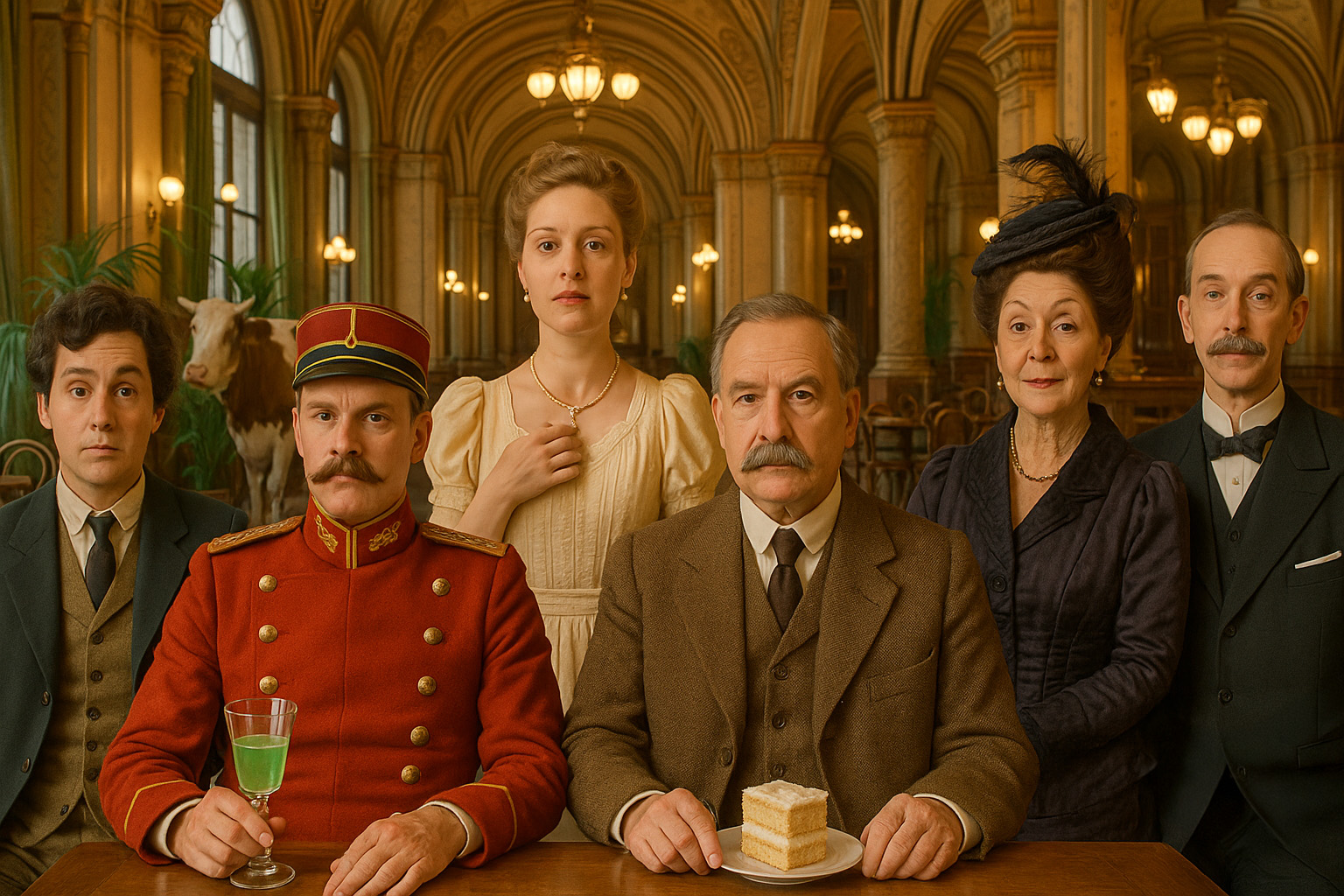
By P.G. Zweighaus
I have often reflected that the Habsburg Empire resembled Aunt Mathilde’s plum strudel: magnificent in circumference, flaky at the edges, and liable to collapse under the least administrative breeze. One handled both, therefore, with delicacy, a steady fork, and—where possible—cream. It was with this philosophical posture that I was reclining in the lobby of the Hotel Imperial, when a cavalry officer with my family chin and the general air of a man pursued by unpaid tailors came hurtling across the Persian rugs.
“Otto!” cried my cousin Leopold, the moustache bristling like two affronted porcupines. “We are ruined!”
He flung himself upon the adjacent ottoman and produced from the inner recesses of his frogged tunic a sheaf of documents, banded and stamped to a degree that would have impressed the Pope. He shook them in my face with such agitation that I found myself reading them backwards, which improved the sense but little.
“The marriage licence,” he gasped. “It has been stamped—” he gulped “—in Hungarian.”
I regarded the thing. It was certainly stamped in a language which employed accents with a robust enthusiasm and arranged its consonants in bracing new formations. One could not, however, say, at a glance, whether this invalidated the proposed union in Vienna, or merely made it bilingual. I coughed, which with me is the sign that the brain has begun to creak into motion.
“Is that…bad?”
“Bad?” Leopold sprang up, knocked over an umbrella-stand carved like a saint, apologised to the saint, and sprang down again. “Hildegard’s father insists on an impeccably Viennese ceremony. He is a patriarch. He is a brewer. He believes nothing good ever came from east of Pressburg, except perhaps paprika, and even there he suspects French interference.”
“Herr Braumeister,” I muttered, for the name had already begun to be spoken in my circle with the respectful dread accorded to volcanic islands. “And where is the dear fellow?”
“Inspecting his barrels in Bohemia.” Leopold produced a second paper. “He telegraphed. ‘No Hungarian stamps. No wedding. Honour. Beer.’ And all that.”
(Of course, one hates to thwart honour or beer, particularly in tandem.)
I pressed the bell for my valet, Herr Schmitt, whose appearance in moments of domestic crisis is as dependable as the waltz-time in a Strauss finale. Where there is calamity, Schmitt blossoms. He glides to the scene like a well-buttered angel, murmurs something low and civilised, and re-arranges reality with an efficiency which has never failed to strike me as slightly improper.
He promptly materialised, bowed, and examined the documents with that grave attention he usually reserves for my neckties.
“Indeed, sir,” he said. “This is a marriage licence, Viennese form B, unfortunately regularised by a clerk of the Komitat Pest-Pilis-Solt-Kiskun. This renders the instrument…topographically ambiguous.”
“Ambiguous?” cried Leopold.
“Not invalid,” soothed Schmitt. “Merely migratory. The happy couple can be married in Hungary, at which point the bride must be imported. Or—if I may—one could pursue a more…metropolitan solution.”
Leopold seized his sleeve. “Name it, sir!”
And the good sir was good enough to do so.
“Obtain a fresh Viennese stamp from District Office VI,” Schmitt said. “A small matter of calling at two counters, three windows, a back office, and the café opposite the back office, where the assistant registrar is known to take his second breakfast.”
“Splendid!” I cried, leaping up. “To District Office VI!”
Schmitt inclined the head. “Alas, the office closes at noon for the Imperial Opera rehearsal parade.”
“Opera?” quizzed Leopold, who, for once, had seized upon the precise syllables that also baffled me.
“They rehearse the bows,” said Schmitt, as if this explained everything. “However, the assistant registrar ushers at the opera in the afternoon. If one were to encounter him there, it might be possible to secure a pre-stamping.”
Leopold beamed, seized my arm, and swept me out. Schmitt, who never sweeps but merely appears where one next requires him, preceded us by a route known only to himself.
**
It is a truth universally acknowledged that an Austrian in possession of a problem must be in want of an usher. We reached the Opera by means of a fiacre driven by a man who conversed exclusively through florid swears at the horse. Leopold wore the expression of a martyr en route to a very well-attended immolation. I had adopted my customary strategy in moments of civic duty: to look decorative and let Schmitt do everything.
The assistant registrar, said Schmitt, was named Blaha. He wore a moustache of the less philosophical school and possessed a face which had learned to say ‘nein’ in six administrative styles. We were to address him by his bureaucratic title, which was something along the lines of Senior Deputy of Reversible Stamps and Miscellaneous.
“And if we mistake him?” I asked.
“You will not,” said Schmitt.
“Suppose he is in the blur of motion?”
“He moves only to the bar.”
We entered the gold-and-burgundy splendour, were immediately wrapped in velvet, and confronted by an usher who, to me, looked exactly as an usher ought. He had the air of a man who would even purse his lips at the Emperor if His Majesty tried to enter through the wrong door.
“Blaha!” cried Leopold, hurling himself forward.
The usher started, dropped his seating chart, and clutched at an opera cloak. “Sir!”
“Marriage licence!” cried Leopold, producing the offending documents. “Hungarian stamp! We require—”
“—a box,” I cut in smoothly, for the usher had begun to look hunted. “For the rehearsal.” I stroked my chin. “And, if you happen to hold the exalted office of reversible stamping with miscellaneous, perhaps a moment of your time.”
The usher drew himself up. “I am not, sir, a reversible anything. I am Koloman, second usher, Grade B. Blaha is within.”
“Where?” said Leopold.
“On stage,” said Koloman, with a bitterness that suggested long service. “They are rehearsing the triumphal finale of The Countess of Pressburg. He is to carry a spear.”
“Spear?” I said, feeling the foundations of our plan tilt. “Is it…reversible?”
“Everything is reversible,” said Koloman darkly, “until the Director has had his coffee.”
We were conducted to the wings, where the scene was such that a man of less mettle than Schmitt might have blinked. The chorus surged. The soprano, as broad as the Empire and twice as resplendent, smote the air with a high note which made my hat feel unsafe. A battalion of spearmen swayed, among them a gentleman who did indeed resemble a clerk with a moustache in search of authority. He bumbled his spear into the baritone’s cuirass, apologised, and lost his place in the swaying. This had the effect seen in more militarised contexts when the man at the front sneezes.
“There,” breathed Schmitt. “Senior Deputy Blaha.”
“On!” cried the Director from the stalls. “On, on! You, the one with the exploratory spear! Less arithmetic, more triumph!”
Leopold, who never quite got the memo about stages being imaginary, took three strides and was among the bellowing barons, making for Blaha. He reached the man, seized his arm, and, with that soldierly clarity which has alarmed our neighbours since 1699, shouted: “You! Stamp me!”
The orchestra faltered. The soprano produced a small avalanche of vibrato. The Director sprang to his feet, white with a rage that could be detected at the Prater. “Sir! Sir! Who are you? Why are you assaulting my spear-carrier?”
“I am a groom!” shouted Leopold. “A groom with a Hungarian stamp!”
“You will be a groom with a broken head if you touch my chorus,” screamed the Director. “Guards!”
Vienna is a place where the exclamatory invocation “Guards!” Is always in the air somewhere, waiting to be plucked. Two large men materialised. Leopold, promptly conscious of honour, squared himself. The spearmen, who had been seeking an excuse to spear in earnest since ten o’clock, lowered their items. It would have made a splendid scene in William Tell if only the cows had come on.
(Be patient, mind. Cows will come.)
“Allow me,” said Schmitt, and, with the diplomatic quick-step that has diffused so many of our domestic storms, slid through the turmoil, intercepted Blaha, and whispered something valuable about second breakfasts. Blaha brightened, nodded furtively, and, while the Director climbed upon the stage to harangue the universe, slipped with Schmitt into the wings.
“Sir,” Schmitt murmured to me, a moment later, having led Blaha like a precious contraband to a pillar. “A preliminary concession has been secured. Herr Blaha will stamp the licence at the café, during his interval, if we agree to the following considerations: a sweet bun, a coffee, and assurances that no one will ever again attempt to conduct state business from within the chorus.”
“Done!” I said, pleased. “Where is Leopold?”
“In disgrace,” said Schmitt. “They have mistaken him for a supernumerary.”
Indeed, at that instant the orchestra surged again, and my cousin, now wearing a helmet several sizes too small and an expression of moral thunder, found himself in the front rank of spearmen. The soprano bore down, flourishing an arm, and clasped Leopold to her rhinestone bosom with a cry of love that echoed about the mouldings like champagne corks.
“Brava!” cried the Director, weeping. “At last! Passion! Courage! Moustache!”
I made a note to inform Hildegard that her betrothed had made his operatic debut with success bordering on felony.
**
We repaired to the café across the street, that hallowed place where Vienna—may it be preserved forever—conducts ninety percent of her life while pretending to conduct none. Blaha accepted his sweet bun and coffee as a public-spirited man might accept a medal. He examined the licence, pursed his lips into bureaucracy, and took from his pocket a little black case with a stamp so dignified I felt faintly ashamed of my passport.
“One must be careful,” he said, polishing the seal as a man might polish his ancestry. “The Viennese stamp is a serious matter. It confers upon the paper a certain gravitas. Improperly applied, it can cause wars.”
“Wars?” I said.
“Civil,” said Blaha, and set the stamp. “Domestic skirmishes.”
The relief was such that I felt we had conquered something. We shook hands all round with the solemnity proper to men who have navigated red tape without tangling in it. Schmitt placed the licence in an envelope as if it were a hatchling and tucked it into the recesses where he keeps our salvation from the weather, creditors, and chocolate on hot days.
“Now,” I said, as we rose, “we return to Leopold, liberate him from art, and bring the glad tidings to Hildegard.”
“Ah,” said Schmitt.
It is a peculiarity of that man that his “ah” may contain within its two millimetres of vowel a complete reversal of fortune.
“What?” I asked.
“The Countess Palffy,” said Schmitt. “She has been seen.”
“Seen where?”
“Here, there, everywhere,” said Schmitt. “She attends rehearsals to collect gossip in its larval stage. And she possesses a megaphone, metaphorical and literal.”
This was grave. Countess Palffy was the sort of woman who could launch a rumour flimsier than Kardinalschnitte and have it marching about in uniform by tea-time. If she had witnessed Leopold embraced by a soprano upon a public stage, Vienna’s telephone wires were even now humming.
We dashed back to the Opera in time to find Leopold being shooed into a dressing-room by the Director, who had become fond of him. “My hero!” cried the man. “My spear! You will return for the ball this evening! I shall put you in Don Juan In The Provinces as a soldier of love! Your moustaches alone are an aria!”
Leopold, blinking like an ungunned goose, escaped, and we herded him into the fiacre.
“Good news,” I said, cheerily. “The licence is stamped.”
“Which allows us to marry?” he asked, clutching my sleeve.
“Which allows you to marry,” I said, making a mental note to avoid confusion in the wording in future.
“Then to Hildegard!” cried Leopold. “We must fling ourselves at her feet and explain everything before the Countess can fling anything at all.”
**
Hildegard von Braumeister resided with her aunt, a lady of iron benevolence who approved of love in principle and kept a tape-measure on the mantelpiece for practical applications. We burst in, leaking Opera and bun, to find Hildegard in a cloud of tulle and trembling. Her eyes, which could be soft as strudel or hard as the brewery yard, were at present oscillating.
“Leopold,” she said.
“My angel!” said Leopold, advancing.
“Stop!” said the aunt. “Before you touch my niece, be good enough to explain why Countess Palffy has telephoned three times to say you have been embraced before witnesses by a woman with high C and low morals.”
Leopold opened and shut in a manner curiously reminiscent of the Director. I stepped in.
“Perfectly simple,” I said. “We were at the Opera on administrative business, and Leopold was mistaken for a supernumerary.”
“Ah!” said the aunt. “And were you mistaken for a rake, Mr. von Schallenberg? Because you certainly look like one.”
“Only on matinees,” I said. “The point, dear lady, is that the licence is now properly stamped.” I produced it with a flourish. “Vienna herself has placed her seal upon this union. See? Blaha.”
Hildegard, who is not immune to the poetry of a good stamp, softened. Leopold seized her hand and kissed it with ardour and a certain desperation. The aunt allowed this for one, two, and precisely three seconds.
“Very well,” she said. “If the licence be in order, and if the Countess be muzzled, and if no further eccentricities ensue—”
At this instant Herr Braumeister entered the room like a hop-field with opinions. He had the stance of a man used to looking into copper vats and seeing his reflection behaving itself. He took in the party at a glance.
“Explain,” he said.
We explained. It was perhaps unfortunate that, at the very moment we reached the part of the narrative involving the soprano’s enthusiastic embrace, the telephone rang and the maid announced: “Countess Palffy.”
“Put her down the well,” muttered Leopold, but the aunt took the call.
“Countess,” she said sweetly, clutching the receiver. “We are quite aware. Yes. Oh yes. Indeed. Thank you.” She hung up and turned to Herr Braumeister. “She says Leopold has promised to appear at the Imperial Ball tonight dressed as a Hussar of Love.”
Braumeister’s eyes narrowed. “The Imperial Ball?” he said. “The Imperial Ball is where I launch my new beer.”
It is curious how the threads of history and hops intertwine. Braumeister, it appeared, had arranged to unveil his latest creation—a foamy triumph—to the great and good that very evening. He had arranged for archdukes to drink it. He had arranged for journalists to praise it. He had arranged, in short, for a family event to be turned into publicity which would drape itself glamorously over barrels for years to come. The faintest whiff of scandal would sour the brew.
“This,” he said, tapping the licence with a finger like a spigot, “must proceed without incident. Leopold will present himself sober, silent, and Viennese. No Hungarian. No opera. No—” he faltered, groping for a word that could encompass the known universe of calamity “—no you.”
He pointed at my cousin.
“I will insist, sir, that you do nothing.”
Leopold began to obey the command at once, and simply bowed. Braumeister then cast an aspersion-fuelled glance in my direction.
“And as for you—do less than nothing.”
I bristled. “My dear sir! I am a model of propriety. Ask anyone. Ask Schmitt.”
“I am asking the universe,” said Braumeister. “And it replies with a bitter laugh.” He jabbed a thumb. “You will come tonight, Mr. von Schallenberg, but in person and not spirit, as it were. As I said, less than nothing.”
“Less than nothing?” I said.
“Actually, far less than less than nothing,” said Braumeister. “If you are tempted to do something, do less. If you are tempted to speak, think. If you are tempted to think—sit.”
Hildegard kissed Leopold’s cheek. “It will be perfect,” she breathed. “A waltz, a blessing, the new beer—oh Leopold, if only you will not be yourself.”
Leopold vowed, on honour and moustaches, that he would be as dull as a ledger. It was a noble pledge. Unfortunately, Fate, which in Vienna is a committee chaired by Countess Palffy, had other ideas.
**
The Imperial Ball, that evening, went off with the sort of polished splendour that makes even one’s dreams tuck in their shirts. There were chandeliers like inverted galaxies, potted palms of heroic size, and a floor upon which the waltz unfurled like a silk ribbon sent on an errand. Braumeister’s beer, trundled in under a brocade coverlet and unveiled by two footmen and a drum-roll, foamed with the solemnity of a civic monument. Archdukes prodded it, pronounced it sound, and drank.
Leopold, faithfully dull, stood by Hildegard and moved at the appointed times. I took up my position beside a column and did nothing with such conscientiousness that my joints began to ache. Schmitt hovered, as ever, at that correct altitude which suggests he is elsewhere and yet precisely where he is needed.
All might have gone as smooth as custard if the orchestra had not, at a signal from the Director (who had been invited to witness his moustache-protégé in a civilian setting), struck up an unmistakable tune: the Hungarian national air, arranged—in a fantasy of reconciliation—into a Straussian waltz.
A tremor coursed the room. Certain archdukes stiffened. An ambassador looked at his shoes. Countess Palffy inhaled so sharply that three young men fainted from lack of oxygen.
“Change it,” hissed Braumeister to the conductor, but the man, having once launched into a waltz, was bound by solemn oath to complete it with full curlicues. Leopold, who had rehearsed all day at being a non-entity, now found himself jostled by cosmic forces, for a tall officer, Hungarian to the boots, stepped forward to ask Hildegard for the dance.
Leopold—oh Leopold—bowed, smiled, and surrendered his betrothed with a grace which might have passed for magnanimity if the Hungarian had not, in the third rotation, whispered something in her ear which caused her to glance back at Leopold with a look that suggested interest in the phenomena of the East.
The cavalryman’s eye lit. He swept Hildegard into a daring figure I am told is known as a csárdás eruption. Half the floor recoiled. Braumeister’s beer, which had been set too near the edge of its dais in the general excitement, trembled.
“Do nothing,” I told myself, sitting virtuously on both hands. The beer trembled further. A footman, eager, put out a hand. The drum acquired a wobble. The great vat slid an inch.
“Sir,” murmured Schmitt at my shoulder. “The barrel.”
“Yes,” I said, paralysed by virtue.
“Perhaps,” said Schmitt, “a very small something?”
I sprang. I reached the dais, grasped the handle of the trundling contraption, and pulled. The barrel lurched, corrected, and, in an excess of zeal, rolled backwards off the far side, where it met a passing tray, a dowager’s lapdog, and a groom’s cousin in the uniform of a minor province. The tray went up, the dog went down, the cousin leapt, and the barrel—well, the barrel continued to roll, gathering a following like a popular policy.
It reached the far entrance, where, by one of those coincidences which convince the thoughtful that Providence enjoys a joke, a small agricultural tableau had been arranged to celebrate Braumeister’s devotion to the rustic art. There was a pitchfork. There was a yoke. There was, for reasons which have never been adequately explained, a cow.
The barrel struck the milk-jug, the milk-jug imploded in a biblically picturesque manner, the cow, affronted by artificial thunder, lowed with the voice of a dispossessed duchess, and entered the ballroom at a trot.
There are moments when a man survives only by the preparedness of his valet. Schmitt, who knows a cow when he sees one and has arranged to be on first-name terms with several, stepped into its path, reached into his pocket, and produced a sugar cube.
“Madam,” he said, with gentle conviction, “consider.”
I cannot swear to what passed between them, but the cow—like Hildegard in her milder moods—paused, sniffed, and accepted the sweet with the air of a lady who has been properly introduced. In that same instant, however, the orchestra, which had no eyes for livestock, modulated into a particularly voluptuous strain, the Hungarian officer, whose intentions had grown operatically vague, dipped Hildegard into a swoon, and Leopold, with a cry that shook the varnish from the violins, advanced in a manner resembling not so much the Charge as the Protruding Chest of the Light Brigade.
The cow, sensitive to cries, took alarm, emitted a sound like a bassoon in distress, and set off at a gallop round the floor. Couples scattered. Palms bowed. Archdukes rose as one and decided to be elsewhere. The cow, completing a circuit, discovered the beer barrel again, assumed it was in flight from justice, and pursued with all the zeal of a bovine constabulary, tail affecting the posture of a raised truncheon.
What ensued cannot be described as a dance, though it had rhythm. There were twirls, certainly. There were also pronouncements, oaths, and at least one prayer. I, seeing that nothing had grown into something, seized the ribbon on which hung Braumeister’s brocade curtain and contrived—do not ask me how—to drape it over the barrel, where it clung like a toga on a senator in a home-printed satire. The cow, confronted by a barrel become suddenly fashionable, stopped dead, reconsidered her position in society, and allowed Schmitt to offer her a second sugar.
“Sir,” said Schmitt over the general thunder, “if you would be so good as to open the servants’ door.”
I flung the door. The cow, now convinced that she was being escorted, allowed herself to be conducted through, swaying like a debutante of size. The door closed. The waltz, which had soldiered on through everything, shuddered to an ecstatic close.
There was a silence in which one could hear the fall of reputations. Braumeister, his face the colour of old copper, approached. He looked at the barrel, the puddle, the hoof-prints, the scattered archdukes, the dowager fanning her lapdog back to life, and then at me.
“You,” he said, with dreadful calm, “did something.”
I opened my mouth to confess all, when Hildegard, released from the Hungarian’s clutches by the decisive intervention of the aunt’s tape-measure, launched herself at Leopold and clasped him with a fervour that would have scandalised a soprano.
“Oh, Leopold!” she cried. “You were magnificent!”
“I?” said Leopold, who had been mainly occupied in being dragged by Fate.
“You saved the beer!” she cried. “You stood between it and disorder! You commanded the very cattle!”
“Ah,” said Schmitt softly in my ear. “The Countess is speaking.”
Indeed, Countess Palffy, who had never been known to miss an opportunity to embroider, had already broadcast the improved version: that Leopold, seeing an onrushing tidal wave of bovine anarchy, had sprung to the breach, flung himself upon the barrel, and wrestled the cow with the strength of ten. Archdukes, whose memories had been shortened by surprise, nodded. The Hungarian officer, staring at his boots, attempted to discover how his reputation might be realigned with events. The Director, weeping again, murmured, “Moustache, destiny, bovines!”
Braumeister blinked. A brewer, I have observed, is never entirely immune to a good story, particularly if it features his beer as a heroine.
“Leopold,” he said, in a tone which might almost have been paternal. “You are—perhaps—fit to be in my family.”
“Sir!” said Leopold, and would have embarked on a speech if the aunt had not trodden firmly upon his foot.
Hildegard glanced at me with a sudden, glowing gratitude that made me wish I had done even more nothing. “And Mr. von Schallenberg,” she added, turning to Schmitt, “you are an angel.”
Schmitt bowed. “Madam is too kind.”
I looked at him. He looked at me. Between us passed the sort of understanding which in other men leads to duels, but in us to a quiet glass of something therapeutic.
Like absinthe.
**
The remainder of the evening proceeded, if not precisely as intended, at least within the charming improvisations of a city that can digest scandal as easily as cake. The cow was led through the back corridors to a yard where she was plied with apples and conversation by the scullions. The barrel was re-throned and drank, with appropriate toasts, by those who required fortification after athletic waltzes. The Director wrote a note upon his cuff to the effect that a cow should be introduced into Don Juan In The Provinces at the earliest artistic opportunity.
Leopold and Hildegard waltzed at last, in that sweet, dazed way of persons who have just discovered how becoming they are to each other in catastrophe. The Hungarian officer made his bow to the aunt and went away to think about nationalism. Countess Palffy declared it the most exciting Imperial Ball since the incident of the exploding meringue in ’97 and telephoned from the anteroom to all of Europe.
Towards midnight, as the chandeliers sighed and the violins tucked themselves into their cases, Braumeister summoned us to a little table in the antechamber and took from his pocket a pen of formidable girth.
“Let us do the thing,” he said, “that I may sleep. Produce the licence.”
I looked at Schmitt, who reached into the leather sanctuary wherein the licence was harbouring, and produced—nothing. For the first time in my association with him, his brow furrowed. He patted, like a surgeon who has mislaid a healthy organ. He felt in the inner pocket, the outer pocket, the private pocket known only to three tailors and a priest.
No licence emerged.
A hush fell in the antechamber. Hildegard clasped her hands. Leopold turned pale. Braumeister turned the colour of beer before it remembers how to foam.
“Sir,” I said, “surely—”
“Ah,” said Schmitt. The vowel was not despairing, but it contained more weather than I like to hear.
“It would appear,” he continued, with that imperturbable courtesy which makes even catastrophe feel upholstered, “that, in the manoeuvres surrounding the barrel, I placed the envelope upon the brocade. When the barrel assumed its toga, the licence—”
“—was rolled into it,” I finished faintly.
“Indeed,” said Schmitt. “And then, when the barrel made its perambulation—”
“—the licence?” said Hildegard, a small tremor in the voice.
“Circled the ballroom,” said Schmitt, “like a discreet comet.”
“Then where is it now?” demanded Braumeister.
“Sir,” said Schmitt, and for the first time in my life I saw the man indulge in whimsy, “I should look where a comet falls.”
We moved as one to the servants’ door, where the cow had been entertained. A footman led us through to the yard. The cow, chewing with philosophical serenity, raised her head. There, in the straw near her hooves, slightly hoof-printed, faintly perfumed with rurality, lay the envelope.
I pounced and extracted the licence. The Viennese seal, praise be, had not reversed. Blaha’s authority glowed like a small red moon.
“Madam,” I said to the cow, who had taken a maternal interest in the affair, “you have saved a marriage.”
The cow took this tribute in good part and returned to her hay.
We trooped back, straighter, lighter, and found a quiet room wherein Braumeister, with the solemnity proper to a man signing a truce, placed his name upon the dotted line. Leopold signed. Hildegard signed. I, who have no legal standing except as a cousin, stood by and smeared a tear as if I were proud of something, which I suppose I was.
“Very well,” said Braumeister, screwing the cap on the pen as if it were a bung upon a cask. “The thing is done. Tomorrow—the priest, the photographs, the public announcements. Tonight—go home. And you,” he added, wagging a finger at me, “do no more things.”
We parted, amid kisses and bows. The city, outside, breathed a cool spring air that made one forgive even one’s relations. Leopold and Hildegard drifted away, drawing behind them a cloud of future domesticity. Schmitt and I, arm in arm, strode back to the Hotel Imperial.
“Schmitt,” I said, when we had reached the sanctuary of my rooms and he had poured us each a civilised glass, “you are a marvel.”
“Sir is gracious,” said Schmitt.
“But tell me,” I added, curiosity pricking, “did you truly misplace the licence? It is so unlike you.”
Schmitt considered the glass with interest. “Sir may have observed that, in our society, a small calamity judiciously applied can, at times, confer benefits otherwise unreachable.”
“You mean—?”
“Madam Hildegard’s romantic instincts, sir,” he said. “They are, if I may, of the operatic persuasion. A perfectly smooth evening might have rendered Herr Leopold—how to say—competent. But a cow—”
“—makes him heroic,” I breathed.
“Just so,” said Schmitt. “Moreover, the barrel, now legendary, will feature in Braumeister’s advertisements for a decade. The Countess is appeased by a narrative, the Director has a surfeit of new aesthetic directions, and the Hungarian gentleman has discovered that nationalism is not improved by farm animals.”
I drank to this, and we sat in a companionable silence. The Empire, outside, hummed its thousand small, polite tunes. I felt that glow which comes to a man who has done very little and yet, through proper delegation, seen the world rearranged in a more cheerful fashion.
“Schmitt,” I said at last, “do you suppose the Empire will last forever?”
He politely affected to consider for a dignified length of time.
“Nothing lasts forever, sir,” he said finally. “But I confess, as long as we have the right stamps, the proper sugar cubes, and a decent waltz, we may contrive to keep it dancing, night by night.”
“And marriages?”
“With luck,” said Schmitt, “they shall all be stamped Viennese from here on in.”
I raised my glass. He raised his.
Somewhere in the city a cow, retired from public life, dreamed of chandeliers. And though the world may once have been made to believe that the Habsburgs were maintained by armies, parliaments, and treaties, I know—because I was there—that on one particular evening it was held together by a valet, a stamp, and a sugar cube.
~Finis~
(c) Die K.u.K. Humoristische Verlagsanstalt (1905); Renewed Anton Verma (2025)
Reproduction forbidden without the proper stamp, a sugar cube, and an attending valet.
P.G. Zweighaus (1860–1931?) was once described by a Viennese critic as “the only man capable of turning a passport stamp into a three-act comedy.” Born in a suburb of Vienna that has since been annexed by the tram system, he devoted his early years to the twin pursuits of strudel-eating and melancholy sighing. Herr Zweighaus’ works, including The Viennese Marriage Licence, A Minor Misunderstanding at the Customs Office, and Countess Palffy’s Umbrella, were originally published by Die K.u.K. Humoristische Verlagsanstalt in limited runs of 47 copies, most of which were misplaced in the filing cabinets of the Ministry of Miscellaneous. Today, his writings survive chiefly in hotel lobbies and the memories of retired valets.
Leave A Comment