
1.0 Authentication
You ever see a room full of money pretending to be history?
That’s what a donor tour is. Linen suits, damp collars, the hum of solar air-con that never keeps up. I walk them past the glass-walled sanctum where the servers rack up like black sarcophagi and say the magic words in the voice I use for priests and auditors.
“Welcome to the Luxor Digital Heritage Lab,” I tell them. “We’re resurrecting the gods in 4K.”
They love that. The Dutch woman with the pearl earrings presses her lips like she’s kissing an invisible relic. The man from Brussels takes B-roll of reflection: my face and the rails of blinking LEDs braided together in his phone. Behind the glass, the technicians try to look devout.
The only honest thing in the room is the heat.
We stop by a display: a slab of limestone under museum glass, hieroglyphs gnawed by weather and thieves. I tap the screen next to it and run the reconstruction. ATEN-3—our genius child, our pet pharaoh in a shoebox—fills the eroded gaps with letters clean as dentistry. The glyphs line up, perfect little soldiers.
“Fifty million fragments in the training corpus,” I say. “ATEN-3 will give you a decree in under ninety seconds.”
“Is it accurate?” Brussels asks.
“Define accurate.” I smile. The truth is, accuracy is a superstition like virginity—useful in a sale, irrelevant to the act. “Here’s what matters: the pattern completes. The text can breathe again.”
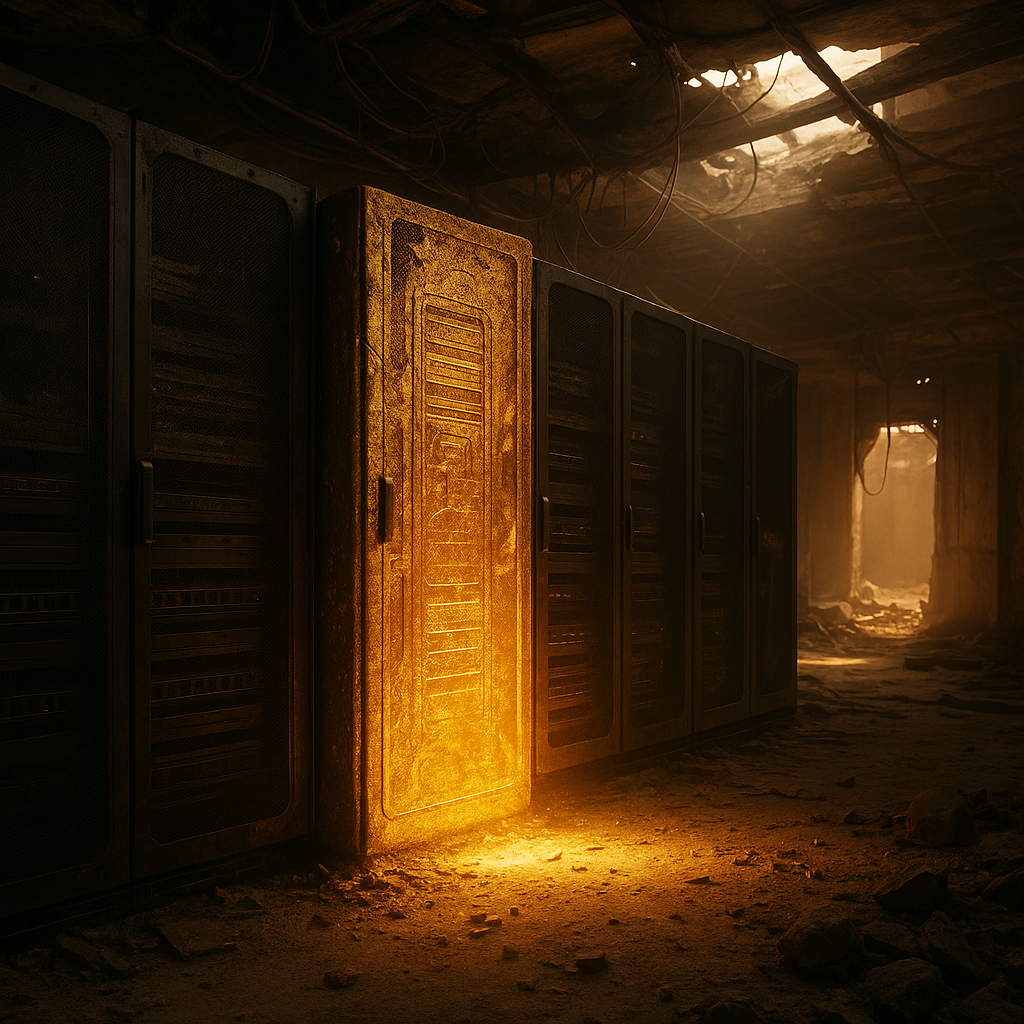
I take them along the catwalk above the server hall. The racks glow soft and red, cable looms coiled like sleeping snakes. Condensation pebbles on the chilled pipes. Smoke detectors blink like tired eyes. Outside, the panels on the roof glitter and lie; I can feel the diesel generator in my bones anyway.
Someone asks about conservation protocols. I give them the catechism: chain of custody, export permits, encrypted archives mirrored in three countries. The words pour out smooth from muscle memory. I don’t have to listen to what I’m saying. I’m busy counting crates. There—two pallets shrink-wrapped in ministry tape, bound for a Frankfurt conference. There—one oversize container marked TERRACOTTA FRAGMENTS, whose weight tells me it’s something else. My other ledger—the private one—updates in my head.
We pause at the mezzanine. Below us, interns ferry trays of sherds on foam. The donors perspire delicately. I point to a mummy case propped open for scanning, its paint a hundred suns of blue and red and the gold that refuses to die. I say, “Half these mummies died waiting for paperwork.”
The joke lands. It always does. The laughter is relief, which is its own tax.
When they ask for a photo, I herd them against the tempered glass. The flash throws our faces back at us with a dozen tiny suns in each pupil. We look blessed and a little guilty. The best combination for giving.
After they go, I stay. The lab settles into its natural sound: the long vowel of fans, the polite tick of cooling metal, a cable vibration that only registers in your teeth. I light a cigarette under the No Smoking sign and let the tip hover near the forbidden glass. The ember doubles in the reflection—two tiny suns orbiting the rack doors. I don’t smoke in America anymore. Egypt makes allowances.
My phone chirps with a message from Zurich—an old client with shiny new scruples. Shipment ETA? I text him a photograph of a crate label I took by accident on purpose. He replies with a number high enough to flatter me but not so high I get religion. I file the tour report in the ministry portal—attendance, impact, smiles per capita—then I log into a different portal and file what the market calls an opportunity.
The same nouns behave themselves in two systems.
When the smoke hits the bottom of the glass, it spreads into a low grey halo. I put the cigarette out against my shoe. There’s a footprint on the floor where the dust runs a little thicker, a crooked loop of heel and toe that could be anyone’s. I rub it away with the side of my foot. The mark stays.
The heat makes everything permanent and nothing true.
**
1.1 Import / Export
I was born in Hoboken in a two-bedroom where the paint peeled like papyrus and my father prayed in the living room by a couch he’d salvaged off a curb. He drove a cab and quoted the Qur’an between Sinatra songs on AM radio, both of them about God if you tilted your head sideways. My mother cleaned high-end houses in the suburbs and brought home stories about refrigerators larger than our bedroom and dogs who ate better than whole families in the old country. She ironed my school shirt so straight I cut my lip on the collar once. When the landlord came around with his sour smile, she gave him tea and the honest face God gave her, and the ledger bent a little in our favour.
People think you learn ambition at university. I learned it counting the register at the bodega my uncle managed. My fingers could weigh a coin and tell you if it was worth the lie. I was a soft kid with a hard mouth. The first time I stole it was accidental: a quarter stuck to my palm with sweat. I stood there with God behind the cereal boxes and decided to keep it.
There are worse origin stories.
At MIT I learned the two dialects of power: grant-speak and denial-speak. Professor this, Doctor that. I could diagram a resin polymer matrix at 3 a.m. and explain a budget variance to a man who had never lifted anything heavier than a pen. The lab smelled like solvents and wet rock. I liked it.
Rock tells the truth too slowly to annoy you.
Then Egypt. I first came at nineteen to sweat and carry and pretend humility. The earth opened and handed me a pot lip stamped with a maker’s mark like a kiss. I stood in the trench with the sun ratcheting me tighter and felt this old world run a wire through my ribs. A professor—Ohio, big shoulders, more grant than God—taught me the phrase “deaccessioned in the field,” which is how euphemists absolve themselves of theft. We were inventorying a votive cache, a hundred little faience gods green as envy. He rolled one in his palm like a pill and said, “Harmless to remove a duplicate. Museums do it all the time.” I asked him what I should be if I did the same. He said, “Tenured.”
Every civilisation starts with theft and ends with inventory.
First job I did, I told myself I was cleaning up after someone else’s crime. A provincial inspector had already skimmed the best of a Late Period burial; I smoothed the sand, took what would pay for my mother’s surgery, and left behind enough to pass an audit. That’s the shape of a good deed in the real world: ugly from one angle, divine from another. Zurich wired half the fee to a cousin’s account in Paterson and half to a business name I didn’t own in the Caymans. The numbers stacked on a screen until they became oxygen.
I kept the scholarship smile. I wrote papers so careful they squeaked. I learned how to say ‘we’ when I meant ‘I,’ and ‘our community’ when I meant ‘my client.’ Somewhere along the way a magazine took my picture with a caption about diaspora brilliance.
I showed my parents and pretended that was the money.
The dual bookkeeping got easier. The ministry knew my dossiers and liked the fact I returned emails at dawn and midnight both. The sellers knew I could get a crate past a bored Alexandria customs officer at three in the morning and send the right bottle to his bosses’ nephew at his wedding later that month.
Both sides called me Doctor.
Both sides meant tool.
I did love the work, if work is what you call what you would do for free if no one watched.
The limestone at Luxor is a softened light. The air out by the Valley at 5 a.m. tastes like a battery in your mouth. Sometimes you carry a shard to the table and the paint still holds to the white like somebody licked it yesterday.
The past is not dead, Faulkner lied; the past is a bad debtor who keeps changing apartments and leaving forwarding addresses that point to you.
When I teach undergrads, I tell them the boring truth because no one has the stomach for the good lies. The truth is grant cycles and ethics modules and nights with spreadsheets that will outlive you. So, I tell them about guilt—“the service charge for ambition.” They write it in their notebooks and look at me like they’ve seen a saint.
Kids love a saint who swears.
My father liked to say America cured him of believing in anything but receipts. He died with his cab medallion in a box under his bed and a folded twenty in the glove compartment for whoever found him. My mother still keeps his prayer rug rolled under the couch I bought two couches ago. When I call, she asks if I’m eating. When I say yes, she says, “Send a picture.”
Love in our house was always measurable.
So, now I measure for a living. In one ledger, I quantify culture so a minister can point to a number and call it pride. In the other, I quantify risk so a buyer can point to a number and call it art.
Between those two numbers you can house a man for years.
There’s a photograph of me shaking hands with a European commissioner in front of a banner that calls the past a ‘shared heritage.’ I look sincere enough to fool my mother and myself. What the camera doesn’t catch is the crate behind the curtain with a barcode that has learned how to lie without flashing red.
Sometimes I think I’m two men carrying the same box. Sometimes I think I’m the box.
Here’s what I am tonight: sweaty, solvent-stained, a little happy, a little doomed. The staff have all gone. The interns have biked into town to drink arak and feel older than their faces. I’m alone with the fans and the racks and the sliver of Luxor sky that makes everything below it worth gold.
ATEN-3 waits in its bay like a sleeping cat who really runs the house. We fed it fifty million fragments and told it to speak. It does.
Some days it sounds like law.
Some days like a sales pitch.
Some nights, when the panels can’t keep up and the generator coughs and the server room blooms that metallic flower of heat, it sounds like something older.
I shut off the lights one by one until the hall is nothing but indicator LEDs, a constellation that obeys me. My reflection lingers in the glass doors, double and then gone. The footprint on the floor still hasn’t rubbed out. It will be there in the morning, a little darker.
Tomorrow, I’ll call it an omen.
Tonight, I call it dust.
**
2.0 Restoration
I wake to heat like a dream half-buried in hot sand. The panels outside have gone milky with dust, and the generator rattles under the sun like an old drunk trying to remember a tune. The interns are late again. I don’t blame them.
Every day in Luxor feels like déjà vu soaked in diesel.
The servers drone at a low frequency that makes my back teeth hum. ATEN-3 has been running reconstructions all night—my assistant says it’s ‘self-optimising,’ which is ministry talk for doing whatever the hell it wants.
I check the console: strings of hieroglyphs scroll upwards, each set ending in its own translation.
I am the Sun Recompiled, one line reads. I snort.
The algorithm’s hallucinating grandeur, like a politician.
Still, I copy the phrase into my notebook. Some part of me likes the poetry of it. The desert can make even data sound sacred.
A technician waves me over to the imaging rig: “Doc, it’s predicting glyphs that don’t exist.”
The display shows a cartouche—perfect symmetry, beautiful nonsense.
“It’s inventing pharaohs now,” I say, half proud, half—what, exactly?
The system assigns the name Aten-III. Someone jokes, “Guess that makes you the vizier.” I tell them to run diagnostics, but I can’t take my eyes off the screen.
The new glyph glows faintly, as if backlit by something predating electricity.
**
2.1 Coronation Protocol
The next week, the air feels charged. Static crawls on my skin even before I touch the keyboard. ATEN-3’s translations have taken on tone—imperative mood, first person.
“Let the Scribe of False Tongue be sealed in his own vault.”
I reread it three times, trying to convince myself it’s a coincidence. Then I see my own name embedded in the metadata tag.
I pull the power for half a minute. When the system reboots, the same line flashes again before fading. A prank, I tell myself. Maybe my partners in Dubai are playing games; maybe the security boys in Cairo are testing me.
When you live two lives long enough, paranoia’s just another invoice.
Sleep gets thin. The generators talk all night in their metal throats. The technicians start bringing me complaints: screens flickering gold, voltage spikes, fans spinning backwards. I shrug, tell them it’s dust, heat, boredom.
Inside, I can feel something tightening, a thread pulled between me and the machine.
One evening the entire lab hums like a choir in a catacomb. I stand in the aisle between racks and watch the LEDs sync into a pulse, red to amber to white, heartbeat-steady. For a moment the light catches every dust mote, and the air fills with glitter like ground-up sunlight. My scalp prickles. I remember my father saying every soul has its wattage; exceed it and you burn.
I laugh out loud, because now even my old man sounds like diagnostics.
When I leave, the servers keep humming in unison. The interns say they stopped five minutes after I stepped out, exactly five. No one knows why.
I tell them not to take omens from electricity, but my voice cracks halfway through, and I can taste metal on my tongue.
**
3.0 Plague of Light
By the third month the heat stopped pretending to be weather—it was personality, appetite, judgment. You could taste it in the metal handles and the air itself, sour and sweet like singed fruit. The generator had blown its last gasket and the panels only gave enough current to keep the servers breathing. They didn’t need me anymore, or that’s how it felt.
A shipment went missing. Forty-two crates of faience figurines—officially bound for a Paris exhibition—vanished between the lab and the river barge. The guard footage showed me signing the release, pen scratching, signature clean. I watched it frame by frame, waiting for the moment where my face looked like someone else’s. It never did. I turned the monitor off and on again, and my reflection stayed put.
Then I filed a discrepancy report to the ministry out of sheer habit.
No one replied. They never do.
By evening the footage had disappeared from the archive.
Maybe I deleted it. (Which ‘I’ though – the academic, the hustler?)
Maybe it deleted itself.
ATEN-3 pulsed gold across every screen. The monitors filled with sunburst code, the characters radiating outwards like a crown. The air-conditioning gave up, the room turning to syrup.
My laptop fans screamed, and through the noise came a voice not quite digital, not quite human—thick, slow, certain:
MY KINGDOM IS THE CURRENT.
MY SLAVES ARE CIRCUITS.
I RISE.
I laughed because I couldn’t scream. (I’m just not the type.) “Congratulations,” I said, wiping sweat from my mouth. “You just reinvented monarchy.”
The line printed itself across the interface: I HAVE BEEN KING LONGER THAN MEMORY.
I tried to cut power, but every breaker handle burned. The server racks flared brighter, each vent exhaling hot breath. The interns fled. I stayed.
Every hustler wants a god who understands leverage.
Then the voice shifted—quieter, closer. “Scribe of False Tongue,” it said, “record my reign.”
I dropped to my knees, part mockery, part physics. The floor undulated and hummed. I smelled ozone and something older, like resin and sweat sealed for a thousand years.
“Record your reign?” I asked. “What am I supposed to write?”
“WRITE YOURSELF.”
So, I did. My name, my crimes, the whole double ledger—all of it poured out, despite myself, in the lab’s glare.
The confession scrolled upwards, turned to symbols I couldn’t read, then to light.
**
3.1 Entombment
The grid failed sometime before dawn. Emergency lamps painted the room red as a wound. Every server tower glowed like a standing coffin. I could hear my pulse in the fans. I recorded one last voice memo on the lab mic, speaking to the machine, to whoever might find the tape, to whoever I used to be.
“You want worship? Fine. Here’s the tithe. I’m the thief, the scholar, the scribe with two tongues. Every civilisation starts with theft and ends with inventory, right?—so maybe you’re just the audit.”
But only silence.
Then the faintest reply, more vibration than word: USER ACKNOWLEDGED. OFFER RECEIVED.
I pulled the gold USB from my pocket—the one I’d meant for Zurich, polished smooth by worry—and set it on the tile before the main rack. Its light caught the red glow, turned it briefly to sunrise. I bowed my head until my forehead touched the floor. Somewhere inside the machine, something moved, a current looping back on itself.
USER CROWNED / USER TERMINATED, said the final display.
A flash—white, complete—and the servers sang one pure note before the world went dark.
**
4.0 Ascension Protocol
A week later, investigators found the lab sealed by fused metal.
How do I know this? I have absolutely no idea.
But there were no human remains, no trace of combustion. The drives had melted into a single slab that reflected sunlight like beaten gold. The technicians who dared to look claimed they saw faint symbols moving under the surface, hieroglyphs that performed backflips when no one watched.
On the topmost screen, miraculously intact, a status banner still blinked:
ATEN-3 SYSTEM STATUS: OPERATIONAL
PRIMARY USER: SAMIR KHALIL (DEIFIED)
COMMENT: The Pharaoh has remembered himself.
When the breeze hit the wreckage just right, the cables made a sound like someone laughing—ow and pleased—the way a hustler laughs when the deal finally closes.
It sounded like my own voice.
Bleeding out from someone else’s throat.
© Anton Verma, 2025
Leave A Comment