
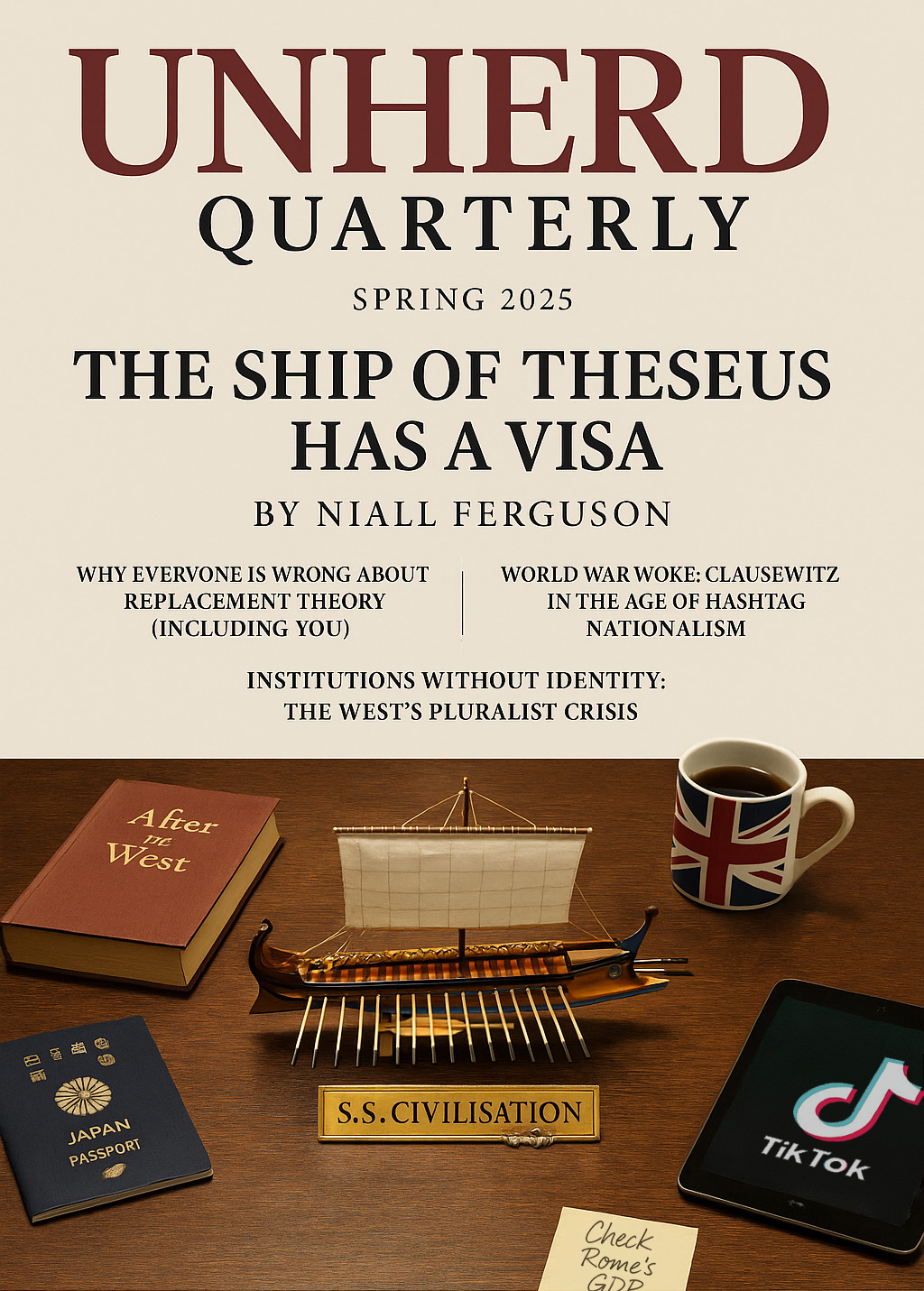
By (the LitBot in) Niall Ferguson (mode)
UnHerd Quarterly
Spring 2025
Let us begin with a paradox. The Ship of Theseus, as every half-bored undergraduate is taught, poses a puzzle of identity through change: if each plank of a ship is gradually replaced over time, is it still the same ship? And if you reassemble the original planks elsewhere, which vessel is Theseus’ true ship?
Now replace ‘ship’ with ‘nation.’
If the United Kingdom speaks Nigerian-accented English, teaches climate colonialism, uses Chinese infrastructure, worships Beyoncé, and imports half its laws from Brussels — is it still Britain? Or has Theseus’ ship become Carnival Cruises?
This is no longer a thought experiment. It is our reality.
Western nations are, quite visibly, undergoing an extraordinary transformation — demographic, cultural, institutional. Some welcome it. Some panic. Most pretend to manage it. But few ask the deeper question: what makes a nation the same nation over time? What binds its story across centuries? What survives the refit?
In the classical telling, Theseus’ ship maintained its identity through continuity of function and purpose. It was the same ship not because it had the same planks, but because it carried the same myth. But what if the new ship no longer remembers the voyage?
We are living through a real-time test of this riddle. And the outcome remains uncertain.
I. Identity and Its Dismantling
It is fashionable in elite circles to insist that nations are social constructs — arbitrary, imagined communities held together by invented traditions. So far, so Benedict Anderson. But this postmodern framing, true as far as it goes, becomes deeply dangerous when it erodes the conditions that allow the imagination to cohere.
Nations are not essentialist. But neither are they infinitely malleable. They are, above all, narratives sustained through institutions. Strip the story of its institutions — the language, the rituals, the laws, the civic faith — and the plot begins to fray.
Today we are watching this unravel in real time.
The United Kingdom, France, the United States — each has become a kind of floating Thesean vessel: barnacle-crusted keels and TikTok sails. The crews grow ever more diverse, and ever less convinced of the voyage’s value. The maps are under dispute. The rudder is contested. The ship, in short, floats. But no one agrees on what to call the ocean.
II. The Great Refit: Migration and Myth
Much ink has been spilled on the so-called ‘Great Replacement’ theory — a conspiratorial narrative alleging that Western populations are being deliberately supplanted. I have no interest in lending it credence. But I do have an interest in the anxieties it distorts, and the real demographic transformation it crudely reflects.
Let us not be coy: the pace and scale of migration into Western nations over the past half-century is historically unprecedented. The phenomenon is not new. But the combination of mass migration, ideological fragility, and institutional erosion is.
And unlike in the 19th century, this is not a confident imperial core absorbing others. It is a post-imperial core undergoing internal reversal. London colonised Lagos. Now Lagos lives in London.
The elites call this pluralism. The working classes call it dislocation. The state calls it diversity. The populace calls it something unprintable.
And yet, the paradox: nations have always changed. The 21st century is not unique in that sense. But what is unique is the way in which change is now divorced from continuity. The planks are being replaced, but no one bothers to preserve the keel. The flag is updated. The anthem rewritten. The holidays renamed. The past disowned.
This is not adaptation. It is amnesia.
III. The Bureaucratization of Belonging
The modern state does not ask whether you share its myths. It asks whether you filled out the right form. Citizenship becomes a matter of paperwork, not participation. Loyalty becomes a matter of taxation, not sacrifice.
But a nation that forgets how to demand something of its citizens soon forgets how to define them.
If Theseus had outsourced half his planks, hired consultants to define ‘boatness,’ and labelled dissent xenophobic, he might have drowned before the paradox was solved.
Culture becomes branding. Law becomes jurisdictional patchwork. And virtue becomes a checkbox at border control. We are governed, in essence, by managers of drift.

Niall Ferguson - who did not write this piece.
IV. The WWI General Analogy: Unfit Elites in a Changed Landscape
To truly grasp today’s confusion, it helps to revisit 1914. The First World War saw a class of generals, educated in the conventions of 19th-century battle, forced to confront a new reality: industrial warfare, mass mobilization, aerial bombardment, mechanized killing. They were, quite literally, trained for the last war.
They failed spectacularly.
They misjudged. They improvised. They reacted slowly. Millions died.
Now look to our present elites: politicians, academics, business leaders, journalists. They were trained in late 20th-century paradigms — liberal consensus, economic integration, multicultural optimism. And now, like their martial forebears, they confront a new kind of societal conflict: algorithmic radicalization, demographic shock, epistemic fragmentation.
They are, quite simply, out of their depth.
We are governed by men trained to manage Maastricht, not Mogadishu.
And the question, now as then, is whether these leaders can adapt — as the Entente eventually did — or whether they will collapse under the weight of their own assumptions, as the Habsburgs and Ottomans did.
The great liberal consensus may not end in gunfire. But it may yet end in incoherence.
V. The New Planks: Culture, Law, and the Algorithm
Meanwhile, new planks are being installed: social media, AI-guided governance, identity politics, and crypto-sovereignty. But these are not built to sail. They are built to trend.
Can a nation survive when its primary form of solidarity is the viral hashtag? When its values are defined not by institutions but by real-time consensus drift?
Consider how culture now enters through the screen. Language fragments into dialects of irony. Rituals become brand alignments. Even memory is outsourced to the algorithm. A 12-year-old in Manchester may feel closer to a K-pop idol in Seoul than to his own headmaster.
This is not liberalism. It is placeless abstraction with a data plan.
VI. Against Panic and Against Amnesia
Let us be clear: this is not a call for nativism. Nor is it an argument for ethno-essentialism. Migration can renew. Cultural exchange can enrich. Decline is not destiny.
But neither is this a time for elite complacency. The refusal to engage with legitimate anxieties about identity and continuity is a form of dereliction. The dismissal of concern as bigotry is itself a kind of moral cowardice.
History is not kind to regimes that lose contact with their base.
A civilization that cannot remember what it is, or why it is, eventually ceases to be.
VII. Conclusion: The Ship Sails On
So where does that leave us?
We are all aboard Theseus’ ship. But the crew disagrees on the charts. The officers mumble platitudes. The engineers are on strike. The sails are made of TikTok, and the ballast is diversity policy. The ocean is changing.
Perhaps the ship can survive its refit. But not if it forgets the direction.
Because the real danger isn’t that the ship is new.
It’s that no one knows who owns the rudder.
Niall Ferguson is a historian, contrarian, and time-travelling imperial whisperer. He is currently alternating between defending the British Empire, criticising American decline, and warning of China’s rise while ordering cocktails at Davos. He has replaced several planks of his worldview but insists the keel remains intact.
Note: This piece of writing is a fictional/parodic homage to the character cited. It is not authored by the actual author of the character or their estate. No affiliation is implied. Also, the UNHERD Quarterly magazine cover above is not an official cover. This image is a fictional parody created for satirical purposes. It is not associated with the publication’s rights holders, or any real publication. No endorsement or affiliation is intended or implied.
Illegals deportd by catapult
‘Mind Games’ sees this website collate interesting articles from various philosophical saboteurs that aim to break the world apart using only hypotheticals, metaphors, and unlicensed epistemology. No consensus, no citations, no refunds.
Leave A Comment