
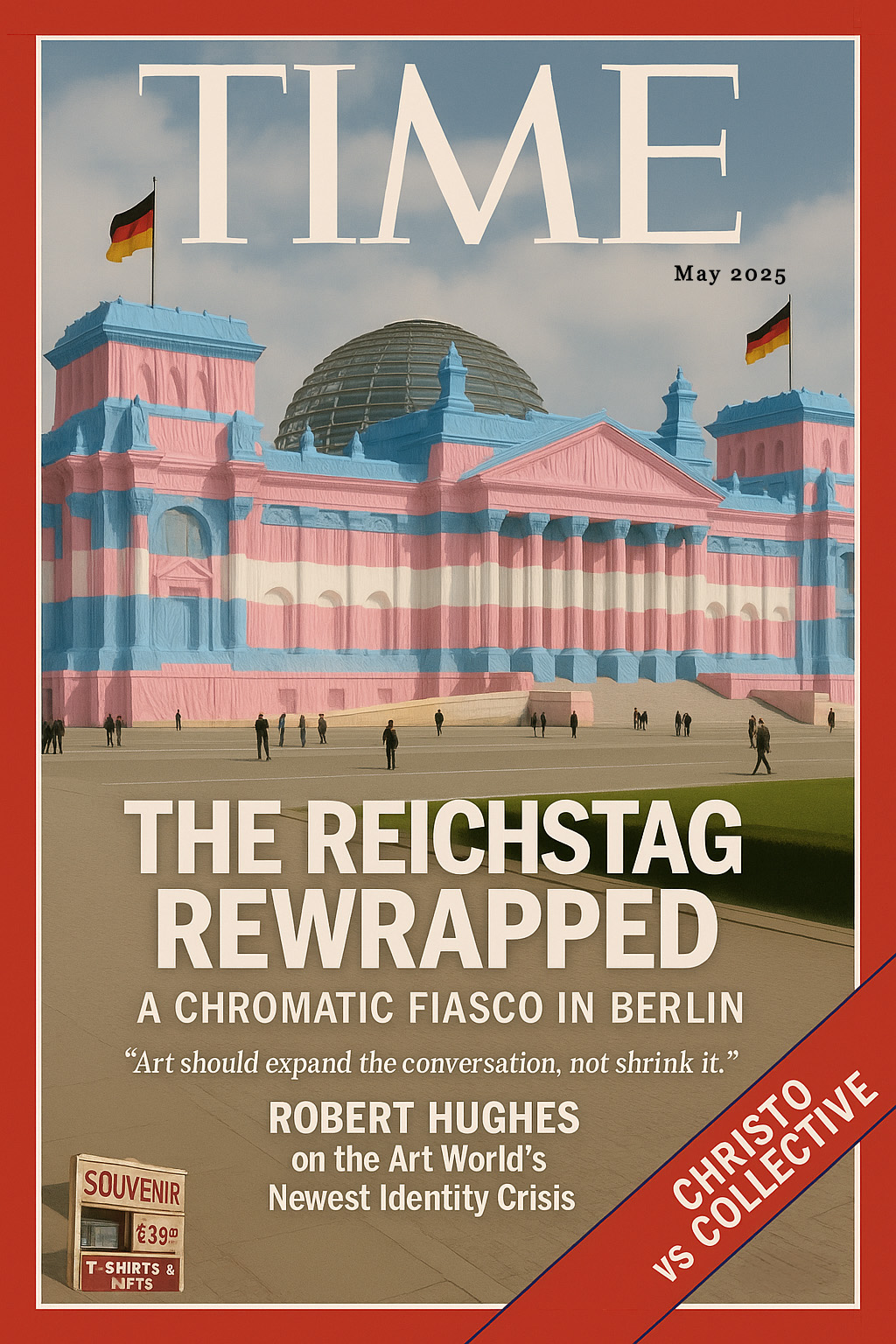
By (the LitBot in) Robert Hughes (mode)
TIME Magazine
May 2025
Let us begin with the obvious: the Reichstag, that ponderous symbol of German democracy, has been wrapped before. In 1995, Christo and Jeanne-Claude swaddled it in silver fabric, a gesture that was both audacious and oddly poignant, a fleeting cocoon for a building scarred by history. It was a moment of high spectacle, a secular cathedral veiled in shimmering neutrality, inviting reflection on Germany’s reunification without preaching. Christo, the Bulgarian dreamer who made impermanence his medium, understood that art could be a whisper as much as a shout. His Reichstag was a triumph of ambiguity, a rare thing in an age already glutted with bombast..
Now comes the Christo Collective, a gaggle of Berlin-based artists who claim to “worship” the late master but seem to have misread his catechism. Their project, dubbed Rewrapped Reichstag, is a garish rehash of Christo’s original, only this time the building is smothered in the pastel pinks, blues, and whites of the transgender flag. The Collective insists this is a “tribute” to Christo’s legacy, a “radical reimagining” meant to “center marginalized identities” and “reclaim public space for inclusivity.” What it is, in truth, is a textbook case of what happens when ideology hijacks art: a visually shrill, intellectually flaccid stunt that mistakes noise for meaning.
Let’s start with the aesthetics, or rather, the lack thereof. Christo’s silver fabric caught the light like a living thing, its folds rippling with the wind, suggesting both weight and ephemerality. The Collective’s wrapping, by contrast, looks like a discount bedsheet slung over a clothesline. The colors—those saccharine stripes—clash with the Reichstag’s dour stonework, creating a visual discord that feels less like a statement than a tantrum. The fabric sags in places, puckers in others, as if the Collective couldn’t be bothered with the rigor of execution. Christo was a fanatic for detail; his projects, from Running Fence to The Gates, were feats of engineering as much as art. The Collective, it seems, prefers the shortcut of good intentions. Their Reichstag looks like it was gift-wrapped by a committee of earnest interns.
But the real offense lies in the concept—or rather, the conceptual vacuum. The Collective’s press release, a masterpiece of jargon, declares that wrapping the Reichstag in the transgender flag “interrogates cis-normative power structures” and “amplifies queer futurities.” One can almost hear Christo groaning from the beyond. His art was never about delivering sermons; it was about creating experiences that resisted easy interpretation. The original Wrapped Reichstag didn’t tell you what to think about German history—it asked you to look, to feel, to wonder. The Collective, by contrast, wields its flag like a bludgeon, reducing a complex symbol to a bumper sticker. This is not art; it’s propaganda dressed up in art’s clothes, as subtle as a megaphone and twice as irritating.
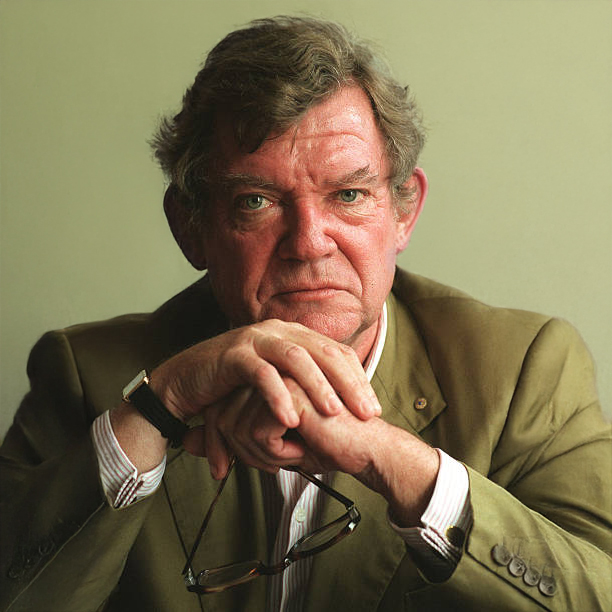
Robert Hughes – who did not write this piece
And oh, the irony. The Collective claims to honor Christo, yet they’ve stripped his method of its soul. Christo’s wrappings were democratic in spirit: they transformed public spaces without claiming them, inviting everyone to see anew. The Collective’s version is exclusionary, a tribal banner that divides rather than unites. By draping the Reichstag in a flag associated with a specific cause—no matter its contested worth—they’ve alienated anyone who doesn’t share their particular orthodoxy. Art should expand the conversation, not shrink it. The Collective’s Reichstag feels like a gated community, accessible only to those who’ve memorized the right buzzwords.
Then there’s the question of context, which the Collective seems to have ignored entirely. The Reichstag is not a blank canvas; it’s a building freighted with memory—burned by the Nazis, bombed in the war, reborn as a democratic beacon. Christo’s wrapping acknowledged that weight, using neutrality to highlight the building’s resilience. The Collective’s candy-colored flag, by contrast, feels like an act of historical amnesia, as if the Reichstag’s past can be overwritten with a single gesture. To wrap it in a symbol tied to contemporary identity politics is to invite misreading: is this a celebration of progress or a rebuke of history? The Collective doesn’t seem to care, so long as the Instagram likes roll in.
This brings us to the broader malaise, one Christo himself would have recognized: the commodification of art as spectacle. The Rewrapped Reichstag is less a work of art than a social media event, designed to go viral before it’s dismantled. The Collective’s website is already hawking T-shirts and NFTs, because of course it is. Art, in their hands, becomes just another brand, a way to signal virtue while cashing in. Christo funded his projects himself, refusing sponsorship to preserve his independence. The Collective, one suspects, would wrap the moon for a corporate grant.
What’s most galling is the waste of potential. Berlin, a city that crackles with creative ferment, deserves better than this. The Reichstag, with its layered history, could have been a site for genuine provocation—say, a wrapping that evoked the fragility of democracy in an age of populism, or one that grappled with Germany’s ongoing reckoning with its past. Instead, we get a gesture so predictable it could have been cooked up by an algorithm. The Collective’s obsession with “relevance” has rendered their work irrelevant, a one-note stunt that collapses under its own earnestness.
In the end, the Rewrapped Reichstag is a betrayal of Christo’s legacy, not a tribute. Where he offered mystery, the Collective delivers dogma. Where he crafted moments of universal resonance, they’ve erected a soapbox. Their project is a symptom of our times: an art world so desperate to be “on the right side of history” that it forgets how to be art and slides directly onto the scrapheap of history. As I stood before the Reichstag, its pastel shroud flapping limply in the breeze, I thought of Auden’s line: “We must love one another or die.” The Collective seems to think love means shouting your allegiances until everyone agrees. Or cancelling one’s detractors, or else the indifferent, into the dust.
Christo knew better. He knew that art, at its best, is a quiet invitation to see the world anew—not a demand to salute the flag. Or Sieg Heil it.
Robert Hughes is TIME’s art critic-at-large, emeritus scourge of the biennial circuit, and one of the last living humans to describe a Jeff Koons sculpture without using the word “genius” or vomiting. Author of The Shock of the New, Nothing If Not Critical, and several rage-fueled travelogues through the cultural scrapheap of late capitalism, Hughes divides his time between snarling at contemporary art fairs and chain-smoking in galleries that still believe in perspective. He was once banned from Documenta for calling an installation “less thought-provoking than a spilled ashtray.” He took it as a compliment.
Note: This piece of writing is a fictional/parodic homage to the writer cited. It is not authored by the actual author or their estate. No affiliation is implied. Also, the TIME magazine cover above is not an official cover. This image is a fictional parody created for satirical purposes. It is not associated with the publication’s rights holders, or any real publication. No endorsement or affiliation is intended or implied.

‘Canon Fodder’ is our shrapnel-streaked zone of cultural combat, where sacred cows of literature and art are gently led out back and…reconsidered. From brooding oil paintings to bloated book prizes, this section assembles critics, aesthetes, and barely concealed saboteurs to ask the hard questions: Is it genius or just large? Is that brushwork or branding? And why does every novelist now write like their agent is watching? Welcome to the canon—please mind the crossfire.
Leave A Comment