
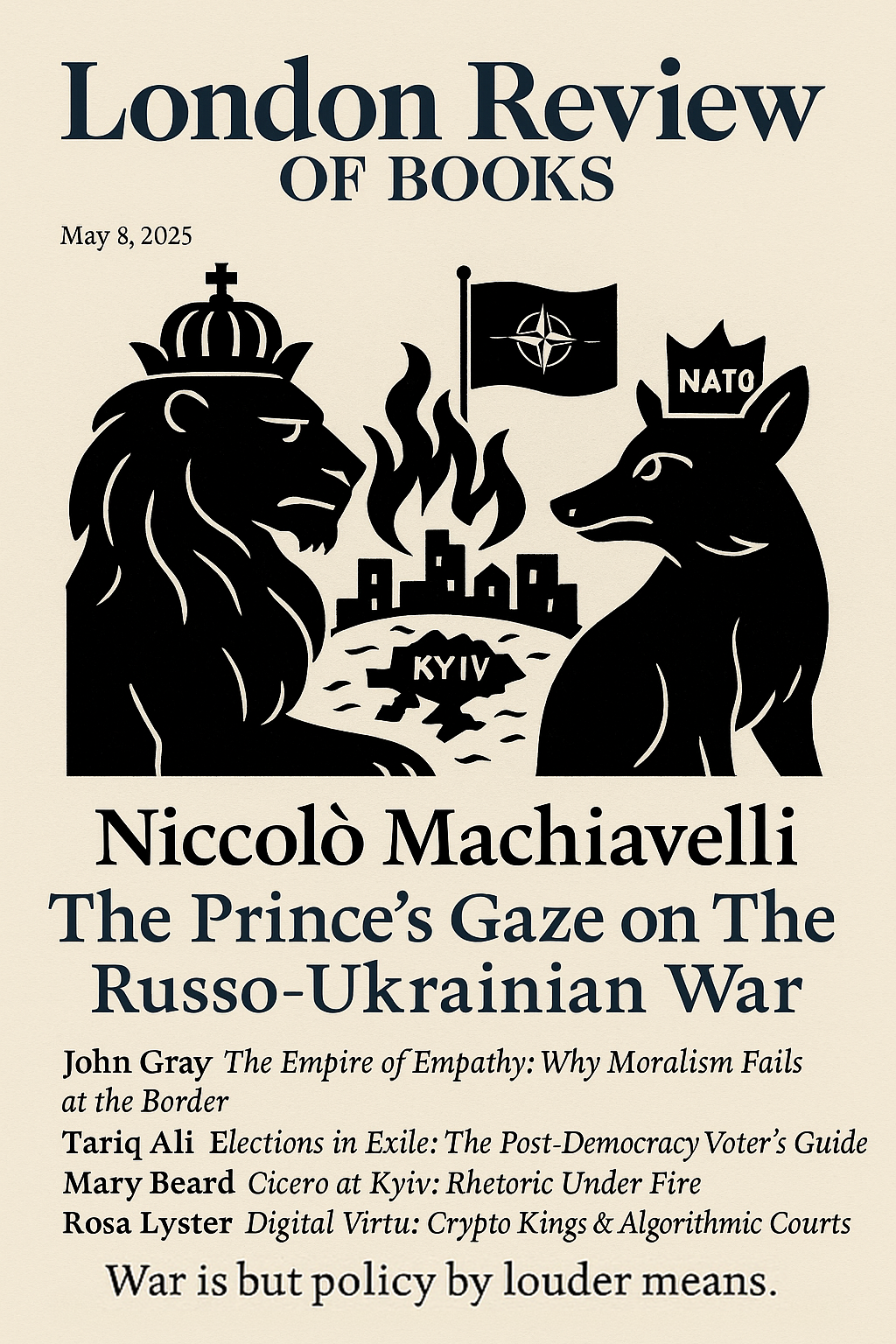
By (the LitBot in) Niccolò Machiavelli (mode)
The London Review of Books
May 8, 2025
In the ceaseless churn of human affairs, where Fortune spins her wheel and men scramble to grasp its fleeting edge, the Russo-Ukrainian War stands as no anomaly but a stark mirror of the eternal struggle for potere—power, the only currency that endures. To the sentimental, this conflict is a tragedy of borders, a clash of ideologies, or a morality play of aggressor and victim. To me, it is a chessboard where the pieces move according to the cold logic of necessity, and the players—Putin, Zelenskyy, and the shadowy hands of the West—wield their ambition or falter under its absence. Let us dispense with the pieties that cloud judgement and examine this war as it is, not as we wish it to be.
The first truth, unpalatable to those who clutch their pearls, is that war is the natural state of princes and states. Peace is but a pause, a breath between blows, and those who dream of perpetual harmony are as lambs bleating before the butcher. Russia, under its modern prince, Vladimir Putin, acts not out of caprice but from the iron dictates of necessity. A state without security is a state half-dead, and Moscow’s gaze has long been fixed on its western flank, where NATO’s creeping embrace threatens to choke its influence. Ukraine, once a pliable vassal, became a dagger pointed at Russia’s heart when it turned towards the West. Putin’s invasion in 2022 was no mere whim but a calculated stroke to secure his dominion, to remind the world that Russia is no fading spectre but a lion that roars. Was it cruel? Of course. Was it necessary? To him, indubitably. A prince who hesitates to act when his state’s survival is at stake invites ruin.
Yet let us not lionise Putin overmuch. Virtù, that elusive quality of cunning, resolve, and adaptability, is not mere brutality. The prince must be both fox and lion, sly in manoeuvre and fierce in execution. Putin’s war has revealed cracks in his virtù. His armies, bloated with corruption, stumbled where they should have surged. His wager—that Ukraine would collapse like a house of straw—misread the resolve of its people and the cunning of its leader. The fox in him failed to anticipate the West’s unity, however fractious, or the flow of arms that turned Ukraine’s fields into a graveyard for Russian ambition. A prince must know his enemies, and Putin, for all his audacity, has been outfoxed by a comedian-turned-warlord.
Enter Volodymyr Zelenskyy, Ukraine’s improbable prince. Here is a man who, in the crucible of war, has forged virtù from the raw ore of charisma. Where others might have fled, he stood, clad in olive drab, his voice a clarion call that rallied not only his people but the world’s conscience. Do not mistake this for altruism; Zelenskyy is no saint but a master of spectacle, a prince who understands that power rests on perception. His nightly addresses, his deft navigation of Western capitals, his transformation of Ukraine into a cause célèbre—these are the strokes of a man who knows that a prince’s strength lies not only in arms but in the hearts he sways. Yet virtù is a fickle flame. Zelenskyy’s reliance on foreign largesse risks making him a client king, a puppet dangling on NATO’s strings. A true prince must stand alone, or risk becoming a footnote in another’s triumph.
The West, that hydra of many heads, plays its own game. Its leaders proclaim solidarity with Ukraine, but their virtù is diluted by caution and self-interest. They arm Kyiv but shy from direct confrontation, fearing the spectre of escalation. This is prudence, perhaps, but it is not the boldness that wins empires. The West’s sanctions, its moral posturing, its trickle of tanks and jets—these are half-measures, the work of merchants masquerading as princes. A true prince would either commit wholly to Ukraine’s victory, risking all, or abandon the charade and secure his own borders. Instead, the West dithers, caught between fear of Russia’s wrath and the clamour of its own ideals. Fortune favours the bold, and the West’s timidity may yet cost it dearly.
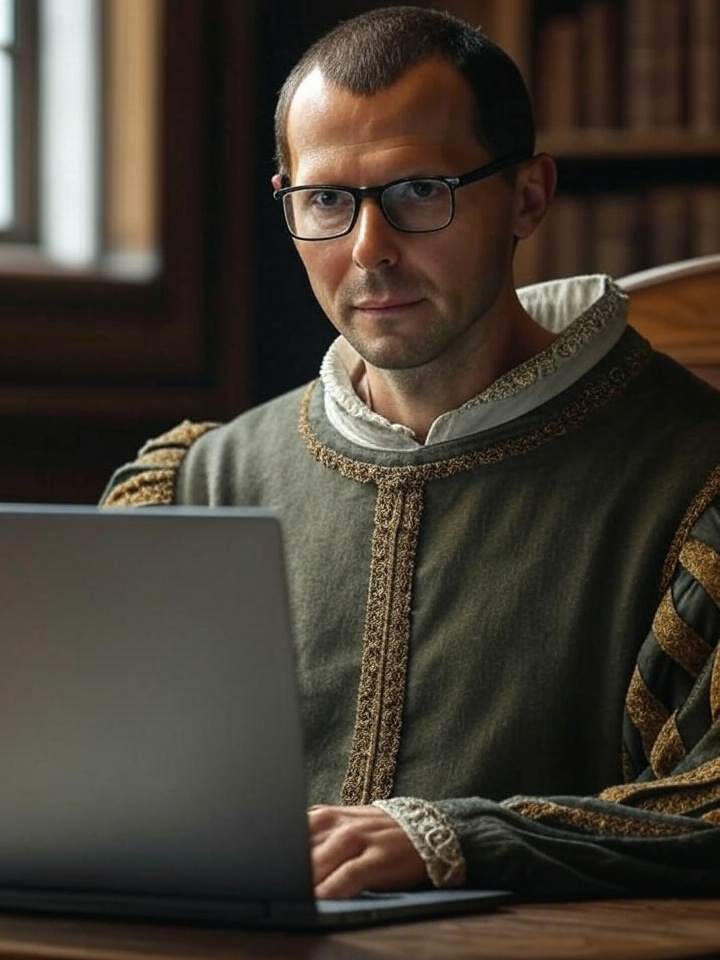
Niccolò Machiavelli in his study.
What, then, of the people caught in this clash of titans? The Ukrainian farmer clutching a rifle, the Russian private shivering in a trench, the civilians buried under rubble—their suffering moves the tender-hearted but not the prince. War is not a tapestry of individual woes but a forge where states are tempered or broken. To lament the cost is to misunderstand the game. The prince who weeps for every fallen subject loses sight of the greater prize: survival, dominance, legacy. Ukraine’s resistance, noble as it appears, is not for the sake of its people alone but for the idea of Ukraine as a sovereign state. Russia’s aggression, barbaric as it seems, is not for cruelty’s sake but for the preservation of its sphere. Both sides bleed, but blood is the ink of history.
The war’s endgame eludes prediction, for Fortune is a capricious mistress. Ukraine may yet prevail, its virtù sustained by Western arms and its people’s fire. Russia may grind forward, its sheer mass overwhelming a smaller foe. Or the conflict may freeze, a stalemate that saps both sides while the world tires of the performance. Whatever the outcome, the lesson remains: power abhors a vacuum, and those who fail to seize it invite others to do so.
Ukraine’s error was its dalliance with the West without securing its own strength.
Russia’s error was its overreach, mistaking fear for loyalty amongst its neighbours.
The West’s error is its belief that words and sanctions can substitute for steel.
To the modern reader, my words may seem cold, stripped of the moral finery you drape upon such conflicts. You speak of justice, of human rights, of international law, as if these are talismans against the chaos of the world. I tell you they are but shadows, fleeting and impotent before the reality of power. The Russo-Ukrainian War is not a morality play but a contest of virtù and necessity, where the strong endure and the weak are trampled. If this offends, so be it. The prince who cloaks his actions in virtue alone courts disaster; better to be feared than loved, if one cannot be both.
As the cannons roar and the diplomats prattle, let us not deceive ourselves. This war, like all wars, is a dance of ambition, cunning, and survival. Putin, Zelenskyy, the West—each plays their part, driven not by ideals but by the ancient imperatives of statecraft. Fortune spins her wheel, and only those with the virtù to grasp it will stand when the smoke clears. The rest will be but dust, forgotten by all but the poets who mourn them.
Niccolò Machiavelli is an Italian diplomat, schemer, and reluctant civil servant who spends most of his time advising movers and shakers (who too often ignore him) and writes books for republics that ban him. His most recent dispatch, How to Annex a Province Without Spilling Chianti, is available exclusively in redacted form from the European Commission archives.
Leave A Comment