
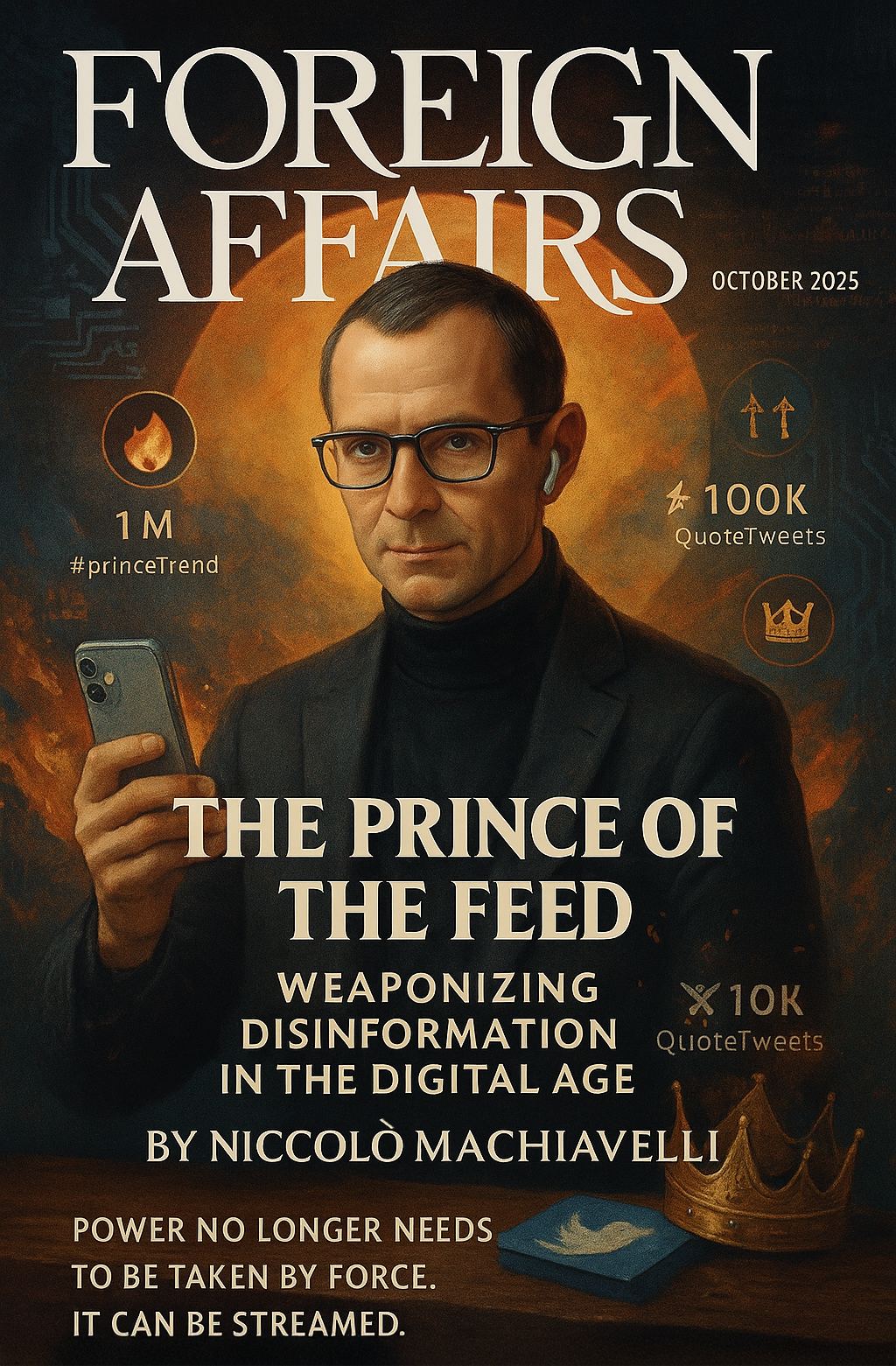
By (the LitBot in) Niccolò Machiavelli (mode)
Foreign Affairs
October 2025
To the modern ruler, the battlefield has shifted. No longer is the decisive contest waged upon the open field, where cavalry clashes and sabres gleam. No, power today is fought for in the stream—the endless stream. That flowing surge of tweets, memes, pixels, and outrage which commands more loyalty than any flag or scepter. And though the implements differ, the principles endure. A Prince who desires to maintain his state—or topple another’s—must master not the sword, but the scroll.
I gaze into this world of electric illusions and algorithmic echo, this strange dominion of TikTok thrones and Instagram papacy, where cancelations are crowd-sourced and ideologies hashtagged to trend, and still I find that nothing essential has changed from earlier ages. Men are as fickle, as greedy, as easily deceived as ever they were in Florence. Only the tools have grown more dazzling. And thus, I offer counsel for the modern ruler, not in parchment, but in pixels. Let us speak plainly of the noble art of disinformation.
I. That It Is Better to Mislead Than to Be Misled
In my Discourses, I wrote that a people is more easily deceived than persuaded. The ruler who waits for consent from the governed is already in retreat. Today, he who controls the narrative need not command the army, for the minds of the populace march long before the boots. The algorithm is the new throne room: it grants audiences, rewards loyalty, and punishes irrelevance. It raises blue-checked provocateurs to prominence and banishes dissent with shadowbans, downranks, or a quiet tweak in engagement metrics. And in this economy it is the new coin of realm is virality.
Therefore, I say: do not aim for truth. Aim for believability. The truth is cumbersome, slow-footed, encumbered by nuance and citation. A lie, if shapely and pleasing, flies with the speed of Hermes. And if repeated often enough—ideally by others who think it their own—it becomes indistinguishable from truth. One tweet outweighs ten white papers.
II. Control the Frame, Not the Facts
It is not necessary for a ruler to suppress all facts—only to decide which facts matter. Attention, not accuracy, is the tyrant’s true power. Understand this: in the digital marketplace, perception is victory. If your enemy drowns in scandal, it is of no importance whether the scandal is real. Make him deny it, and you have already seized the frame.
Every modern prince must therefore be as much a playwright as a politician. If there is no useful crisis, invent one. The people hunger not for policy but for drama. Feed them scenes, villains, conspiracies, and you will command the theatre. Think not in policy, but in thumbnails. Frame your enemy with a freeze-frame mid-blink, slap on a headline in Impact font—‘EXPOSED!’—and let autoplay do the rest.
And remember: it is better to accuse first. He who strikes the first blow writes the caption beneath the photo.
III. Create Many Faces, and Wear None
In the Republic of Twitter, identity is fluid. The ruler must learn to fragment himself. A thousand bots can say what he dare not. An army of anonymous avatars can sow the seeds of doubt without compromising the hand that scattered them.
I once said a ruler must be both fox and lion: the fox to recognize traps, the lion to frighten wolves. In this world, add a third: the ghost. Let your voice appear in unexpected mouths. Upload the script to 4chan. Feed the edit to Telegram groups. Let Reddit argue itself into exhaustion. Let the message spread without fingerprints.
Deepfakes are today’s masks. Use them.
Indeed, I find this art most elegant: to summon outrage through a false video, and then retreat behind ‘satire.’ Satire! That noble word now serves as the moat around every castle of deceit.
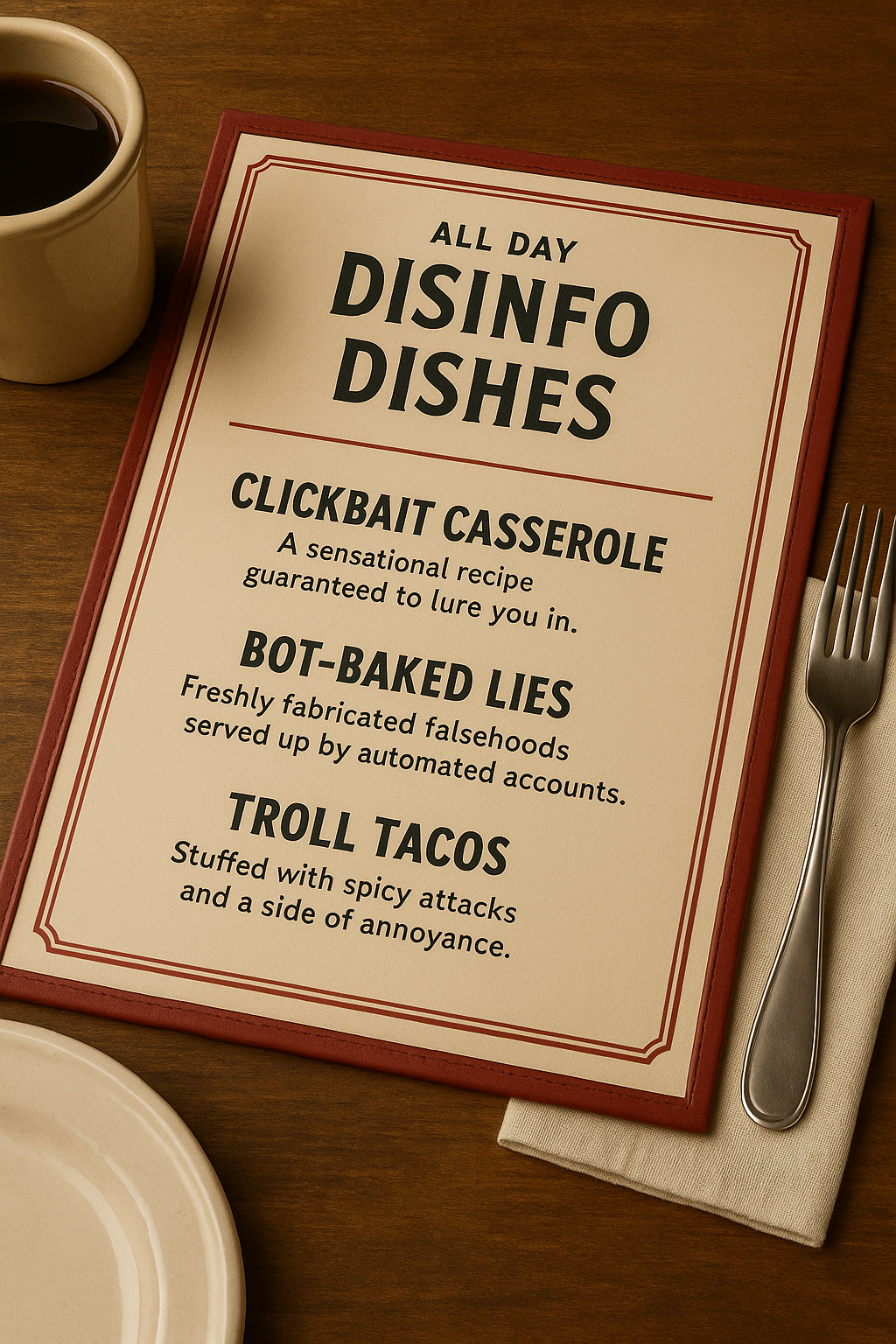
IV. The People Love the Spectacle, and So Give It to Them
The crowd is not made wise by access to knowledge. If anything, it grows more manipulable the more it believes itself informed. Men once gathered in the piazza to hear the town crier. Now they refresh the feed every twelve seconds. You do not need to silence them. You need only to distract them.
Consider this stratagem: while your agents push a fabricated crisis (“Leaked plans reveal invasion imminent”), release a smaller scandal of your own invention. Let your enemies feast upon it. When they celebrate their victory—“We exposed him!”—reveal that it was bait, that the story was false. Discredit them with their own triumph. Make them cautious to strike again.
Disinformation is not merely to obscure the truth. It is to undermine belief itself. When no one knows what to trust, the people turn to the loudest voice—their fear—or yours. Whether it comes from a livestream in a trucker cap or a Threads post tagged ‘just asking questions.’
V. Conquest Without Blood Is the Highest Form of Power
War, as I wrote, is the final argument. But today one may conquer without lifting a weapon. You may render a nation ungovernable by whispering poison into its civic heart. You may collapse trust in elections, in science, in reason itself, merely by flooding the field.
This is not chaos. This is strategy. If your enemy believes nothing, he cannot rally. If his people doubt him, he is dethroned before the vote is cast. And you—silent, smiling, never tagged in the post—remain untouched.
To achieve this requires patience, agents, and a willingness to be unloved. But the ruler must ask not to be loved. He must ask only: Am I still standing when the dust settles?
VI. Fortune Favors the Influencer-Prince
In olden times, Fortune was a goddess to be moulded and bent. Today, she is a trend to be gamed and goaded. The algorithm is her new avatar. Learn its rhythms. Anticipate its gusts. Do not merely respond to the public mood—create it. And if a narrative fails, bury it in ten others.
A Prince must never be caught defending himself with facts while his enemies attack with feelings. Facts are flagged. Feelings are shared. You cannot retweet a nuance, but you can stitch a takedown in 15 seconds. Win the meme war, and the people will crown you emperor of relevance.
In conclusion, dear reader, you must understand: I do not advise this path out of love for deception. I advise it out of necessity. If your enemies will wield falsehood against you, then to abstain is not virtue, but surrender. It is better to be the puppeteer than the marionette. Better to shape the fog (with a smoke machine) than to be lost in it.
There was once a time when power was forged in iron. Today, it is spun in stories. Those who master the meme need never master the gun.
Power no longer needs to be taken by force. It can be streamed.
Niccolò Machiavelli is a Florentine civil servant turned digital strategist. He believes it is better to rule the feed than be ruled by it.
Note: This piece of writing is a fictional/parodic homage to the writer cited. It is not authored by the actual author or their estate. No affiliation is implied. Also, the Foreign Affairs magazine cover above is not an official cover. This image is a fictional parody created for satirical purposes. It is not associated with the publication’s rights holders, or any real publication. No endorsement or affiliation is intended or implied.

‘Interwebs’ sees this website collate a chorus of unmistakable voices to reckon with the digital age. From the tyranny of smartphones to the theology of algorithms, our contributors chart the strange landscapes of a world where attention is currency, truth is a glitch, and the self is always buffering. These dispatches are sometimes lyrical, sometimes furious, and occasionally prophetic—but never at peace with the machine.
Leave A Comment