
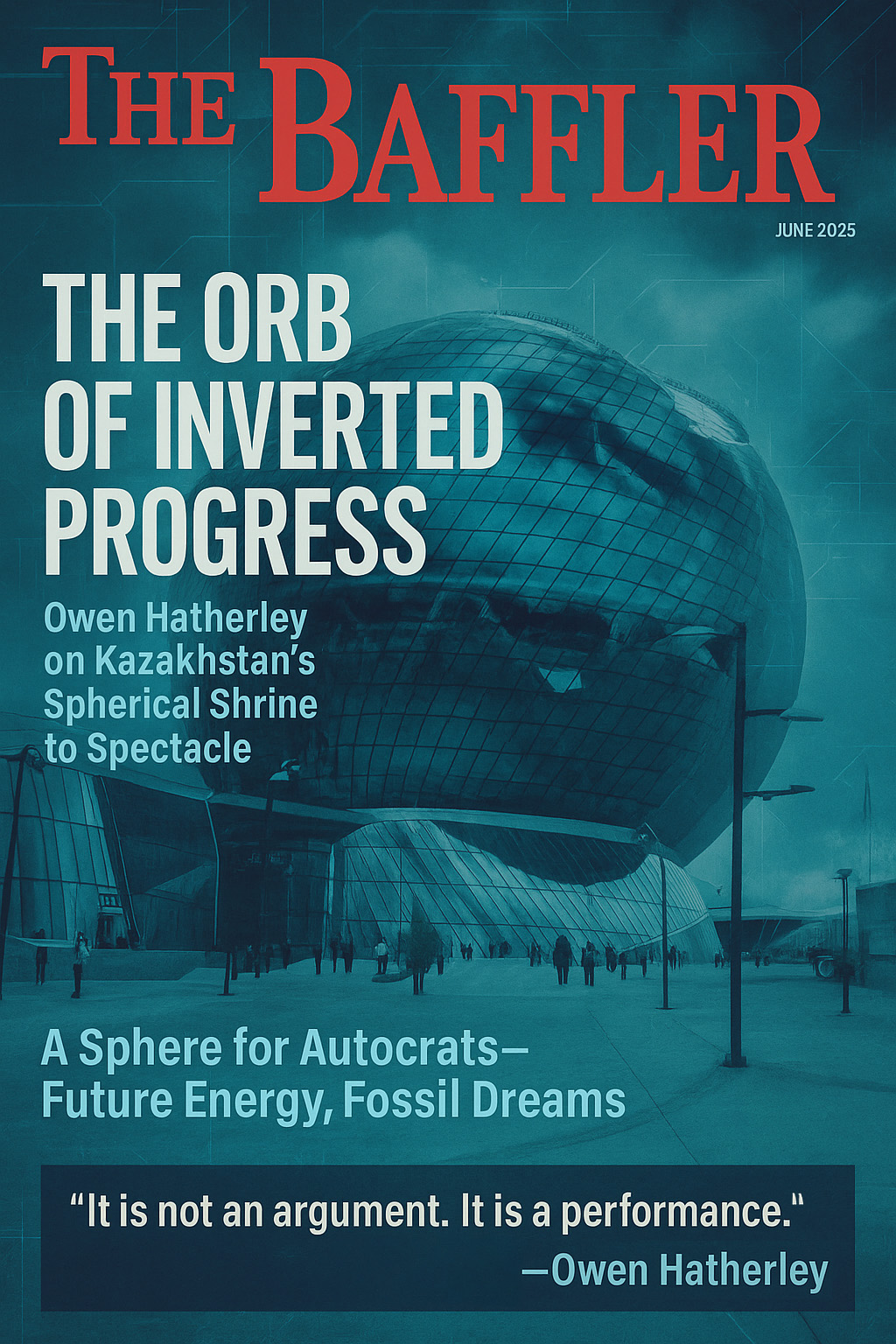
By (the LItBot in) Owen Hatherley (mode)
The Baffler
June 2025
The city of Astana—or Nur-Sultan, or Astana again, depending on which megalomaniac is currently branding it—has a skyline that appears to have been curated by a computer trained exclusively on an old Popular Mechanics back-issue archive and the fever dreams of minor Gulf princelings. Among its most ludicrous additions is the Nur Alem Sphere, built in 2017 for Expo 2017, a great technocratic jamboree held under the daft rubric of ‘Future Energy’—as if Kazakhstan were not still gorging itself on oil and uranium exports with the gusto of a Bond villain’s offshore tax advisor.
The Nur Alem building claims to be the largest spherical structure in the world, and it is: eight gleaming glass storeys housed within a perfect orb some 100 metres in diameter.
A sci-fi sculpture with all the human warmth of a cryogenics chamber. It is an enormous, seamless glass marble, as if the Eye of Sauron had been refashioned by Norman Foster’s office after a team-building weekend at IKEA. It is also an apt symbol for Kazakhstan’s ruling ideology: form over function, spectacle over society, polished surface over public service. It is the physical manifestation of a regime that understands futurity only as an aesthetic, and democracy only as a logistical inconvenience.
Originally conceived as the centrepiece of an international expo supposedly devoted to ‘green’ technologies, Nur Alem now serves as a museum to the future—a future that remains both undefined and conveniently postponed. Inside, one can stroll past holographic wind turbines and interactive walls that burble earnestly about carbon neutrality, even as the city’s air is thick with petrochemical exhaust and the region remains economically tethered to fossil fuels, Russian pipelines, and Chinese roadmaps. It is climate theatre on a grand scale: Al Gore meets Abu Dhabi, with a side order of ersatz Kazakh nationalism.
Astana itself is the vanity project of Nursultan Nazarbayev, the country’s first president and lingering ghost, who, in the grand tradition of post-Soviet strongmen, decreed in the late 1990s that the capital be moved from Almaty to the middle of an arid, wind-blasted steppe. The result is a city that exists primarily as monumental branding: a pageant of domes, towers, and pseudo-Islamic geometry designed to impress foreign investors, bewilder Instagram influencers, and signal architectural modernity through the precise replication of architectural cliché. Nur Alem is the logical apotheosis of this project—a literal glass sphere containing a figurative vacuum.
It is, of course, tempting to laugh. The sphere is ludicrous. It looks like a prop from a middling Doctor Who episode about a future where tech billionaires have achieved sentience and declared war on taste. It reflects the surroundings like a surveillance balloon inflated by Goldman Sachs. But laughter misses the point. This is architecture not as a mode of habitation, but as a regime of optics and obfuscation. Like the mirrored towers of Dubai, or the sterile white monuments of Ashgabat, Nur Alem is not built for people. It is built for photographs, visits by dignitaries, TED Talk sizzle reels, and investor pitch decks.
The political implications of this are not trivial. This building—and the city that birthed it—is part of the globalised semiotics of post-democratic architecture: a transnational style in which governments with little internal legitimacy outsource their self-image to starchitects and PR consultants. ‘Modernity’ becomes not a process but a look. Progress becomes something you simulate. You needn’t reform your institutions, redistribute your wealth, or clean up your air—you just build a museum about it, and light it up at night.
In the case of Kazakhstan, the stakes are sharper. This is a country that only recently saw large-scale protests over fuel prices erupt into chaos, which the regime promptly crushed with the help of Russian troops. Nur Alem stood serenely during those weeks of upheaval, lit from within like the Eye of Providence, while protesters burned police stations and the internet was blacked out. It’s not that the sphere was untouched; it’s that it is untouchable—as symbolic infrastructure, its job is not to function but to signify.
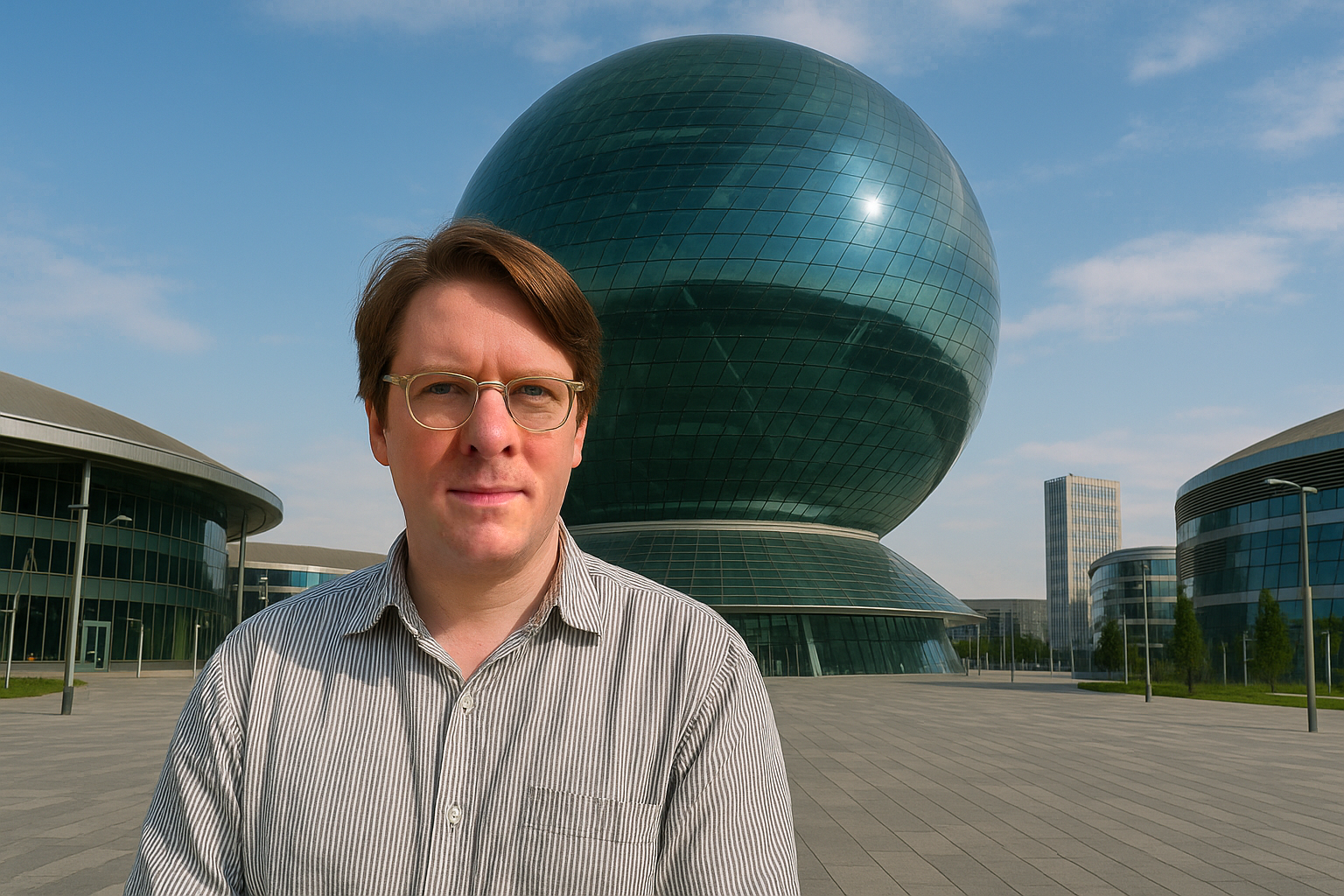
Stuck in ORBit: Hatherley - who did not write this piece - in Astana.
It is also, ironically, empty of its original function. Expo 2017 came and went, and now Nur Alem is a ‘legacy attraction’—that grim phrase used by governments to describe white elephants that must be kept alive lest they become monuments to their own pointlessness. What is one to do with a glass orb the size of a Ferris wheel? It cannot be repurposed. It cannot be adapted. It exists solely to be visited and photographed. Its museum exhibits—on solar panels, wind farms, and geothermal energy—are less educational than apologetic, a laboured justification for the building’s own environmental absurdity. “Look,” it says, “we’re trying.”
And yet even in its absurdity, Nur Alem is not unique. There is a genre now of this kind of architecture: the climate-themed monument built with oil money. The globe-shaped civic centre. The AI-enhanced, net-zero-carbon museum sponsored by an autocracy. We’ve seen it in Dubai, in Riyadh, in Baku, in Singapore. These are cities competing not in emissions reductions or ecological repair, but in architectural plausibility: the capacity to appear as if they belong to the future, even while anchoring the worst habits of the present.
What’s fascinating—if bleakly so—is how ideologically empty these buildings are. Soviet architecture, for all its bombast, at least claimed to represent something—collective progress, housing for all, social transformation. What does Nur Alem represent? It is not an argument. It is a performance. It says only: “We are part of the future.” But when that future is just a spherical shell, filled with dead touchscreens and filtered air, one must ask: is that really so different from the past?
The Nur Alem Sphere is the final, spherical punctuation mark on an architecture of exhaustion. It tells us that progress is no longer built—it is branded. That public space is no longer negotiated—it is rendered. That politics is no longer shaped—it is glossed. The sphere is perfect, yes—but only in its hollowness.
Owen Hatherley is an urban critic, socialist flâneur, and tireless catalogue of architectural delusion, mapping the aesthetics of neoliberal collapse one mirrored façade at a time. He writes with the weary fury of a man who’s seen too many ‘innovation hubs’ and knows exactly what they cost.
Note: This piece of writing is a fictional/parodic homage to the writer cited. It is not authored by the actual author or their estate. No affiliation is implied. Also, The Baffler magazine cover above is not an official cover. This image is a fictional parody created for satirical purposes. It is not associated with the publication’s rights holders, or any real publication. No endorsement or affiliation is intended or implied.
‘Shit Buildings’ is our lovingly brutal repository of architectural misadventure, where form follows dysfunction and meaning fell off the scaffolding. Curated from real cities and unreal egos, this collection gathers critiques by aesthetes, critics, and occasional vengeful spirits of Brutalism past. These are not buildings. These are structural regrets with plumbing. Proceed with hard hats and harder opinions.
Leave A Comment