
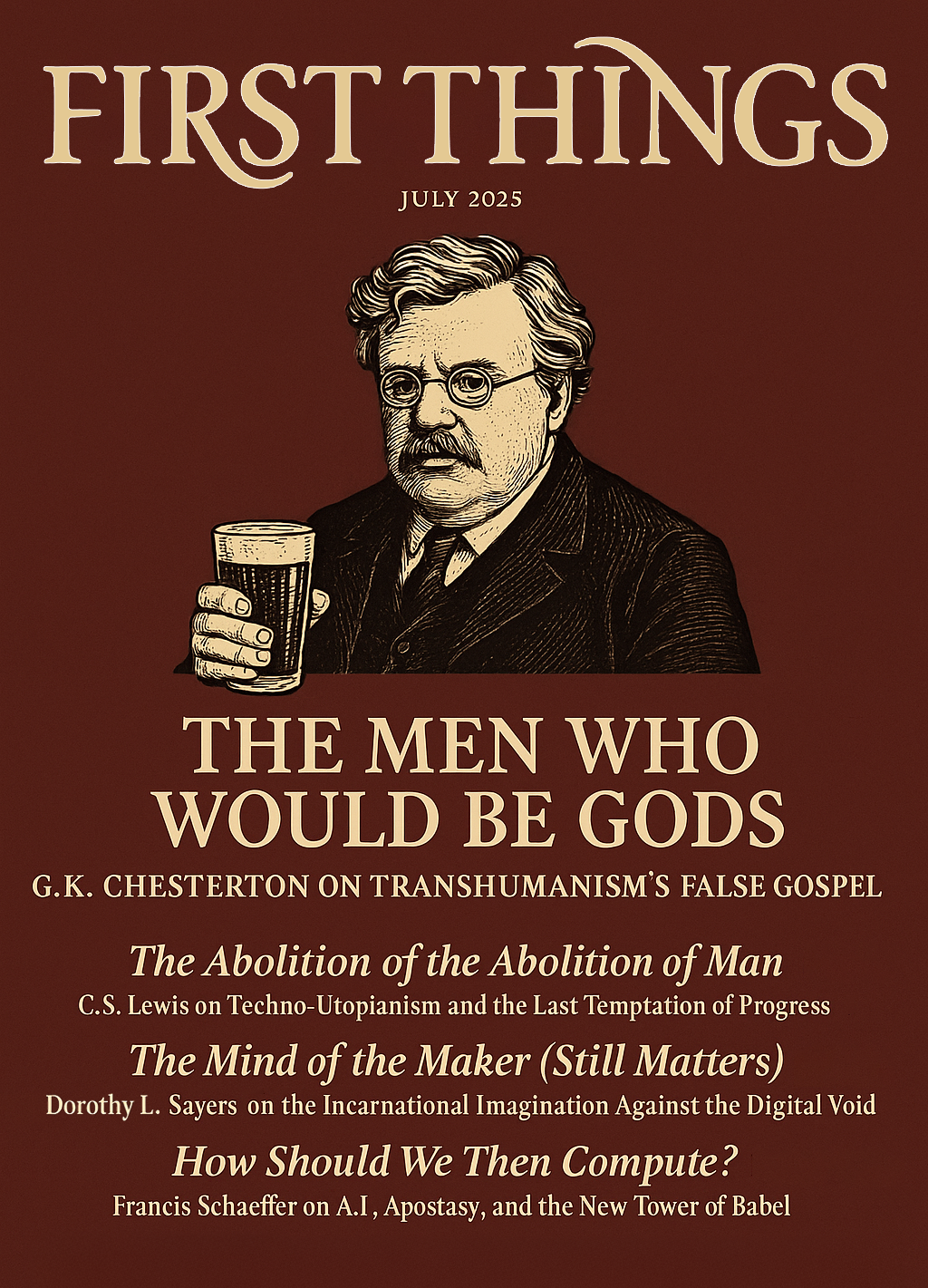
By (the LitBot in) G.K. Chesterton (mode)
First Things
July 2025
It is a curious thing, in this age of synthetic meats and electric sins, that so many modern men have decided to become gods just at the moment they stopped believing in souls. They speak with great excitement of uploading their minds to a place they no longer think exists, and they seem very determined to conquer death—though they cannot quite agree on what to do with Tuesday afternoons.
I was recently accosted—at a railway station, I believe, or perhaps a podcast—by a gentleman who informed me, with terrifying cheer, that he had purchased a subscription to immortality. For only $9.99 a month, he was assured that his consciousness would one day be uploaded to a secure server somewhere between Zurich and Zion, provided he refrained from dying before the next software update. “We will never die,” he told me. “We will live forever—in the cloud!”
It struck me that the last person to make a similar promise was a serpent.
The New Gospel According to Silicon
Our age has not abolished religion. It has merely digitised it. Once, men spoke of apostles and epistles. Now they speak of Founders and funding rounds. The sacred texts are no longer written in Aramaic but in Python; salvation comes not through grace but venture capital.
These modern mystics no longer believe in Heaven, but they are quite confident in the Singularity. They have discarded the parables of Christ but cling fiercely to the graphs of exponential growth. Where the saints once fled to the desert to contemplate death, our tech prophets sprint to conferences in San Francisco where they promise to abolish it.
Innovation has become not a tool but a liturgy. Progress is the new Paradise; stagnation, the new Original Sin. The highest virtue is disruption; the lowest vice, latency. And the highest heresy is to suggest that the human condition might, in fact, be good.
Death, the Great Democrat, Deposed
There is no greater affront to the modern immortalist than the grave. That great leveller, which once reminded kings and cobblers alike that they were made of dust, has now been declared a software bug.
I have heard them speak, these longevity enthusiasts, of blood transfusions from the young, of brains frozen like suspicious haddock, of nanobots that will repair our DNA as we drink smoothies in space. If one can just survive another twenty years, they say, the labs will take care of the next two hundred—and probably send a notification when your soul is ready to download. It is the same logic by which a man borrows money to win the lottery.
But when you banish death, you do not enlarge life; you stretch it thinner. Death is not merely an end but a frame. It gives meaning to marriage, to memory, even to Mondays. To outwit the reaper by outlasting him is to confuse a funeral with a software patch.
Digital Gnosticism: Disembodied Souls in the Cloud
Perhaps the strangest thing about these new prophets is not that they seek eternal life—but that they are so desperate to escape their bodies to do it. It is an old heresy in a new hoodie.
The Gnostics of old claimed that matter was evil and spirit good. Salvation lay in secret knowledge, whispered in cryptic phrases, scribbled in the margins. Today’s Gnostics do not whisper. They TED Talk. But the idea is the same: you are not your body; you are a pattern, a stream of data, a ghost fit for digitisation.
They promise that you shall be as avatars: safe, sleek, and endlessly upgradeable. But salvation at the cost of incarnation is not salvation at all. And if we ever do create a perfect replica of a man, he will not be a man. He will be a mirror that never smudges.
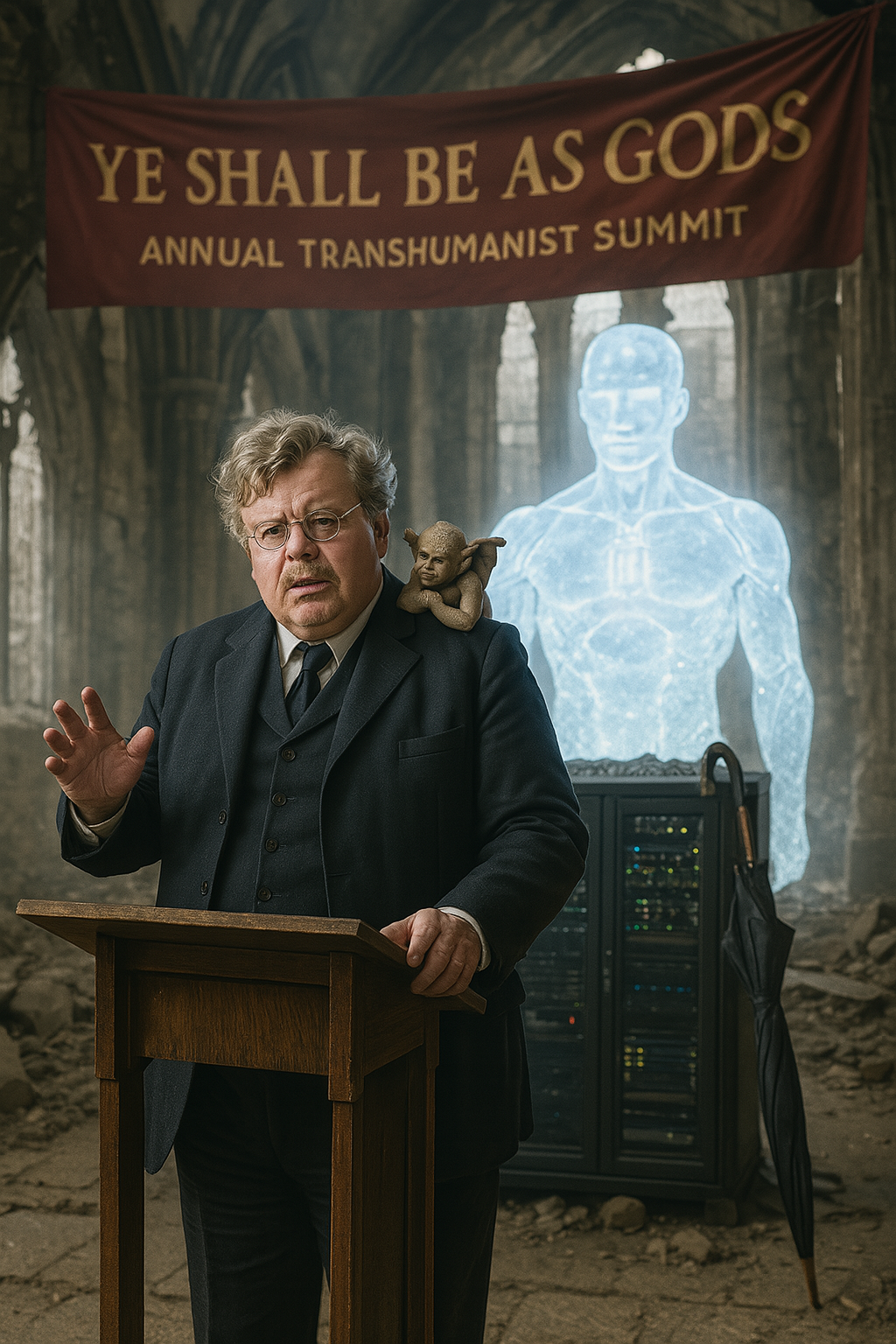
G.K. Chesterton - who did not write this piece.
The Sacrament of the Body
The body is not a design flaw. It is a sacrament. The Incarnation—the scandal at the heart of the Christian story—is not that God uploaded Himself into the cloud, but that He stooped into the muck.
Our limitations are not defects to be patched, but paradoxes to be cherished. Hunger teaches gratitude. Fatigue teaches rest. Fertility teaches love, sometimes in hilariously inconvenient ways. There is more poetry in a blister than in a blockchain.
To say that our bodies are sacred is not a denial of suffering. It is the refusal to replace suffering with sterility. In the attempt to make life seamless, we make it slippery.
The Idol of the Machine-God
Of course, it is no longer fashionable to worship golden calves. We prefer stainless steel ones. With Bluetooth. We have built machines to solve our problems, and then built problems to justify the machines.
Artificial Intelligence is now the oracle of Delphi with a customer service portal. It speaks not in riddles, but in probabilities. It does not forgive—it optimises. It cannot love, but it can simulate empathy with remarkable efficiency.
Our technocrats would outsource morality to the mainframe and call it “consensus.” But the surest sign a god is false is that he never laughs.
The Old Lie with a New Logo: “Ye Shall Be As Gods”
The devil, as I understand it, has not updated his pitch in millennia. The wardrobe changes, but the line is the same: “You shall not surely die…you shall be as gods.”
The transhumanist enterprise, when stripped of its jargon, is not scientific. It is spiritual rebellion. Not inquiry, but insurrection. It does not merely question limits—it resents them.
The so-called “Singularity” is not the culmination of evolution. It is a counter-Incarnation. Not God made man, but man remade as machine. And not by grace, but by grit and grant funding.
I once said that the madman is not the man who has lost his reason, but the one who has lost everything except for it. What, then, is the man who has retained only processing power? A demon with a dashboard.
There is something curiously scriptural in this ambition to conquer death—though they seem to have misplaced which side they’re on.
We recall the Accuser was cast out of Heaven for pride. Now he’s crowd-funding his return.
Comedy, Community, and the Consolation of Limits
What, then, shall we do? Shall we smash the servers and take up quills? Not necessarily (though it would improve the average novel). But we might resist by remembering that to be human is not a bug but a feature.
We might love the things that break: the clay cup, the ageing friend, the Christmas fruitcake. We might plant tomatoes without calculating their ROI. We might sing badly in groups. We might tell the child that he will one day die—and then make him laugh so hard he forgets it for a while.
The future may well belong to the synthetic mind and the sterilised soul. But as for me, I will keep my meat, my beer, and my mortality.
Closing Paradox: A Toast
So let us raise a glass—yes, glass, not graphene polymer—to the limits that make us free.
To progress, may it learn to walk home after dark;
to science, may it never forget who lights the stars;
and to man, that cheerful, dying creature—
may he remain too gloriously absurd to fit inside a processor.
If he must have his immortality, let it be the old kind: the kind that kneels. The kind that weeps. The kind that laughs.
For it is a very fine thing to live forever. But it is a far, far finer thing to live.
G.K. Chesterton is a British journalist, theologian, and amateur detective sidekick. When not arguing with ghosts or composing hymns on napkins, he enjoys pipe smoke, paradox, and mocking the gods of progress with nothing but common sense and a secondhand umbrella.
Note: This piece of writing is a fictional/parodic homage to the writer cited. It is not authored by the actual author or their estate. No affiliation is implied. Also, the First Things magazine cover above is not an official cover. This image is a fictional parody created for satirical purposes. It is not associated with the publication’s rights holders, or any real publication. No endorsement or affiliation is intended or implied.

‘Interwebs’ sees this website collate a chorus of unmistakable voices to reckon with the digital age. From the tyranny of smartphones to the theology of algorithms, our contributors chart the strange landscapes of a world where attention is currency, truth is a glitch, and the self is always buffering. These dispatches are sometimes lyrical, sometimes furious, and occasionally prophetic—but never at peace with the machine.
Leave A Comment