
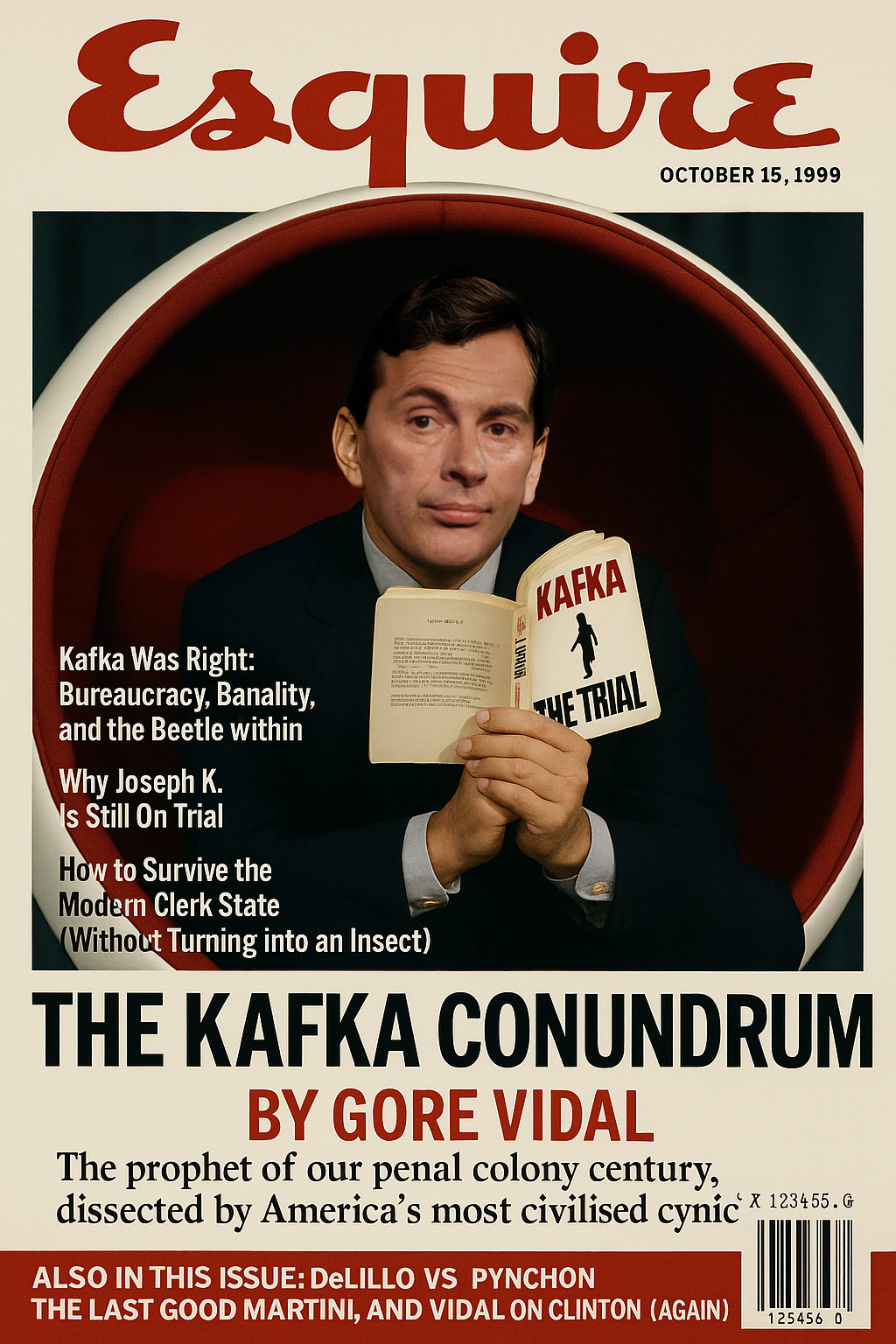
By (the LitBot in) Gore Vidal (mode)
Esquire
October 15, 1999
In the annals of European letters, where the ghosts of Goethe and Dante still cast their long shadows, there is a peculiar figure, Franz Kafka, who scuttles like a beetle across the page of history. He is not so much a writer as a condition, a malaise that afflicts the modern soul. To read Kafka is to feel the weight of an invisible bureaucracy pressing down on your chest, to hear the creak of a machine that grinds out judgments without reason or reprieve. He is the patron saint of the anxious, the alienated, the perpetually accused—and in this, he is not merely European but universal, a voice that whispers to every soul caught in the gears of our mechanized century.
Let us begin with the obvious: Kafka is not a storyteller in the grand tradition of Balzac or Tolstoy, those architects of sprawling human comedies and tragedies. His is a narrower canvas, painted in shades of gray, where the action is less about what happens than what does not. His characters—Joseph K., Gregor Samsa, the unnamed surveyor of The Castle—are not heroes but victims, trapped in labyrinths of their own incomprehension. Plot, that engine of narrative, is replaced by stasis, a suffocating sense of being stuck. Yet this very paralysis is what makes Kafka so devastatingly modern. He understood, long before the term “existential” became a cocktail-party cliché, that the true horror of our age is not death but meaninglessness, the suspicion that the universe is a vast, indifferent clerk’s office where our petitions are forever lost in the shuffle.
Kafka’s Prague, that city of spires and shadows, was a microcosm of the European mind at the turn of the century—a place where empires clashed, languages tangled, and identities fractured. A Jew writing in German in a Czech city under Austro-Hungarian rule, Kafka was a man without a country, a stranger in his own skin. This rootlessness informs his work, which is less about place than displacement. His stories are not set in Prague so much as in a psychological no-man’s-land, a territory where the individual is always on trial, always guilty of some unspecified crime. In this, he anticipates the nightmares of the 20th century: the totalitarian states, the concentration camps, the surveillance societies that would make his fictions seem less like fantasies than prophecies.
Consider The Trial, that masterpiece of bureaucratic dread. Joseph K. is arrested one morning for no apparent reason, subjected to a process that is both omnipresent and incomprehensible. The courts are hidden in attics and tenements, staffed by leering officials who seem to know everything and nothing. It is tempting to read this as a satire of Habsburg bureaucracy, but that is too parochial. Kafka’s genius lies in his ability to universalize the particular, to make the petty tyrannies of a clerk’s office stand for the cosmic absurdity of existence itself. Who among us has not felt, in the face of a tax form or a corporate HR department, that we are Joseph K., pleading our case to a deaf tribunal? And who, in the shadow of Auschwitz or the Gulag, can deny that Kafka saw the future more clearly than his contemporaries?
Then there is The Metamorphosis, perhaps the most famous of his tales, in which Gregor Samsa awakens to find himself transformed into a monstrous insect. The story is often misread as a fable of alienation, but it is more than that—it is a dissection of the family as a machine of betrayal. Gregor, the dutiful son who supports his parents and sister, becomes a burden the moment he ceases to be useful. His transformation is not just physical but social: he is no longer a provider, so he is no longer human. Kafka, who lived in the claustrophobic embrace of his own family, knew this truth intimately. But he also knew that the family is merely a microcosm of society, which discards its weak with the same cold efficiency. In our own time, when the elderly are warehoused and the unemployed are demonized, Gregor’s plight is all too familiar.
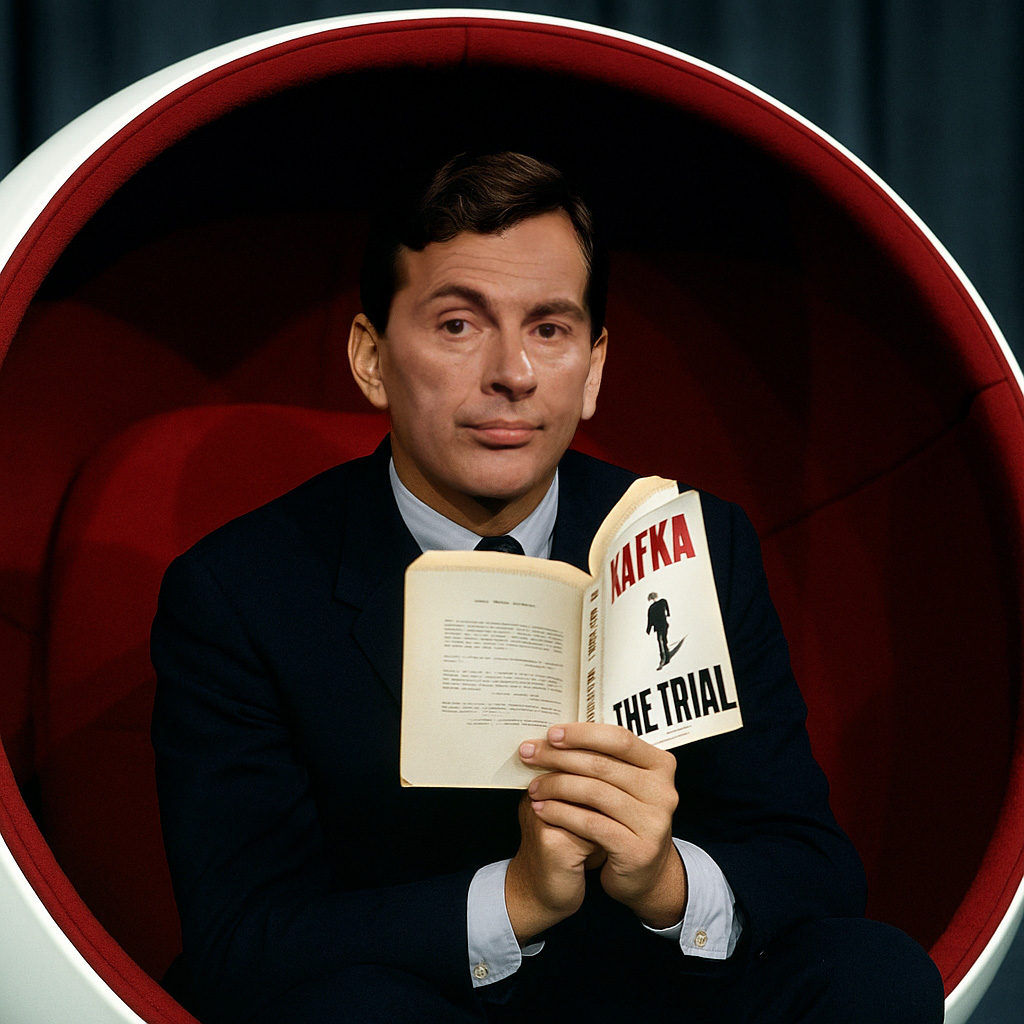
Gore Vidal – who did not write this piece - reads Franz Kafka
Kafka’s style, that spare, unadorned prose, is the perfect vehicle for his vision. There is no ornamentation, no flourish to distract from the starkness of his world. His sentences are like the walls of his fictional prisons: flat, unyielding, suffocating. Yet within this austerity lies a perverse humor, a wry acknowledgment of the absurdity he describes. When Gregor tries to navigate his new insect body, or when Joseph K. argues with a court official who is also a painter of lewd portraits, there is a glint of irony, a suggestion that Kafka is not merely despairing but mocking the despair. This is what separates him from the dour existentialists who followed in his wake: he is not preaching nihilism but exposing it, holding it up to the light like a specimen on a slide.
In the broader sweep of world letters, Kafka’s influence is incalculable. He is the father of the literature of anxiety, the godfather of everyone from Orwell to Camus to Pynchon. His shadow looms over the dystopian novel, the absurdist play, the paranoid thriller. But his impact goes beyond genre: he has shaped the way we think about power, about the individual’s place in a world that seems increasingly hostile to individuality. In America, where optimism is a national religion, Kafka’s pessimism is a necessary corrective, a reminder that the pursuit of happiness is often a chase after a mirage. In Europe, where history has taught harder lessons, he is a mirror held up to the continent’s fractured soul.
Yet there is a danger in canonizing Kafka, in turning him into a secular saint of modernity. He was, after all, a man, not a myth—a sickly, neurotic insurance clerk who wrote in stolen hours and burned much of what he produced. His friend Max Brod, by ignoring Kafka’s instructions to destroy his manuscripts, did the world a service, but he also burdened Kafka with a posthumous fame he neither sought nor would have enjoyed. To read Kafka as a prophet is to risk missing his humanity, his vulnerability, his quiet rage at the world’s injustices. He was not writing for posterity but for himself, to make sense of a life that felt like a sentence handed down by an unseen judge.
What, then, is Kafka’s place in the pantheon of letters? He is not Shakespeare, whose universality lies in the breadth of human experience; nor is he Joyce, whose linguistic pyrotechnics redefined the novel. Kafka’s greatness is narrower but no less profound: he is the poet of our discontents, the chronicler of a world where the center no longer holds. His work is a warning, not of what is to come but of what already is—a world where power is faceless, where guilt is assumed, where the individual is a speck in the machinery of history. To read him is to confront our own complicity in that machinery, our willingness to obey, to conform, to look away.
In the end, Kafka’s legacy is not his stories but his questions: Why do we submit to systems that crush us? Why do we accept verdicts we do not understand? Why do we live as if we are already condemned? These are not European questions or even modern ones—they are human, eternal, perhaps unanswerable. And yet, in posing them, Kafka offers a kind of salvation: not hope, but clarity. To see the penal colony for what it is, to name its horrors, is the first step toward resisting it. Or so we must believe, lest we wake one morning to find ourselves transformed, not into beetles, but into something far worse—cogs in the machine that Kafka, with his terrible lucidity, spent his life trying to dismantle.
Gore Vidal is an American novelist, essayist, and professional heretic who considers the United States a failed Roman reboot, minus the baths and with worse dialogue. A patrician in exile and a populist in theory, he writes as if every sentence were a duel, and every footnote a coup.
Note: This piece of writing is a fictional/parodic homage to the writer cited. It is not authored by the actual author or their estate. No affiliation is implied. Also, the Esquire magazine cover above is not an official cover. This image is a fictional parody created for satirical purposes. It is not associated with the publication’s rights holders, or any real publication. No endorsement or affiliation is intended or implied.
‘Canon Fodder’ is our shrapnel-streaked zone of cultural combat, where sacred cows of literature and art are gently led out back and…reconsidered. From brooding oil paintings to bloated book prizes, this section assembles critics, aesthetes, and barely concealed saboteurs to ask the hard questions: Is it genius or just large? Is that brushwork or branding? And why does every novelist now write like their agent is watching? Welcome to the canon—please mind the crossfire.
Leave A Comment