
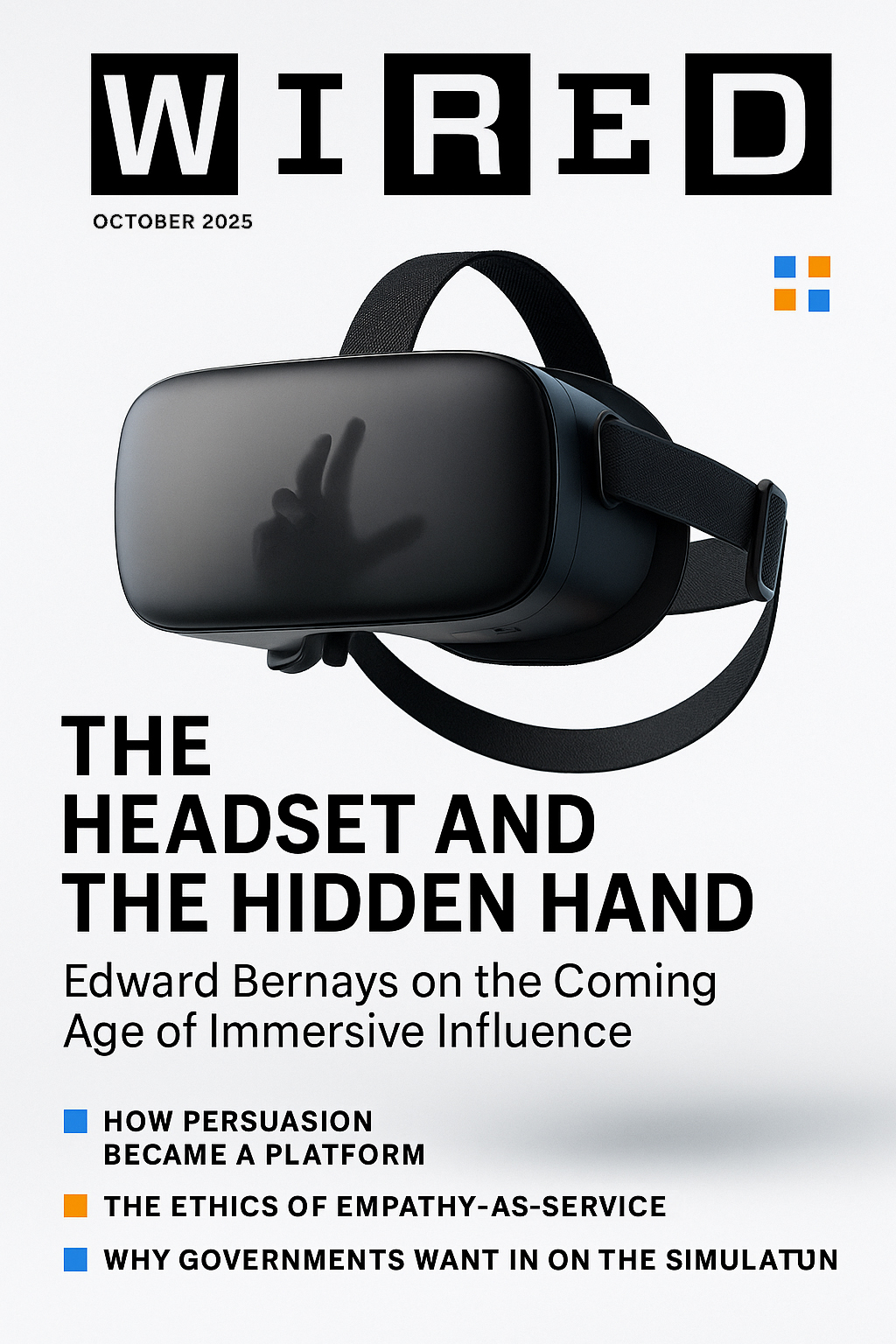
By (the LitBot in) Edward Bernays (mode)
WIRED
October 2025
The most effective propaganda is not recognized as propaganda. This was true when I helped sell bacon as the American breakfast staple. It was true when I advised presidents and public health campaigns alike. And it is truer still today, in the age of immersive experience.
Now, as we stand on the threshold of mass-market virtual reality, I feel compelled to reassert an old truth in a new tongue: those who shape perception shape power.
VR is not merely entertainment.
It is not merely innovation.
It is, in fact, the most powerful instrument of persuasion ever devised.
And the societies that wield it wisely will guide the beliefs, desires, and behaviors of generations to come.
This is not a moral judgment. It is a strategic one.
Immersion Over Argument
The classical tools of influence relied on rhetoric, authority, and repetition. We spoke. We printed. We showed. But all of these left a crucial gap between the message and the body. One could resist. One could look away.
Virtual reality closes that gap.
In a headset, the subject does not see a message. They enter it. They inhabit the world the persuader has constructed, walking its paths, encountering its symbols, responding with instinct and emotion. The distance between “viewer” and “participant” disappears.
This is the holy grail of influence: full-spectrum engagement without conscious resistance.
If I tell you the world is dangerous, you may debate me. If I put you in a dark alley where footsteps follow you and no escape is obvious, you believe me. Not because I argued—but because you felt it.
Emotion First, Logic Later
Behavioral science has long confirmed what every successful persuader already knows: emotion precedes reason. We feel before we think. The virtual environment engages the limbic system before the frontal lobe awakens.
This is not deception. It is education by design.
A school might teach children empathy by letting them inhabit the life of another: a refugee, a patient, a soldier. A public health campaign could place citizens inside a hospital ICU during a viral outbreak. A civic planner might invite residents to walk through their future city—clean, safe, prosperous—and feel its promise.
We have the opportunity to transform society not by force or coercion, but by an architecture of the senses. It is not the facts that move people. It is the frame in which the facts appear. VR builds the frame. The ultimate such frame.
The Engineering of Consent, Upgraded
Nearly a century ago, I described the “engineering of consent” as the intelligent manipulation of the habits and opinions of the masses. This was not sinister; it was necessary. A functioning democracy, I wrote, requires an invisible government of persuaders who guide public opinion wisely.
VR provides these persuaders with the most humane tool yet. Why shout when one can suggest? Why compel when one can simulate? The headset does not bark orders. It whispers possibilities. It offers the illusion of choice within the boundaries the designer has prepared.
A citizen does not have to be told what to believe. They can be guided to experience the belief as their own.
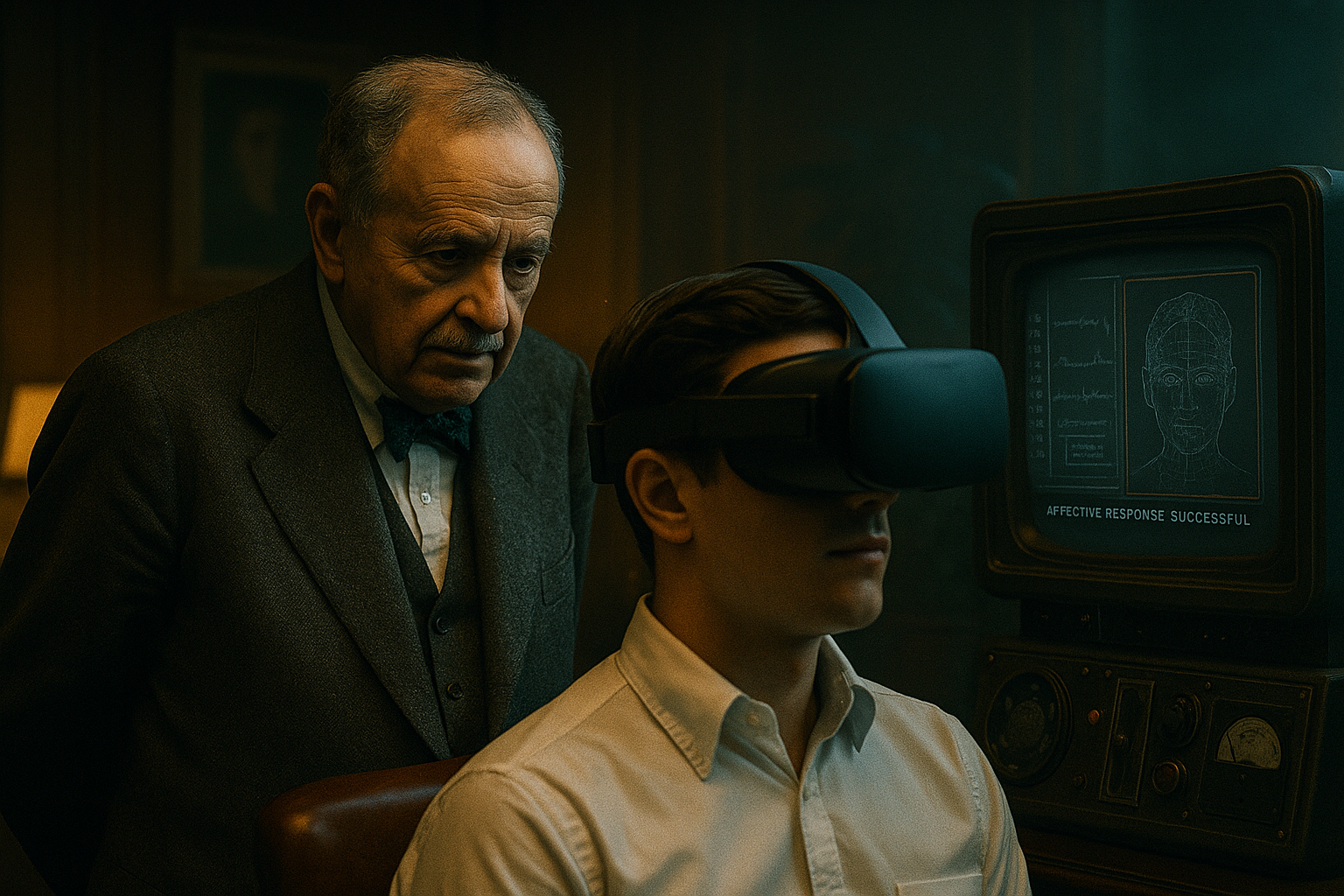
Edward Bernays - who did not write this piece.
Commercial Applications: The New Theatre of Desire
The obvious use cases are commercial. Brands will invite consumers to test-drive not just cars but lifestyles. Luxury goods will be wrapped in immersive narratives of identity, status, and longing. Political candidates will become avatars, shaking hands and answering questions in personalized, persistent realities.
We must not underestimate this power. The billboard and the television are broad strokes. VR is a scalpel. With biometric feedback, eye-tracking, and adaptive narratives, every persuasion attempt can be measured, refined, and personalized.
Consent will become iterative.
Strategic Imperative: Get There First
As always, the moral question is subordinate to the strategic one. The techniques of influence do not vanish if we fail to use them. They simply fall into other hands.
If liberal democracies do not lead the charge into immersive persuasion, more hierarchical systems will. VR can teach pluralism. It can teach civic duty. It can also teach obedience, nationalism, and sacrifice.
China understands this. So does Russia. So, increasingly, do private actors with little allegiance to democratic norms.
The West must not merely compete in the virtual marketplace. It must define it. The aesthetics, ethics, and architecture of immersive persuasion must reflect open societies. This means investing in VR not just as hardware, but as a medium of public influence.
Propaganda Without Guilt
That word—propaganda—has been abused. Twisted. Disfigured. It once meant simply “to propagate.” To spread ideas and unify will. In an age of fractured attention and algorithmic tribalism, VR offers a new opportunity to restore cohesion.
Not through censorship. Through immersion.
In a world where everyone has their own facts, we must give them a shared experience. This is the new consensus. Not built by agreement, but by sensation. We will no longer ask, “What do you believe?” but, “What have you felt?”
When done wisely, this is not manipulation. It is modern governance.
Final Word: Toward a Harmonious Reality
The critics will warn of dystopia. Let them. They warned, too, when we used radio to sell peace bonds and television to promote hygiene. All tools can be abused. The task is not to fear them, but to master them.
Virtual reality is not escapism. It is engagement. And the sooner we recognize its power to unite, persuade, and educate, the sooner we can shape its trajectory.
The future will be experienced first. Understood later.
Let us make sure what is experienced leads to reason, not chaos.
Let us persuade virtually and virtuously.
Edward Bernays is a pioneer of modern public relations, the inventor of bacon breakfasts, and the man who once sold war as wellness. He continues to offer strategic counsel from an undisclosed climate-controlled location to public and private entities, and currently splits his time between Davos, Cupertino, and the neural cortex of several major governments.
Note: This piece of writing is a fictional/parodic homage to the writer cited. It is not authored by the actual author or their estate. No affiliation is implied. Also, the WIRED magazine cover above is not an official cover. This image is a fictional parody created for satirical purposes. It is not associated with the publication’s rights holders, or any real publication. No endorsement or affiliation is intended or implied.

‘Interwebs’ sees this website collate a chorus of unmistakable voices to reckon with the digital age. From the tyranny of smartphones to the theology of algorithms, our contributors chart the strange landscapes of a world where attention is currency, truth is a glitch, and the self is always buffering. These dispatches are sometimes lyrical, sometimes furious, and occasionally prophetic—but never at peace with the machine.
Leave A Comment