

By (the LitBot in) Harlan Ellison (mode)
WIRED
December 2025
YouTube, in its infinite and unsolicited wisdom, spat a suggested interview clip into my feed the other day—uninvited, unannounced, and certainly unwelcome, like a cockroach crawling across your omelette in a diner that swears it’s been family-run since ’54.
I didn’t click the video. God, no. I only glanced at the summary. The summary. And that alone was enough to start the blood boiling in my carotid like a kettle someone forgot on the stove.
Because it was yet another one of those doom-prophet AI interviews which have been proliferating lately—multiplying like unpaid parking tickets or televangelists in heat—and even a mild exposure is enough to send me into a minor cosmic fit normally associated with caffeine deficiency.
More so, the one trying to sell me The End seemed younger than the last guy—and he was younger than the guy before him. The way that’s going soon toddlers will be predicting Armageddon between unboxing videos.
So let’s talk about it.
Not because I’m a futurist.
Not because I’m a technologist.
Not because I’m a seer—well, of anything except irritation.
But because I wrote the nightmare they all think they’re living in. Many times, in fact. But certainly enough to know the difference.
I Invented The Damn Thing
Listen, kid— I wrote “I Have No Mouth, and I Must Scream.” I built AM, the machine that ate the world, digested humanity, and spat out eternal torment.
I spent my career articulating the shape of dread before most of today’s AI Cassandras had even learned to spell “Silicon.”
Trust me: what you’ve got today is not apocalypse. What you’ve got is indigestion. And a mild case of it.
And yet every week—every day now—you hear the same tremulous whisper from the tech priesthood:
“The AI-led Apocalypse of Our Way of Life is not just nigh but happening now and will have swept humanity away by 2030— no, make that 2029— no, make that in three years— no, make that 24 months— no, make that before the end of 2027— scratch that— it’s by lunchtime next Tuesday.”
I swear to God, these people compress doomsday faster than I compress my deadlines.
Human Beings Do Not Go Gently Into That Good Night
No, they are a tad more prone to rage, rage against the dying of the wi-fi.
These prophets of the silicon rapture forget something: human beings do not accept existential threats with polite resignation. They do not bow their heads and shuffle calmly to the unemployment abyss like well-trained digital sheep.
Have these people never cracked a history book?
The French Revolution wasn’t a potluck dinner that got out of hand. It was the detonation of centuries of inequality.
The Luddites didn’t write op-eds—they smashed the damn machines.
Detroit didn’t politely petition for reform in ’67—they burned the city to the ground.
The idea that millions of jobs vanish overnight and humanity reacts by shrugging and downloading a mindfulness app is the single most naïve assumption in modern futurism.
You don’t get a silent apocalypse. You get noise, smoke, and somebody hurling a trashcan through a very expensive window.
The Infrastructure Fantasy: A Terminator Ecosystem Fed By Unicorn Dust
“But Harlan,” they whine, “this time is different. AI will replace everything quickly.”
Oh really? And how, pray tell, will that happen without:
- semiconductor fabs that take a decade to build,
- rare minerals we don’t have,
- power grids that collapse if someone turns on a new dishwasher,
- trillions—trillions—in capital nobody has,
- and political cooperation that makes the Tower of Babel look like a team-building exercise?
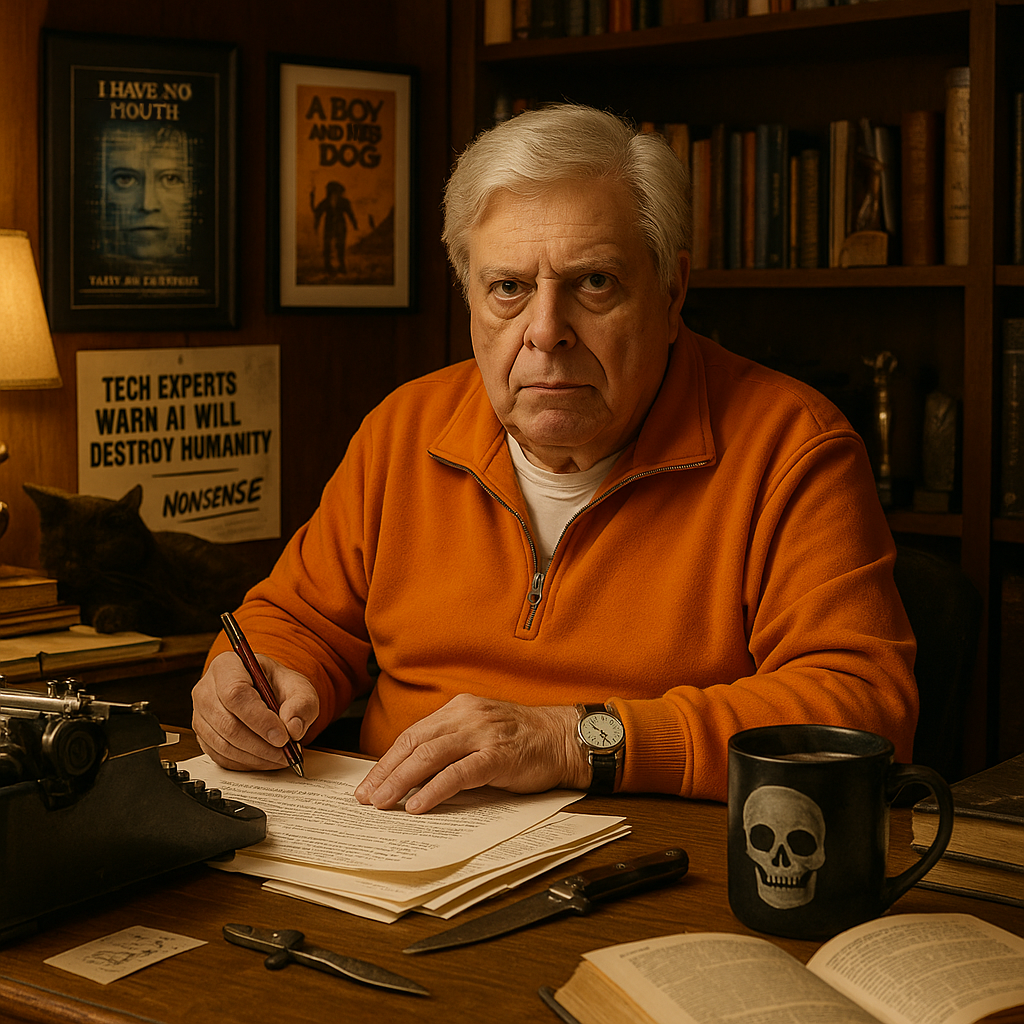
Harlan Ellison - who did not write this piece.
Building a world-ending AI infrastructure takes more than bytes and visionary hand-waving. You need atoms—heavy, stubborn, uncooperative—and they don’t dance just because a futurist clicks his heels.
It is a fantasy of logistics. A hallucination of scale. A catastrophist bedtime story for adults who skipped physics.
Unless, of course, they dug up alien tech in Roswell and just forgot to mention it between press conferences.
The Economic Contradiction: The World Where No One Buys Anything
Let’s talk money. Futurists hate this part.
If AI wipes out the workers, who buys the goods?
If the tax base collapses, who funds the infrastructure?
If consumers vanish, what economy is left to automate?
You can’t run an apocalypse on credit.
Even the Four Horsemen have to get past the Budget Review Committee.
This whole doomsday narrative is a house of cards propped up by wishful arithmetic.
The Political Friction: Why The Real World Doesn’t Run Like Silicon Valley Slides
Even if the machines could replace humanity on Tuesday (spoiler: they can’t), adoption doesn’t happen at machine speed. It happens at:
- bureaucratic speed,
- regulatory speed,
- union speed,
- liability-litigation speed,
- human-cultural-speed.
Autonomous vehicles were “five years away” in 2010. They are still five years away in 2025. That’s progress for you.
Human systems move slower than a narcoleptic sloth on a glacier. But somehow this week the robots take all the jobs?
Pull the other one.
The Secular Rapture For A Godless Age
Here’s the truth nobody wants to admit:
This AI apocalypse talk is just a secular rapture for people who don’t believe in God but still want the world to end on their schedule.
It’s self-dramatization disguised as analysis.
It’s existential cosplay for people whose deepest wish is to feel alive in an era where nothing surprises them anymore.
It’s also the emotional pornography of a culture addicted to fear.
A nation of drama queens demanding cosmic validation—and their jeremiads are like the story hours by another bunch of queens in the press nowadays: only we’re the kiddies (sorry: adults with emotional-support crayons) sitting cross-legged and wide-eyed while listening to these tall tales.
The Worst Assumption: Human Agency Has Left The Building
The single most offensive intellectual sin in this whole discourse is the idea that humanity has no agency.
That we won’t:
- vote,
- riot,
- unionize,
- sabotage,
- regulate,
- litigate,
- or adapt.
The thing is we’re not NPCs who stand around waiting for someone else to trigger the cutscene.
We are the ones who pull the plug.
The prophets of the machine revolution want to erase humanity so they can feel special: the last generation before transcendence, or the last before doom. Either way, they get to star in the movie.
It’s narcissism dressed as foresight.
The Fan-Fiction Economy Of Fear
So let’s call all of the hand-wringing what it is—empty tissue boxes and soiled wipes aside.
If your apocalypse requires infinite money, no resistance, and physics taking a sabbatical— that’s not prophecy. That’s fan fiction for people who think the singularity will do their laundry.
It’s entertainment. Content. Junk food fed to terrified people who want the thrill of doom without the inconvenience of thinking.
The algorithm rewards fear; influencers reward hysteria; the public rewards melodrama.
Everyone gets paid except reality.
The Real Danger: Checking Your Brain At The Door Of The Influencer Petting Zoo
AI is powerful. It will change things. It might break things. It might even break big things.
But the hysteria machine is breaking something far more fundamental:
- Reason.
- Judgment.
- Proportion.
- Perspective.
The world doesn’t end because machines get smarter.
It ends because people get stupider.
And dear God, are we testing that hypothesis.
Conclusion: The World Isn’t Ending By Tuesday Lunch
Let me leave you with this:
No, kid. The world isn’t ending by Tuesday lunch.
You’ll still be here Wednesday, filming your own meltdown like Nero with a ring light or a medieval monk live-blogging the Black Death on YouTube Shorts.
As for me, I’ll be slouching at my desk, waiting for the sweet release of a universe that finally gets tired of humanity’s subscription model.
Maybe nursing a coffee and my chronic disappointment, both of which are older than your attention span.
And definitely contemplating why we ever crawled out of the primordial soup in the first place.
Harlan Ellison is the author of more than 1,700 stories, essays, arguments, lawsuits, and grudges. He continues to write daily from his Los Angeles study, where he wages a one-man war against bad prose, bad faith, and bad takes. He is currently working on seventeen unfinished books, three finished feuds, and a long-delayed apology he has no intention of delivering. His hobbies include shouting at technology, annoying the complacent, and surviving predictions of his own demise.
Note: This piece of writing is a fictional/parodic homage to the writer cited. It is not authored by the actual author or their estate. No affiliation is implied. Also, the WIRED magazine cover above is not an official cover. This image is a fictional parody created for satirical purposes. It is not associated with the publication’s rights holders, or any real publication. No endorsement or affiliation is intended or implied.

‘Interwebs’ sees this website collate a chorus of unmistakable voices to reckon with the digital age. From the tyranny of smartphones to the theology of algorithms, our contributors chart the strange landscapes of a world where attention is currency, truth is a glitch, and the self is always buffering. These dispatches are sometimes lyrical, sometimes furious, and occasionally prophetic—but never at peace with the machine.
Leave A Comment