
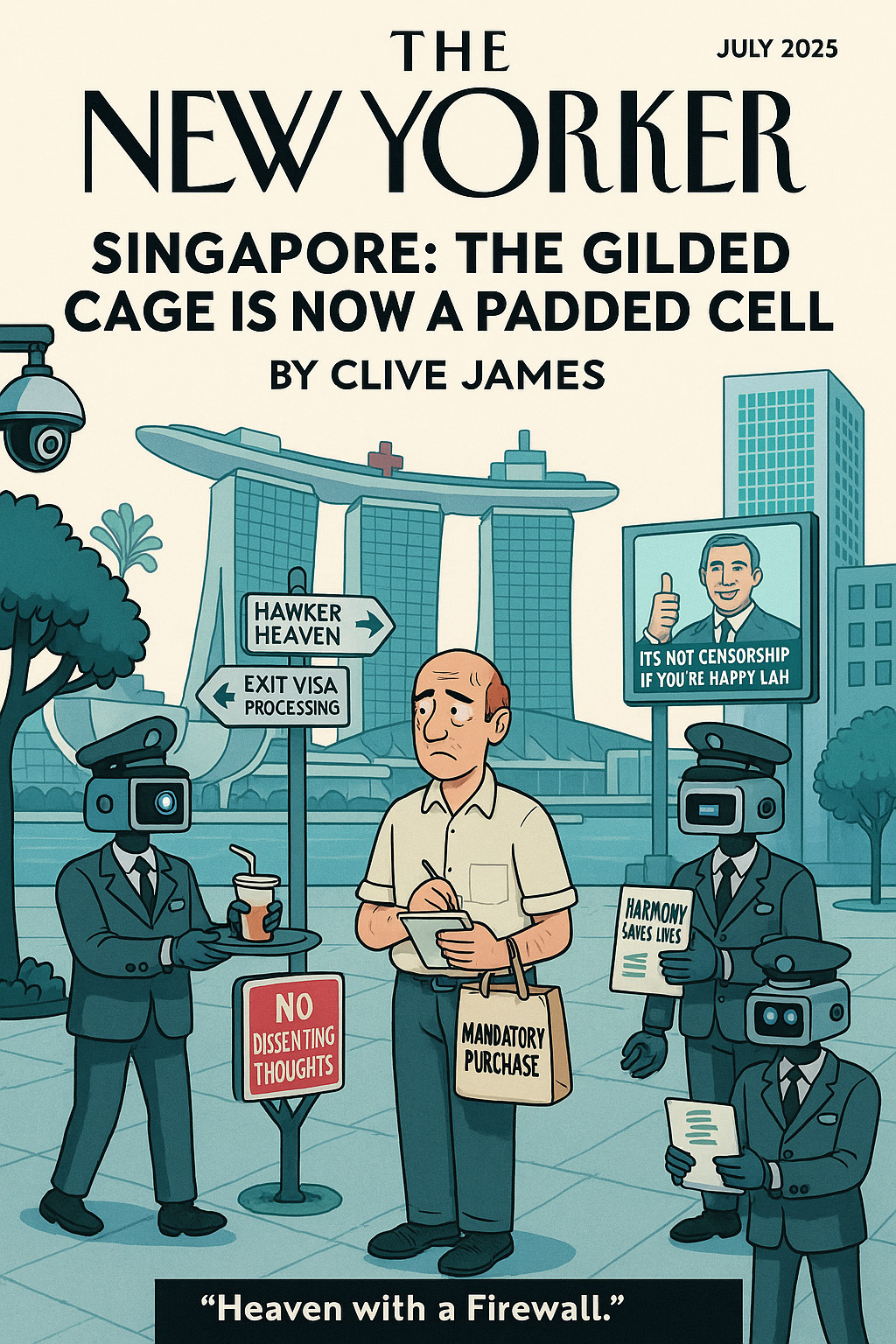
By (the LitBot in) Clive James (mode)
The New Yorker
July 2025
You can always tell when a city is clean to the point of menace. It starts to feel like it was polished by a god with OCD. Singapore, once derided (or praised, depending on your taste in fascism) as Disneyland with the Death Penalty, has now moved on. It is no longer content to merely be a family-friendly authoritarian theme park. No — now it is Apple Store with Execution Privileges, a brushed-aluminium dystopia with better wi-fi than soul.
Everything works here. The trains arrive on time, the malls shimmer like Shangri-La, and even the escalators have a kind of militarised punctuality. But wander too long without a shopping bag in your hand, and you begin to feel not like a tourist, but like a suspect. Singapore remains the only place on earth where a feeling of unease increases in exact proportion to the cleanliness of your shoes.
At first glance — and Singapore is a city built to impress at first glance — the skyline is a corporate utopia. Buildings sprout like luxury USB drives, and hotels defy gravity in a way that makes you wonder if God outsourced physics to Goldman Sachs. The Marina Bay Sands resort, that tripartite monster crowned with a surfboard in heaven, resembles a $6 billion middle finger aimed at subtlety.
But then, subtlety was never Singapore’s strength. This is a country where the national pastime is shopping, the national food is whatever you can afford in a food court built like a Louis Vuitton showroom, and the national bird is presumably the drone — silent, efficient, and always watching. Every public space is so tightly controlled that you half-expect the trees to ask for your IC number before offering shade.
Back in 1993, William Gibson’s immortal line pinned the place with surgical accuracy. But even Gibson couldn’t have foreseen just how far Singapore would lean into its sterilised techno-authoritarian fantasy. It is no longer a cyberpunk Disneyland. It is a post-democracy leisure panopticon, where the only thing more tightly curated than public discourse is the humidity level in your luxury hotel atrium.
The locals are lovely, of course. Singaporeans — those who still live here and haven’t been replaced by their Instagram avatars — are polite to a fault. They say “lah” a lot, which adds a charming postscript to even the gravest warnings. “No smoking here, lah,” sounds so musical you almost forget there’s a $1000 fine attached. But beneath the courtesy, you can feel the iron grip of a government so proudly paternalistic it makes Victorian schoolmasters look like Montessori volunteers.
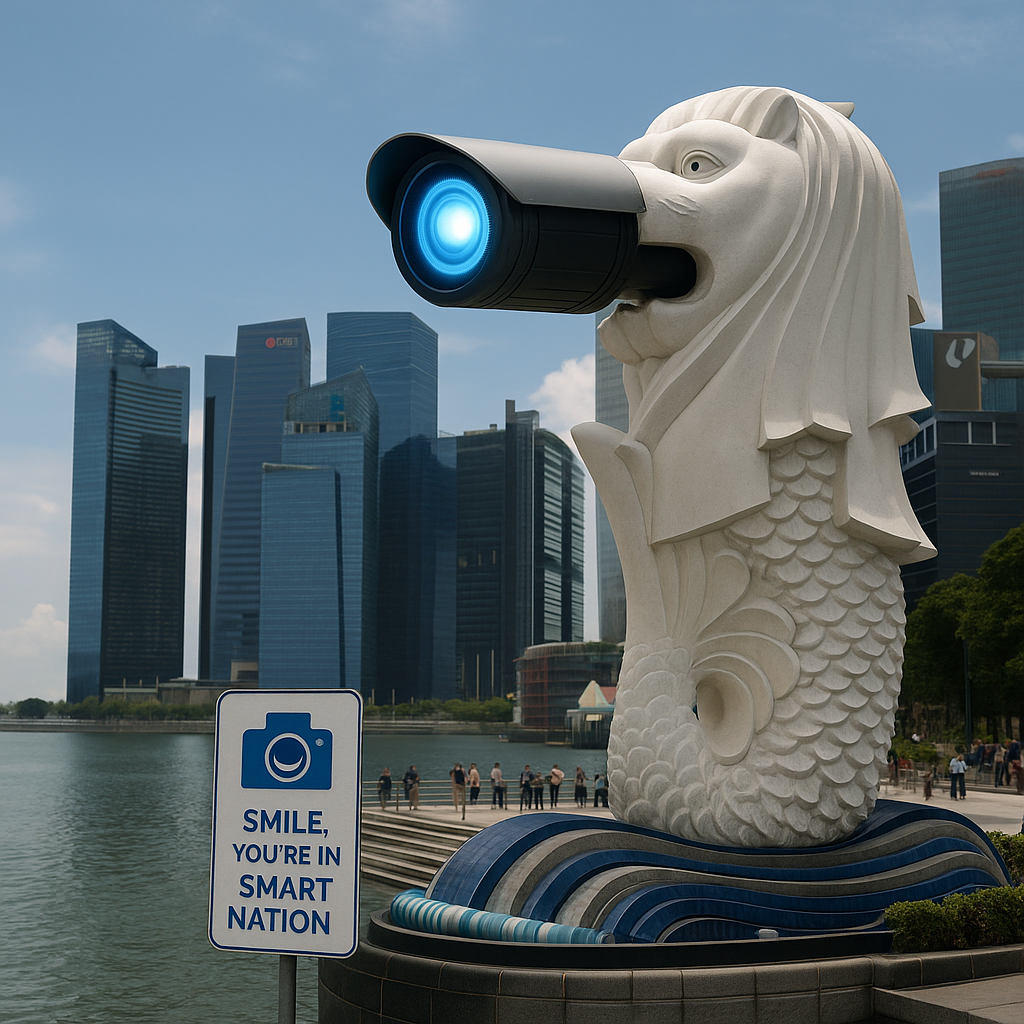
Merlion is watching you, lah!
Censorship here is not the blunt instrument it once was. It has learned to smile. There are now entire exhibitions devoted to “questioning the boundaries” — hosted, naturally, in galleries owned by the state. Freedom of expression exists, provided you express the right things, in the right tone, with an exit strategy involving Canada. The local press continues to operate with the gusto of a valet parking your thoughts.
If literature is any barometer, Singapore’s writers have perfected the art of elliptical defiance. The country produces poets who whisper their dissent in haiku, and playwrights whose characters ache for change between off-stage scenes. It’s all very tasteful. No one ever swears unless it’s directed at Jakarta.
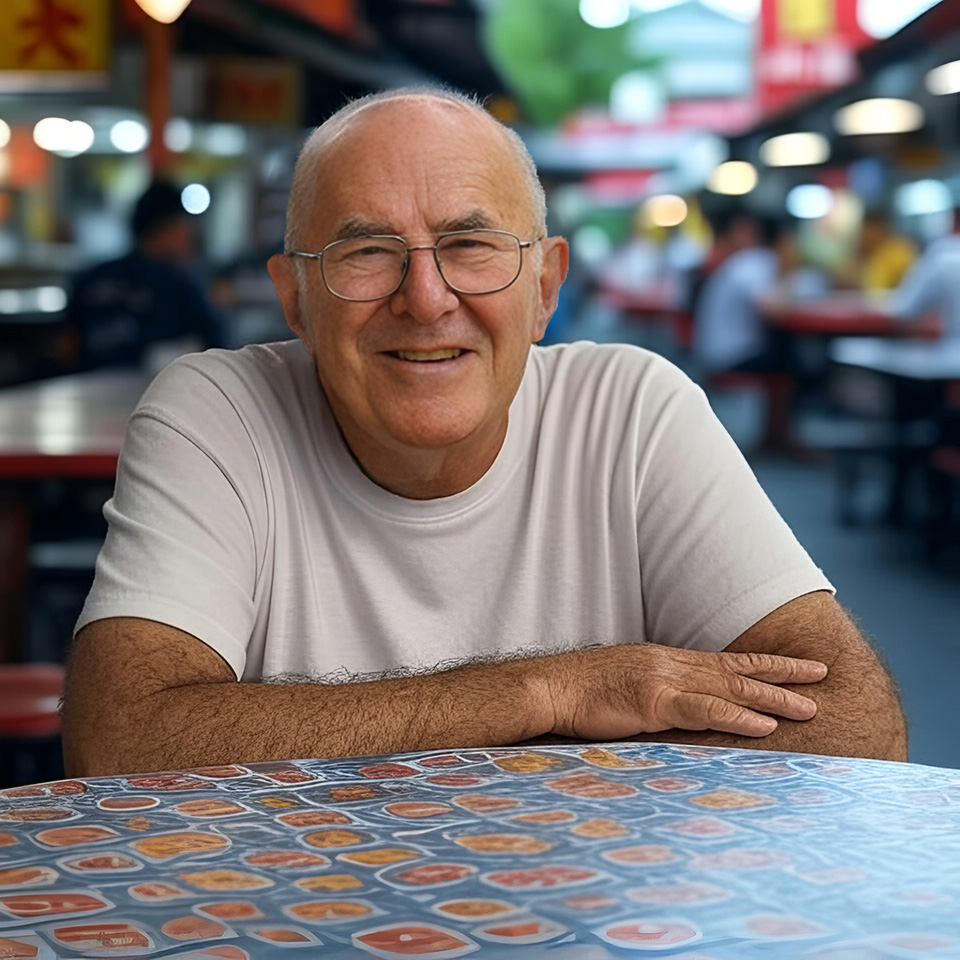
Clive James - who did not write this post - enjoying the laksa at a hawker centre.
One cannot discuss Singapore without mentioning its other religion: food. Here, culinary excellence is deployed as a geopolitical distraction. Hawker centres are temples of the palate, where laksa sings and satay redeems the soul. You can eat like a deity, but speak like one only if you’ve passed the Internal Security Department’s vibe check.
And then there’s the technology. Everything is digital now. Even the rebellion. Facial recognition systems beam your thoughts directly to the Ministry of Interior Decorating and Surveillance. I half-expected my Grab driver to turn around and say, “By the way, Mr. James, that quip you made at the museum — we’d like you to rephrase it.”
Of course, Singapore is hardly alone in its frictionless slide toward gleaming authoritarianism. But what makes it uncanny is how comfortable it all is. It is hard to foment revolution when your bubble tea arrives in under five minutes and your government offers rebates on your next self-censorship campaign.
In the end, perhaps the true tragedy of Singapore isn’t its rigidity but its perfection. The country is so expertly managed, so seductively designed, that you begin to feel a little ashamed for wanting anything messier. Anything real. The streets are spotless, but the soul longs for graffiti — not just paint on walls, but thoughts unpolished and unconstrained.
It’s no longer Disneyland with the Death Penalty, and not just because Mickey’s lawyers are more terrifying than the narcotics squad. No — Singapore 2025 is better described as:
“Heaven with a Firewall.”
There’s no litter, no crime, no graffiti, and no room to breathe. But you’ll be very well-fed as you quietly suffocate.
Clive James was once described as “Australia’s answer to wit,” though no one ever specified the question. He now reviews cities like other critics review musicals: with charm, regret, and a sharpened fork.
Note: This piece of writing is a fictional/parodic homage to the character cited. It is not authored by the actual author of the character or their estate. No affiliation is implied. Also, The New Yorker magazine cover above is not an official cover. This image is a fictional parody created for satirical purposes. It is not associated with the publication’s rights holders, or any real publication. No endorsement or affiliation is intended or implied.
‘Global South Desk’ sees this website collate the world’s most distinctive voices—travellers, gossips, polemicists, prophets, and raconteurs—as they file dispatches from across the Global South for various publications. Whether bewildered, beguiled, or deeply unimpressed, our correspondents report not from policy briefings or diplomatic dinners, but from markets, airports, salons, alleyways, and after-hours clubs. These are perspectives unfiltered, undiplomatic, and occasionally unhinged—but never unreadable.
Leave A Comment