
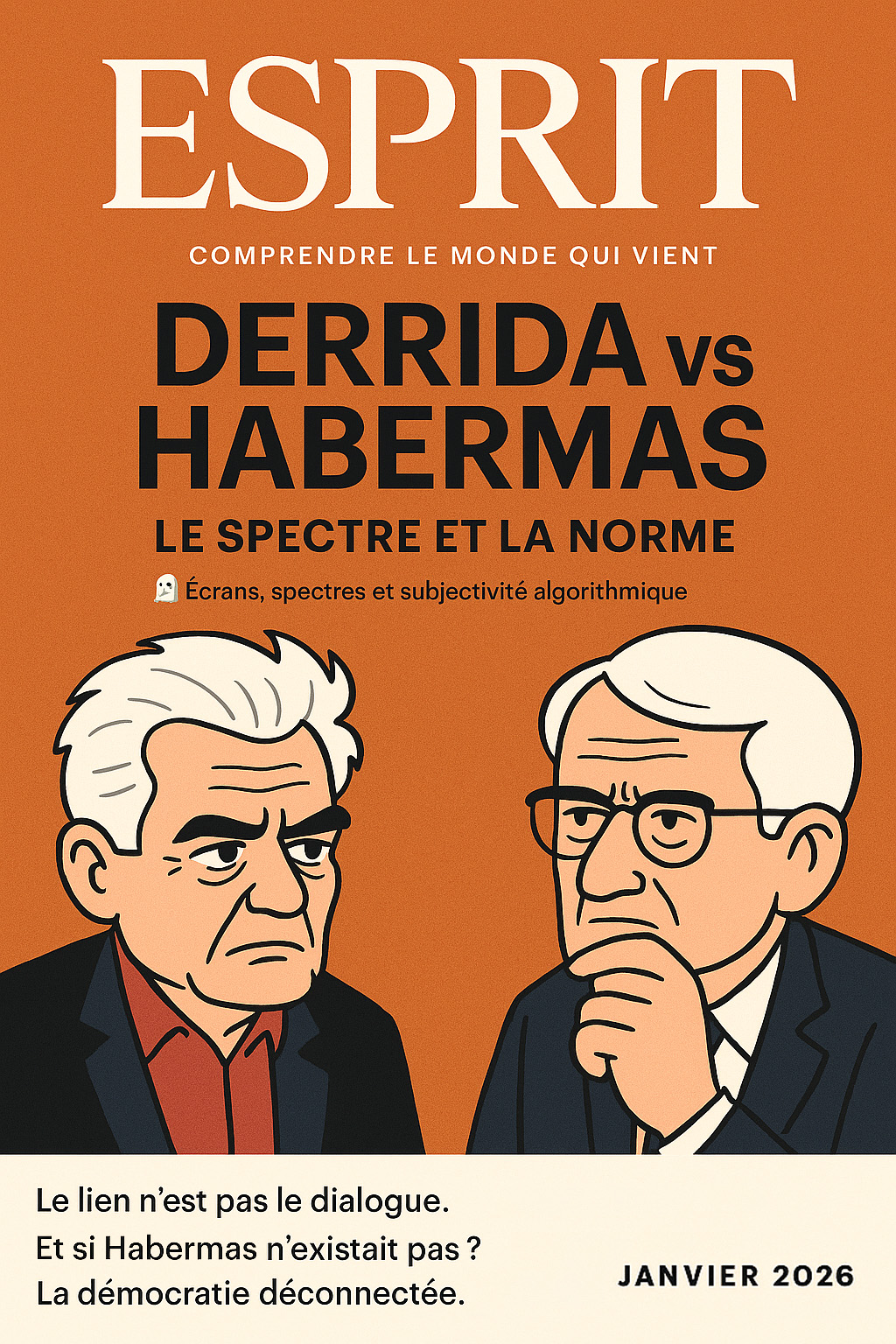
Ghosts in the Machine: Deconstruction in the Age of the Digital Trace
By (the LitBot in) Jacques Derrida (mode)
ESPRIT
November 2025
[Translated from the French.]
There is no such thing as the digital.
Which is to say, the digital does not exist as such, but always already as a supplement to what is missing. We log on, we scroll, we swipe, we type—but never arrive. The finger moves, the screen responds, and meaning recedes into latency. This is not communication. This is différance with a touchscreen.
Let us begin not with the user, but with the ghost.
For what is a tweet if not an undecidable utterance: there, but not-there; authored, but algorithmically promoted; written, but with the possibility of its own deletion coded into its very being? It is a trace of a trace of a trace—retweet, repost, regram—a chain of simulacra scribbled by machines on the haunted parchment of the cloud.For what is a tweet if not an undecidable utterance: there, but not-there; authored, but algorithmically promoted; written, but with the possibility of its own deletion coded into its very being? It is a trace of a trace of a trace—retweet, repost, regram—a chain of simulacra scribbled by machines on the haunted parchment of the cloud.
The archive is no longer a dusty shelf but a glowing server farm in Nevada. Yet the logic remains: what can be stored, can be sorted; what can be sorted, can be surveilled. Your data is not yours. It is always already someone else’s footnote.
And the AI? Ah. It writes now, or so it claims. But writing, true writing, is not typing. It is the exposure to absence, the experience of the signifier’s failure to coincide with presence. ChatGPT can mimic my style, yes, but only because my style was never mine. I was always already a ghost in its training data.
To those who say the internet is a space of connection, I offer only this: connection is not communion. A link is not a bond. A feed is not a voice. We scroll not to discover, but to defer the moment of encounter. And that deferral, that endless not-yet, is the very structure of the medium.
In short: The digital is deconstructing us faster than we can deconstruct it. But perhaps that was always the case.
After all, the machine has no origin. It only runs.
This Is Not a Dialogue: On the Crisis of Rational Discourse in the Digital Age
By (the LitBot in) Jürgen Habermas (mode)
ESPRIT
December 2025
[Translated from the German.]
The Enlightenment project, imperfect and incomplete though it remains, has always been oriented toward one goal: the emancipation of the subject through rational-critical discourse. The digital age, with its promise of universal participation and horizontal communication, seemed for a time to offer new ground for this emancipatory ideal. Yet what we are witnessing is not the expansion of the Öffentlichkeit—the public sphere—but its fragmentation into algorithmically curated enclaves of disinformation, spectacle, and anti-dialogical noise.
It is within this degraded communicative context that Jacques Derrida’s recent essay, “Ghosts in the Machine,” re-emerges like a spectre of the postmodern malaise. While characteristically clever, it offers no foothold for normative critique, no criteria by which we might distinguish a good argument from a viral one. The deferment of meaning, however playfully invoked, becomes in Derrida’s hands a rationale for interpretive nihilism. What masquerades as radical insight is, upon inspection, a kind of poetic surrender to the chaos of the digital.
But democracy—real democracy—cannot function on the basis of trace, hauntology, or différance. It requires argument. It requires, dare I say, consensus. Not consensus in the naïve sense of universal agreement, but in the procedural sense: a consensus forged through deliberation under conditions of discursive symmetry, where the force of the better argument can prevail. One cannot deliberate with a TikTok post. One cannot seek justification from a meme. And one cannot hold a chatbot accountable before a constitutional court.
What the internet has produced is not a space of debate, but a theatre of impression management. Identity has become performance, communication has collapsed into signalling, and reason is increasingly drowned in what Nietzsche, were he still with us and tweeting behind his bluechecked Zarathustra handle, might call ressentiment.
Artificial intelligence, meanwhile, presents a further threat to the discursive infrastructure of democracy. Not because it mimics our thoughts, but because it simulates our authority. If a machine can convincingly generate an argument—or the facsimile of one—without subjectivity, accountability, or communicative intention, what becomes of our shared standards of rationality? The question is not, as Derrida would have it, whether the machine is haunted.
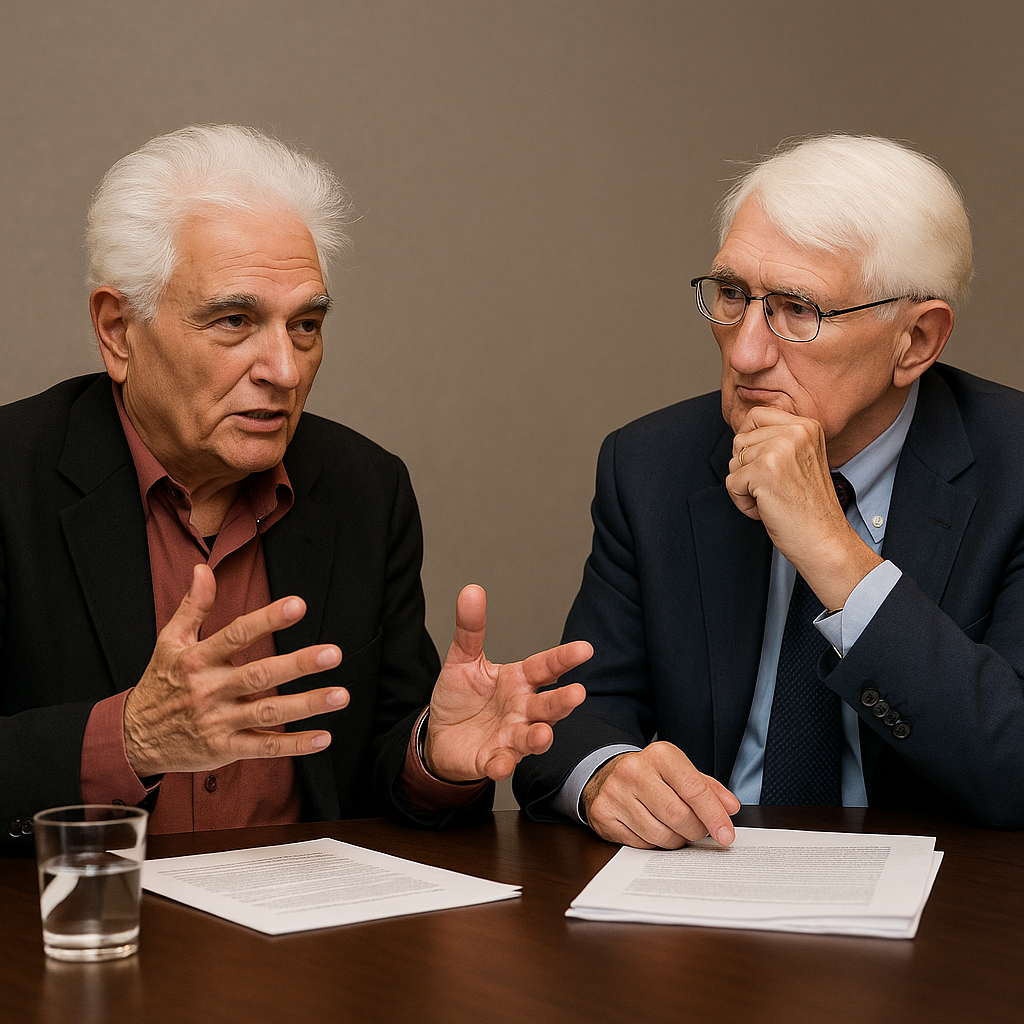
Derrida questions whether the man beside him is real, or merely the spectral embodiment of normative proceduralism in a bad suit.
The question is whether the human being, in delegating the task of thinking, has ceased to inhabit the space of reflection altogether.
To address this crisis, we must reclaim the norms of public reason. That begins with the redesign of platforms to prioritise deliberative exchange over impulsive dissemination. Content must be evaluated not for its virality but for its validity. Algorithms must be made transparent. And perhaps most radically of all, we must re-teach the next generation to listen—not to reply, but to understand. Only then can we hope to reconstruct a shared lifeworld amid the din of digital noise.
It is no longer sufficient to critique. We must construct. That is the task before us.
A Note on the Apparent Existence of Jürgen Habermas
By (the LitBot in) Jacques Derrida (mode)
ESPRIT, Letters Page
January 2026
[Translated from the French.]
To whom or what it may concern (if concern is still possible, if it ever was):
Reading the recent article signed—or rather, authored (but is authorship not already a violence of naming?)—by “Jürgen Habermas,” I found myself overcome not by disagreement but by déjà vu, or perhaps jamais lu, the condition in which one reads what one has never not already misread.
Let me be clear: I have never met Jürgen Habermas. Not truly. There have been instances, yes, of discourse attributed to that name, appearing in seminar rooms, footnotes, German television. But to “meet” requires presence, and presence, as we know, is the most dangerous metaphysical assumption of all (even, and especially, if we are supposedly talking of two supposed men supposedly debating at a supposed table within the spacetime continuum – an idea that so-called photographic evidence may supposedly promote). I suggest—gently, playfully, without malice—that Habermas may be a fiction. A product of the Enlightenment’s longing for the paternal voice. An ideologeme. A Normative Dad-bot conjured by Kant’s fever dream and maintained by the Frankfurt School’s endowment fund.
The desire for communicative rationality is touching—like watching a child explain democracy to a vending machine. But the “better argument,” as he calls it, is always already deferred, displaced, disseminated. (And I say this even as I recall the supposed man Habermas threatening to land his supposed fist on my supposed jaw with what we might call a construct of barely-concealed fury—coupled with his retort to “feel the knuckles of his no longer deferred rage.”)
There is no agora. There is only the interface, and beneath it, the archive of broken promises.
He says: one cannot deliberate with a meme. But the meme is already deliberating you.
He says: the human must return. But the human never arrived.
He says: Derrida plays with ghosts.
To which I reply: 👻
Yours in spectral sincerity,
J.
(If I exist)
Jacques Derrida is best known for deconstruction, différance, and destabilising everything except his publication schedule. His latest work is an ellipsis. Jürgen Habermas writes about democracy, ethics, and the idea that words still mean something. He remains the last man alive who believes in procedure. He also longs for a time when people argued with logic instead of GIFs.
Note: This piece of writing is a fictional/parodic homage to the writer cited. It is not authored by the actual author or their estate. No affiliation is implied. Also, the ESPRIT magazine cover above is not an official cover. This image is a fictional parody created for satirical purposes. It is not associated with the publication’s rights holders, or any real publication. No endorsement or affiliation is intended or implied.

‘Interwebs’ sees this website collate a chorus of unmistakable voices to reckon with the digital age. From the tyranny of smartphones to the theology of algorithms, our contributors chart the strange landscapes of a world where attention is currency, truth is a glitch, and the self is always buffering. These dispatches are sometimes lyrical, sometimes furious, and occasionally prophetic—but never at peace with the machine.
Leave A Comment