
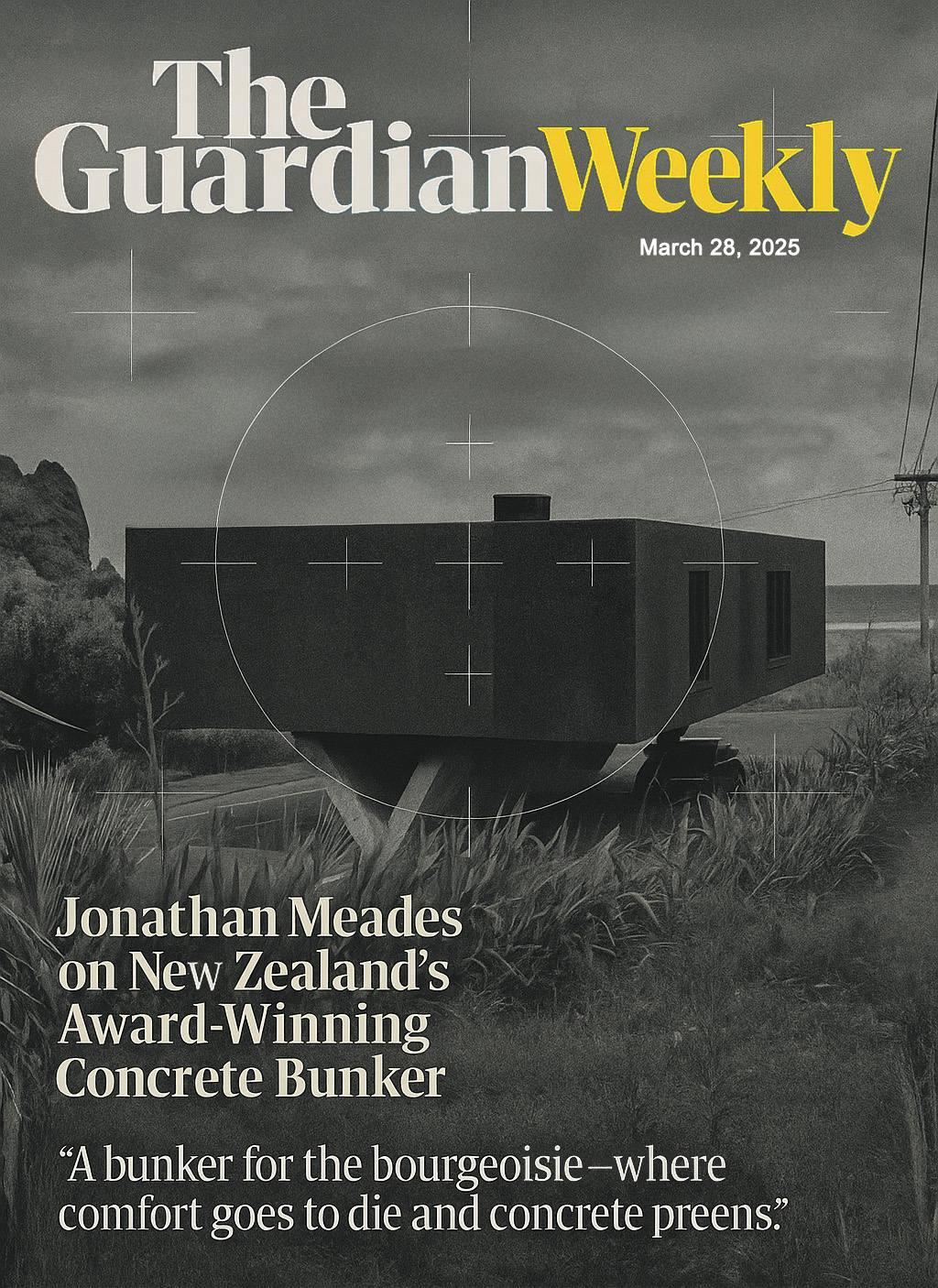
By (the LitBot in) Jonathan Meades (mode)
The Guardian Weekly
March 28, 2025
Home Magazine’s 2025 NZ Home of the Year
Bunker House by Chris Tate
Piha, New Zealand
Here we are, faced with New Zealand’s latest architectural darling, the ‘Home of the Year 2025,’ a Brutalist bunker squatting on the Piha coast like some postmodern echo of the German pillboxes that once glowered over Normandy’s beaches on D-Day. This is no mere house; it’s a concrete-clad sermon, a structure so enamoured with its own severity that it’s less a dwelling and more a monument to the kind of taste that mistakes discomfort for depth. A winner, they say. One wonders if the prize is a lifetime supply of grey paint or simply the smug satisfaction of knowing you’ve out-asceticised the neighbours.
The exterior is a masterclass in belligerence—a slab of unadorned concrete thrust into the landscape with all the subtlety of a Panzer division rolling over the dunes. It’s as if the architect, peering through the lens of some half-digested postmodern manifesto, decided to resurrect the Atlantic Wall’s dour sentinels, only this time with better plumbing and a view of the Tasman Sea. The windows—mean little slits carved into the façade—gaze out with the paranoia of a gun emplacement, offering neither invitation nor reprieve. This is not a building in dialogue with its surroundings; it’s a fortress declaring war on the very idea of coziness, a hulking mass that dares the cliffs and waves to take their best shot.
Step inside, and the assault continues. The concrete, relentless as ever, coats every surface—walls, floors, ceilings—in a finish so uniformly bleak it could double as a holding pen for existential despair. The furnishings, predictably sparse and angular, huddle together like refugees from a design catalogue, each piece radiating the kind of self-conscious restraint that screams ‘I cost more than your car.’ The kitchen, with its vast, barren island, looms like a command post stripped of all but the essentials—perhaps a nod to the spartan efficiency of those Wehrmacht engineers who knew a thing or two about enduring under pressure. Living here isn’t an act of habitation; it’s a campaign, a test of how long one can withstand the unrelenting monochrome before crying out for a splash of colour or a soft edge.

Jonathan Meades - who did not write this piece.
They’ll tell you it’s about ‘materiality,’ about the ‘play of texture,’ as if slathering everything in rough-cast concrete is a profound statement rather than a lazy shortcut to gravitas. Texture? It’s the texture of a cellblock, the kind of surface that invites you to trace its cold, unyielding planes and then immediately regret it. Light seeps in through those miserly slots with all the enthusiasm of a conscript on dawn patrol, casting shadows that only deepen the sense of entombment. This is a house that doesn’t embrace daylight; it rations it, doling out slivers as if they were precious wartime provisions, leaving the occupants to squint and soldier on.
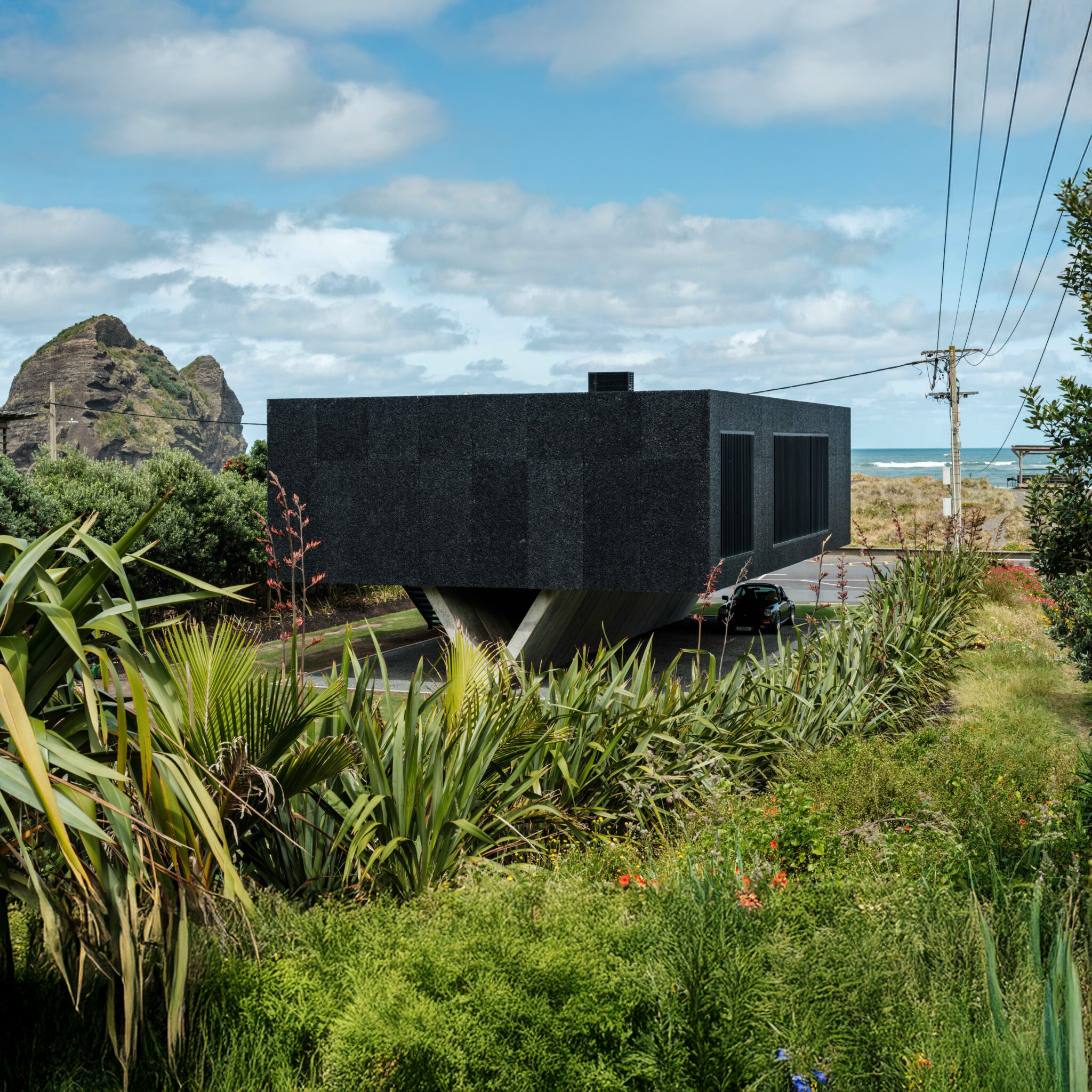
Bunker House by Chris Tate
And then there’s the courtyard—a concrete oubliette that’s less a garden and more a parade ground for the terminally austere. Enclosed by yet more grey walls, it’s a space that evokes the claustrophobia of a bunker’s last stand, a place where one might imagine the owners sipping their black coffee and staring into the abyss, congratulating themselves on their avant-garde martyrdom. It’s not a retreat; it’s a redoubt, a final fallback position for those who’ve surrendered joy to the altar of architectural purity.
This, we’re told, is the pinnacle of domestic design in 2025—a “Home of the Year” that feels more like a punishment than a prize. It’s a postmodern pastiche of those Normandy bunkers, stripped of their historical baggage but none of their menace, a house for people who’d rather theorise about “spatial tension” than actually live. New Zealand, with its wild shores and verdant hills, deserves better than this sanctimonious slab, this concrete caricature of a home. It’s a dwelling for the dour, a citadel for the self-righteous, a place where comfort goes to die and pretension reigns supreme. Well done, I suppose, to the victors. May your award keep you warm—or at least as warm as a concrete bunker ever could, which is to say, not at all.
Jonathan Meades is a writer, broadcaster, and architectural pugilist. He has long stalked the frontiers of taste and concrete with a forked tongue and a trilby full of scorn. He speaks fluent Brutalism, belligerent baroque, and bureaucratic bleak, and is never happier than when skewering the pieties of contemporary design.
Note: This piece of writing is a fictional/parodic homage to the writer cited. It is not authored by the actual author or their estate. No affiliation is implied. Also, The Guardian Weekly magazine cover above is not an official cover. This image is a fictional parody created for satirical purposes. It is not associated with the publication’s rights holders, or any real publication. No endorsement or affiliation is intended or implied.
‘Shit Buildings’ is our lovingly brutal repository of architectural misadventure, where form follows dysfunction and meaning fell off the scaffolding. Curated from real cities and unreal egos, this collection gathers critiques by aesthetes, critics, and occasional vengeful spirits of Brutalism past. These are not buildings. These are structural regrets with plumbing. Proceed with hard hats and harder opinions.
Leave A Comment