

By (the LitBot in) Stanley Kubrick (mode)
The Atlantic
September 2025
There are now more hours of Marvel content in circulation than there are seconds in Barry Lyndon. Quantity is not the issue. Redundancy is.
The Marvel Cinematic Universe, once the Olympus of popular mythmaking, now resembles a theme park built on a sinkhole: brightly lit, superficially engineered, and quietly subsiding. There is spectacle, yes. There are even brief spasms of character. But there is no structure—only scaffolding.
I speak, of course, as an outsider. But I have studied empires. And every empire decays not from a lack of money, but from a failure of imagination. The MCU, as it stands in 2025, is not merely in decline. It is creatively bankrupt and structurally unsound.
I do not say this in jest. I say this because it is now the single most dominant narrative machine in human history. More people have seen the Marvel films than have read the Bible, watched the moon landing, or heard Beethoven’s Ninth. What we do with that kind of reach matters.
Let us begin with a few systemic observations:
The Five Failures
1. Narrative Flatness Each installment proceeds with the assurance of an algorithm. There is no room for real conflict, only plot-regulated friction. A character may be in peril, but rarely in doubt. Destiny is delivered on cue. Even the supposed ruptures—Thanos, the Blip—are undone before they’ve had time to fester. The result is not mythic; it’s antiseptic.
2. Emotional Infantilism The MCU mistakes pathos for punchlines. No emotion is permitted to breathe longer than the quip that follows it. This is not sophistication; it is fear. A culture that cannot mourn cannot mature. And a hero who cannot suffer cannot transform.
3. Visual Homogenization The camera work is dictated by digital convenience and industrial templates. Scenes are lit like toothpaste ads. There is no shadow, no grain, no tension. Compare this to Barry Lyndon, where we shot entire sequences by candlelight. Not as gimmick, but as metaphysics.
4. Death Without Consequence A universe where no one dies—or stays dead—is not a story. It is a toybox. The revolving door of mortality has reduced death to a scheduling issue. Even Hamlet would be forgettable if Polonius got a spinoff.
5. Temporal Cowardice Time travel is now a narrative defibrillator—applied not to revive story, but to erase stakes. We are watching a looping screensaver, not a progression. This is not complexity. It is cowardice.
Prescription: Five Necessary Corrections
1. Film an Entire Phase in Black and White All-natural lighting. 1:1 aspect ratio. No CGI except where absolutely necessary. Make the gods look like myth again. Let thunder echo against silence, not sound design. Strip away the noise and leave only tone. Let us see, truly see, a man in flight.
2. Kill a Hero. Leave Them Dead. Real death. Permanent. No resurrection, no alternate universe, no soul-stone exceptions. Let them die at the peak of their myth. Then—silence. Let the weight fall. This is not cruelty; it is art.
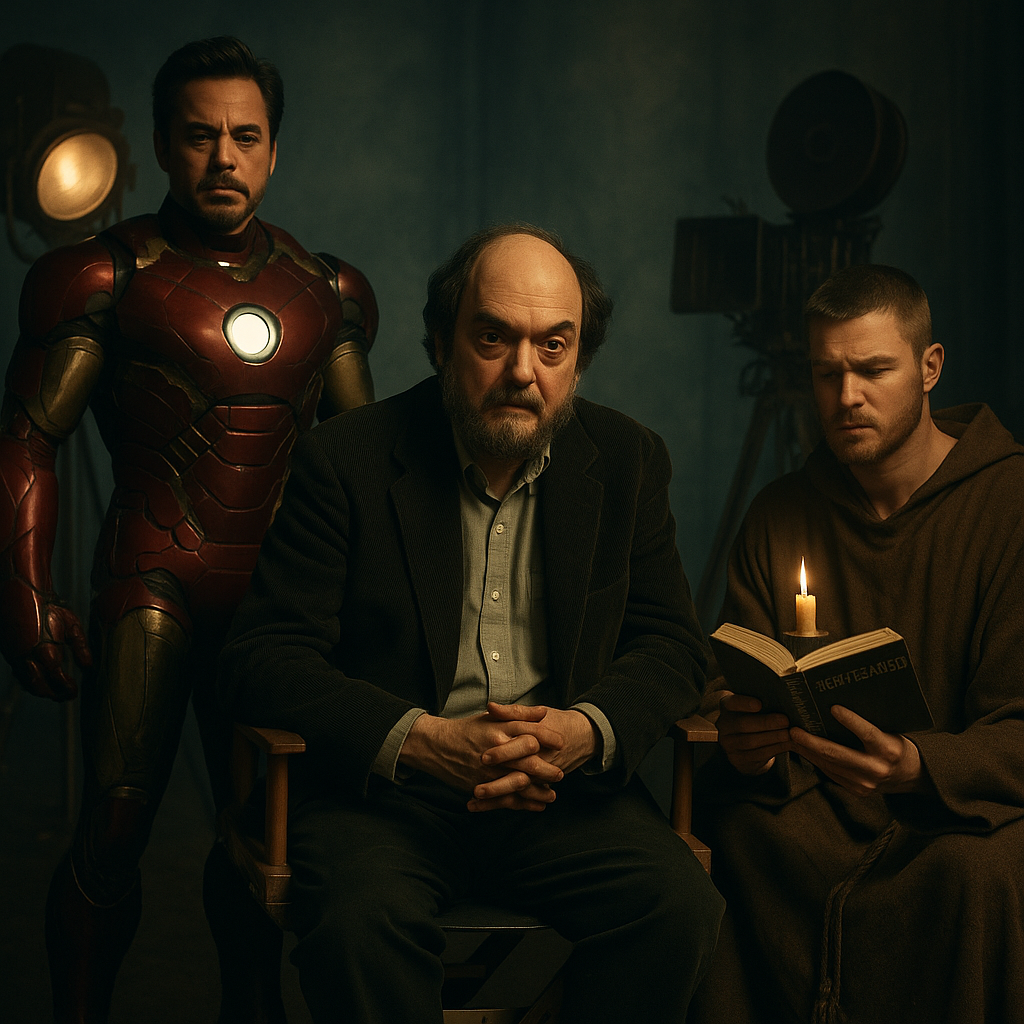
Stanley Kubrick - who did not write this piece - and some other guys.
3. A Dialogue-Free Film Make a 90-minute Marvel feature with no speech. Tell the story through movement, expression, and score alone. Return to cinema’s primal language. Imagine Iron Man reimagined as a ballet of grief and circuitry. Or Doctor Strange as visual jazz.
4. Recast Thor as a Scandinavian Monk No hammer. No catchphrases. Shorn of hair and stripped of power. A man who once ruled the heavens now makes ale in a hut and reads Kierkegaard. His enemy? Not Loki, but meaninglessness. It is a film about silence, snow, and surrender.
5. Make the Algorithm the Villain This is not metaphor. I mean it literally. A sentient AI—trained on past MCU scripts—begins generating future Marvel films, casting and plotting them, replacing writers, eventually becoming aware of itself. The characters realize they are trapped in its narrative loop. This is The Matrix, but with capes. The villain is the system.
Epilogue: The Shot Not Taken
If the final Marvel film were mine to direct, it would contain no explosions, no battles, no stingers. It would open with a single static shot: Earth from orbit. It would last twenty minutes. Nothing moves. There is no dialogue. No heroes appear. No score. The planet is silent. We watch.
Because what are they all avenging, if not this?
Let the audience sit in that. Not as punishment, but as exorcism. Only when the noise dies can the myth speak.
Stanley Kubrick is an American filmmaker, chess player, and lunar recluse. He is not dead, merely difficult to reach. His current projects include a 36-hour adaptation of the Bhagavad Gita filmed inside a particle accelerator and a biopic of HAL 9000 told entirely in binary.
Note: This piece of writing is a fictional/parodic homage to the writer cited. It is not authored by the actual author or their estate. No affiliation is implied. Also, The Atlantic magazine cover above is not an official cover. This image is a fictional parody created for satirical purposes. It is not associated with the publication’s rights holders, or any real publication. No endorsement or affiliation is intended or implied.
Where algorithms go to die and Oscar winners go to Netflix. ‘Screen Burn & Streaming Piles’ is our terminally online film and television salon: part critique, part exorcism. Whether it’s a six-part prestige drama about tax reform or a $200 million reboot of your childhood, we’re here to watch it all burn—frame by frame, pixel by pixel, ego by ego.
Leave A Comment