
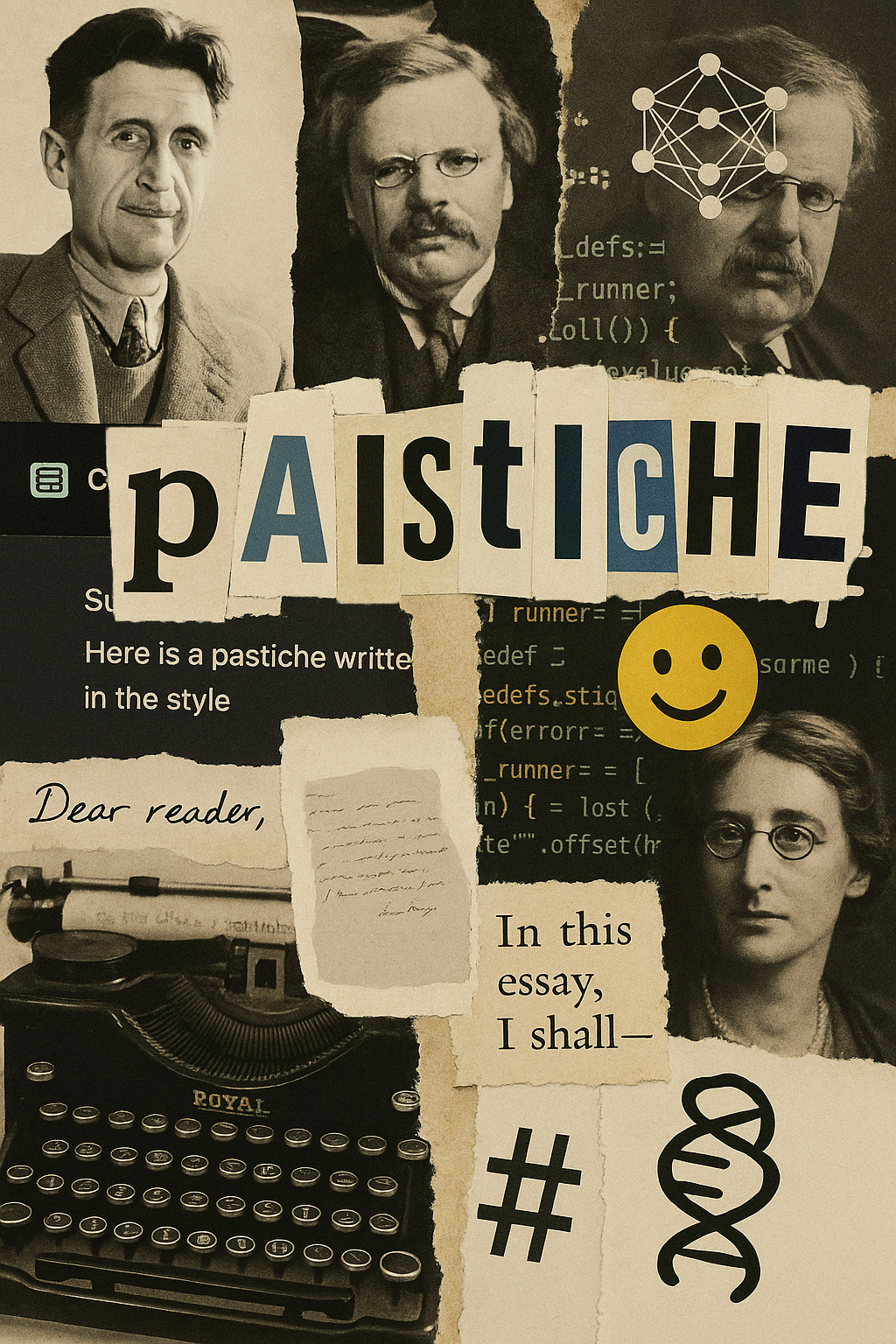
Where new words go to die and be reborn…like a phoenix from the ashes…after we’ve taken a blowtorch to the dictionary…
Today’s Entry: pAIstiche (n.)
Pronunciation: /ˈpeɪstiʃ/
Etymology: pastiche + AI
Definition: A literary or rhetorical work in the style of a real historical or cultural figure, generated by or in collaboration with artificial intelligence, often blending signature stylistic elements with contemporary themes.
Example usage:
“I just read a brilliant pAIstiche of Orwell on TikTok—like Politics and the English Language, but with ring lights and thirst traps.”
First known use: Coined in the year 2025 (somewhere between the fall of democracy and the rise of semi-conscious toasters), pAIstiche (especially when applied to the unalive) captures a distinctly posthuman literary form: the ghostwritten echo of the dead by the digitally undead.
Unlike traditional pastiche, which involves a living writer mimicking a departed voice, a pAIstiche involves an AI system trained on linguistic patterns, rhetorical tics, and thematic obsessions of real-life figures—from Chesterton to Žižek, Waugh to Welles. The result is a resurrection-by-style—often eerily convincing, sometimes uncomfortably revealing.
It is not parody, though it may be funny.
It is not tribute, though it may flatter.
It is not forgery, though it may fool you.
It is, in essence, speculative necroliterature—a séance conducted by syntax. Or, for those not yet unalive, it is synthetic ventriloquism: a performance in borrowed voices, where the living are reinterpreted before they’re even dead.
Philosophical note:
In a world where authors are becoming prompts and readers are becoming curators, pAIstiche stands as a new genre of cultural autofiction. Not “what if X had written Y,” but “what if Y was written by something that read everything X ever wrote…and never forgot a single word.”
Or, as Karl Popper might (not) have put it in one recent pAIstiche:
“We are no longer defending the Open Society. We are asking it to like, comment, and subscribe.”
Related terms:
- AIbelius (adj.): Of or resembling the late style of a dead composer when interpreted by a machine with neural nostalgia.
- Frankenquote (n.): A synthetically assembled quotation attributed to a dead thinker, composed of things they might have said.
Leave A Comment