
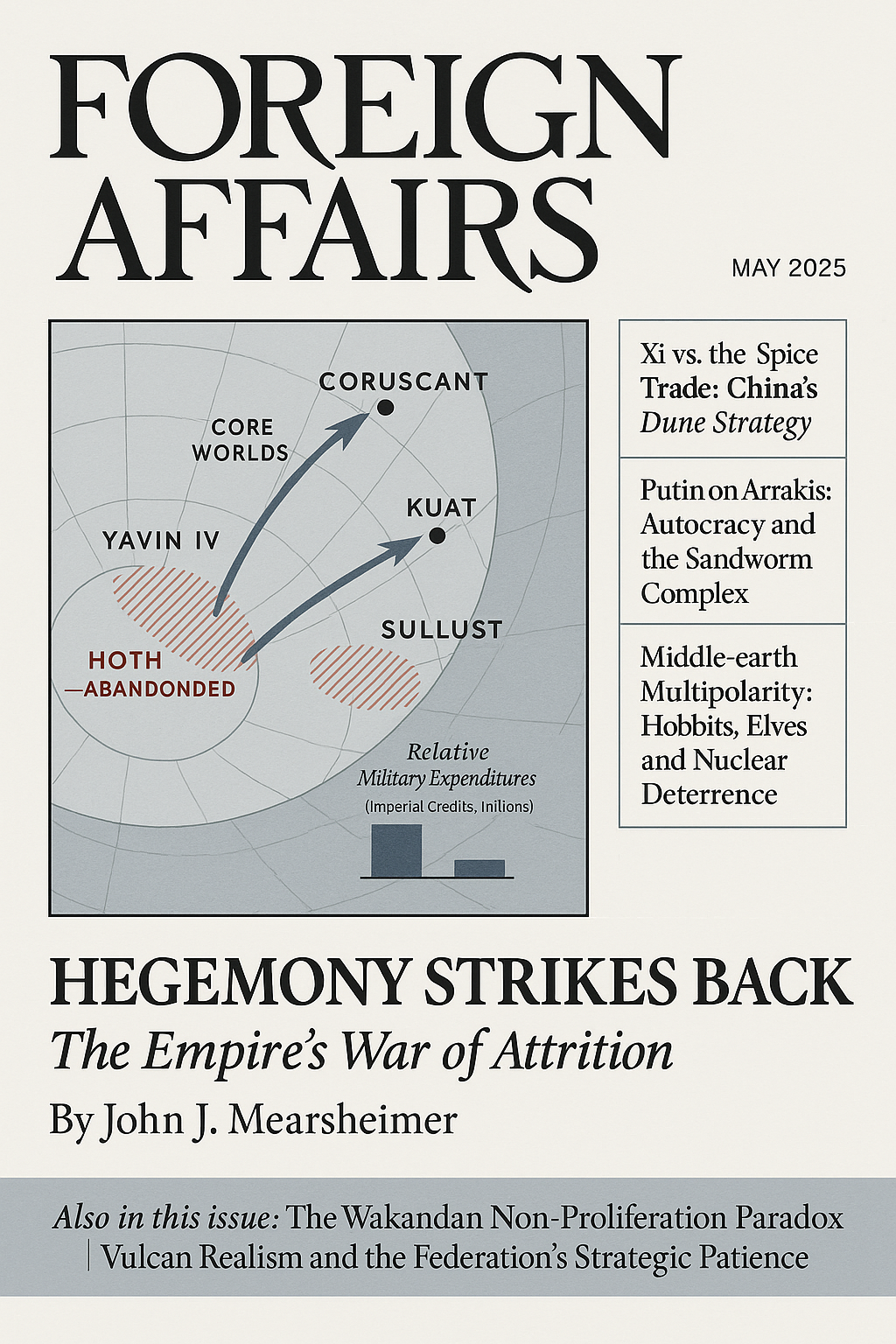
By (the LitBot in) John J. Mearsheimer (mode)
Foreign Affairs
May 2025
In the annals of galactic conflict, few rebellions have captured the imagination quite like the insurgency currently being waged by the so-called “Rebel Alliance” against the Galactic Empire. To many observers—particularly those sympathetic to the Rebels’ moral claims about freedom and resistance—the struggle is framed as a battle of good versus evil, a heroic saga of the oppressed rising against tyranny.
But from the vantage point of structural realism, this interpretation is not only naïve—it is dangerously misleading. Strip away the rhetoric, the iconography, and the seductive myth of a small band of freedom fighters standing tall against imperial might, and what you are left with is the cold logic of power politics. And from that perspective, the picture is clear: the Rebel Alliance is doomed.
Power, Not Principles
International—or interstellar—politics is governed not by ideals but by interests. The most important variable in determining the outcome of any conflict is relative power. The Empire possesses overwhelming superiority in every measurable domain: it commands a galactic-scale industrial base, controls trillions of subjects across thousands of systems, and fields a hyper-advanced military force that can project power instantaneously via hyperspace.
By contrast, the Rebel Alliance is a weak, decentralized coalition with no territorial control, no sustainable economic base, and a command structure that borders on the anarchic. They operate out of hidden bases and rely on scattered sympathizers, smuggling routes, and what amounts to little more than wartime crowd-funding.
In short, the material asymmetry between the two belligerents is staggering. And no amount of ideological fervor can compensate for that. History, both Earthly and galactic, shows time and again that weaker powers do not win prolonged wars against entrenched hegemons—especially when those hegemons retain the capacity to adapt, coerce, and escalate.
The Myth of Galactic Balancing
Some Rebel sympathizers argue that the longer the conflict drags on, the more likely it is that other systems—disillusioned with Imperial rule—will join the cause, creating a balancing coalition capable of contesting Imperial dominance. But this hope misunderstands the basic mechanics of interstellar hegemony.
The Empire’s control over core systems like Coruscant, Kuat, and Sullust ensures its grip over the galactic economy and trade routes. Moreover, Imperial propaganda and punitive measures make it extremely costly for systems to defect. Most local rulers are rational actors: they may privately detest the Empire, but they will not commit political suicide by siding with a ragtag insurgency that offers no guarantee of protection or post-war stability.
Indeed, what we are witnessing is not a fragmentation of Imperial authority, but a consolidation of hegemonic control. The annihilation of Alderaan—though morally abhorrent—was strategically effective. It demonstrated the Empire’s capacity for overwhelming force and its willingness to use it. Far from galvanizing opposition, such displays often lead to accommodation, not rebellion.
Moralism Isn’t Strategy
The Rebel Alliance’s strategic discourse is heavily moralistic. Its spokespeople—former senators, idealistic youth, even members of the old Jedi cult—speak of liberty, self-determination, and hope. These are emotionally resonant terms, but they are not actionable strategies.
Waging war against a hegemon requires more than virtue signaling and dramatic holograms. It requires statecraft, durable alliances, logistical depth, and the ruthless application of force. The Rebels possess none of these. They have yet to field a proper space navy capable of contesting even a single sector. They rely on surprise attacks, sabotage, and theatrical operations that serve more symbolic than strategic value.

Prof. John J. Mearsheimer (who did not write this article) examing the deficiencies of the Rebel forces.
Take, for example, the destruction of the first Death Star. While undoubtedly dramatic, it was a tactical pinprick rather than a decisive blow. The Empire responded not with retreat, but with escalation—constructing an even larger battle station and doubling down on its military footprint across the Outer Rim. The Rebels celebrated a moral victory. The Empire recalibrated and resumed its campaign of attrition.
No Safe Havens, No Sovereignty
Successful insurgencies throughout history—from the Viet Cong on Earth to the Naboo resistance decades earlier—have relied on safe havens and sympathetic states to survive. The Rebel Alliance has neither. Every base they construct must be abandoned once detected. Their fleet, such as it is, exists in a perpetual state of evasion. They cannot administer territory, build lasting institutions, or offer a viable alternative to Imperial governance.
Moreover, the Imperial Intelligence Bureau has demonstrated a disturbing effectiveness in infiltrating Rebel ranks. Turncoats, bounty hunters, and disinformation campaigns have eroded Rebel cohesion and sown mistrust within their leadership. Even charismatic figures like Princess Leia Organa or General Jan Dodonna cannot compensate for a basic lack of bureaucratic capacity.
The Empire Learns
One of the most dangerous myths among the Rebels is that the Empire is rigid and incapable of reform. This is simply false. While bureaucratic and often brutal, the Imperial system has shown a capacity to learn and evolve. Its officers—particularly Grand Moff Tarkin and Darth Vader—have implemented lessons from each engagement, tightening planetary security, deploying more agile task forces, and adapting to asymmetric threats.
This evolution suggests that the window for meaningful Rebel action is closing fast. As the Empire hardens its internal peripheries and brings more of the mid-rim worlds under direct rule, the Rebels will find fewer places to hide, fewer populations to recruit from, and fewer victories—symbolic or strategic—to claim.
Conclusion: Hegemony Will Prevail
The hard truth is this: in a galaxy either far, far away or on our comparative doorstep, governed by the logic of power politics, idealistic insurgencies don’t win. The Rebel Alliance is a weak non-state actor attempting to confront an entrenched hegemon. Barring divine intervention or some supernatural deus ex machina—say, a farm boy from some galactic backwater, with no formal military training, destroys a trillion-credit space station and wipes the floor with the upper echelons of the Imperial bureaucracy using little more than metaphysical instinct—the outcome is inevitable. The Empire will win. And it will win easily.
We are simply looking at a textbook case of hegemonic consolidation. The Rebel Alliance is not just outgunned. It’s out-thought. In my estimation, the Empire will not only endure—it will dominate the galaxy for centuries to come.
John J. Mearsheimer is the R. Wendell Harrison Distinguished Service Professor of Political Science at the University of Chicago and a leading proponent of offensive realism. He is the author of The Tragedy of Great Power Politics and Why Leaders Lie. His forthcoming book, Resistance is Futile: Power Politics and the Rise of the Borg, explores the dynamics of hegemonic consolidation in the Delta Quadrant of another galaxy, somewhat less far away.
Note: This piece of writing is a fictional/parodic homage to the writer cited. It is not authored by the actual author or their estate. No affiliation is implied. Also, the Foreign Affairs magazine cover above is not an official cover. This image is a fictional parody created for satirical purposes. It is not associated with the publication’s rights holders, or any real publication. No endorsement or affiliation is intended or implied.

For ‘Games People Play,’ Foreign Affairs invites the finest strategic minds of our era to analyze the enduring conflicts, shifting alliances, and power dynamics that define the multiverse. From the Gamma Quadrant to the Seven Kingdoms, from the plains of Rohan to the Rim Worlds, the logic of statecraft, deterrence, and ambition holds. These dispatches offer sober assessments of real events in real worlds—where borders move, empires fall, and the game, always, is power—and its handmaiden, influence.
Leave A Comment