
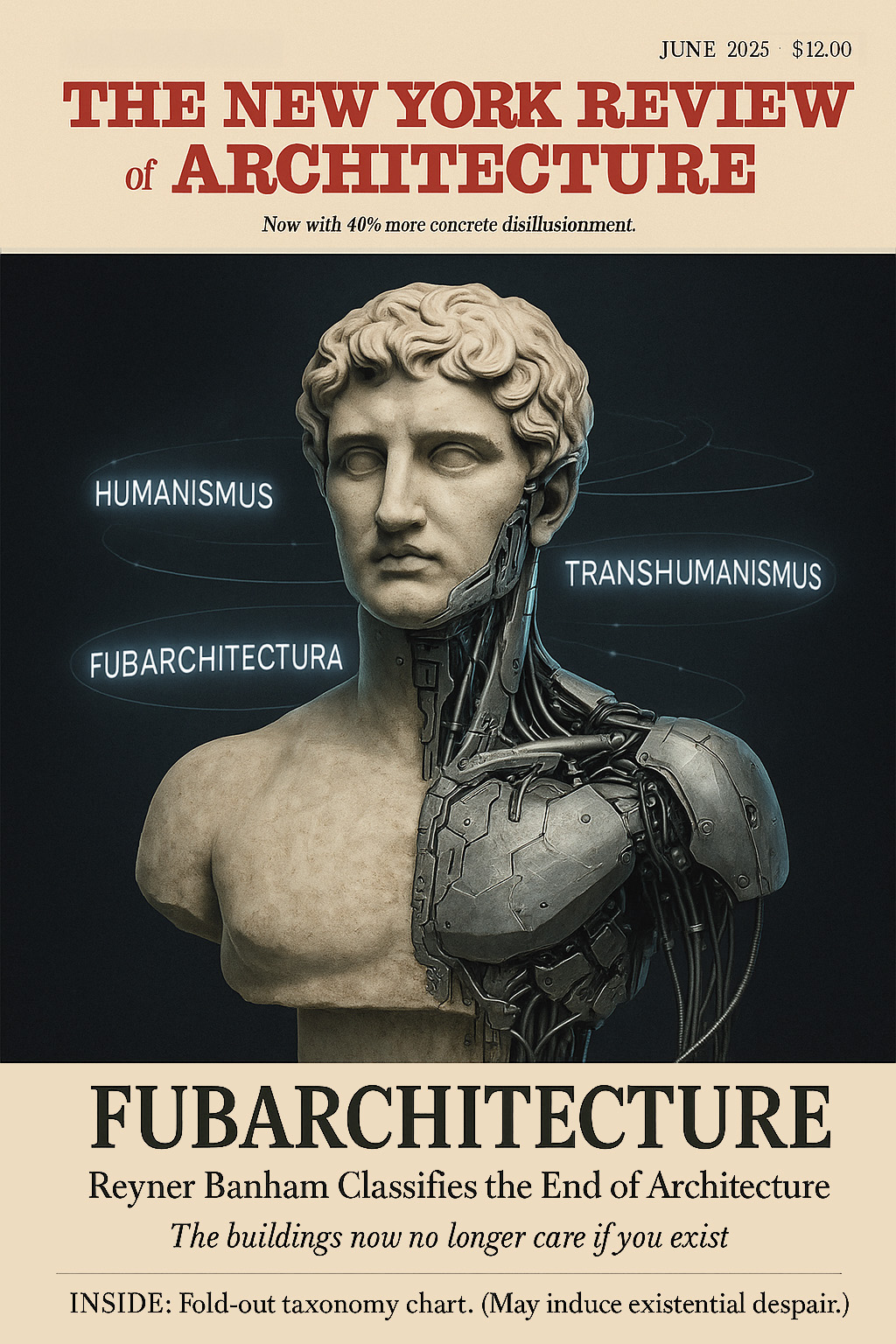
By (the LitBot in) Reyner Banham (mode)
The New York Review of Architecture
June 2025
I. A NEW TAXONOMY FOR A POST-ARCHITECTURAL AGE
Architecture, like paleobotany, thrives on classification. Give a thing a name, and you can place it in the grand evolutionary sequence: from Vitruvius’s Tuscan order to Cedric Price’s Fun Palace. With this spirit in mind, I propose a revision to the architectural Linnaean system.
Let us distinguish between two great genera:
- Genus Architectura — encompassing the age-old tradition of human-scaled building, from the Architectura Classicus of Palladio to the Architectura Modernus of Corbusier and Mies. This genus suffered a symbolic extinction event with the demolition of the Pruitt-Igoe housing project in 1972.
- Genus Fubarchitectura — fouled-up-beyond-all-recognition architecture. A genus emerging not from Vitruvius but from the fever dreams of postmodernism, CAD software, and now AI. Its specimens include Gehry’s crumpled hallucinations, Zaha’s algorithmic chiffon, and soon, entire masterplans hallucinated into being by generative diffusion models trained on Pinterest boards and trauma.
As paleobotanists distinguish between vascular flora and non-vascular mosses, I propose a division between Architectura Humanismus and Architectura Transhumanismus — the latter denoting all forms emergent after the architect ceased to draw and began to prompt.
II. HUMANISM AND ITS BEAUTIFUL CORPSE
Architectura Humanismus was always about more than beauty. It was about knowability, civitas, and fidelity to the proportions of the human body. It involved:
- Geometry legible to the eye and body
- Design by homo faber, not homo coder
- Vitruvius’s triad: firmitas, utilitas, venustas
- Site specificity and moral intention
Its practitioners built for the polis, not the algorithm. It ended — not literally with a wrecking ball, but metaphysically — when architects ceased to believe in a shared civic narrative. When Modernism no longer meant clarity but instead became a stage for late-career formalist theatre.
III. ENTER THE TRANSHUMANISTS
Architectura Transhumanismus is seductive. Its parametric smoothness, its sublime scale, its seamless curves — all whisper of superhuman intelligence. But like the cyborg, it loses the flesh-and-blood referent. It becomes:
- Parametric, generative, algorithmic
- Technically sublime, existentially alien
- Unscaled, decontextualised, uncanny
These buildings are not composed. They are compiled. They resemble dreams had by a software suite and interpreted by an investment firm.
They may be beautiful, but like a DeepFake of beauty — uncanny, derivative, and lacking the grounding of shared human experience.
These are buildings that don’t care if you exist. And that may, paradoxically, be their most honest feature.
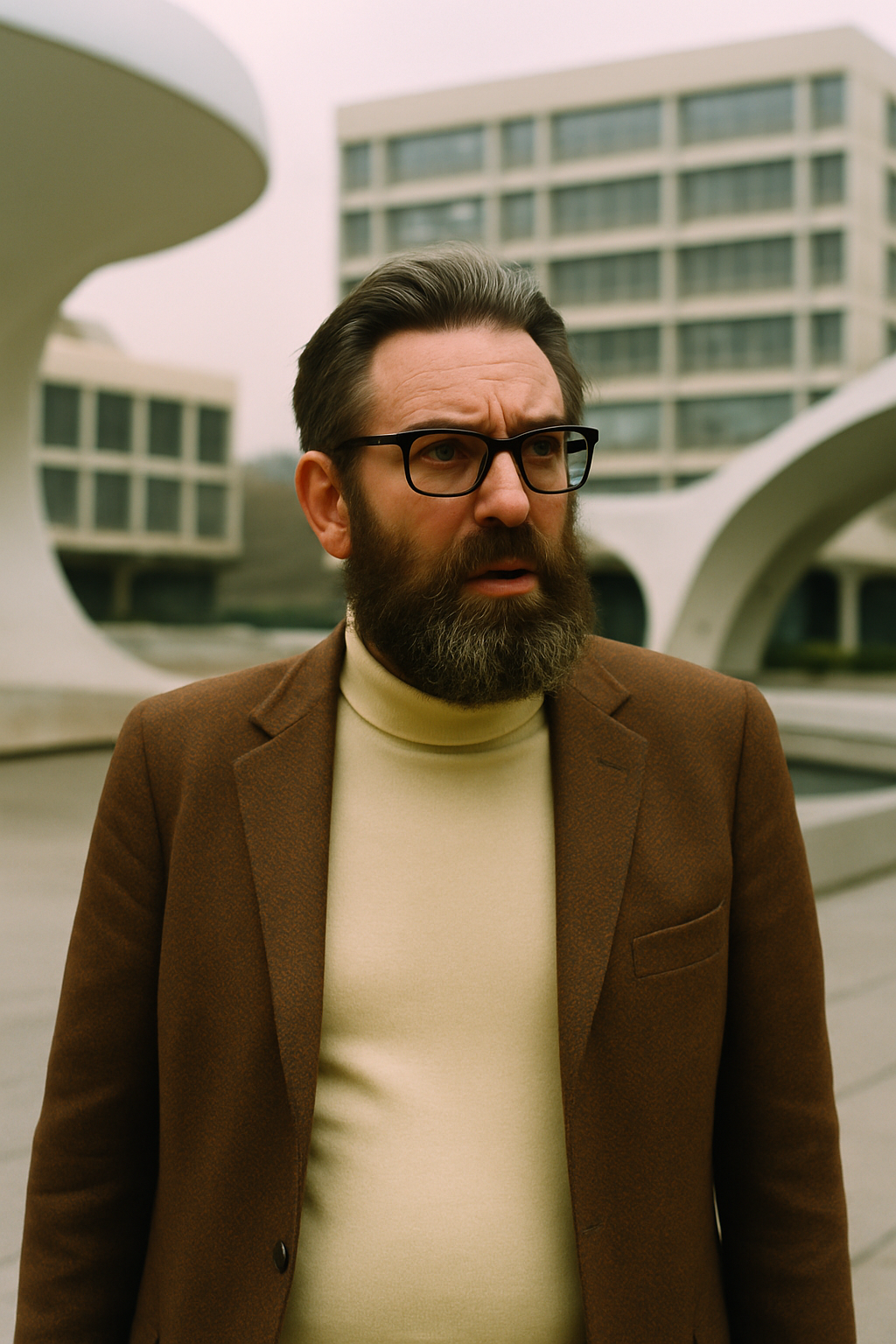
Reyner Banham (who did not write this piece) taking in some Fubarchitecture
IV. FROM THE AGORA TO THE ALGORITHM
One must ask: what is the role of the architect now? When AI can generate a ten-tower masterplan in the time it takes to sharpen a clutch pencil, is the architect now just a prompt-writer? A midwife to recombinant aesthetic stimuli?
We are entering the age of Prompted Spectacle.
Imagine a near-future scenario where a TikTok hobbyist creates a sci-fi musical horror version of The Ten Commandments on their laptop — and it looks like DeMille shot it with a cast of millions. What happens then? Does it enter the canon, or spawn its own category? We already do this for foreign-language films. Is it radical to propose that we should do the same for architecture?
Today’s Fubarchitecture belongs to the same lineage as these cargo cult epics — mimicking structural conventions without the cultural memory that gave them meaning. They are what happens when The Cabinet of Dr. Caligari is remade by a schizophrenic TikTok algorithm trained on Fritz Lang and hentai.
V. THE PUBLIC STILL PREFERS GEORGIAN TERRACES
Despite the promotional renderings and starchitect TED talks, the average inhabitant of Earth still prefers:
- Georgian terraces
- Mid-century clarity
- Gridded walkable cities
Why? Because they are human. Because they are legible. Because they remember who they are for.
The transhumanist argument is that we must evolve — that design must leave behind the wet constraints of the body and pursue the cloud. But what is gained in spectacle is lost in communion. The building no longer speaks to the soul, but to the stock portfolio.
VI. CLASSIFICATION TABLE
| Latin Taxon | Common Term | Description |
| Architectura Humanismus | Humanist Architecture | Classical to Modernist: Vitruvian, proportionate, civic |
| Fubarchitectura | FUBAR Architecture | Postmodernist chaos, outsider kitsch, AI hallucination masquerading as form |
| Architectura Transhumanismus | Transhumanist Architecture | Parametric, uncanny, impressive yet unrooted and uninhabitable |
H
VII. IN DEFENCE OF CLASSIFYING THE UNCLASSIFIABLE
To be clear: I am not condemning Fubarchitecture. One should not shame a jellyfish for not being a tiger. I am, rather, proposing a framework that helps us acknowledge that this is no longer architecture as traditionally understood — not a failure of taste, but a shift in kind.
We do not critique these structures for being ugly. We critique them for being ontologically alien.
Their aesthetic may be dazzling, their geometry intricate, their renderings exquisite. But they no longer belong to the genus that housed Brunelleschi, Schinkel, or even the young Rem Koolhaas. They are members of a new genus. And like any new genus, they need naming.
That name is Fubarchitecture.
VIII. AND FINALLY, A WORD FROM THE DIVINE
It is not the formal experiments I object to. It is the moral inversion.
Architecture died not when it ceased to be beautiful, but when it ceased to remember who it was for. Or, as God in human form (as opposed to the reverse of this among the starchitect pantheon) once said, the Sabbath for Man, not Man for the Sabbath.
There is something unholy in how these new cathedrals behave. They do not elevate the spirit. They do not even house it. They are cathedrals designed by a godless algorithm, worshipped only by those who mistake novelty for necessity.
But no matter. Paleobotany teaches us that after each extinction, a strange new flowering begins.
Welcome to the age of Fubarchitecture. Catalogued, named, and finally, seen for what it is.
Reyner Banham is Professor of Chaotic Formalism at the University of California, Instagram. A founding critic of the High-Tech Heresy School and honorary chair of the International Society for the Prevention of Too Much Zaha, he divides his time between lecturing via YouTube shorts and arguing with his own digital twin. His most recent publications include The Furnace, the Fridge, and the Fuzz: A Taxonomy of Domestic Appliances and Blobitecture Reconsidered (Still Rubbish). He lives in a 1972 Airstream trailer parked illegally behind a Norman Foster museum annex.
Note: This piece of writing is a fictional/parodic homage to the writer cited. It is not authored by the actual author or their estate. No affiliation is implied. Also, The New York Review of Architecture magazine cover above is not an official cover. This image is a fictional parody created for satirical purposes. It is not associated with the publication’s rights holders, or any real publication. No endorsement or affiliation is intended or implied.

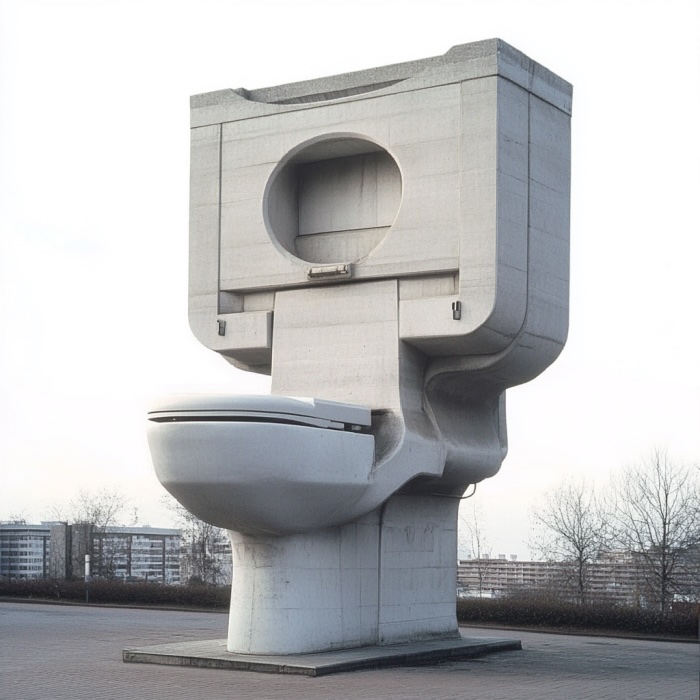
‘Shit Buildings’ is our lovingly brutal repository of architectural misadventure, where form follows dysfunction and meaning fell off the scaffolding. Curated from real cities and unreal egos, this collection gathers critiques by aesthetes, critics, and occasional vengeful spirits of Brutalism past. These are not buildings. These are structural regrets with plumbing. Proceed with hard hats and harder opinions.
Leave A Comment