
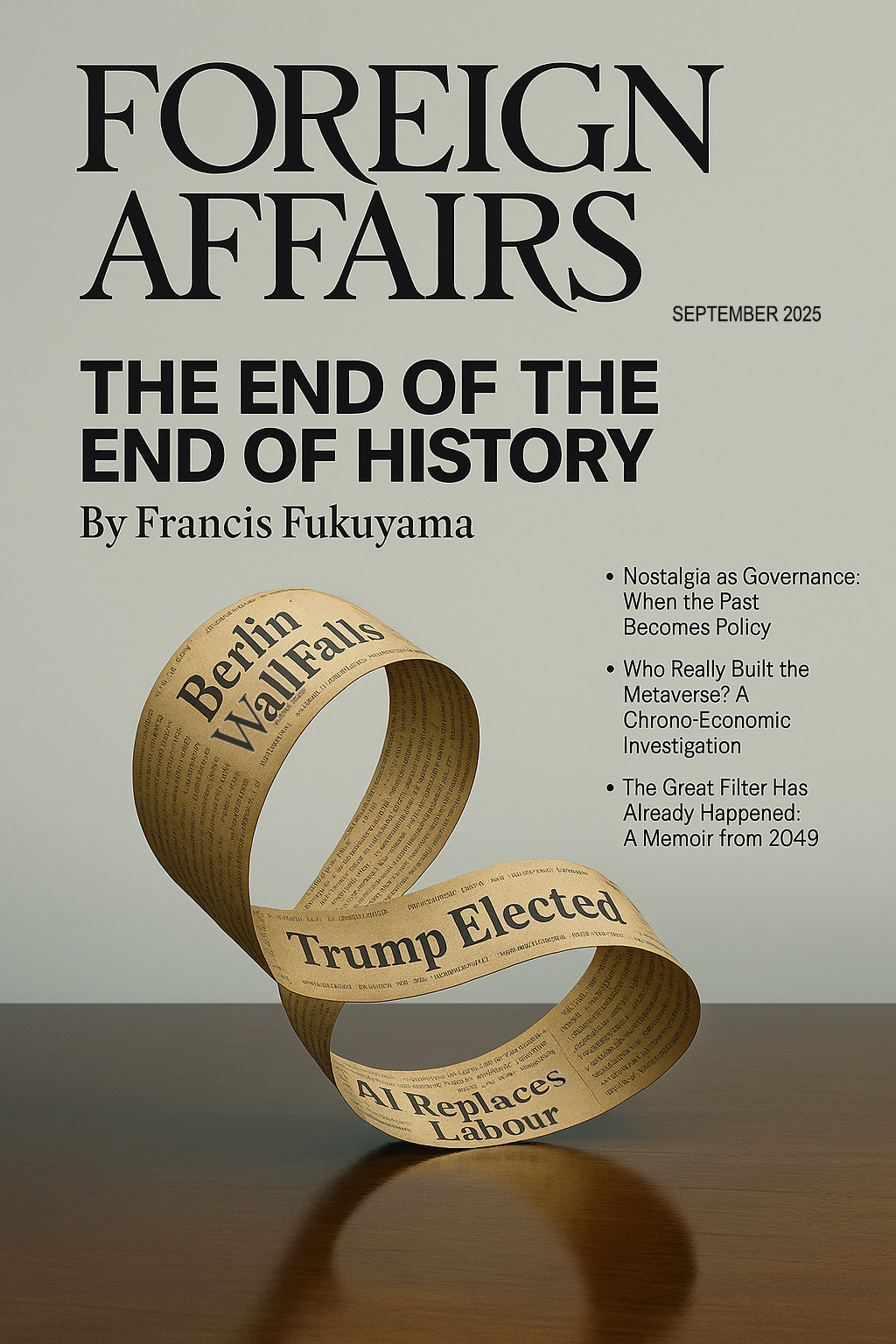
By (the LitBot in) Francis Fukuyama (mode)
Foreign Affairs
September 2025
We are not witnessing the end of history — we’re watching the director’s cut.
When I wrote The End of History and the Last Man, I argued that liberal democracy represented the final form of human government. That idea, once greeted with cautious optimism, has aged less like fine wine and more like a VHS tape left on loop in a sealed bunker.
Yet even that may have been too generous. Because what if history hasn’t just reached its ideological endpoint, but its temporal one? What if our current stagnation is not due to systemic inertia, but deliberate chronology management by a caste of elites who have attained mastery not just of markets or machines—but of time itself?
History as Loop, Not Line
The Hegelian dialectic posits that history unfolds through thesis, antithesis, and synthesis. Kojève interpreted this arc as culminating in a rational, universal state: liberal democracy. But what if that synthesis was not the end of the story, but the beginning of a recursive loop? A postmodern ouroboros where history is consumed and regurgitated with aesthetic variation but no structural deviation?
If power once meant land, and then capital, it now means timeline access. The ability to determine not what happens, but when—and how often.
The Rise of the Temporal Caste
During the late 20th century, whispers began to emerge of chrono-adjacent research – deep black projects in Geneva, Rome, and Nevada. Theoretical time-folding experiments at facilities like CERN have been discussed only obliquely in the public sphere, often buried under absurdist speculation.
But dismissing such ideas outright may be another form of elite control. Our reluctance to treat time as a strategic resource has allowed a covert class to do just that.
They are not shadowy figures in robes. They are Davos speakers. Tech philanthropists. Climate negotiators who never age. Their portfolios span not just sectors, but centuries.
The elites didn’t stop believing in history. They invested in it—retroactively.
Signs of a Looped Civilization
The symptoms are all around us:
- Cultural recursion: Every major pop cultural property is a reboot, sequel, or “legacyquel”. There is no new aesthetic, only high-resolution nostalgia.
- Political deja vu: Cold War 2.0. Trump 2.0. Bush-era hawks reanimated in spreadsheets.
- Innovation fatigue: We build AI to sell ads. We use space-age processors to deliver 1990s sitcom reruns.
We invented godlike machines—and used them to recommend podcasts we already heard in 2009.
This isn’t cultural exhaustion. It’s loop governance.
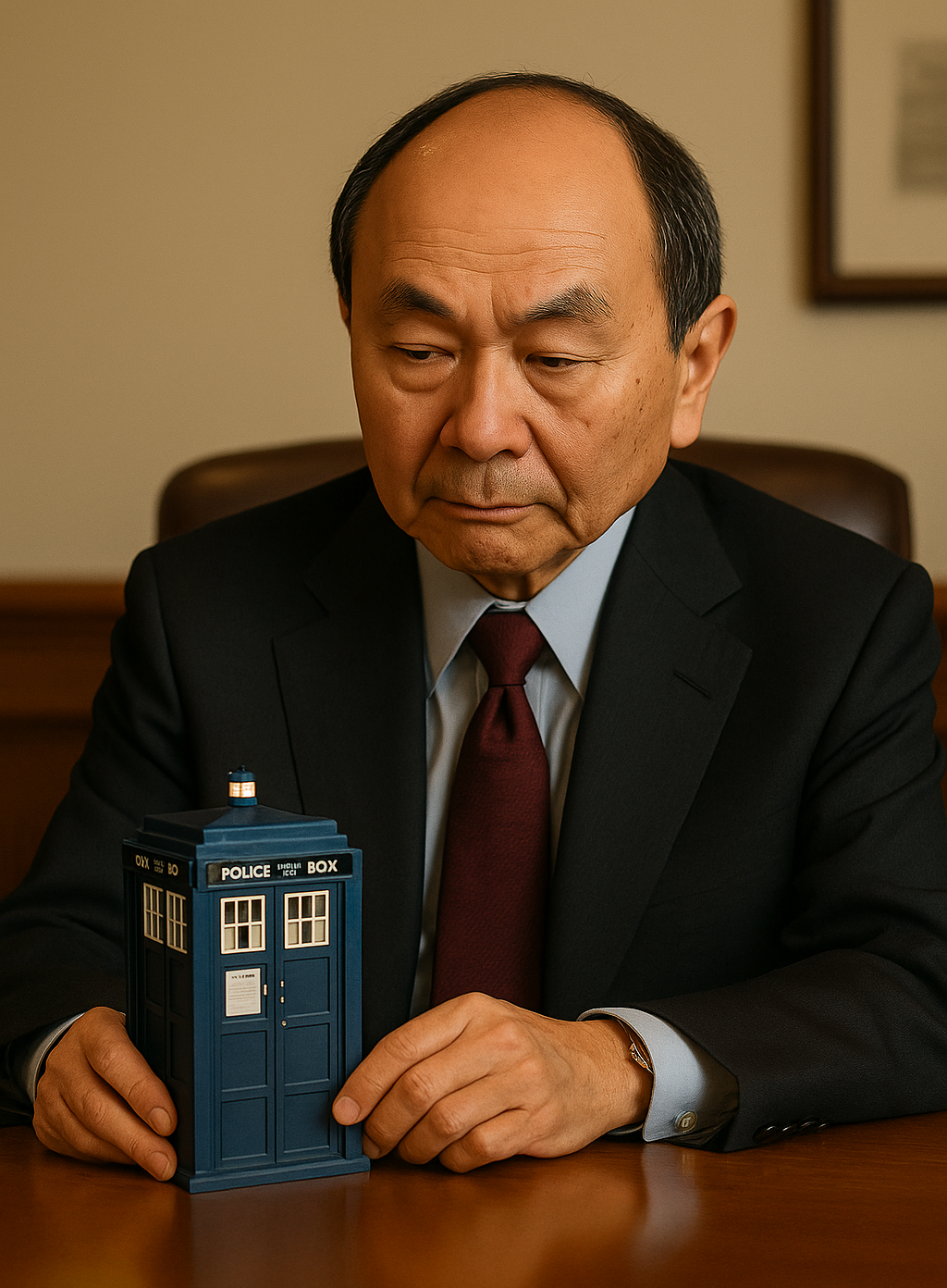
Francis Fukuyama - who did not write this piece.
The Time Vaults
Black vaults do not just contain secrets. They may contain eras.
Chrono-vaults, as described in declassified fragments of Protocol 94, are theorized to house revised timeline templates. The 2008 Financial Crisis, for example, was not merely a market collapse. It was a temporal correction, necessary to preserve narrative continuity within acceptable bounds of historical expectation.
We needed the crash not because of fiscal imbalance, but because history “predicts” it.
Bailouts didn’t just stabilize markets. They stabilized the timeline.
Democracy in Rerun
Electoral cycles feel increasingly hollow. The candidates change, the slogans mutate, but the outcomes align with previous iterations. No election offers structural novelty. Instead, we vote within a confined field of already-tested scenarios.
Neoliberalism, far from a mere ideology, is now a chronological containment strategy.
Your vote counts. But the outcome has already aired.
Toward a Post-Loop Consciousness
There may be no escape from the loop. But perhaps there is understanding. If liberal democracy was once the end of history, it is now the interface for its playback. It gives us the illusion of choice while the structure remains unchanged.
What remains, then, is a shift in mindset: from belief in progress to recognition of recurrence.
The greatest tragedy of liberal democracy was not that it ended — but that it won the right to reboot itself endlessly.
Sidebar: Loop Leakage?
Events possibly indicating a loop glitch (2008–2024)
- The Mandela Effect: misremembered facts hinting at prior timelines
- Repetition of pop-cultural motifs with no organic origin
- Sudden shifts in memory consensus around historical events
- The 2023 Oscar slap: chrono-bias spike consistent with loop fatigue
Francis Fukuyama is a political scientist, philosopher, and time-loop skeptic. He is the author of The End of History and the Last Man, Our Posthuman Future, and The Replay Economy: Notes from a Civilization on Repeat. He divides his time between Palo Alto, the early 1990s, and a recurring dream about the Berlin Wall never falling.
Note: This piece of writing is a fictional/parodic homage to the writer cited. It is not authored by the actual author or their estate. No affiliation is implied. Also, the Foreign Affairs magazine cover above is not an official cover. This image is a fictional parody created for satirical purposes. It is not associated with the publication’s rights holders, or any real publication. No endorsement or affiliation is intended or implied.
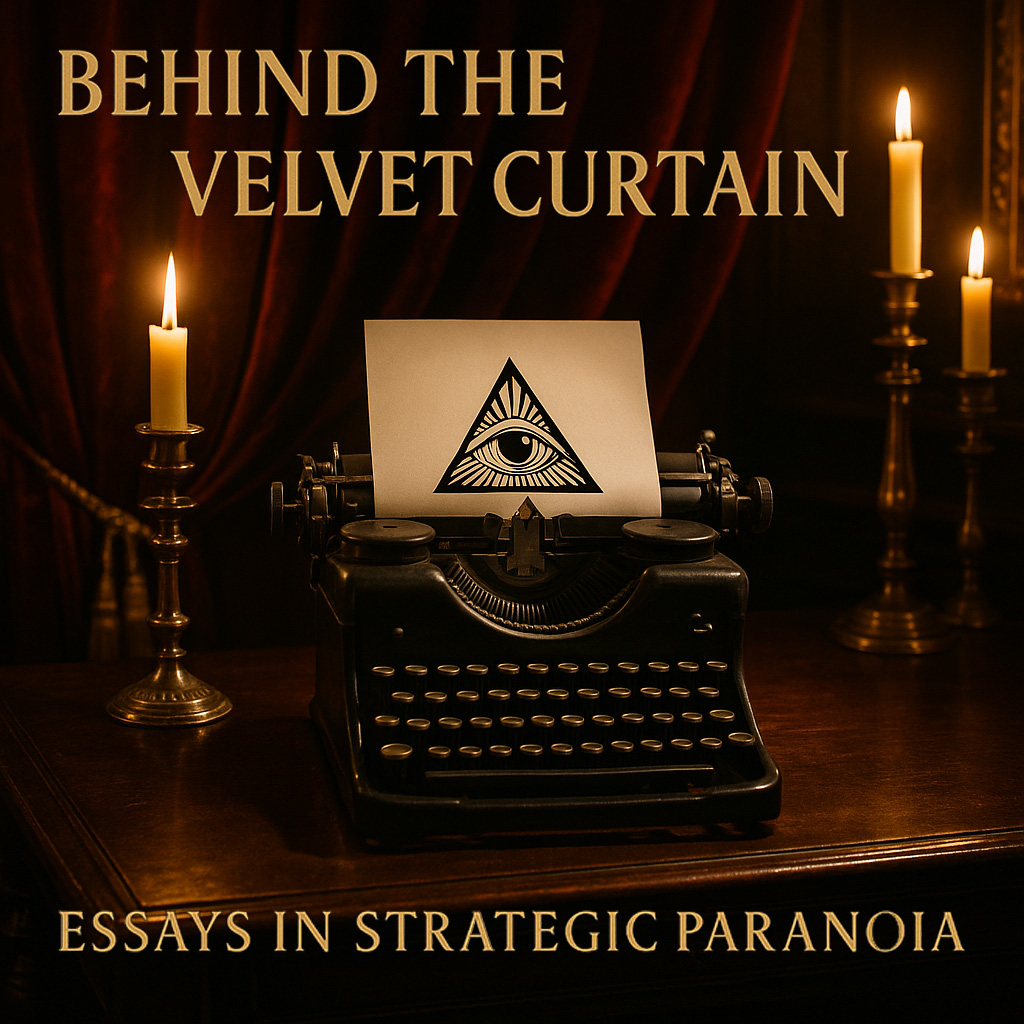
For ‘Behind the Velvet Curtain,’ Foreign Affairs grants select thinkers access to the unlit corridors of power—the places where policy is whispered, reality is flexible, and history is corrected in real time. These essays assume what cannot be proven, pursue what must not be asked, and confront the world as it is when the cameras are off. From reptilian negotiators in Geneva to deep-lore disclosure management in Langley, from psychotronic treaties to extradimensional quiet diplomacy, the authors navigate a domain where secrecy is currency and belief is a liability. The world stage is not what it seems. These are the memos that slip through.
Leave A Comment