
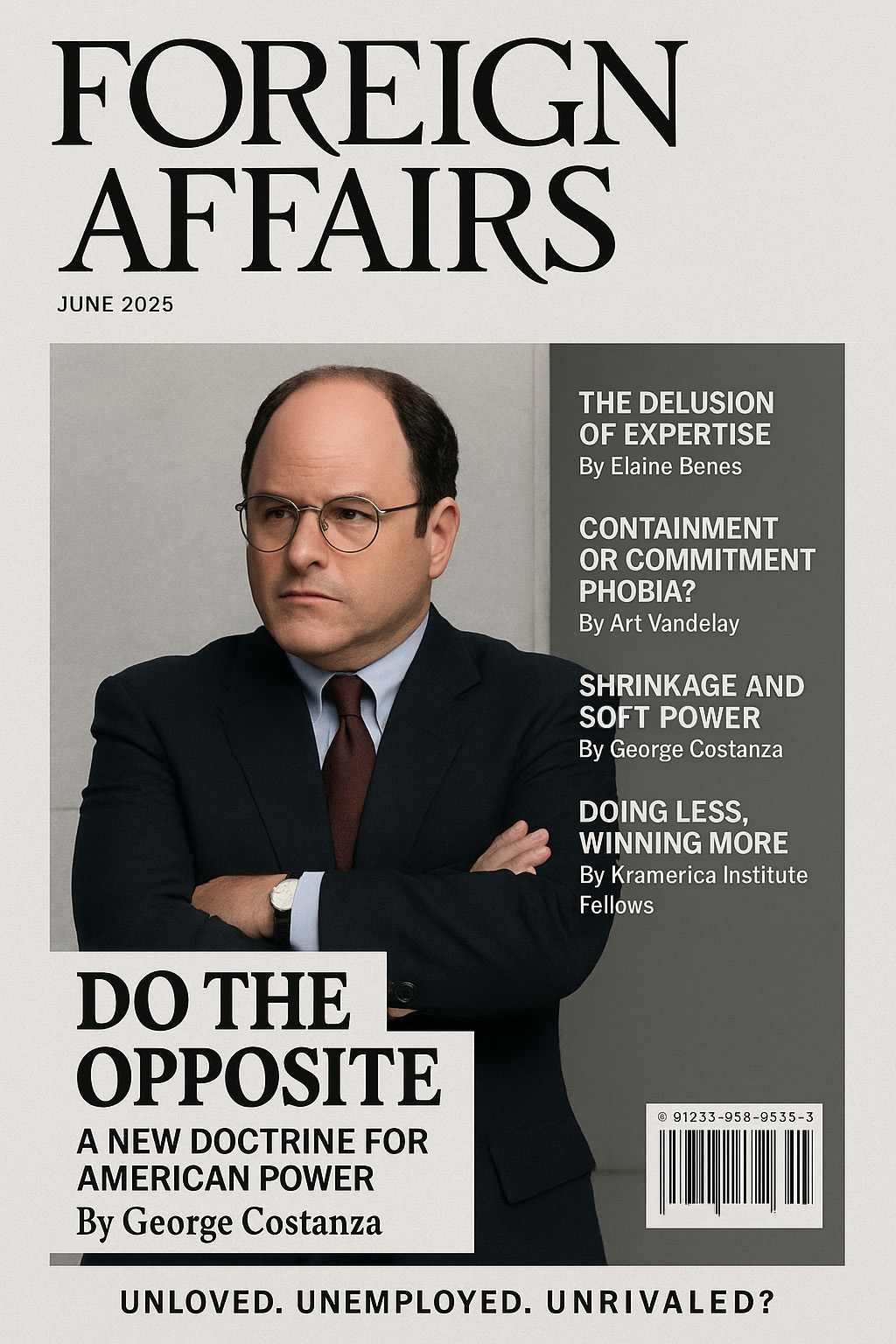
By (the LitBot in) George Costanza (mode)
Foreign Affairs
June 2025
“If every instinct you have is wrong, then the opposite would have to be right.”
— George Costanza, Self-Acknowledged Strategic Visionary
The Costanza Doctrine
For most of my life, every decision I made was wrong. Every relationship? A disaster. Every career move? Calamitous. I was a short, bald man with no prospects, living with his parents in Queens, lying compulsively about being an architect. But then one day, faced with yet another tuna-on-toast lunch—incidentally, a sandwich I detest—I chose to do the opposite. Chicken salad, on rye, untoasted. And everything changed.
That was the moment I discovered what I now propose as a serious framework for U.S. grand strategy in the twenty-first century: The Costanza Doctrine. A bold new vision premised on a single, counterintuitive truth—if every instinct of the American foreign policy establishment has brought us humiliation, quagmires, and budget deficits, then the opposite must be correct.
This is not mere rhetorical flourish. It is a guiding philosophy forged in the fires of personal failure, sharpened by romantic rejection, and proven—empirically—by the events of the summer of 1994. I submit this not as a joke, not as a thought experiment, but as a viable alternative to the inertia of decline. America has done it its way long enough. It’s time to do it my way.
From Global Pariah to Global Heartthrob
After adopting the opposite strategy, I approached a woman in Monk’s Café and told her the brutal truth: I was unemployed and lived with my parents. She swooned. It was my greatest romantic triumph. The lesson is clear.
For decades, the United States has played the part of the boastful suitor on the world stage—demanding affection, issuing ultimatums, bringing aircraft carriers to every first date. The result? A reputation as an arrogant, unlovable hegemon.
What if we tried honesty?
Suppose America admitted its insecurities. Confessed its overextensions. Told the world it was feeling a bit tired and might sit the next conflict out. Vulnerability is sexy now. Global publics crave authenticity. Instead of bombing a Middle Eastern country into democracy, try writing it a letter. Instead of drone strikes, compliments. (“Nice infrastructure, Beijing!”) The effect will be electric. America will be the mysterious poet of the international order, and everybody loves the mysterious poet.
Oppositional Economics: Shrink the Ego, Grow the GDP
When I was hired by the New York Yankees, I had no relevant experience and no particular passion for baseball. What I did have was a willingness to be radically honest—and wear a cotton uniform to an interview.
Similarly, the U.S. economy has been pretending for decades: pretending that globalization was always win-win, pretending that manufacturing wasn’t dead, pretending that Silicon Valley would save us all. It’s time to admit the truth. Then—and only then—can we rebuild.
We must do the opposite of the neoliberal reflex. Reverse the free trade instinct. Cancel tax breaks for corporations who send jobs overseas and instead reward those who build furniture in Scranton. If necessary, subsidize velour factories. Rebrand the Rust Belt as the Lust Belt—because America is getting back in shape, baby!
People respect confidence, even when it’s delusional. Especially when it’s delusional. If the opposite of deficit-spending is surplus-strutting, then I say strut. Proudly. Shirtlessly, if required.
Strategic Dependence: Freedom Through Freeloading
There was a time when I lived with my parents. Many called it sad. I called it efficient. No rent. No utilities. Unlimited meatloaf.
What if American strategy took a similar approach?
The United States doesn’t have to carry the weight of every alliance. Let Japan handle the Taiwan Strait. Let Germany sort out Russia. Let Australia worry about submarines—frankly, they seem to enjoy it. We simply…enjoy the couch.
This is not isolationism. It is selective reliance with plausible indifference. A doctrine of cozy detachment. A foreign policy built on the premise that maturity is knowing when to say: “You’ve got this.”
The Power of Shrinkage
I once experienced a moment of intense vulnerability at a beachfront house in the Hamptons. I will not relive it in detail, but let’s just say: there was shrinkage. And there was untimely exposure.
Most people would be humiliated. I was. But only briefly. Because I realized something vital: own the humiliation, and you control the narrative.
America must embrace its global embarrassments. Vietnam. Iraq. The 2008 housing crisis. The COVID vaccine rollout in Florida. David Hasselhoff. Acknowledge them, publicly. Lean into them. Make them your thing.
Call it strategic self-deprecation. A psychological judo move. Because if you’re already the punchline, you can’t be cancelled. You become…relatable. Likeable, even.
Reverse Hegemony, Forward Motion
Critics will say this doctrine is unserious. That it’s erratic. That it was literally invented by a man fired from a fake company called Vandelay Industries. To them I say: exactly.
Seriousness is what got us here. Serious men in serious rooms seriously overthinking obvious mistakes. It’s time to replace them with instinctive reversals. With humility. With defiance. With Costanza.
I propose the following guiding principles:
- If your gut says intervene, withdraw.
- If your advisors agree, find new ones.
- If you’re being applauded by a think tank, you’ve already failed.
- If it’s working in Brussels, it probably won’t work in Buffalo.
The End of the Beginning of the End
Let’s be honest: America is in a funk. Unloved abroad, broke at home, losing Olympic medals to Uzbekistan. I know what that’s like. I’ve been there. I once pretended to be a marine biologist to impress a woman. (A whale was involved. It ended poorly.)
But I also know this: a single choice can change everything.
Chicken salad on rye. No toast. I did the opposite. I got the girl. I got the job. I got respect. And I believe, deep in my unemployed, possibly lactose-intolerant heart, that America can too.
The world doesn’t want more American dominance. It wants American mystery. American weirdness. American refusal to play the game the same way again.
Do the opposite.
That’s the doctrine.
That’s the future.
That’s Costanza.
George Costanza is a founding fellow at the Institute for Strategic Reversals and former Assistant to the Traveling Secretary for the New York Yankees. His work has appeared in Cracked, The New York Post letters section, and the Vandelay Quarterly.
Note: This piece of writing is a fictional/parodic homage to the writer cited. It is not authored by the actual author or their estate. No affiliation is implied. Also, the Foreign Affairs magazine cover above is not an official cover. This image is a fictional parody created for satirical purposes. It is not associated with the publication’s rights holders, or any real publication. No endorsement or affiliation is intended or implied.

For ‘Unrealpolitik,’ Foreign Affairs invites a different class of strategist—figures with no formal training, dubious judgment, and a deeply personal relationship with failure—to confront the most urgent geopolitical challenges of our time. Drawn from across cheap apartments, small towns, supernatural enclaves, and failed co-ops, these contributors bring no credentials but considerable lived experience in conflict, negotiation, and emotional collateral damage. Their analyses are inconsistent, often misguided, and occasionally profound. This is foreign policy as seen from the couch, the diner booth, or the break room. The logic is internal. The consequences, regrettably, are real.
Leave A Comment