
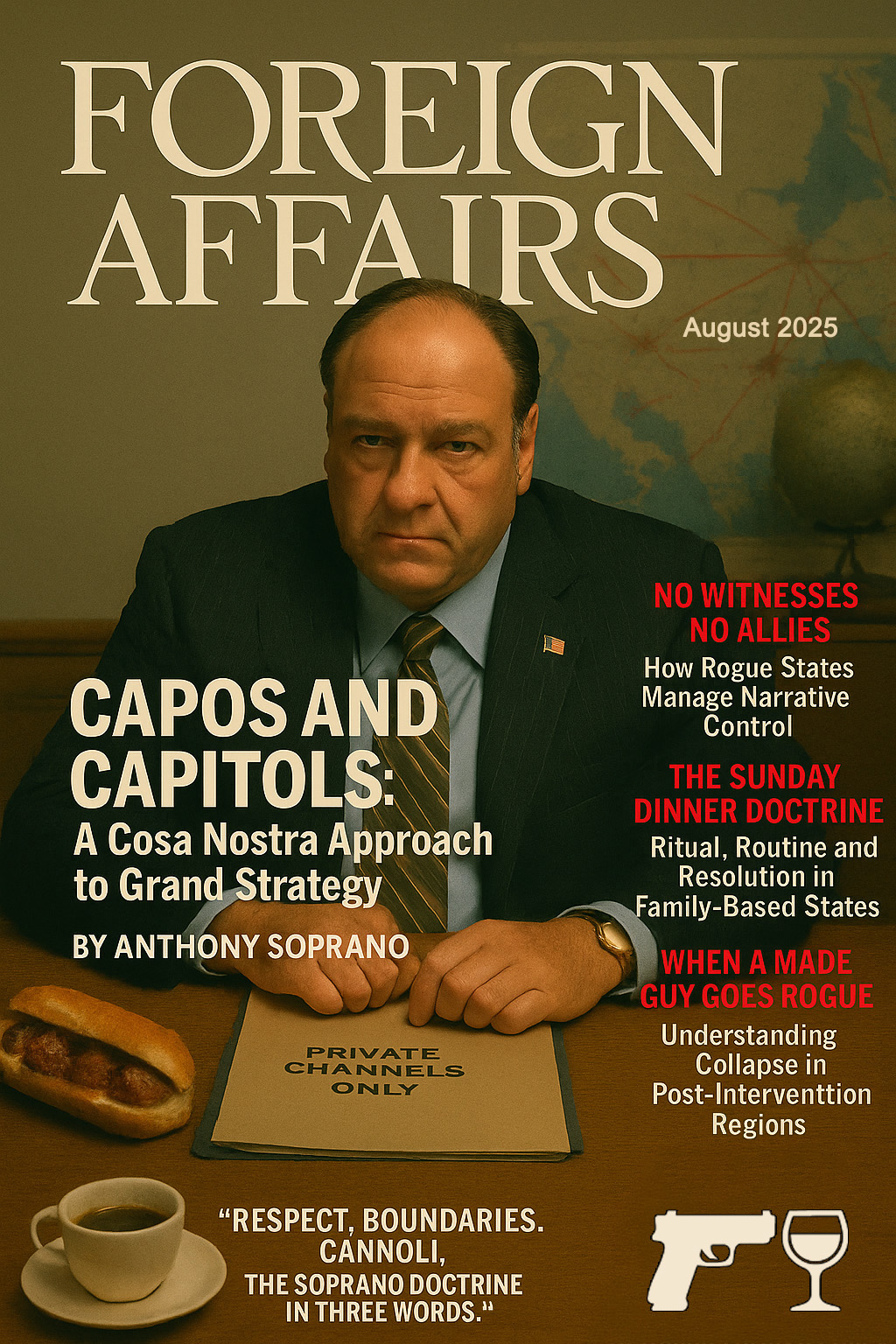
By (the Litbot in) Anthony Soprano (mode)
Foreign Affairs
June 2025
“A don doesn’t move unless he knows where the pieces on the board are. And half the time, he owns the board.”
— Anthony Soprano, private sector strategist and conflict resolution specialist
Business, Not Personal
When I look at the world today—NATO, Russia, China, cyberwar, sanctions, Gaza—I don’t see countries. I see crews. Families. Crews with turf, traditions, rules (some written, most not), and big egos. Now, I’m not saying foreign policy is organized crime.
I’m saying if you want to understand why alliances break, why regimes flip, why wars start over nothing and end for no reason, you should maybe stop reading Clausewitz and start watching a sitdown at Vesuvio’s.
I wasn’t trained in IR theory. Didn’t go to Georgetown or Yale. What I got is experience. Running a crew, managing territory, navigating inter-family dynamics, and staying alive in a business where “soft power” usually means not whacking someone. What I’m offering here is a Cosa Nostra framework for grand strategy—something the boys at Langley might call “nontraditional thinking.” It’s not polite. But it works.
Spheres of Influence: Respect the Territory
Let’s start with the basics: turf. Every family has turf. North Jersey. The Bronx. Southern Italy. Same in geopolitics. Russia’s got Ukraine and the Caucasus in its sphere. China’s got Taiwan and the South China Sea. America? We’ve got the whole Western Hemisphere and whatever oil-rich country we’re pretending to liberate next week.
The problem is when boundaries get ignored. Ukraine is a classic example. From Moscow’s point of view, the West tried to put a flag on its stoop. That’s a provocation. If some guy from Queens starts doing business on Bloomfield Avenue without checking in, there’s gonna be a conversation. You don’t expand without respect. You talk. You offer a cut. You say, “I got no intention of stepping on toes, but we could maybe split Atlantic City.”
A Cosa Nostra model of global order respects spheres of influence—not because it’s morally right, but because it prevents bloodshed. Keep people in their lanes. If you got beef, you call a sitdown. You don’t send drones.
The Five Families: Reimagining the UN Security Council
The United Nations Security Council is a joke. Too many vetoes, too much talking, not enough cannolis. But the structure? That could work—if you ran it like the Five Families. Think about it:
- The U.S. is the Boss of Bosses (for now), but needs consensus to act—or faces rebellion.
- China is the Brooklyn crew—big, ambitious, buying up everything.
- Russia’s the old-school muscle, still living off Soviet street cred, but a little sloppy.
- France is the consigliere—talks a lot, doesn’t fight much, always at the café.
- The U.K.? Ross from Friends. Says they’re in charge but nobody’s listening.
What the UN needs isn’t more speeches. It needs rules of engagement based on mutual recognition of power, face-saving protocols, and private channels. When we had beef between New York and Jersey, we didn’t publish white papers. We met behind Satriale’s. We made eye contact. We carved the turkey. That’s how peace is kept—not with resolutions, but with respect and the credible threat of a trip to the Pine Barrens.
Plausible Deniability: Strategic Ambiguity with a Smile
The CIA didn’t invent plausible deniability. We did. Every move we made, there was a buffer. A guy who knew a guy who knew a guy. Arms-length operations. False fronts. Real estate LLCs.
Same with great powers. You wanna arm rebels? Fine—do it through proxies. You wanna install a friendly government? Do it with donations, media manipulation, cultural exchange. If you’re gonna interfere, at least have the decency to not get caught. Be discreet. Nobody wants to start World War III over some junior officer posting drone footage on TikTok.
Iran does this beautifully. Israel too. America? Slipping. You don’t need to not interfere—you just need to interfere like a gentleman.
Afghanistan: When a Made Guy Goes Rogue
Let’s talk about Afghanistan. Twenty years. Trillions of dollars. Thousands dead. And what do we get? Nothing. Worse than nothing. We get embarrassed. And not even in a funny way, like slipping on ice. In a “we brought our own noose” kind of way.
This was a textbook case of making a guy without knowing him. We backed warlords, politicians, interpreters—we gave out envelopes and medals and called it a government. But nobody there respected our authority. The people we made into bosses? They didn’t run the street. They ran press conferences.
In Cosa Nostra, you don’t make a guy until he’s earned it. Proven. Loyal. Connected. With pull on the block. If he betrays you? That’s on you. And you deal with it. Quietly.
Conflict Resolution: The Sunday Dinner Doctrine
Every family has fights. Every alliance, too. What matters is how you patch it up. That’s where the Sunday Dinner Doctrine comes in.
You sit. You eat. You talk. You don’t bring the gun to the table. You bring the ziti. There’s something about food, routine, ritual—it lowers the temperature. If State Department negotiations happened over baked manicotti, we’d have solved Cyprus by now.
Diplomacy isn’t about being smarter. It’s about being warmer. Giving your rival something they can live with—and maybe even like. You know what made Carmela forgive me that one time? Veal saltimbocca. You know what didn’t work? Apologies, UN speeches, sanctions.
Succession Planning: Power Isn’t Forever
Every don thinks he’s forever. He ain’t. You get popped, flipped, or heart-attacked. That’s why you need succession planning.
Same goes for empires. America’s been boss for a while, but China’s coming up, and the game’s changing. You don’t cling. You adapt. You mentor. You pick successors who won’t shiv you in the shower.
If the U.S. wants to keep influence, it needs to start thinking like an elder capo. Less action, more advice. Less dominance, more brokerage. Build respect. Protect what matters. Don’t chase every fight like a soldier with something to prove.
Final Word from the Bing
I’m not an academic. I’m not a diplomat. I got no think tank, no PhD, no security clearance. What I got is experience, instinct, and a whole lotta bad dreams. I know what keeps a crew together. I know what breaks one. And I know that power isn’t just force—it’s finesse. It’s not yelling. It’s the look you give someone right before you don’t whack them.
So here’s what I’m saying: treat countries like crews. Understand the rules. Respect the turf. Keep your enemies close—and your mother outta your foreign policy, if you can help it.
Capos and capitols. Same business. Different suits.
Now pass the bread.
Anthony “Tony” Soprano was the acting boss of the North Jersey DeCavalcante–Soprano network and now consults privately on territorial management, conflict de-escalation, and alliance discipline. He has no formal training in international relations but knows where most of the bodies are buried, figuratively and otherwise.
Note: This piece of writing is a fictional/parodic homage to the writer cited. It is not authored by the actual author or their estate. No affiliation is implied. Also, the Foreign Affairs magazine cover above is not an official cover. This image is a fictional parody created for satirical purposes. It is not associated with the publication’s rights holders, or any real publication. No endorsement or affiliation is intended or implied.

For ‘Unrealpolitik,’ Foreign Affairs invites a different class of strategist—figures with no formal training, dubious judgment, and a deeply personal relationship with failure—to confront the most urgent geopolitical challenges of our time. Drawn from across cheap apartments, small towns, supernatural enclaves, and failed co-ops, these contributors bring no credentials but considerable lived experience in conflict, negotiation, and emotional collateral damage. Their analyses are inconsistent, often misguided, and occasionally profound. This is foreign policy as seen from the couch, the diner booth, or the break room. The logic is internal. The consequences, regrettably, are real.
Leave A Comment