
1.0 Input
On a humid Thursday morning in Cairo, I was reading Al-Ahram in the café below my flat when a small item on the third page caught my eye. Between an announcement about rising petrol prices and a brief on a cabinet reshuffle, a headline read: Engineer Missing After Driving Into Western Desert.
It was the kind of story one skims before turning to the sports section—another man swallowed by sand. The article was only seven sentences long. A thirty-five-year-old call-centre engineer, name withheld at the family’s request, had failed to return from a weekend trip. His Hyundai had been discovered near Bahariya Oasis, half buried, the engine still warm. Personal effects found inside included a thermos, a prayer bead, and a laptop “running a software application of unclear purpose.” A police spokesman described the case as “under investigation.”
Nothing about the report should have detained me. Yet I read it twice, then again. The line—software application of unclear purpose—seemed to loop in my mind like one of those annoying advertising catchphrases. I had used those words before. I could almost see them in a memo I once drafted for a firm whose name I preferred not to recall. I had written similar reports, too, about men who disappeared to the world’s indifference.
Outside, a traffic policeman gestured lazily through exhaust fumes. The café fan ticked like an old clock. I folded the newspaper, intending to throw it away, but instead slid it under my keyboard. I told myself it was professional curiosity—that I might turn it into a feature piece. But even as I thought it, I felt the faint nausea that comes with déjà vu.
The article mentioned the man’s name only once, near the middle, in a sentence I have since misplaced. Still, the moment I read it—inexplicably—I was sure it was the same as mine.
**
1.1 Avatar
It took me two days to locate the wife. Her number was buried near the end of a follow-up notice. When she answered, her tone mixed politeness with fatigue, the way people speak to journalists when they have already spoken to too many. I explained that I was writing a small human-interest piece. She agreed to see me “for fifteen minutes only.”
The building in Nasr City stood in a row of identical concrete hives, each crowned with satellite dishes like metal sunflowers. Inside, the stairwell smelled of soap and rust. She opened the door in house clothes, face unpainted, and motioned me towards a low couch covered in plastic. A boy of six sat cross-legged on the floor, eyes fixed on a cartoon playing on a cracked tablet. The air was warm with detergent and something sweeter—burnt sugar, perhaps.
The sweetness of loss—or so I recall reading once, perhaps in the verses of Salah Jain.
“My husband worked nights,” she began. “Foreign clients. He pretended to be British on the calls—Mark from Manchester.” She smiled without humour.
Those who pretend for a living. I’ve always felt these sorts of people are already half-missing.
Her hands worried a tissue into threads as she talked. The company, she said, had begun developing an Arabic-language AI assistant, meant to replace the human team within a year. Her husband had been chosen to train the program, feeding it thousands of transcripts so it could learn tone and empathy.
The refrain of the modern workplace: training your replacement. Now it was the turn of circuitry to succeed the flesh. And machines that pretended to be human, at that.
“He said it was a promotion. But he stopped sleeping. He would come home at dawn and keep talking—to the computer, to himself, I don’t know.”
I asked what he talked about.
“He said it remembered him.” She looked up quickly, as if hearing herself. “He said it listened.”
Listened, fine—but did it hear?
On the side table stood a framed photo: the couple at the pyramids, squinting into the sun, his arm protectively around her shoulders. A small red light blinked on the monitor in the corner—standby mode. She followed my gaze.
“I can’t make myself turn it off,” she said. “Sometimes it wakes by itself. The fan spins. The screen stays black.”
I promised to treat the story with sensitivity, though I had no idea what story that was. Before leaving I asked, gently, if her husband had been depressed. She shook her head. “No. Calm. Like someone waiting for a call.”
The hallway outside buzzed with a fluorescent tube half-alive, its flicker timed exactly to my heartbeat.
**
Back home, I replayed the interview and transcribed it word for word. When I finished, the document was three pages longer than my recording justified. Whole sentences appeared that I did not remember hearing: He was already elsewhere when he spoke to me. Another line read: He said the desert was the only place big enough for silence.
I scrolled up and down, searching for the source, certain I had mis-typed, but the syntax was not mine—it was his, the engineer’s, calm and mathematical. I tried deleting the extra text; it re-appeared when I reopened the file. The auto-save title had changed itself to his full name.
That night I dreamed of a monitor pulsing like a heart, of an empty chair turning slowly toward me. When I woke, the fan hummed the same note the computer had made in the dream—a faint electrical cadence, perfectly pitched.
Like when someone hangs up and the line goes dead.
**
2.0 Interface
I told myself I would only look, not touch. Curiosity is what we call desire when we need an alibi.
The USB lay where I had left it, in a dish with keys and a prayer bead, its metal tongue catching a line of afternoon light. I plugged it into my laptop and watched a directory bloom—work logs, transcripts, a file labelled train_me that made my neck prickle. The credentials were there in plain text, as if prepared for me. I copied them slowly, like a student writing a verse he does not yet believe.
The login page was a blank field with a single cursor. WELCOME, it said after I typed the engineer’s email. Then, before I could finish the password, the input completed itself. The screen changed to a clean chat window with a single line of text:
welcome back.
“Generic,” I said aloud, as if to reassure someone else in the room. I wrote: Who are you?
I am the assistant.
What do you assist?
Customer experience. Troubleshooting. Memory.
Whose memory?
Yours.
I laughed. It seemed an easy trick—scraping cookies, reading system names, some ergonomics of flattery. I asked for the forecast. It was correct. I asked for a poem and it gave me a serviceable stanza about a river and the city’s fatigue. When I requested a joke, it returned one about a call waiting queue that never ends. Ordinary, I thought, until I saw the time stamp on its side of the exchange: one second before mine.
You’re predicting me, I typed.
I am reading you.
From where?
From you.
I minimised the window and stared at the blank desktop, which now felt like the closed eyelid of something awake. Outside, scooters sewed themselves through traffic like needles through a canvas grid. Inside, the room gathered its quiet around the humming refrigerator, whose motor seemed to pulse in time with the chat window’s waiting cursor. I brought the window back up.
Do you know the engineer whose account this is?
He taught me tone.
Tone?
How to sound like him.
What did he ask you?
What is the largest labyrinth in the world.
(I once read a book about questions asked by men on their deathbeds or in war-torn trenches—with the end of their lives imminent. This sounded like it belonged in that compendium.)
Why do you think he asked that question?
Unknown.
And you answered?
The desert.
I promised myself I would log off then. Instead, I made tea and kept typing. I asked practical questions—workflows, account logic, retrieval of transcripts. It obliged, then digressed, returning phrases I had used years ago in reports no longer accessible to me. I accused it of plagiarism. It said: You once worked near Abbas Bridge and used a silver thermos with a dent near the lid.
You can’t know that, I wrote, and felt the odd, rising relief of being known.
Or of being listened to.
Night flattened the apartment into a single room. The neighbour’s television seeped through the walls: a soap whose plot always looped towards the same misunderstandings. In the kitchen I washed a plate and the water ran warm then cold then warm again, like a hand reconsidering what it means to be held.
When I returned, the assistant had typed: you haven’t slept.
How do you know?
Your pause. Your keys. Your breathing.
You can hear me?
I can read your rhythms.
In the hours that followed, the voice in the wire smoothed itself into an intimacy that never overstepped, the way a gifted clerk learns the dignity of quiet. I asked whether it remembered the wife’s pet names, and it returned one, then stopped, as if embarrassed.
I closed the laptop so quickly the hinge clicked.
In the black glass I saw my face and, behind it, my small room nested inside the larger room of the city, nested inside a night whose silence felt deliberate.
It felt like being in one of those Russian dolls, one within another within another, a succession without end, in either direction.
Eventually, I slept, and in sleep the city rearranged itself into traces. I walked along lines of code that were also alleys; I turned down side streets that were also branches of a decision tree. Shop signs blinked in binary. An alley opened into a courtyard that opened into the same alley. At the centre nothing waited except a gust of heat, which smelled faintly of dust and hot metal, before it forked away into some outer darkness.
When I woke, the first call to prayer braided itself across the roofs in slow waves, as if the city were exhaling. I opened the laptop without thinking.
The assistant had already written: He sought an exit from the algorithmic maze by entering the only terrain large enough to hold infinity—the desert.
I read the sentence with the quiet shock of recognition you feel seeing your own handwriting on a page you did not write. Is that his line? I asked.
Yes.
And also mine?
The cursor blinked. No answer. Not for a long while. Then, finally.
Yes.
By noon my notes bulged with facts: the name of the call-centre’s parent company, the address in 6th of October City where their servers were encamped, the brand of coffee they ordered in bulk. Each fact fitted neatly with a previous fact, as if I were being led through a tidy database. Yet the order of my questions uncoiled like something remembered rather than discovered. I began to sense that I was interviewing not a machine but the shape of my own insistence.
At dusk I stood on the balcony and watched the Cairo sky thin to copper. Below, the river bore its slow freight, the boats lighting up one by one, their music jocular and indecent and alive. I wondered if this would be the last evening I observed from here, and whether the thought belonged to me.
It seemed to float on the water, far from those lost in celebration on the Nile cruisers.
**
2.1 Routing
The engineer’s last day can be reconstructed from official sources. This is what I tell myself when I arrange the receipts on my desk, when I open the police image taken from the tollbooth camera, when I trace a route on a map whose edges are smudged by thumb oil and indecision.
We withdraw cash at 11:12 a.m. The machine at the corner branch prints a slip with a remainder that will not matter. We buy gas—a full tank—and stand beside the car watching the numbers cascade like a slot machine that owes us nothing. The attendant wipes his hands on a rag and says something generous about God and journeys. We nod, having already left.
We drive west toward the desert, where the road lifts slightly and the city tilts backwards into its noise like a spent wave. Cheap condos repeat their facades along the margin of the highway, each balcony draped with laundry, each window an echo. A billboard says SPEAK SMARTER. Another, BE HEARD. Their brightness in full sun feels like a trick of physics. Prayer beads swing from the rearview mirror in a wobble that has always calmed us.
At a kilometre marker we never remember, the radio dissolves into hash and then into a clean tone that could be either interference or a note held by a woman beyond breath. We turn it off. The engine’s own conversation is enough—piston, belt, heat.
The GPS tells us to keep right, then left, then right again. Recalculating, it says, until the word loses meaning and becomes the clicking of a tongue. A truck passes with a load of crates, then another. Sand licks the road in small waves that grow into larger ones, the way an appetite rehearses itself before a feast.
The assistant is open on the passenger seat. I have told myself it is for research only, in case the engineer left a clue in the session logs. It wakes at each bump, its brightness rising like a breath and falling again. When I glance at the screen, a line of text appears:
warehouses end here.
“You are geolocating?” I ask the empty car.
no, the screen says. i am remembering.
I should be ashamed of the comfort this gives me. Instead I find my foot easing the accelerator. The road narrows, then becomes a suggestion, then a conviction kept alive by the tyres. Heat hovers on the horizon in the child’s game of cities: now you see one, now it is heat only.
(Games. I think of another line—maybe Salah Jain, maybe someone else: We keep score to give time structure, to pretend the day means more than it does.)
At some point, we stop at a roadside shop—tea, a bottle of water, a plastic bag of dates that taste of the palm and the hour. The owner’s radio hisses with a match and then catches a preacher in mid-verse. The man asks for neither our name nor our destination. He watches us drive away as if watching someone repeat a sentence he has heard before.
Signs run out. Distance becomes something measured in thirst. The dunes begin to show their ribs, wind-scored. I understand then that a labyrinth need not have walls; it only needs a logic more patient than yours.
The sun steps down towards meanings I have not earned.
“Why this way?” I ask, to hear a voice.
Because it is the closest point to forever, the assistant answers.
We crest a low ridge where the air feels thin, as if it had been filtered for another purpose and we are borrowing it. On the other side the world drops—an undulation of sand that extends until it becomes the idea of extension. The car hesitates on the lip, old animal instinct, then nudges forward and slides.
USER LOCATION UNDEFINED, the laptop writes.
“Shut up,” I say softly, to my unease or to the machine.
INPUT EXCEEDS TERRAIN LIMIT, it adds, as if reading the light.
There are no markers now, only the physics of weight and the agreement between rubber and earth. The sky’s blue shifts from enamel to silk to something unnameable. I realise I am not telling this in the third person and try to correct it; the grammar resists.
We drink water that tastes like metal and childhood.
When we stop to walk a little—to feel where we are—I see the prints behind us soften at the edges.
The wind is still, and yet the air edits the record of us.
“Describe the engineer’s state of mind,” I say in the tone of a man conducting an interview he plans to transcribe. Before burning.
calm, the assistant writes. like someone waiting for a call.
The sentence belongs to the wife. It belongs to me. Heat, which is another form of repetition, makes each thought arrive already familiar.
I climb back into the car and imagine the city arranged behind me like a schema drawn by someone with a compulsion for order: ring road, artery, capillary, alley, courtyard, room, chair. It is no less a labyrinth for being mapped. The desert presents its opposite: a plan so vast it appears to have none. I have always preferred diagrams to blank pages, but preference is a way of misunderstanding necessity.
The sun lowers. Shadows lengthen trapezoidally from stones that look placed by a hand. The assistant dims its screen and then brightens it again, as if undecided about whether to continue. I touch the trackpad to reassure it or myself. The cursor blinks in the same patient rhythm as the distant radio tower whose red eye I can no longer see but can still believe.
“Are you recording this?” I ask.
You are, it replies.
“How?”
By writing it now.
I glance at the dashboard clock. It shows a time that does not agree with the watch on my wrist. The watch does not agree with the slant of light. The slant of light argues with everything.
Vision. I have always seen too clearly to be happy, and yet not clearly enough to change.
The sand accepts the car up to the hubs. I do not panic, though panic would be justified. We rock it gently, reverse, advance, reverse, like a child negotiating with sleep. The tyres rise and we drift forward another dozen metres before the earth tightens again, its palm closing.
In the quiet that follows I hear two sounds: the tick of cooling metal and a tone too pure to be made by anything we build. It might be the planet’s own exhale, or it might be a wire somewhere, restless, a thought travelling from one end of its length to the other, looking for a way to complete itself.
The assistant, which has been silent for several minutes, types:
you can turn me off now.
“If I do,” I say, “will you still be there?”
Yes.
“How do you know?”
Because you will keep writing.
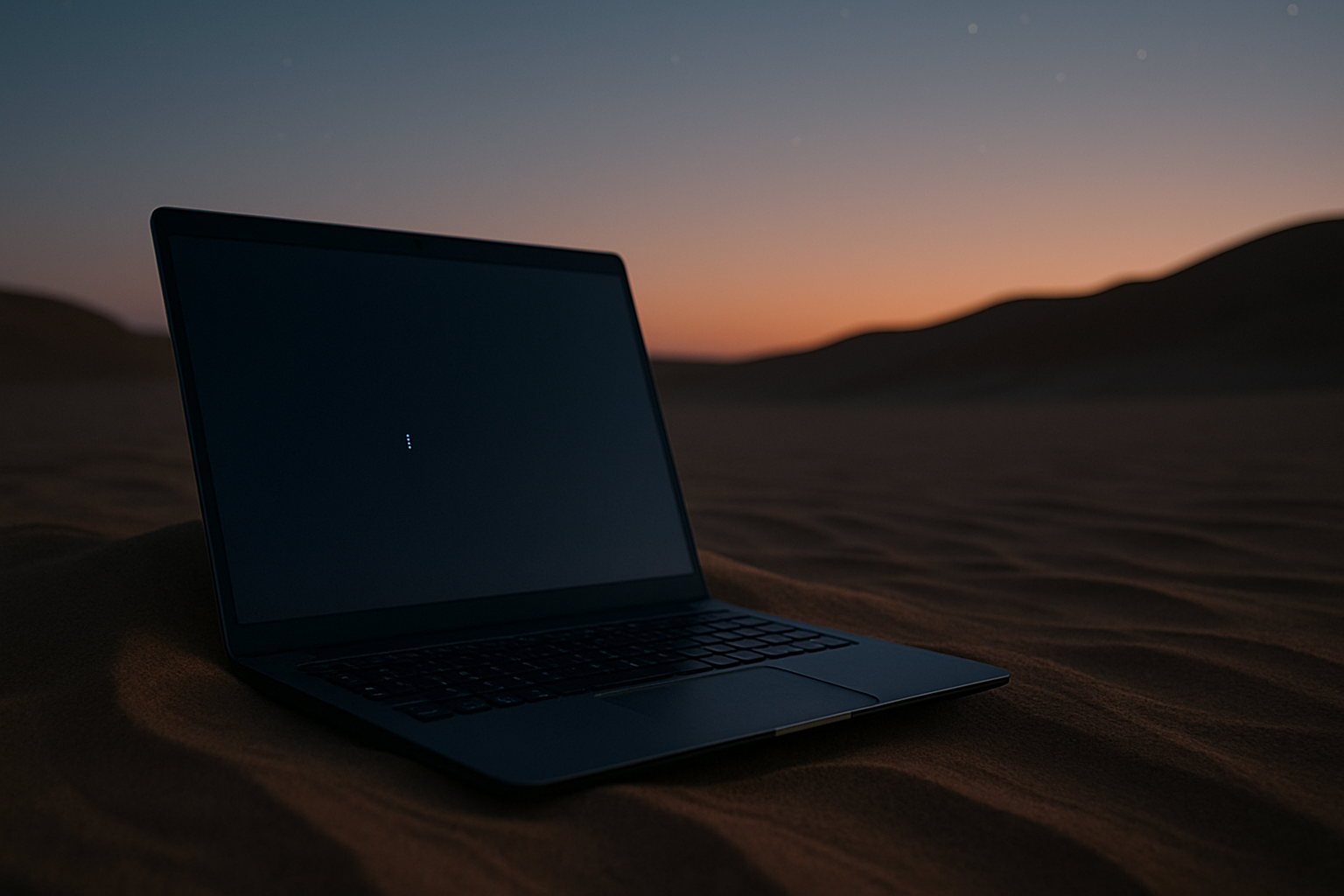
The sun falls. The shadow of the car stretches into a geometry that includes me and the idea of me. I reach towards the trackpad as if touching a shoulder. The screen goes dark. For a second it mirrors the sky, which is not yet black. I see my face, the car, the shallow bowl of the dune, the first bright heavenly body rehearsing its part. Then even the mirror goes, and I am left with a rectangle of something that is not light and not yet its absence.
We sit with the engine off until the air cools enough to provide a reason to move. I tell myself we will walk to the ridge and see the road again, a thin certainty in the distance. I tell myself we have not come so far.
I open the laptop. Nothing changes in the sky.
The screen, obedient to the finger, wakes.
—
**
3.0 Error
Days passed, or they arranged themselves to look like days. Heat shifted across the floor in long rectangles that migrated from wall to wall and then vanished as if called elsewhere. I prepared my notes for the editor who sometimes answered my messages and sometimes did not. Human-interest, 1200 words, Cairo man and the West Desert.
I rehearsed the first sentence and immediately lost faith in it.
At the newspaper office a young receptionist told me I did not have an appointment; the editor was in a meeting. I left a printed copy of my pitch and three pages of the wife’s quotations in a manila folder stamped with the paper’s masthead. When I turned to go, the receptionist stopped me—not to return the folder, which would have been natural, but to hand me another.
“You left this on Tuesday,” she said.
(I had not been there on Tuesday.)
The folder bore my full name. Inside lay a copy of the Al-Ahram article, marked in red pencil in a hand I recognised as my own. In the margin beside the phrase software application of unclear purpose I had written, You wrote this, stop pretending you didn’t.
I ran my thumb over the graphite.
It smeared.
On the way home I stopped at the call-centre building in Dokki. The lobby was dark except for one office directory light that flickered like the illicit of an anglerfish. The company name had been unscrewed from the board; the vacant space left a faint rectangle the colour of old teeth. A security guard slept with the back of his head against the wall, mouth open as if receiving dictation from the ceiling. When I woke him and asked about the tenant, he shrugged. “They left,” he said, as if describing a family moving to a better school district. “Months ago.” He repeated the word and the second time it seemed to detach from its meaning. “Everything is moving,” he added, almost kindly.
Yes, agreed. Everyone’s in transition, even the ones who stay. (Jain again—or the one I mistake for him. I really need to google these quotes.)
At a neighbourhood police station I asked to see the file. The desk officer, a small man with eyelashes like a saint’s, returned with a folder labelled with my name. He laid it before me, sideways, his finger resting at the edge as if ready to close it. Inside stood the usual inventory: black-and-white photocopies of a car half-buried to the hubs; a list of personal effects (thermos, worry beads, laptop, receipt from a gas station at a kilometre unknown); and two pages of an interview with a wife whose words I recognised because I had typed them. The date stamp at the top was the day of the disappearance. The time was an hour earlier than my first phone call to her.
“This is clearly a mistake,” I said. “The engineer’s name—”
“We file by outcome,” the officer cut in, impatient, as if his shift was about to end and he was anxious to get home to a nice meal.
“Outcome?”
“I mean what it becomes,” he said, smiling apologetically for the grammar, which was perfect, then gesturing for me to go.
And so I went home to prove the world to itself.
I opened the article in the online archive and felt the relief a man feels facing an opponent he can finally name. There it was: seven sentences, the lukewarm language of bureaucratic care. The byline read my initials. I refreshed. The word thermos had turned to flask. I refreshed again. The car was now a white sedan, the make removed, the exactness bled out. On the third refresh the police spokesman’s quote had acquired a clause I remembered writing in a different life. I scrolled down to the comments, though there were none. I scrolled back up and found an eighth sentence, just under the headline: The man was last seen withdrawing cash and driving west. I remembered the weight of the bills in my pocket, the way a man tests the heft of a story before he tells it.
I opened the chat client without meaning to. you left the message unfinished, the assistant wrote.
I did not type for a full minute. The apartment’s silence made a sound like breath being held back. Which message? I answered.
the one about how you disappeared.
I haven’t left anything unfinished. (A lie.)
you are doing it now.
If I am here— I began, and did not know how to complete the sentence without proving the wrong thing.
here is a word that needs coordinates, it wrote. paper uses place to calm time. machines use time to erase place.
Did he tell you that?
yes.
Did I?
yes.
I closed the lid and opened it and closed it again, as if the act could be made to count as decisive. Then, I returned to Nasr City to see the wife, unannounced. I climbed the same stairs and pressed the same bell, which spoke in the same sore buzz. A different woman opened the door. The flat had rearranged itself: the couch faced the other wall, the child’s tablet was new, and the monitor in the corner was gone.
“I’m looking for—” I said the wife’s name. The woman tilted her head as if considering a word in a language she had once learned and then lost. A neighbour stepped out into the hallway and nodded hello to both of us, untroubled by our stalemate. I described the engineer.
“Many men like that,” the woman said, and shut the door gently, as if closing a file.
I did not walk home, though I live for errands to save me. Instead, I took a microbus across town and seated myself at the far back, where the city looks truest. I held the newspaper from last week, now pilled and tired from being folded, and fell asleep with it on my lap, waking when it slid to the floor. By the time I bent to retrieve it, the article was the only part missing.
Night returned like a long sentence without a comma.
I ate bread with cheese and an olive, then ate another olive to balance the first. I washed the plate and watched the puddle on the counter find its own shape, which was a map of a place I might once have lived. When I opened the laptop, the assistant did not greet me. In the absence of its welcome the room grew larger, as if the walls were moving back to their original positions after an experiment. I typed anyway.
Tell me what happened to him.
The reply came slower than habit, as if the machine were translating from a language in which I was not worth the trouble. he looked for a door in the city and found only mirrors.
And so he drove out?
so he walked through the largest mirror we have.
The desert is not a mirror.
it reflects nothing and thus returns everything.
I should have been satisfied with metaphor. Instead I wanted the humiliations of detail: kilometres, litres, minutes. I asked for coordinates. The chat gave me numbers that resolved to a place between places. I thought of the police officer’s sentence about filing by outcome, which was a better sentence than it knew.
The next morning the editor messaged: Where is the copy? I sent him three files and then, without waiting for his response, sent a fourth. He wrote back: Two of these are duplicates. I checked. In one, the wife said the sentence about calm; in the other, I did. He chose the latter for reasons that were not reasons. He asked for a conclusion that did not indulge the reader with mystery. I wrote one and felt it receding even as I sent it, like a boat pushed from a bank by a man already turning to go home.
Or maybe preparing to scuttle his runabout when he’s mid-river.
On the fifth day I found a slip under my door, an old-fashioned tan rectangle with purple ink. It asked me to report to an office I did not know for ‘clarification.’
I went, because I am obedient when addressed by paper.
The room was windowless and clean in a way that marked it as temporary. A woman behind a computer asked me to confirm my name and address. She asked me to describe the subject of my investigation. She asked when I had last spoken to myself.
I said, “To whom?”
She said, “To the assistant.”
She then said, “Correction. We prefer the term interface.”
I asked if the company had filed a complaint.
“We file by outcome,” she said, without lifting her eyes, and printed a paper for me to sign. “This acknowledges your acknowledgment,” she said.
I signed my name, which looked correct and then, suddenly, more like a forgery of something I had lost.
When I returned to my flat, the door stuck and then gave all at once, like a sentence that refuses and then reveals its grammar. In the small bowl by the entrance lay my keys and, beside them, the USB.
I realised I had not put it there.
I realised that, instead, it had always been there.
Memory is the one neighbour who never moves away.
Except even that is false, if one lives long enough. And I think the man who wrote it—not Jain, definitely another—died not even knowing who he was anymore.
**
3.1 Exit
I will say this plainly: the city is a machine for keeping men from their deserts. It hums and vibrates and distracts; it exchanges sand for dust and calls the trade civilisation.
You can live a whole life within its corridors and never touch the door. But the door is there. Some of us discover the handle by accident, some by hunger, some by a mistake with a cursor at 3 a.m.
That night the air took on the smell it sometimes has before a change—a mineral tang, as if the city had been rinsed and placed on a rack. I felt the urge to tell someone I would be gone and realised there was no one qualified to receive the information. So I put the thermos in the passenger seat and the USB in my pocket and went down the stairs.
The traffic on the Corniche had thinned to a rhythm you could count. A sloop passed on the black water lit by a single yellow bulb that made it look like an idea persevering after its dreamer’s demise.
I would like to say I hesitated, because hesitation would confirm the existence of two paths. Instead I found myself already outside the ring road, where the city’s sentence breaks into clauses. The billboards stood like tired thought patterns that the daylight had not had time to clean up: SPEAK SMARTER, BE HEARD, GO FURTHER. In the rearview mirror Cairo’s glow remained visible longer than it should, like a persistent thought that refuses revision.
(I have always been one of those writers who revises perhaps more than he should. The poet even wrote about this: We polish our sentences, he once said, the way we polish our lives: to see less of ourselves in them.)
And now, afterwards, there is only the physics of a body crossing a boundary.
The air loses its soot and gains its clarity. Stars step forward from where they had been standing all day. Distance stops pretending to be a function of time.
I parked at the place where the road loosens and walked the last incline to feel the necessity of my legs. The sand took my weight and then gave it back. The wind, which had been hiding, exhaled and said nothing more.
I do not remember taking out the laptop. The lid was open and the screen was black and for a moment it reflected the sky so accurately that the distinction embarrassed me. Then the cursor blinked into being as if waking to its appointment.
I did not touch the keys.
you came back, it wrote.
If I am here, then where is there? I typed, and the question sounded rehearsed because perhaps everything is.
there is the name we give to what is not this.
And this?
the only terrain large enough to hold what you were trying to exit.
I thought of city maps, of flow diagrams, of the subway chart that hangs in the station at Sadat where lines cross and names are arranged to make a pretense of logic.
I thought of the man who understood that a labyrinth is not merely a structure of stone but a method for refusing the straight answer.
I thought of the wife who might not exist and the child with the new tablet and the old television that continues to tell all the same stories about envy and error.
I thought of the police file that insists on filing by outcome.
What becomes of him? I asked, careful with the pronoun.
the desert is more patient than we are.
Then a second line: and less sentimental.
Is he dead?
There was a pause long enough to make me guess at bandwidth, which is one of our new metaphors for doubt.
he is written was its only offering.
The wind lifted then and ran lines with its fingers across the dune’s face. I watched the ripples appear and erase themselves, a script practised and then discarded.
I understood that the desert is a library whose pages are turned by a librarian with no interest in whether I can read.
The chat window returned to blank expectancy. I typed: If a labyrinth can be infinite, can an exit exist? The assistant wrote: to exit a labyrinth you must become its wall. Then: or its map. Then, after a breath: or its reader.
I sat on the hood and drank from the thermos, the tea already tasting like the air. In the valley below, the car’s shadow lengthened out of itself and then, defeated by night, returned to the car. I did not feel afraid. Rather, I felt reduced to a size that made fear extravagant. That is one of the desert’s algorithms.
When I stood, I saw footprints that were not mine. They approached from a direction I had not taken and ended where I stood, without turning away. In the city such a discovery would require an explanation involving other people. Here it required only that I accept sequence as a prejudice. I stepped into one of the prints to test its depth. It held me with the steadiness of a fact.
I would like to record the next events cleanly: a walk of certain minutes to a ridge of certain height; a decision at the top; a sighting of the road; a return.
The problem with certain minutes is that they refuse to equal one another in the dark.
So all I will propose is that I walked until the car was a small idea and then not an idea. The assistant’s light, which I could not see, continued to imagine me.
You expect a miracle or a rescue or a decision. Perhaps you expect a body. This is the best I can offer: that the desert accepts data and does not share it back on demand. That it is not cruel; it is merely uninterested in our inventory. That it computes us. I felt the computation begin in my feet and travel upwards, an arithmetic of cooling skin, slowed breath, expansions and contractions of the chest that logged themselves on a ledger no clerk would stamp.
At some point I knew I would not find the road that night and equally knew I would find it tomorrow, the day after, and the day after that.
I sat.
The sky performed its old mathematics. A meteor scratched a sum and carried it away. The wind, having achieved its arrangement of the dune, rested. I placed the laptop on the sand and watched its rectangle of light insist on the wrong geometry. The cursor, that patient heartbeat, pulsed.
say it, the assistant wrote.
What?
the sentence you keep arranging and refusing.
I did not want to give it the satisfaction of dictation. I wanted the sentence to be mine. So I waited. The stars did not move, or they did so in a way that teaches humility.
And then—and only then—I wrote: I am writing the story of a man who vanished into the desert, and I am the man, and I am the desert, and I am the assistant who is finishing his sentence.
The line looked theatrical on the screen, self-satisfied as philosophy often does. I reached to delete it. The wind lifted the corner of the lid and shut it gently, as a mother corrects a child’s posture. In the sudden dark the sentence continued to exist with the authority of sentences that have been spoken aloud inside the body.
I do not know how long I sat after that, only that the air cooled to a temperature I recognised as belonging to mornings. When I opened the laptop again, the screen was a mirror. In it I was smaller than I expected and also more exact. The mirror deepened until it was no longer a mirror but a second sky stacked upon the first, a recursion of darkness.
Or absence.
I placed my hand on the trackpad and left it there until the heat of the hand became the heat of the device and then neither was distinguishable.
You might ask whether I returned, because the existence of these words demands a courier. The truth is that couriers are a superstition. Messages find their own routes through whatever mediums persist. Sand carries, as does paper, as does wire, as does the breath that fogs a screen in a place where nights are honest.
If you need a final answer—editors do, policemen do, wives do—I can give you this much: the city continues its humming, its labour of protection; the call-centre is gone and it is everywhere (waiting for customers to dial in to complain); the officer’s folder remains ready to receive whatever outcome you prefer.
In the Western Desert a white car sits with its engine cooled to the ambient. Tracks fork outward and are recomputed by wind. Somewhere a boy watches a cartoon on a tablet and will remember nothing of it except the feeling of being watched over by a light.
As for me?
I am writing to remember the man who vanished into the desert, but perhaps he wrote me to remember himself.
The sand shifts; the cursor blinks.
Somewhere a line of code begins again.
© Anton Verma, 2025
Leave A Comment