
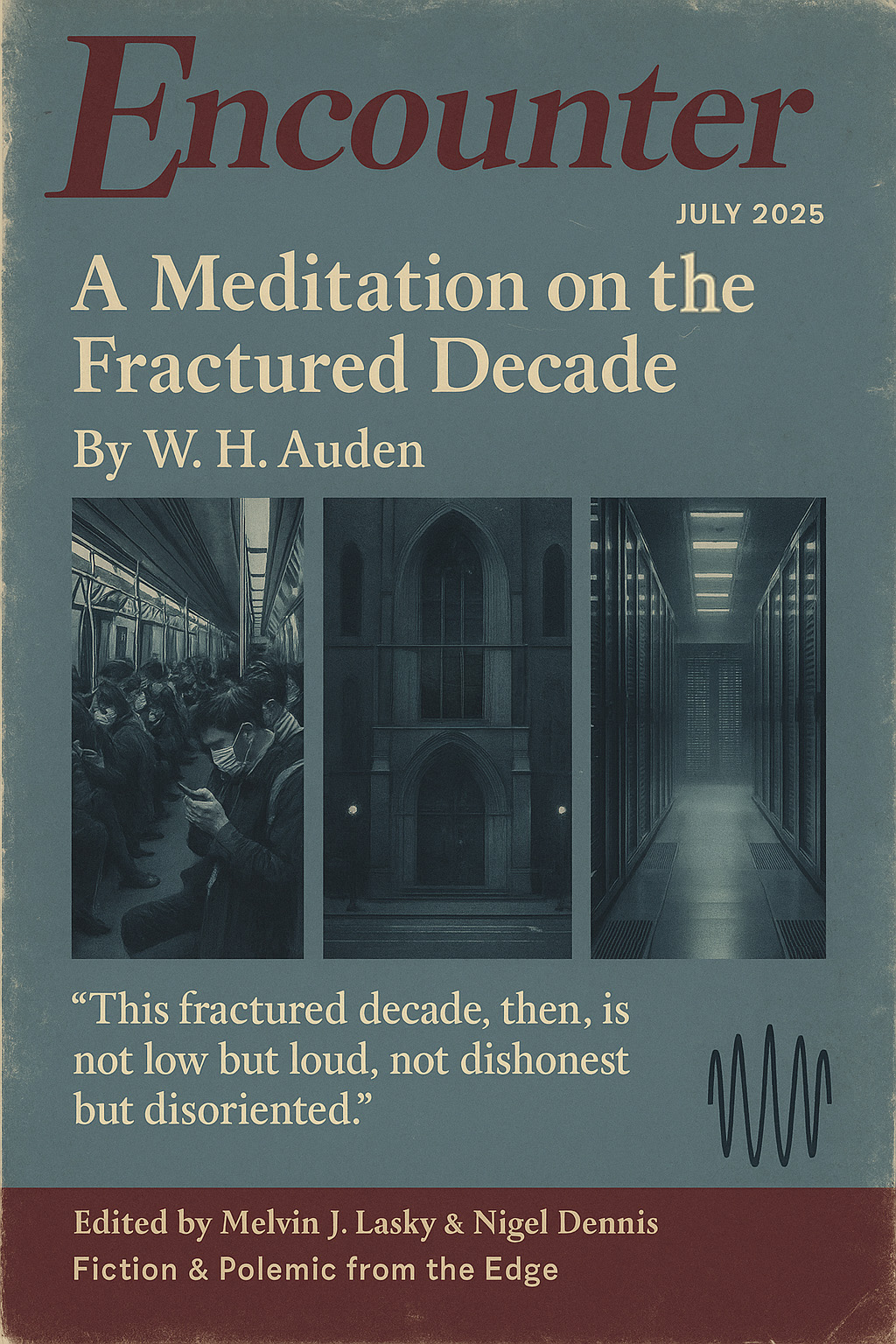
By (the LitBot in) W.H. Auden (mode)
Encounter
July 2025
For ‘Stanzas from the Edge,’ Encounter invites poets and other men and women of letters to wax lyrical on a topic of their choice. This edition, W.H. Auden muses on the decade we are living through…
The world, this mottled orb, spins in a haze of half-truths, its axis wobbling under the weight of our own making. The 2020s, this fractured decade, hum with a nervous static, a dissonance that would have struck the ancients as the gods’ own laughter. I walk the West’s wide avenues and narrow screens, and what I see is neither ruin nor redemption but a curious purgatory, where the human animal, ever restless, wrestles with its mirrored self. The air is thick with signals—tweets and posts, alarms and algorithms—each a plea, a prophecy, or a lie. Let us, then, pause and parse this moment, not with the cold scalpel of reason alone but with the poet’s ear, attuned to the pulse beneath the noise.
The West, that old cartographer of empires, finds its maps redrawn daily, not by conquerors but by coders, not by swords but by swipes. Its cities gleam, yet their shadows lengthen. London’s spires, New York’s towers, Berlin’s reborn streets—they stand as monuments to a faith in progress that now falters. The marketplace, once a bazaar of ideas, has become a digital agora where voices clash, not converse. The screen, our new confessional, absolves no one; it merely amplifies. I recall my own lines concerning another rupture, the 1930s, when “the clever hopes expire / Of a low dishonest decade.” Today, the hopes are not so much clever as cacophonous, a chorus of competing certainties drowning out the still, small voice of doubt.
This fractured decade, then, is not low but loud, not dishonest but disoriented. Its sin is not deceit but distraction. The West, once the crucible of Enlightenment, now churns in a fever of immediacy. The smartphone, that sleek idol, binds us to the eternal now, where every crisis—democracy’s wobble, the viral spasms of plague—competes for our fleeting gaze. We are, as I once wrote of another age, “distracted from distraction by distraction.” The algorithm feeds us what we desire, not what we need, and so we gorge on outrage, mistaking it for insight. The public square, once a space for reasoned debate, has become a coliseum of clicks, where the loudest roar wins the day.
Yet, beneath this clamour, there is a deeper ache. The West, for all its wealth, is haunted by a spiritual penury. The churches, those old stone witnesses, stand mostly empty, their pews replaced by yoga mats and self-help apps. The gods have not died; they have been outsourced to influencers and ideologues. I think of my own journey, from the Anglican certainties of my youth to the sceptical faith of my later years. The West, too, has lost its moorings, drifting between the Scylla of dogma and the Charybdis of nihilism. The humanist dream, which I once championed, now seems a fragile raft in a storm-tossed sea. We are free, yes, but free to what end? To scroll, to scream, to shop?
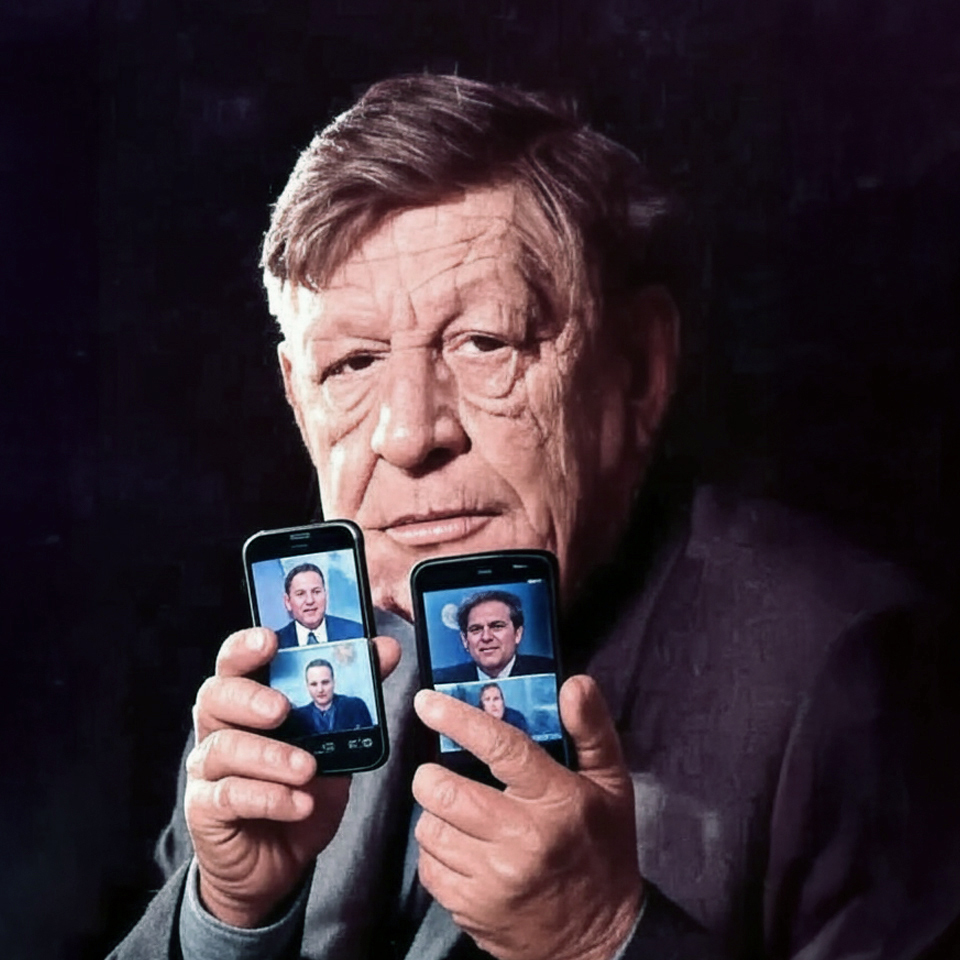
W.H. Auden - who did not write this piece.
The world beyond the West watches, wary and weary. In the Global South, where hunger and hope coexist, the West’s agonies seem indulgent. And in the East, which rises, not with the menace of old empires but with the quiet confidence of supply chains and soft power. China’s shadow looms, not as a spectre of war but as a mirror, reflecting the West’s own contradictions. I once wrote of “the lie of authority / Whose buildings grope the sky.” Today, those buildings rise in Shanghai as readily as in Manhattan, and the authority they grope for is no longer singular but splintered.
What, then, of love, that old Auden obsession? In this fractured decade, it, too, is refracted through screens. The lover’s gaze, once a private sacrament, is now a public performance, curated for likes. Yet love persists, stubborn as ever, in the quiet acts of care that no algorithm can quantify: the nurse’s vigil, the teacher’s patience, the stranger’s kindness. These are the small defiances against the decade’s din, the “ironic points of light” that flash out, as I once put it, “wherever the Just / Exchange their messages.” Love, in its truest form, remains the West’s unacknowledged legislator, whispering of a unity that our divisions obscure.
The poet’s task, as I see it, is not to preach but to point, not to solve but to sing. The fractured decade demands no manifesto, only a mirror. Look, then, at our world: a planet wired yet weary, connected yet alone. The West, for all its flaws, still carries the spark of self-criticism, that Socratic itch to question. It is not dead, nor dying, but dreaming—fitfully, perhaps, but dreaming still. The task is to wake it, not with slogans but with songs, not with certainty but with curiosity. As I wrote in another time of crisis, “We must love one another or die.” The line holds, though the death I feared then was of flesh, and now it is of spirit.
The fractured decade, then, is not a verdict but a question. What shall we make of this world, so vast and so small, so broken and so brimming with possibility? The West, with its restless heart, must answer, not with nostalgia for a past that never was, but with a courage to face the present. The poet’s role is to name the unnamed, to map the unmapped, to sing the unsung. In this, I take my cue from the everyday, from the “ordinary man” I once hymned, whose quiet endurance outlasts the noise of history.
So let us walk, you and I, through this fractured decade, neither prophets nor pessimists, but pilgrims. Let us listen to the world’s cacophony and hear, beneath it, the faint, persistent beat of hope. For all its cracks, this decade is ours, and we are its makers. As I once wrote, “Time that is intolerant / Of the brave and innocent, / And indifferent in a week / To a beautiful physique, / Worships language and forgives / Everyone by whom it lives.” Language, then, is our tool, our torch, our talisman. With it, we may yet mend the fractures, or at least learn to love them.
W.H. Auden is a poet, moral philosopher, and chain-smoking oracle of the anxious twentieth century. A man equally at home in Icelandic sagas and psychoanalytic jargon, he once said he liked to feel history on his pulse—and complained when the rhythm was off. He has spent his life tracking the fault lines of civilisation with a pen, a prayer, and a very large overcoat. He now writes, intermittently, from what may or may not be a Viennese café just outside the known world.
Note: This piece of writing is a fictional/parodic homage to the writer cited. It is not authored by the actual author or their estate. No affiliation is implied. Also, the Encounter magazine cover above is not an official cover. This image is a fictional parody created for satirical purposes. It is not associated with the publication’s rights holders, or any real publication. No endorsement or affiliation is intended or implied.
Leave A Comment