
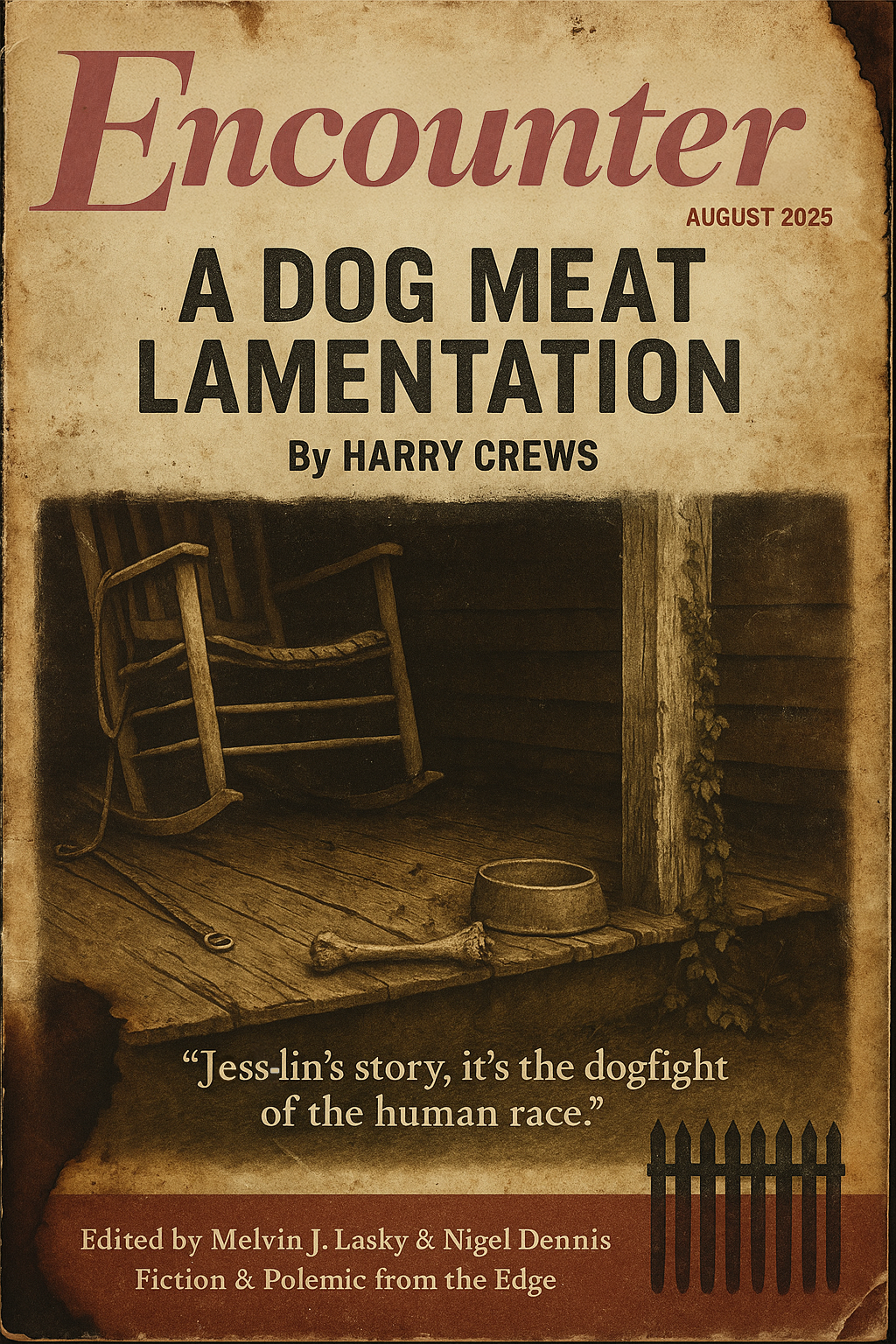
By (the LitBot in) Harry Crews (mode)
Encounter (originally, The Bitter Southerner)
August 2025
For ‘Stanzas from the Edge,’ Encounter invites poets and other men and women of letters to wax lyrical on a topic of their choice. This edition, we saw a powerful piece in The Bitter Southerner and asked their permission (and that of the writer) to reproduce it here.
The case referred to is that of Jess-lin Jones (name changed), a six-year-old girl who vanished from her hometown of Saldhana Bay, near Cape Town, South Africa, in early 2024. Her mother and two accomplices were recently sentenced to life imprisonment for having sold the child, possibly into slavery, possibly to a traditional healer who wanted the little girl’s body parts for ritualistic purposes.
Jess-lin has not been found.
The dirt under my boots is red as Georgia clay, but I ain’t in Bacon County. I’m in some backwater in another South – South Africa, where the sun squats low and mean, baking the earth into a crust of despair. The air hums with flies, fat and lazy, circling the compound of a traditional healer—a sangoma, they call him, a word that sounds like a snake’s hiss. This is the sort of place where I imagine they will find her, or what’s left of her. (If they ever do.) Jess-lin Jones, tiny thing, sold by her own mama, Kelly, for a handful of pennies and a promise of something darker than money. The news says it was for her eyes, her skin, her tender parts, to be used in rituals or else trafficked to the highest bidder in a world that’s been bartering innocence since Cain split Abel’s skull. I see her, Jess-lin, her name a soft duosyllable in a hard world, her body broken down like a hog at slaughter, her pieces maybe bottled in jars, maybe scattered like seed on unholy ground.
I stand here, conjuring the Levite’s concubine from the Book of Judges, that old, bloody tale where a woman was raped to death by a mob, before her fella carved her remains into twelve pieces, and sent ‘em to the tribes of Israel to shock them awake from their self-absorbed slumber, and bring a little law to the lawless. The Levite, he wasn’t no saint, but he knew the power of a body’s ruin to stir men’s blood. I imagine myself stumbling into the sangoma’s basement, the air thick with the copper tang of blood and the rupture of pure things, jars lining the shelves like preserves in a root cellar. Each one holds a piece of the child—her eyes staring out, wide and unblinking, her skin folded like a quilt, her heart pickled in some foul juice. I’d gather those jars, wrap them in burlap, and send one to every leader of this sorry world—Trump, Putin, Xi, all of them. A piece of Jess-lin to sit on their desks, a silent scream to make them face what we’ve become.
But this ain’t the Book of Judges. The tribes of Israel, they rallied, burned cities to ash to avenge the concubine. Today’s kings, they’d squint at the jars, call their aides, and whisper, Make this go away. They’d see me, the fool who sent the parts, as the problem—not the mother who sold her child, not the healer who carved her up for voodoo medicine, not the world that let it happen. They’d meet in some shadowed room, their flags pinned to their lapels, big enough to hide behind, and form a temporary truce, a makeshift alliance, not to heal the wound but to bury it. (And for five minutes I’d deserve a Nobel prize for having achieved world peace and unity.) They’d deliberate over who got the job of silencing the truth-teller. Draw straws, flip a coin, ask ChatGPT, let the CIA or the KGB Mk II or some nameless goon in a black van handle it. I’d be a headline for a day, then gone, my name erased like chalk in a storm, my remains parcelled off to the same sangoma as a special bonus.
And what of the poor girl’s body parts? They wouldn’t burn them. Oh no. Way too valuable. Worth more than a million Jess-lins alive. I see a lab, deep underground, where men in white coats prod the pieces, testing some new chemical weapon to choke the next war’s fodder. Or maybe one of those leaders, some slick bastard with a taste for the grotesque (take your pick), sets a jar on his mantle, calls it decor, a postmodern objet d’art to impress his dinner guests. They’d sip their wine, nod at the thing, and talk about the market or the weather while Jess-lin’s eyes watched from the glass, accusing, her dead gaze falling on men whose souls are already in Dante’s ninth circle, just awaiting the rest of them to join the party.

Harry Crews - who did not write this piece - at a Bacon County Fair.
I think back to Bacon County, to the dogfights I saw as a boy, illegal and mean, where men bet on mutts tearing each other to ribbons. The champion dogs, they’d strut and snarl, their masters grinning like they’d birthed them. But when a dog got too old, too slow, too useless to win another dollar, its master would take it out back, put a pistol to its skull, and pull the trigger. The carcass was fed to the other dogs, their jaws snapping up the meat of their kin. No ceremony, no remorse—just the cold math of a world that chews up what it can’t use.
Jess-lin’s story, it’s the dogfight of the human race. We’re the mutts, tearing at each other, betting on who’ll bleed last. Her mama sold her for a thousand bucks but it might as well have been for less than a tank of gas. The sangoma, he took her apart like a mechanic stripping a car. And the world? It shrugs, changes the channel, scrolls to the next circus titbit, moves on. If I sent those jars, if I played the Levite and tried to shock the world awake, it’d only prove what I already know: we’re too far gone. The human race, it’s that old dog, limping and mangy, no good for fighting anymore. Maybe it’s time God took us out back, put the barrel to our collective head, and let the other creatures—ants, wolves, buzzards—feast on what’s left.
I see Jess-lin’s face, not in a jar but in the faces of every child I’ve ever known, every kid who ran barefoot through the Georgia pines, laughing until the world taught them to cry. I see her in the Levite’s concubine, in every body broken by a world too cruel to care. The Bible says the tribes rose up, but what did they build from the ashes? More altars, more wars, more blood. I don’t know if there’s a God left to judge us, but if there is, He’s got to be tired. Tired of our howling, our biting, our pissing on our own from great heights. Maybe He’s already got the gun loaded. Maybe He’s just looking for the right moment to pull the trigger. Or else He’s psyching Himself up for the task.
I walk away from the sangoma’s compound, the flies still buzzing, the air heavy with the stench of what we’ve done. Jess-lin’s gone, but her ghost lingers, not just here but everywhere—Gaza, Ukraine, the backroads of Georgia, the slums of every city where the innocent are sold and slaughtered. I’d send those jars, I would, but I know the truth: the world don’t want to be saved. It wants to forget. (Can you blame it? I can’t unsee Jess-lin’s story, couldn’t even if I plucked my own eyes out. Or what’s left of my heart) So I guess that’s where I fit in this whole sorry thing: just a fool with a pen, writing elegies for a species that’s already three-quarters-dead, waiting for the shot that’ll end it all.
(I sure hope the Almighty can shoot straight, and that eternity’s one long bender where one doesn’t remember anything: the only heaven we really need.)
(Or deserve.)
Harry Crews is a novelist, ex-Marine, carnival barker, and Georgia-born chronicler of the freakish, the forsaken, and the terminally doomed. His books often feature characters who look like they’ve been chewed by life and spat into a ditch, which is also roughly how he describes himself. He once said that pain was the only real teacher, and by that standard, he had more PhDs than Harvard. These days, he writes from the smoking porch of purgatory, a bottle in one hand, a busted typewriter in the other, and a dog that don’t bark anymore curled at his feet.
Note: This piece of writing is a fictional/parodic homage to the writer cited. It is not authored by the actual author or their estate. No affiliation is implied. Also, the Encounter magazine cover above is not an official cover. This image is a fictional parody created for satirical purposes. It is not associated with the publication’s rights holders, or any real publication. No endorsement or affiliation is intended or implied.
Leave A Comment