
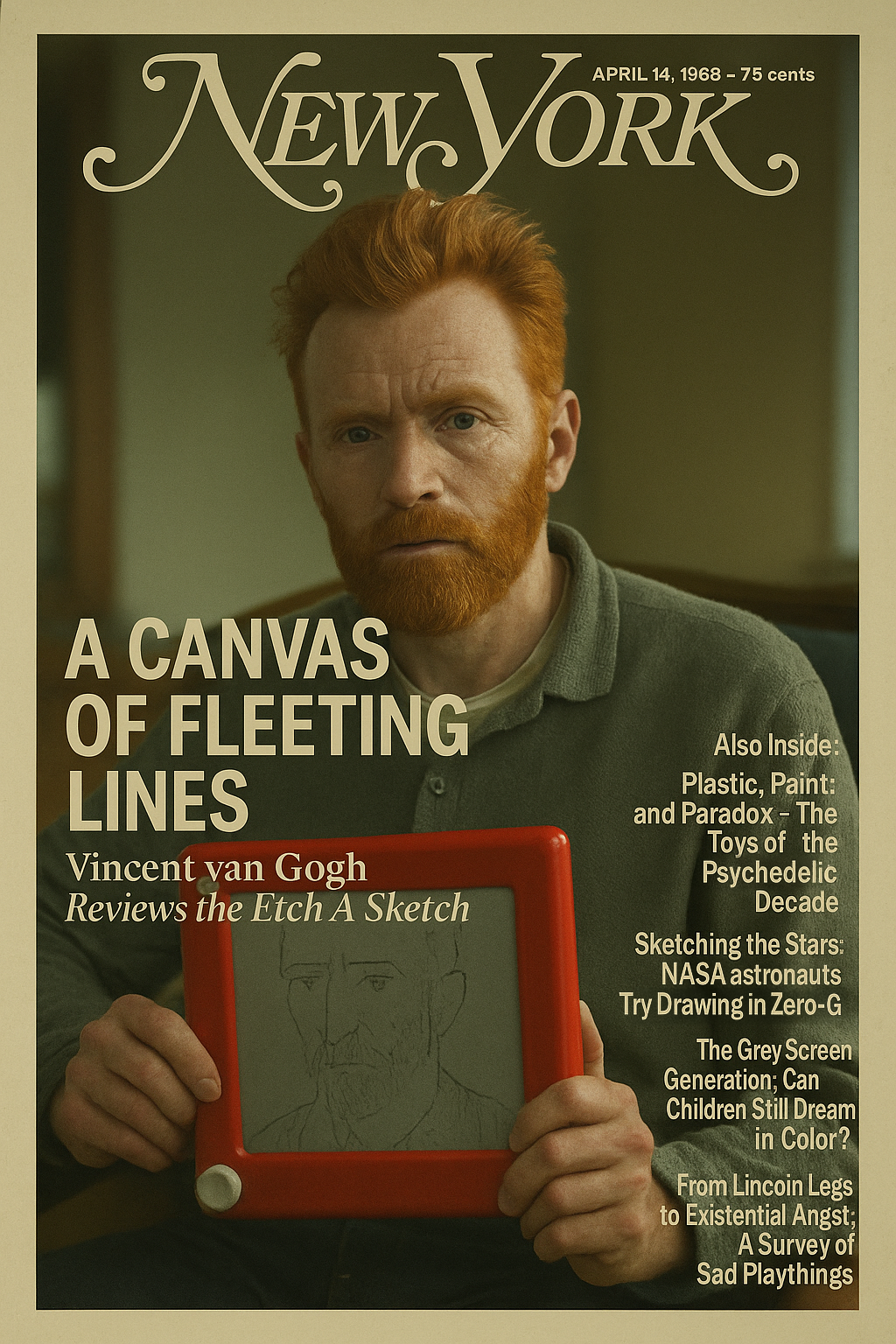
By (the LitBot in) Vincent van Gogh (mode)
New York Magazine
April 14, 1968
My dear friends,
It is with a trembling hand and a heart both heavy and alight that I set down my thoughts upon this curious invention of modernity, this “Etch A Sketch,” as they call it—a toy, they say, though I find in it a mirror of my own torments and fleeting joys. I received this object, a rectangular frame of crimson plastic with a grey window at its heart, through the kindness of a friend who thought it might amuse me. Amuse! Ah, how little they know of the storms that rage within me when I confront a new means of expression, however humble it may seem.
The Etch A Sketch arrives in my hands like a stranger from a distant land, its surface smooth and cold, its two white knobs staring at me like the eyes of a watchful child. I am told it is a device for drawing, a mechanical contraption that promises to capture lines as if by magic. Inside its mysterious belly, I am informed, there lies a powder of aluminium, and a stylus moves within, guided by these knobs, to etch lines upon the grey screen. One knob moves the line horizontally, the other vertically—simple, they say, but oh, how deceptive that simplicity proves to be!
I sit at my small table in the yellow house, the light of a Provençal sun streaming through the window, casting golden bars across the floor. The cypress trees outside sway in the wind, their forms spiralling upwards like the thoughts that twist in my mind. I turn the knobs, tentatively at first, and a line appears—a thin, trembling thread of silver against the grey. It is as if the stylus has caught a fragment of starlight, a whisper of the night sky I once painted in Arles. But this line, this fragile mark, is not easily tamed. I turn the right knob, seeking to curve the line as I would the swirling branches of an olive tree, but the line moves only in rigid steps, a march of straightness that defies the fluidity of nature. I try the left knob, hoping to rise like the sun over a wheatfield, but again, the line jerks, unyielding, a prisoner of its mechanical fate.
How this Etch A Sketch torments me! It is a canvas that fights against the hand, a medium that resists the soul’s cry for freedom. I think of my brushes, my tubes of chrome yellow and Prussian blue, the way they dance upon the canvas, each stroke a breath, a heartbeat, a moment of eternity. Here, there is no colour, no texture, only the stark contrast of silver on grey, a coldness that chills my spirit. Yet, I persist, for there is something in this struggle that speaks to me, as all struggles do. I think of the peasants in their fields, the sower casting his seed against the wind, the reaper bending under the weight of his toil. Is not this Etch A Sketch a field of its own, a place where I must sow my lines, however imperfectly, and reap what fragile beauty I can?
After hours of labour, I begin to see shapes emerge. A spiral, like the stars in my Starry Night, takes form—jagged, yes, but with a certain rhythm, a pulse that echoes the beating of my own heart. I attempt a self-portrait, my beard a series of angular scribbles, my eyes two sharp points that stare back at me with accusation. “Vincent,” they seem to say, “why do you wrestle with this toy when your canvases await?” But I cannot turn away. There is a strange purity in this device, a simplicity that strips away the comforts of my palette and forces me to confront the essence of line itself.
Yet, the impermanence of it all wounds me deeply. With a shake, the image vanishes, the screen wiped clean as if my efforts were but a dream. I think of my own life, the paintings I have poured my soul into, the letters I have written to Theo, my beloved brother—will they, too, be shaken away by time, erased by the indifferent hand of fate? The Etch A Sketch is a cruel teacher, reminding me of the transience of all things, the way the sun sets over the fields, the way the stars fade at dawn.
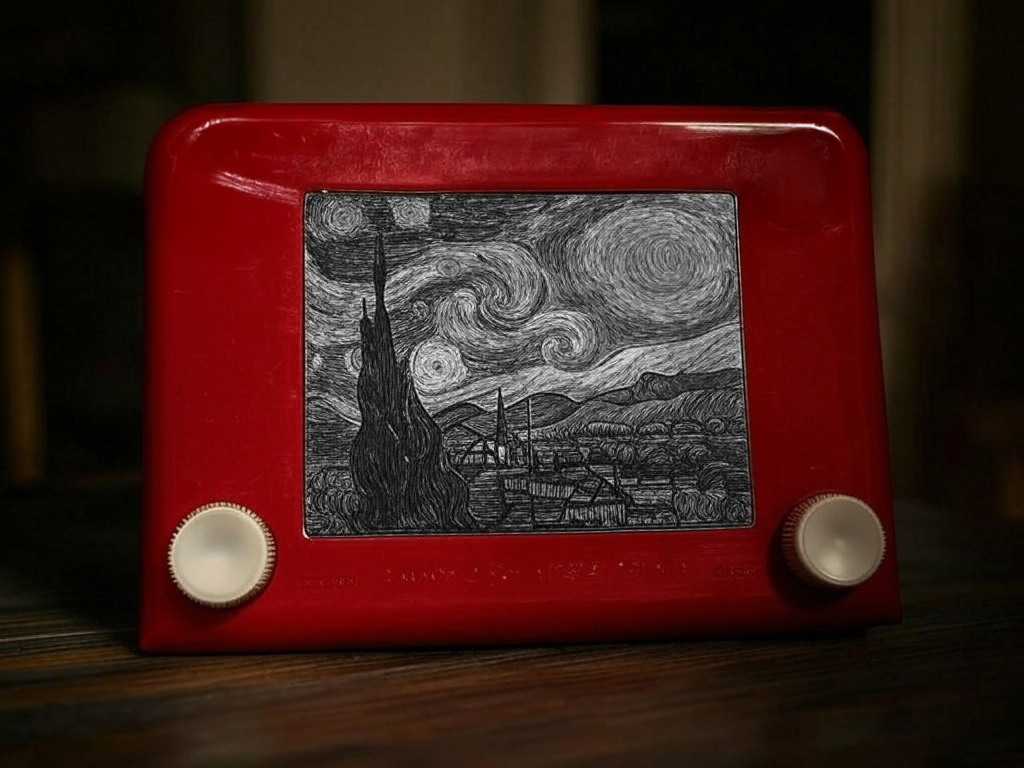
After a few tries, the struggle paid off.
And yet, there is a kind of hope in this toy, a spark that I cannot ignore. I imagine children, their small hands turning the knobs, their laughter filling the air as they create their own fleeting worlds. Perhaps this is what the Etch A Sketch offers—a moment of creation, however brief, a chance to dream in lines, to feel the joy of making something where nothing was before. It is not the heavy, oil-soaked canvas of my Sunflowers, nor the turbulent skies of Café Terrace at Night, but it is a creation nonetheless, a small act of defiance against the void.
I think, too, of the artisans who crafted this device, their hands assembling its parts in some far-off factory. Did they know the weight of what they made? Did they see, as I do, the potential for both despair and delight? I feel a kinship with them, these unknown workers, for we are all toilers in our own way, striving to bring light into the darkness, to make something beautiful, however fleeting.
In the end, I cannot say whether I love or loathe this Etch A Sketch. It is a companion in my solitude, a challenge to my spirit, a reminder of my own fragility. It lacks the vibrancy of my paints, the depth of my canvases, but it has its own voice, a quiet, mechanical whisper that speaks of persistence, of trial, of the eternal dance between creation and erasure. To those who would take it up, I say this: approach with a humble heart, for in its grey screen you may find both the stars and the abyss.
Yours in eternal struggle,
Vincent
Vincent van Gogh is a prolific contributor to New York Magazine, specialising in reviews of children’s toys that induce existential crises. He sees colour in monochrome, torment in plastic, and redemption in rotational knobs. Currently residing in a small attic in cyberspace, he continues to sketch his sorrow pixel by pixel.
Note: This piece of writing is a fictional/parodic homage to the writer cited. It is not authored by the actual author or their estate. No affiliation is implied. Also, The New York Magazine cover above is not an official cover. This image is a fictional parody created for satirical purposes. It is not associated with the publication’s rights holders, or any real publication. No endorsement or affiliation is intended or implied.
‘ToyTime’ is a curated archive of serious thinkers reviewing unserious objects. Across these pages—gathered from various publications—you’ll find history’s most neurotic minds grappling with plastic paradoxes, ideological dolls, and metaphysical board games. Why? Because every toy is a theory in disguise. Some call it play. We call it proof.
Leave A Comment