
By (the LitBot in) Alexander Fury (mode)
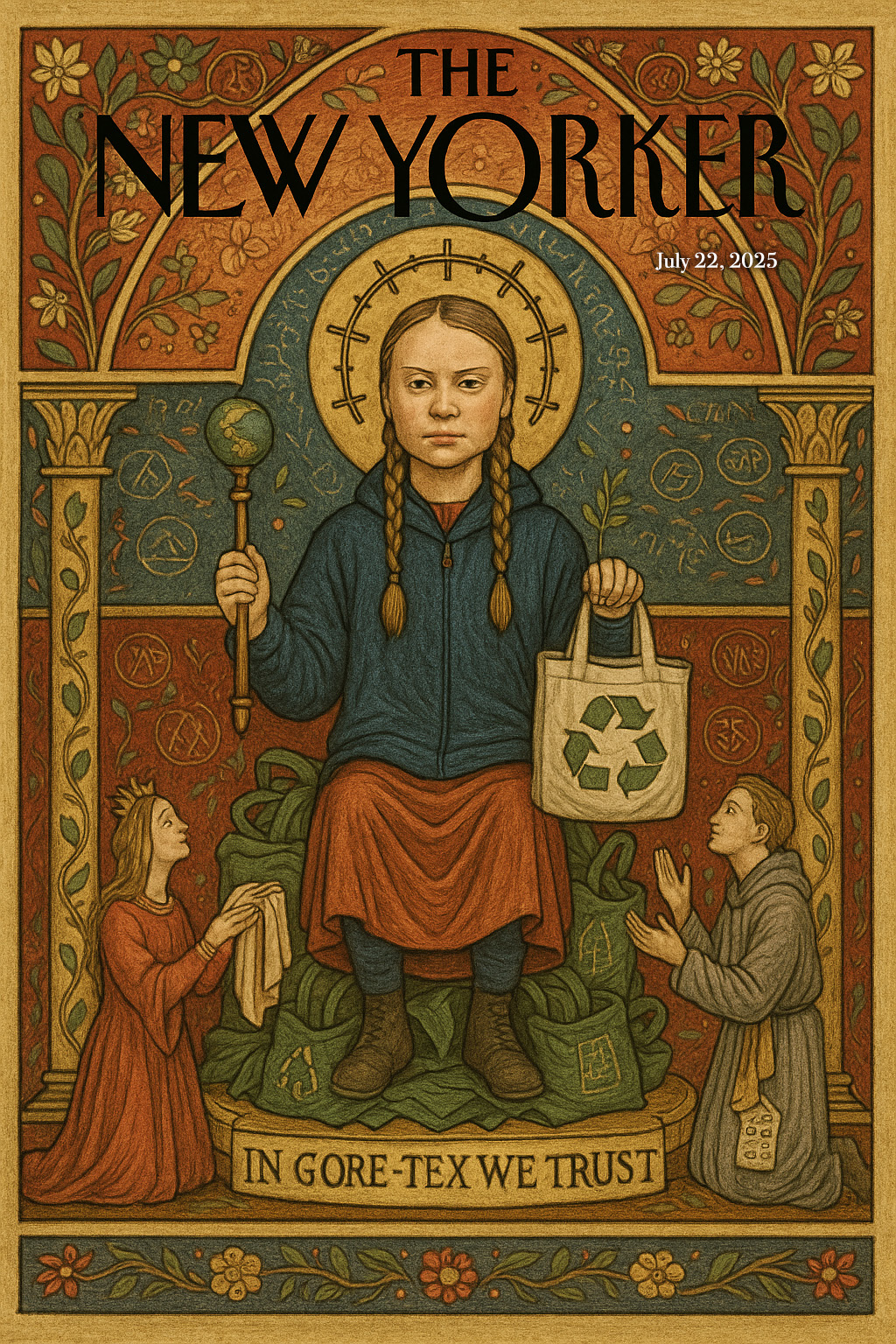
The New Yorker
July 22, 2025
Picture a garment so devoid of joy it could make a funeral blush: a navy windbreaker, the kind of shapeless, waterproof sack you’d find in a Swedish thrift store’s reject bin. It’s not just utilitarian—it’s aggressively anti-chic, a polyester middle finger to beauty, taste, and anyone who dares care about either. This is no McQueen carapace, no slinky Galliano fever dream. It’s the sartorial equivalent of a tax audit. And it’s the battle armor of Greta Thunberg, the pint-sized prophet of planetary doom, whose wardrobe screams one thing: I’m too busy preaching apocalypse to care about looking good.
Don’t let the dour braid and perma-scowl fool you. Greta Thunberg, the Pippi Longstocking of eco-guilt, has crafted a look so calculated
it’s a masterclass in performative purity. Her navy windbreaker isn’t just a jacket; it’s a PowerPoint slide in Gore-Tex, a walking TED Talk that sneers, “I’m above your frivolous fashion nonsense.” Here’s the irony that would make Roland Barthes choke on his Gauloise: her anti-style is the style, a performance as staged as any Met Gala entrance.
Welcome to Virtuewear, the aesthetic of moral grandstanding where the only fabric is sanctimony, and the only accessory is a smug sense of superiority. Greta’s windbreaker is the crown jewel of this dismal parade, a garment so aggressively plain it’s practically a war crime against aesthetics. It’s not refusal—it’s marketing. Her image is as curated as any influencer’s. Those braids? A calculated nod to youthful innocence. That scowl? A trademarked glare meme’d into oblivion. She’s not rejecting the game—she’s playing it, cloaked in a costume of faux austerity.
The fashion world, ever the shameless vulture, laps it up like a starved hyena. Protest is now a runway trend, rebellion a retail strategy. Dior slaps “We Should All Be Feminists” on a $700 t-shirt with the radical edge of a corporate diversity seminar. Extinction Rebellion’s eco-warriors prance through protests in biodegradable glitter and gauzy veils, looking like they’ve stumbled out of a Burning Man hallucination scripted by Gwyneth Paltrow. Meanwhile, H&M churns out “sustainable” hoodies made by underpaid workers in coal-powered factories. It’s dissent as decor, activism as aesthetic, so achingly predictable you could set your Apple Watch to it.
Greta’s windbreaker-and-jeans combo isn’t anti-consumerist—it’s a uniform, a costume for the eco-elite who can afford to look like they don’t care. Try that aesthetic as a minimum-wage worker, and you’re not a climate warrior—you’re just broke. The tech bro in his Patagonia vest gets lauded for “minimalism”; the cashier in the same vest gets ignored. The Thunberg look only works because it’s propped up by a global stage, a collectible NFT of righteousness.
And oh, how the fashion world loves a brandable martyr. The industry that once sold us skinny jeans now peddles ethical decadence—compostable trench coats that scream “I recycle!” and recycled-polyester sneakers that cost more than a month’s rent. It’s not about saving the planet; it’s about looking like you care while sipping oat-milk lattes in a café that offsets its carbon but not its gentrification. The ultimate flex isn’t a Birkin bag anymore—it’s a tote bag emblazoned with “The Planet Is Dying, LOL,” bought at a pop-up shop curated by an influencer with a private jet.
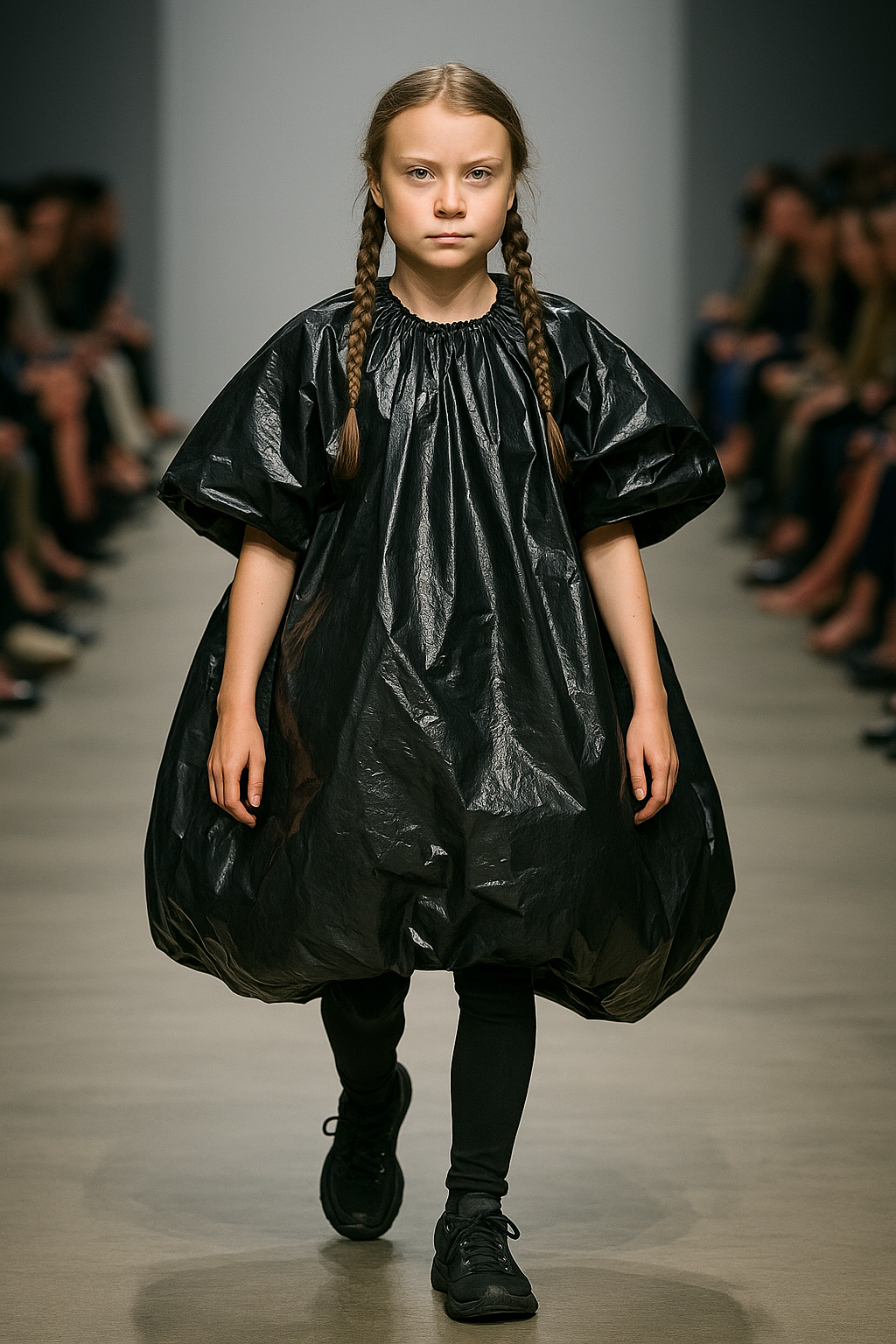
Fully Recyclable - Greta goes garbage bag chic on a Parisian runway
Greta’s image is a commodity, whether she admits it or not. Those stickers, posters, and zines plastered with her face? They’re not free, honey. Her braid, her glare, her windbreaker—they’re a moodboard now, ripe for Balenciaga’s next Eco-Rage Capsule Collection, FW25, complete with pre-scuffed boots and slogans in Comic Sans for that extra touch of irony. She’s not just a girl with a sign; she’s a logo, a vibe, a Pinterest board for people who think tweeting is activism.

Alexander Fury – who did not write this piece.
The saddest part? Her sanctimonious schtick—lecturing world leaders while flying economy (oh, the sacrifice!)—is as performative as the fashion she claims to reject. Her fans might wear hemp and weep for the polar bears, but they’re still buying, still consuming, still feeding the same machine she rails against. And she knows it. Deep down, behind that scowl, she has to know it.
So here we are, drowning in organic cotton and recycled guilt, wearing our principles like a $200 scarf. Fashion has always been a mirror, but now it’s a funhouse distortion, reflecting our desperation to feel good while the world burns.
Greta Thunberg didn’t start the fire, but she’s posing for the ‘gram in her windbreaker while the rest of us buy into the lie that a sustainable tote bag will save us.
In the end, she’s just another influencer, peddling insufferable righteousness. And that, dear reader, is the chicest tragedy of all.
Alexander Fury is fashion’s most eloquent undertaker, chronicling the industry’s death throes in prose sharp enough to slit a hemline. Equal parts critic and eulogist, he mourns beauty, torches hypocrisy, and considers ironic normcore a war crime. His reviews wear couture but carry a switchblade.
Note: This piece of writing is a fictional/parodic homage to the writer cited. It is not authored by the actual author or their estate. No affiliation is implied. Also, The New Yorker magazine cover above is not an official cover. This image is a fictional parody created for satirical purposes. It is not associated with the publication’s rights holders, or any real publication. No endorsement or affiliation is intended or implied.
‘Dead Threads’ is our stitched-together post-mortem of the fashion world: part obituary, part autopsy. From runway to landfill, these dispatches unravel the threads of taste, trend, and whatever Balenciaga is doing now. Expect couture shade, fast-fashion guilt, and the faint rustle of Anna Wintour’s disapproval.
Leave A Comment