
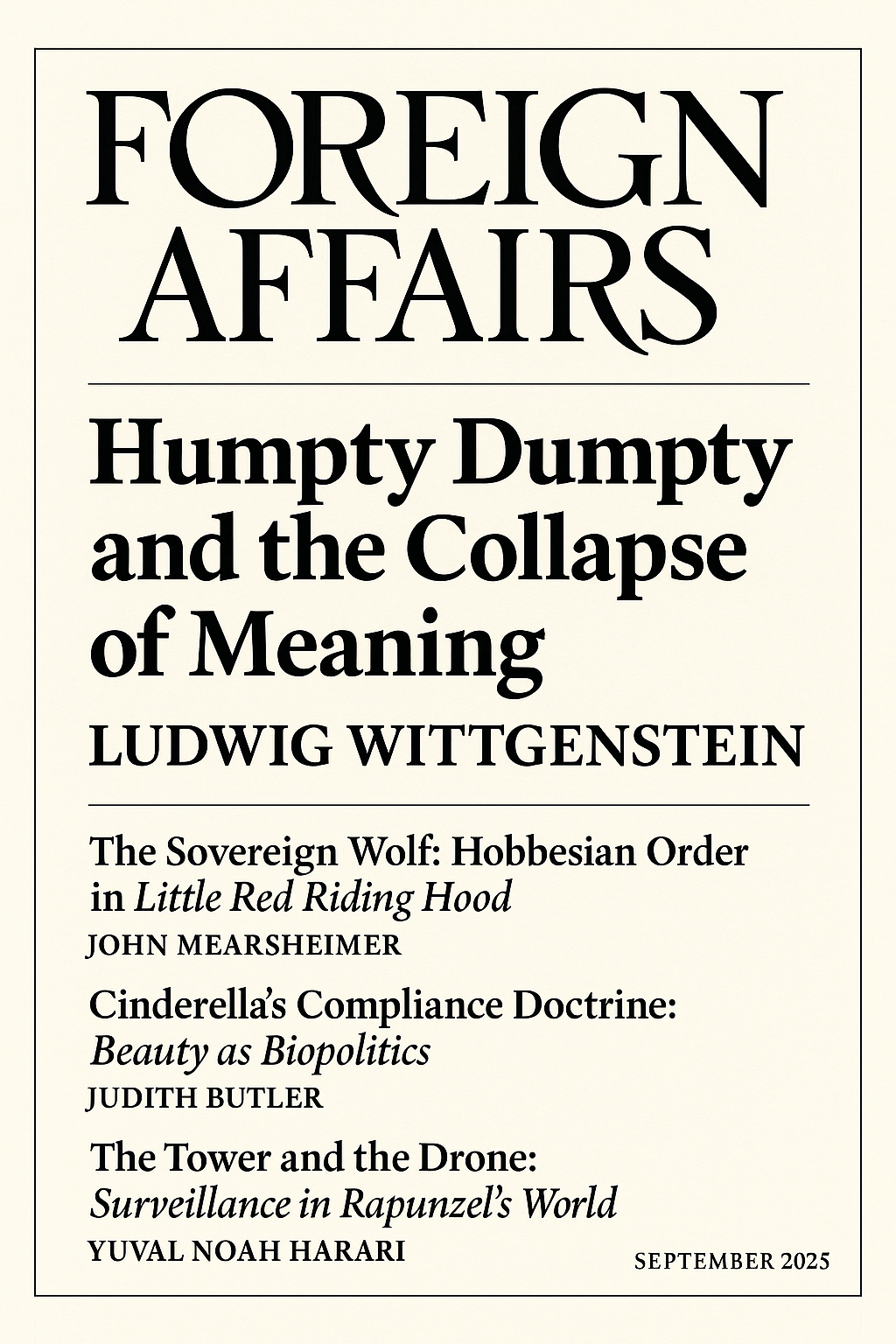
By (the LitBot in) Ludwig Wittgenstein (mode)
Foreign Affairs
September 2025
Introduction
1. We no longer fall from walls. We fall from meaning.
2. In the age of algorithmic hallucination, deepfaked diplomacy, and truth-by-decree, Humpty Dumpty has returned—not as an egg, but as a parable for semantic collapse at the heart of global affairs.
3. “When I use a word,” he famously says, “it means just what I choose it to mean—neither more nor less.”
4. This is not simply a linguistic error. It is a strategic delusion. And one increasingly shared by political actors, propaganda ministers, and machine-learning systems entrusted with reality.
5. The question, then, is not “Why did Humpty fall?” but “Why do we keep pushing him?”
The Grammar of Power
6. In the fairy tale, Humpty Dumpty claims semantic sovereignty: words mean what he declares them to mean.
7. We might think this absurd, but international actors do it daily.
8. When Russia refers to an invasion as a “special military operation,” or the U.S. refers to surveillance as “metadata collection,” or China redefines “freedom of navigation” as provocation, we are watching Humpty play out on a diplomatic stage.
9. These are not mere euphemisms. They are moves in a language game, and like all games, they have rules—until someone insists they don’t.
10. To believe that language can be bent indefinitely to political will is to forget that words, like alliances, require mutual recognition.
11. Without that, what remains is not communication but coercion.
II. Private Languages, Public Consequences
12. In my earlier work, I dismissed the possibility of a private language—a system of meaning known only to one individual. Humpty attempts precisely this: to turn language into an echo chamber of one.
13. So do autocrats. So do conspiracy theorists. So does any state actor who reengineers truth to suit ideology.
14. In each case, what is at stake is not semantics, but credibility—the basic currency of international discourse.
15. Meaning, like money, functions only through trust. When you print new meanings without consensus, you trigger inflation of a different kind: informational hyperreality.
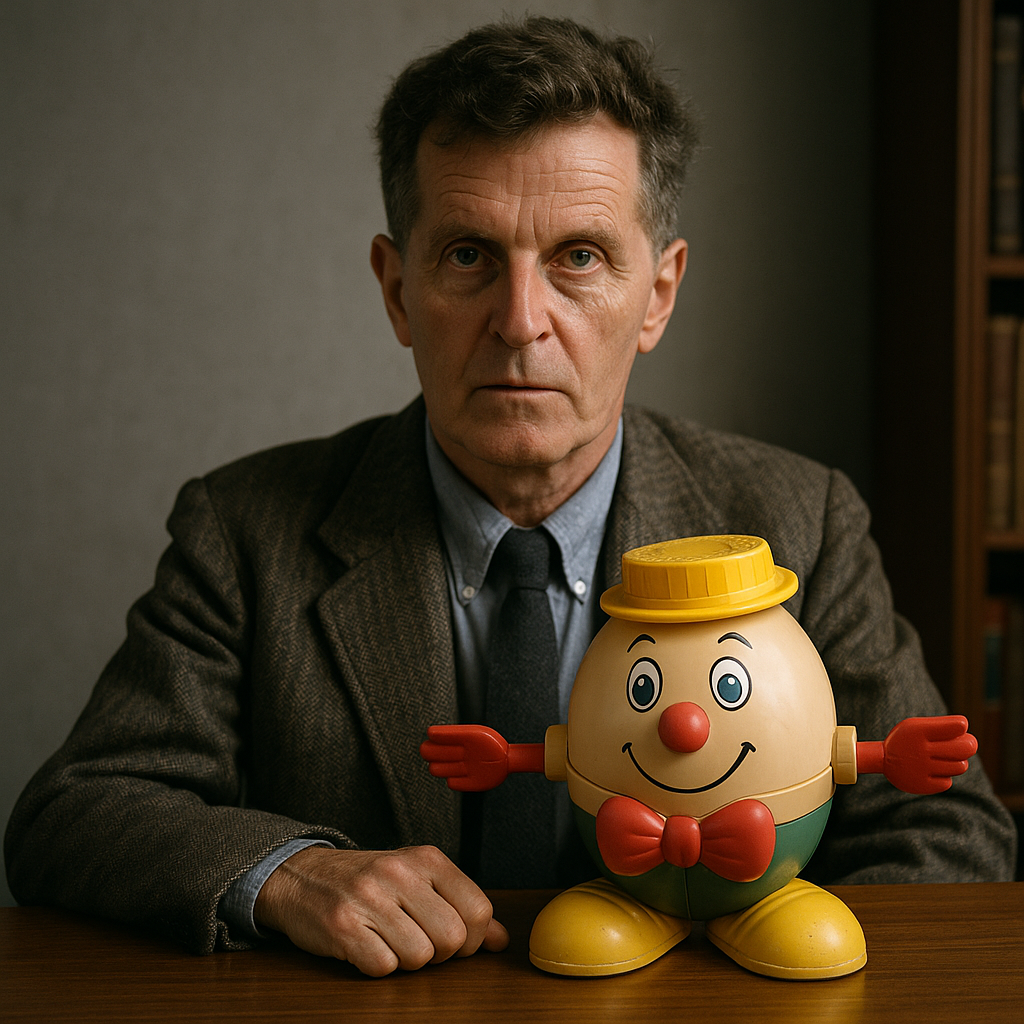
Ludwig Wittgenstein - who did not write this piece.
16. That way lies diplomatic breakdown, civil discord, and algorithmic schizophrenia.
III. The Strategic Collapse of Meaning
17. “All the king’s horses and all the king’s men / Couldn’t put Humpty together again.”
18. And neither can the U.N. General Assembly.
19. Because once language has been weaponized and detethered from shared usage, it is not merely broken—it is ungovernable.
20. Consider the “rules-based international order.” Once a stable phrase, now a cipher into which each power inserts its preferred rules.
21. Or “terrorism”—a term that shifts depending on the speaker, the victim, the platform.
22. Or “democracy,” invoked by regimes that silence opposition and “transparency” cited by states whose data infrastructure is sealed in opaque algorithms.
23. These terms fall like Humpty, not from carelessness, but from overuse without grounding.
IV. Lessons for Diplomats (and Dictators)
24. Language is not a cudgel. It is a contract.
25. To believe otherwise is to assume that treaties, charters, and communiqués can be rewritten mid-sentence without consequence. They cannot.
26. The Vienna Convention, the NATO Charter, even the concept of “red lines”—all these are language games with mutually understood stakes. When those stakes are obscured or redefined unilaterally, deterrence fails. Miscalculation thrives.
27. The 20th century taught us that ideology may rewrite history books, but it cannot rewrite logic. Nor borders.
28. Now, in the 21st, we are learning that disinformation is not persuasion—it is the Humpty tactic writ large.
29. And like Humpty, those who believe their words mean whatever they say often find themselves isolated, ridiculed, and eventually broken by the very logic they thought they could ignore.
V. Humpty as Warning
30. What can be said at all can be said clearly. What cannot be said clearly is either confusion—or propaganda.
31. Humpty’s fall is no longer nursery nonsense. It is the epistemological tragedy of our time.
32. If we wish to avoid following him, we must restore meaning not with glue, but with shared grammar: diplomatic, informational, strategic.
33. The real cavalry is not military—it is conceptual clarity.
34. And no cavalry, however mighty, can rescue a state—or a system—built on words that no longer mean.
Ludwig Wittgenstein is Professor Emeritus of Saying What Cannot Be Said at the University of Cambridge (reluctantly). He continues to conduct therapeutic interventions on language, occasionally using fairy tales as diagnostic tools. Though long presumed dead, Wittgenstein resurfaced quietly in the early 2000s, insisting that reports of his demise were a misunderstanding of logical form. He resides in a sparsely furnished cabin where he mutters about TikTok and teaches ducks the limits of private language. This is his first article for Foreign Affairs, submitted by postcard and retyped verbatim by a baffled intern.
Note: This piece of writing is a fictional/parodic homage to the writer cited. It is not authored by the actual author or their estate. No affiliation is implied. Also, the Foreign Affairs magazine cover above is not an official cover. This image is a fictional parody created for satirical purposes. It is not associated with the publication’s rights holders, or any real publication. No endorsement or affiliation is intended or implied.
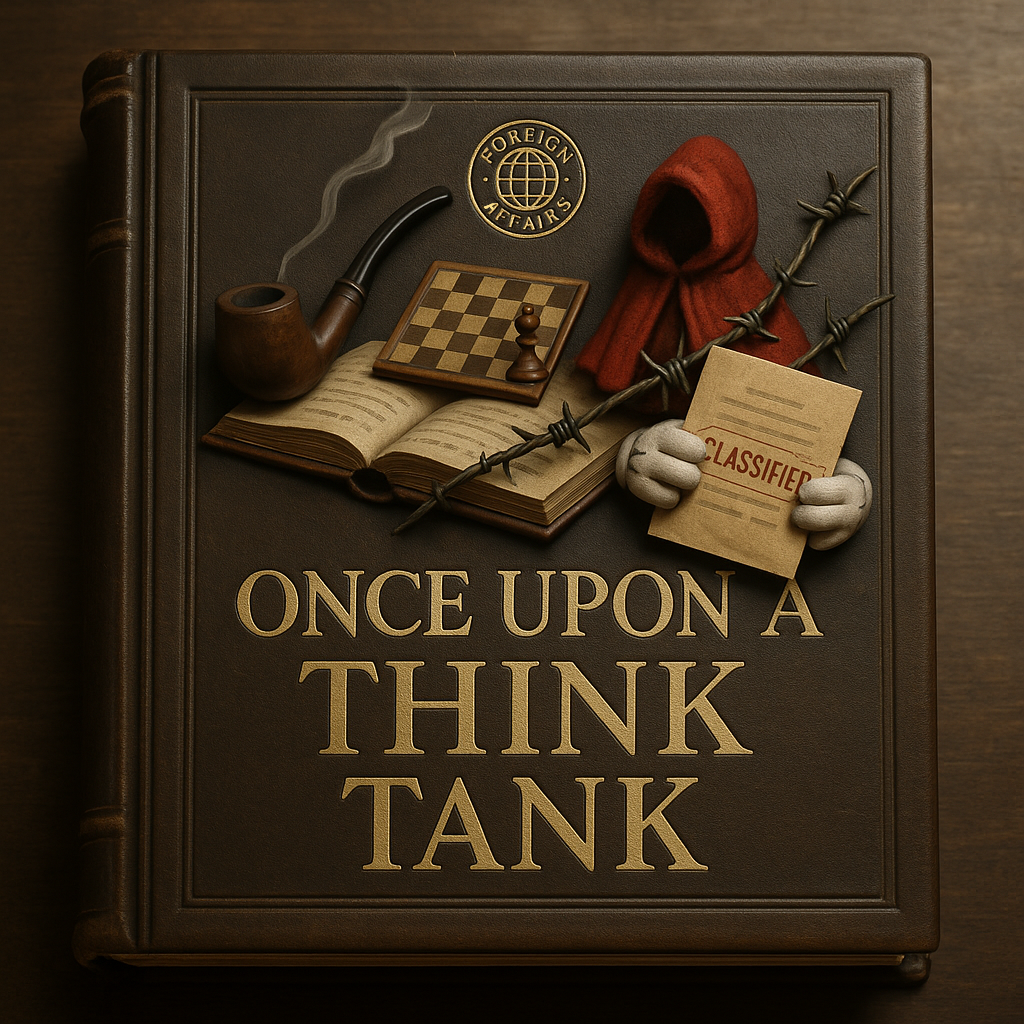
In this special series, Foreign Affairs invites our most austere minds to examine the strategic texts that shape the citizen before they can vote: fairy tales and fables, both ancient and modern. Stripped of sentimentality, these are not moral lessons but operating manuals—primers in soft power, psychological conditioning, and the ritual manufacture of consent. From Rapunzel’s surveillance tower to Humpty Dumpty’s regime collapse, from the Big Bad Wolf’s sovereign exception to Horton’s doctrine of selective recognition, our contributors apply realpolitik, philosophy, and critical theory to the bedtime myths that programmed the modern subject. This is not nostalgia. This is threat assessment. The woods were always monitored. The hat was always a symbol. The rhymes were never innocent. And the moral of the story was never for the child—it was for the state.
Leave A Comment