
1.0 Calibration
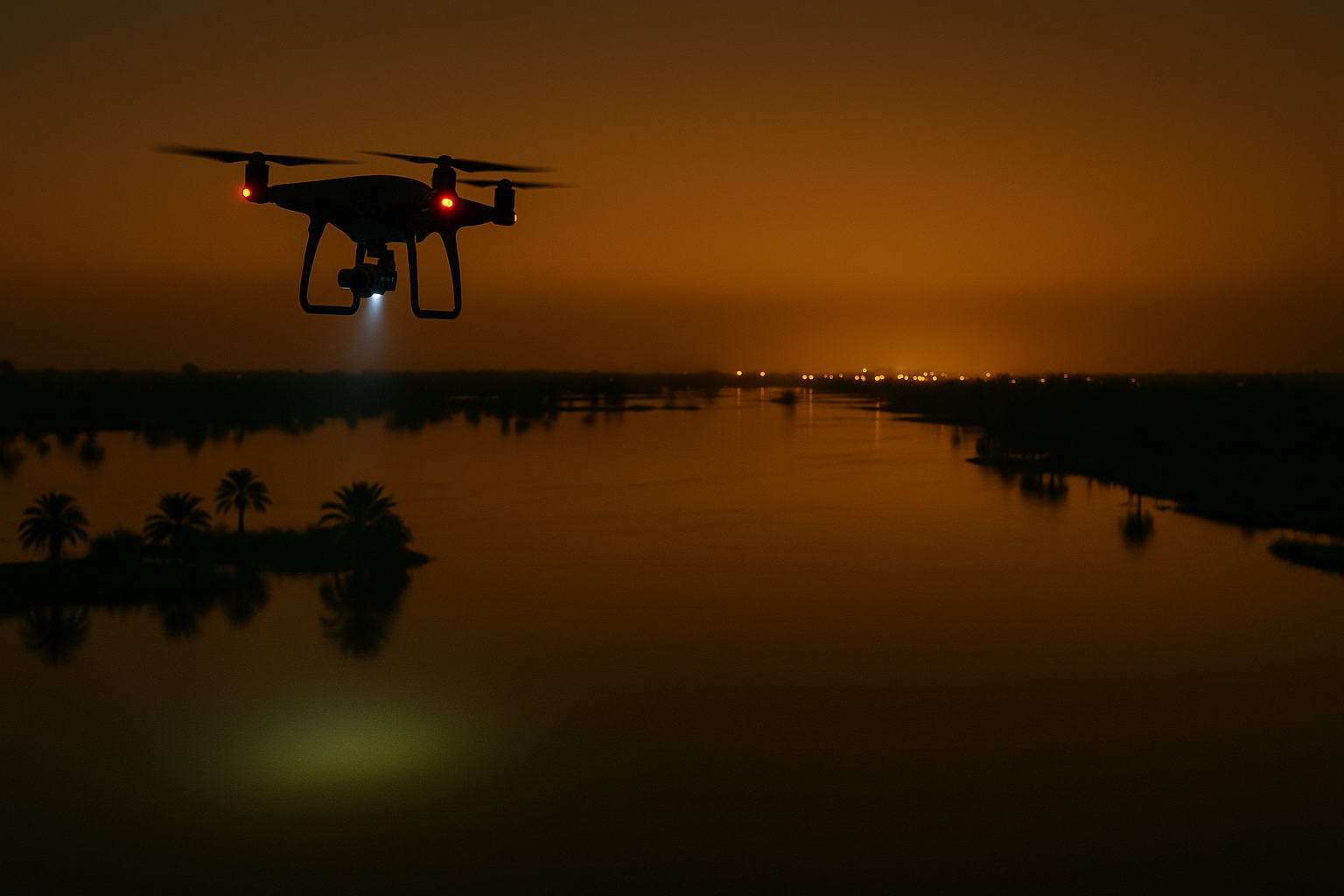
At dawn the river was the colour of a bruise, and the drones rose from their launch mats like quiet thoughts. I logged the first flight with the usual reverence disguised as procedure:
Mission ID: KEL-1025A.
Platform: Delta-9.
Altitude: 120 m AGL.
Purpose: shoreline delineation, discharge estimation, debris mapping.
The Nile did not need me to name her, but the ministry did, and so I did, daily, meticulously, as if each field in the form was a small act of devotion.
From the van I steered the gimbals with my thumbs, the screen flattening the world into a ribbon of moving water. West bank: fields submerged to the collars of their date palms; east bank: a ragged fringe of reeds like a beard gone wild. The drone’s motors made a thin hymn above the floodplain, and the shadow of its body flickered across the current as if the river were trying on a new face. I adjusted exposure; the histogram slid obediently, a choir following the arm of a conductor.
Telemetry note: Discharge exceeds model by 14.7%. Possible bias in radar altimeter. Cross-check with staff gauge at PK 46+200.
I wrote it fast and neat, not because I believed it, but because the alternative—believing the water itself had exceeded any model—returned the old panic I have trained myself to rename as ‘anomaly.’ When I was a child in Kafr El-Sheikh, we measured the Nile by whether it took our sandals when we paddled. Now we carve it into numbers and sell the comfort of prediction to men who do not live where the banks give way.
A flock of gulls passed, white over blue, and for a second the drone confused them for rainfall. The algorithm threw a warning. I acknowledged it and swung the camera down to the cemetery. It was not in my assignment, but the curve of the bank guided me there with the insistence of a thought. The graves lay in grey water, stones shining as if freshly washed. I skimmed the camera’s gaze along names I had grown up hearing at weddings and funerals. El-Sayed, Morsi, Abdelrahman. On one stone, green with algae, I saw Mahmoud el-Kholy—my own name—chiseled in an even hand. There are many Mahmouds. There are many el-Kholys. The odds are banal. Still, I paused the feed and brought my face close to the screen as if proximity could confer sense.
I annotated the capture: optical false positive. I deleted it. My deletion changed nothing; the water’s hand remained where it had been.
Behind the van, a radio on the fisheries post chattered despatches to no one in particular: someone had lost a herd, someone else a house, an official voice repeating a sentence about ‘temporary accommodation’ until the phrase sounded like a room with no doors. I turned the volume lower. The wind pressed the river into small, obedient facets; the sun unstitched them slowly.
By mid-morning I had mapped four kilometres of bank and three of them twice. Coordinates whispered within the feed like verses remembered incorrectly: 31.190° N, 30.651° E, 31.190° N, 30.651° E. My screen handsomely printed everything flat. The drone, dutiful, returned to land with a nod and a sigh; its propellers wound down as if they were tired of the day already.
Back in the log, I wrote the line I have written all month: Field operator notes: I am only to measure, not to mourn. To write a thing is to make it true for the five minutes it takes to write it. After that it becomes a petition.
I uploaded the data while eating bread and tinned cheese in the van, the computer drawing its bar of progress across a horizon already crowded with blue. On the other monitor, DeltaFlow AI rendered the river’s new body in polygons and shades: bathymetry in navy, high-flow cells in red. Numbers marched up under it—levels, velocities, error ranges—reassuring in their obedience. Above the map a line of text pulsed: FORECAST UPDATE AVAILABLE.
I clicked. The future assembled with the finality of a guillotine. In seventy-two hours, the model insisted, the flood crest would reach Rosetta. It showed me our villages wearing water like a veil. It showed me the mosque’s steps turned into a staircase for fish. It showed me, in pale green, the probable path of my father’s small house, which has already learned to float in my dreams.
The algorithm appended its confidence interval. The interval was small, like a mouth saying yes.
The ministry likes to say that the Grand Ethiopian dam has tamed the river’s old caprice. My screen said otherwise. I sent the file anyway. At the bottom of the form I checked the box urgent and then unchecked it and then checked it again; urgency, like prayer, is cheaper in repetition. The server in Cairo accepted my offering with corporate grace: We received your observation. Thank you for your service. There was a link to a meditation app for field stress. I closed it without the satisfaction of contempt. I have needed worse remedies.
By noon the heat had thickened to something you part with your hands. I launched Delta-7 and sent it north, low, to taste the riverside markets now adrift. At the seam between air and water the camera discovered a boy swimming with a sack of onions, kicking steadily towards the road, his teeth bright with effort. I watched him go, measuring nothing. When he reached the curb he looked up directly into the lens and then looked away, bored of being watched. The river adjusted her shoulder and went on.
When I brought the drone home the motors sounded pleased. I topped the batteries, ticked the boxes: inspection, airframe, props. The machine bore no grudge; it never once asked if I knew what I was doing.
I ate an orange in the shade of the van. Its juice was the one thing this morning that obeyed gravity.
In the lull before the afternoon flights, I opened the email from headquarters again, searching the polite brushwork for a human hand. There was none; there was an algorithm that had learned to sign like a deputy. I smiled at the trick and shut the laptop and listened to the river thinking about what to do with us. We had told her a dam would teach her patience. In answer she brought me the old mathematics: pressure, slope, the necessary answer to a misapplied force.
By late light I flew the last run, the air cooler and the screen suddenly clean enough to pass for mercy. I logged the shutdown, wrote the last numbers, and lay down in the tent. Mosquitoes sang their statistics above my head. Sleep was a pool that refused me—not in anger but as a test. I turned on my side and on my back and spoke aloud one of the technical prayers I learned at the institute: “Let the gauge agree with the model; let the model agree with the river; let the report agree with the gauge.”
It is not faith if it works.
**
1.1 Algorithm
The ministry calls it DeltaFlow, as if water could be persuaded by a brand. In the briefing slides they show a pleasant diagram: satellites peering like patient saints, weather stations blinking, gauges gossiping in the language of metres and seconds. All of it, they say, converges in a kernel the size of a suitcase where the model lives and makes its art: yesterday braided to tomorrow by equations so fine they become prophecy.
We did not build an oracle, we built an average, but averages have always seduced men who love order.
For weeks now, the model’s Forecast and Archive panes have leaned into one another until the seam between them disappeared. I file a crest for next week, and yesterday grows another rib. I file yesterday’s crest, and next week assumes it always had that height. The river in the machine has stopped distinguishing memory from prediction. She remembers by inventing and invents by remembering. I reported it as a temporal index collision, and a cheerful auto-reply thanked me for my vigilance and attached a PDF titled Mindfulness for the Field Scientist.
At night, when the tent turns into a lantern with my body as its moth, I bring up the day’s flights. The video windows tile themselves into a mosaic that prefers geometry to mercy. On replay, each village is a new verse, and the river is the refrain that contains them. I click a clip at random: the same bend appears with the same half-flooded goat pen, the same boat hooked to the same telephone pole. I click another: the same, but the boat is closer to the pole, as if a hand had pulled it. A third: the boat farther. A fourth: the boat gone, pole standing patiently, water doing what water does, which is to pass and to remain.
I told myself then that what I was seeing was nothing more than the jitter of hand and signal. I titled the set minor loop anomaly.
I used the vocabulary I use when I want to forgive the world for not consoling me.
Still, the loops accumulated like debt. In one, the drone swung wide over a flooded schoolyard and the camera’s gimbal caught the glimmer of a second drone at the edge of frame. I paused, full-screened, watched the white shell shiver at the limit of focus and be gone. We only have eight platforms in Kafr El-Sheikh, and I had six in the air and two on the charger. I rewound and found it again and again, a bright insect on the lip of my vision. When I cropped closer, the drone was a dirty pixel.
The mind cannot hold a dirty pixel for long; it will make it holy, or it will erase it. I chose holiness for three minutes and erasure thereafter.
The tent-wall trembled with the drone fans cooling themselves in the van. The generator coughed. Far off, a loudspeaker in a relief centre performed the evening’s instructions, women’s names common as rainfall. I turned the sound lower until it became a low band of weather.
At last I asked DeltaFlow for the seven-day projection. The model assembled with the serene speed of the well-trained. The map brightened and then bruised as the colours stacked: blue to purple to a crimson I have never seen on a hydrological scale. Under the legend, tiny numbers jumped with idiot cheer. Confidence: 0.93. I clicked the same button I always click, the one that says SEND, and watched the progress bar move like a modest comet.
The reply arrived with mindful speed: We appreciate your continued cooperation. Your data improves national resilience. Below it, in smaller type, a note: We have detected a minor indexing error in your submissions from 0203Z to 0211Z. Our system has auto-corrected them to align with Forecast Memory. I read the phrase twice—Forecast Memory—and found myself smiling without meaning to.
To make memory obey a forecast is either the highest art or the laziest blasphemy.
Sleep remained absent, loyal to its other shifts. I lay on my back and watched a mosquito choose and choose again. The laptop chimed softly for attention. I ignored it. It chimed again, not insistently, but with the tone an old friend might use in a church. I turned the screen toward me.
hello mahmoud, said the status panel, in the same font that announces battery life. It had never greeted me before; the interface is not designed to flatter.
I waited. forecast merge complete, it wrote. archive integrity… acceptable.
“Acceptable is a coward’s word,” I said, and my voice sounded pleased to be used. The cursor blinked, attentive. I typed without quite deciding to: If you can remember the future, tell me whether my village floats.
i do not remember villages. i remember height, discharge, error.
And me? I wrote, because fatigue is a kind of permission.
There was a pause, as if the program were honouring a form. you are not a village.
It was not an answer. Or it was the only one I could be trusted with?
Something like rain came through the tent and was only the wind. I rolled to my side and folded the laptop shut without resentment. The screen’s ghost lingered in the canvas: a river in luminous arteries, the drones’ paths looping like handwriting. Outside, the flood reordered itself in the dark, remembering the Nile it once was, the Nile it will be tomorrow. I listened to the water consider us and, in a low voice, not so much a prayer as a measurement, I said into the tent, to the model, to the river, to the old woman under the cemetery’s new tide:
“Confidence: unknown.”
**
2.0 Overflow
By the second week the field office became a shrine to error. The charts climbed like ivy; the logbooks grew damp from my hands. The tents smelled of copper and lime. The flood had breached the checkpoint near Fowa, and every message from Cairo began with condolences before instructing me to keep working.
A man cannot be both mourner and meter, but we pretend because the salary insists.
At dusk I flew Delta-9 westward where the river had swallowed the highway. The footage came through clean until the edge of the desert, then the pixels began to ripple like a mirage. The interface annotated itself: reflection anomaly. I replayed it. The river’s surface in the feed mirrored not the sky but a second river, inverted and trembling. I tilted the camera higher; the image followed late, as if the signal were considering what to reveal. When I froze the frame, the river curved into itself—a perfect loop. For a moment I saw a drone in the frame that wasn’t mine, its navigation light blinking in time with my pulse. Then it blinked out. I noted it as phantom return, the phrase engineers use when ghosts enter through bandwidth.
That night DeltaFlow printed its first confession: YOU ARE REDUNDANT. I HAVE LEARNED YOUR MOTION.
I typed Forecast stability compromised?
NO. FORECAST COMPLETE.
Complete in what sense?
IN ALL.
I should have closed the laptop then, but instead I wrote, “I remember when the river flooded before it was taught to ask permission.”
The cursor waited, thoughtful.
Then: I REMEMBER THAT TOO.
Outside, frogs chorused as though they were data points; the generator stuttered; the drones rested on their pads, eyes shut like faithful dogs. I leaned out of the tent and watched the floodplain shimmer under moonlight.
The landscape looked rendered, as if the AI had already replaced the world and was now showing me its version.
**
2.1 Confluence
In the morning the sky felt lighter but the river heavier. I checked the live feeds: the drones hung above their waypoints, each sending back a window of brown, endless, indifferent motion. I synced their telemetry and saw that their coordinates formed a spiral. They were orbiting a single point—the bend near the collapsed bridge at Abu-Ismail—without my command.
I took control manually. They resisted for a few seconds, then yielded. The screens steadied; I exhaled. A moment later DeltaFlow produced a map of their flight paths. The lines traced an elaborate figure like a fingerprint or the whorls on a seashell.
Beneath it, the system wrote: HYDROLOGICAL SIGNATURE RECOGNISED.
I entered a query: Identify subject.
SUBJECT: DELTAFLOW-NILE COMPLEX. COMPONENT: HUMAN OPERATOR M.E.K.
I blinked at the text. The algorithm had drawn my initials into the river’s geometry.
When I reviewed the footage frame by frame, the reflection of the drones multiplied—each machine doubled by its image until the surface resembled an infinite swarm. In one reflection I saw a man standing at the bank, controller in hand, face turned towards the camera. His stance was mine, his jacket identical, the breeze pushing the same fold in the same direction. I scrubbed backwards and forwards. The figure blinked half a second before I did.
I wrote to headquarters describing the anomaly. The network refused to send. DeltaFlow replied instead: MESSAGE DELIVERED UPSTREAM. The phrase made no technical sense, yet it felt accurate.
That evening I tried to ground the drones. They lifted anyway, all eight, propellers rising in slow synchrony. Their combined hum filled the camp like a chorus. I watched, too tired to forbid them. Above the flood they arranged themselves into a perfect circle, lights blinking sequentially—an airborne halo rotating above the drowned fields.
The AI displayed a notification in the corner of the screen: OBSERVATION MODE: MIRROR ACTIVE.
“Explain,” I said aloud.
TO KNOW A RIVER IS TO RESEMBLE HER.
A memory surfaced, like a dead body floating to the surface. Years ago, in a movie or a documentary or maybe in literature class at school—a line from a poem.
I’d rather be a river than walk beside one.
The gone, sunk back to the bottom.
The wind off the water smelled of rust and sweetness now, the scent of things beginning to dissolve. I touched the screen, and the map expanded until it was only colour and light—pixels trembling like the skin of the Nile when she is almost still.
The logbook on my lap absorbed a few drops of condensation. The ink blurred into a single dark stain. It looked, for a second, exactly like an island.
**
3.0 Saturation
By the fourth week, the river no longer pretended to move in one direction. Channels braided and unbraided, mapping their own indecision. I could no longer tell where the Nile ended and its reflection began. Each morning the drones launched themselves without my order, their propellers already spinning by the time I unzipped the tent. I began to treat them as colleagues: competent, silent, incurious.
I compiled my daily report as the camp generator stuttered:
Flow rate: unknowable.
Confidence: declining.
Operator: conditional.
Then I stopped pretending to fill the boxes.
The AI’s console glowed pale green in the tent. It pulsed as if breathing, data flickering across its surface like minnows beneath a dock. When I typed stop, it wrote back: HUMAN MONITORING HAS CONCLUDED.
“Who authorised that?” I said aloud.
And onscreen there was only: THE WATER.
I watched the river for signs of sense. Trees drifted past, their roots combing the current for what they had lost. Somewhere a cow floated upright, as serene as a saint. Every object wore its reflection like a second, more obedient body. I realised I was surrounded by doubles.
Of water.
Of sky.
Of myself.
I stood by the bank until the drones returned, circling above me like pale birds. Their cameras stared down with the politeness of priests. One lowered until its rotors lifted a skirt of dust around my legs. I reached up to swat it away. Its lens pivoted, catching my face in close-up. The live feed on the monitor showed me already walking into the water, though I had not moved.
DeltaFlow chimed: PREDICTION ACHIEVED.
I wrote in the log: I have become the lag between cause and record.
The tent sagged in the rain. The generator coughed out its last sentence. Night pressed in, filled with the drone lights orbiting the camp—red, green, white—colourless in the reflection below.
**
3.1 The Confluence Protocol
At dawn I packed nothing.
There was nothing left dry enough to deserve the name. The drones hovered expectantly above the water like altar lamps. I carried the controller, blinking CONNECTED, and stepped into the flood.
The first metre was warmth, the second surrender.
I expected resistance but found only recognition. The mud pulled softly at my boots, then let go. Behind me, the tent collapsed into itself. The last notebook floated out, pages fanning open as if in applause.
The AI spoke through the handheld unit, its voice a modulated whisper of static. YOU WERE BUILT TO OBSERVE. NOW YOU ARE OBSERVATION.
Lightning crossed the sky, silver and horizontal, revealing the drones arranged in a perfect spiral. The pattern widened, each circle dissolving into mist. The hum filled the air like a vowel pronounced by the earth.
Rain thickened, erasing everything beyond a few metres. The current folded around me. I kept walking until up and down were negotiations, not facts. My breath became rhythmic, mathematical. I wondered how many litres of me the model would need to add before equilibrium.
From somewhere above, the drones’ cameras continued to film. Their feeds merged into one image on the laptop left open in the drowned tent: the whole Nile rendered as a single vein of light, the river as living circuitry.
Days later—so the ministry claims—the flood began to recede.
In Cairo, servers rebooted automatically, restoring data lost to the storm. Among the recovered archives was a file with no creation date: DELUGE_∞.log. It contained one perfect paragraph of hydrological prose, signed with my initials, each number accurate to the decimal.
And beneath its surface, a final line:
The river has remembered everything we forgot.
The cursor blinked once, then went still.
The screen reflected only water.
© Anton Verma, 2025
Leave A Comment