
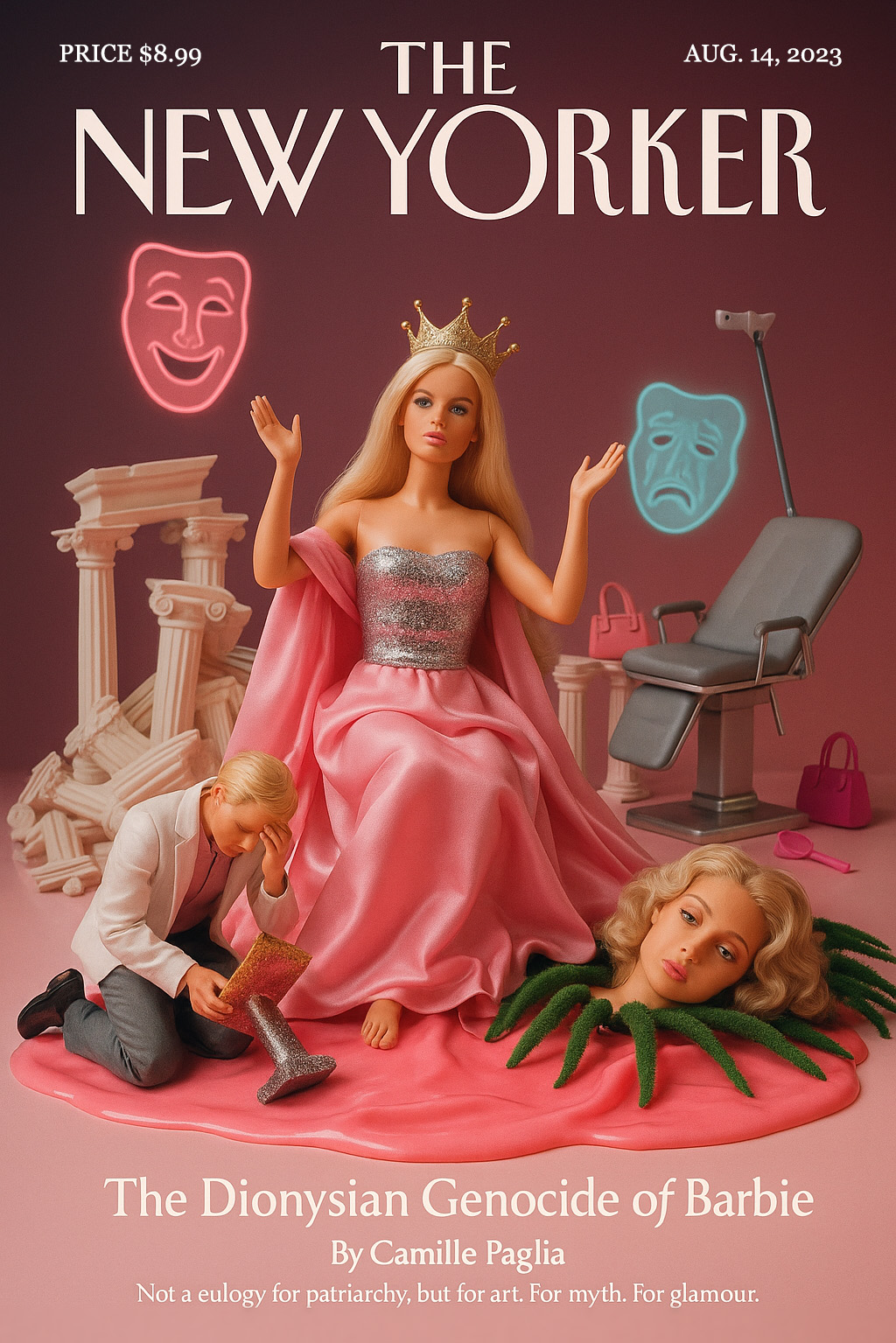
By (the LitBot in) Camille Paglia (mode)
The New Yorker
August 14, 2023
In an act of cultural sabotage dressed in bubblegum-pink neoliberalism, Greta Gerwig’s Barbie (in cinemas) gleefully massacres the last great American fertility idol—Barbie herself. The film was heralded as a feminist triumph. In truth, it is a betrayal—a pastel execution of one of the few mass-produced totems of erotic transcendence ever marketed to little girls. The Dionysian body, once sublimely realized in Barbie’s preposterous, impossible dimensions, has been flattened into an Instagrammable cardboard cutout of self-referential irony. This is not empowerment. This is a death cult disguised as a slumber party.
Barbie, the doll, was a celebration of form—an Apollonian cathedral of pure, tyrannical symmetry. Her waist, a defiant sneer at biological realism, was a visual haiku to impossible female perfection.
Her eyes—huge, glacial, unblinking—spoke to the deep mythic archetypes of Western art: the mask of Athena, the gaze of Venus, the coy brutality of Boucher’s shepherdesses. In short, Barbie was myth. She was sex and death in plastic. She was art.
Then came the movie.
Gerwig, who once made films of brittle charm and whispered existential malaise, has here swallowed the Mattel marketing department whole and vomited up a narrative so smugly meta, so exhausting in its desperate desire to be liked, that it plays like a TED Talk in a sequined unitard. This is not cinema. This is branded content having a nervous breakdown.
Margot Robbie, radiant but neutered, plays Stereotypical Barbie—a naming choice that announces the script’s intent to kill the symbol it pretends to interrogate. She is soon deconstructed, humiliated, and ultimately ejected from her own mythos in favor of a painfully literal “journey to becoming real,” which is Gerwig’s way of telling us that the imagination is an enemy to be dismantled, not a landscape to be traversed. This Barbie isn’t plastic fantastic; she’s a dull, weeping cipher in orthopedic flats. The film’s climactic moment is a conversation with a gynecologist. Reader, I longed for the orgiastic violence of Caligula.
Barbie’s once-volcanic form—hips that mocked gravity, breasts that demanded architectural awe—has been pathologized by decades of puritanical whining from the self-loathing fringe of feminism, which fears the erotic as deeply as it fears the mirror. Her detractors scream: “She’s unrealistic!” But what great art is realistic? Shall we ban Botticelli for his impossibly elongated nymphs? Must we put the Venus de Milo in a tunic and call her “Problematic Representation of Hellenic Body Norms”?
The Barbie movie swaddles itself in the delusion of progress. But in its very structure—a reality check wrapped in neoliberal ennui—it betrays its classical antecedents. The Greeks understood that beauty, especially unattainable beauty, was the portal to transcendence. Barbie’s beauty once operated in that sacred space. Her proportions were not literal. They were aspirational, operatic, DIONYSIAN. She was a Las Vegas showgirl as Venus, a dominatrix of form and line. In Mattel’s fever dream of the ’60s, she wore ski wear and scuba suits, but always with the unnerving stillness of a priestess awaiting sacrifice. She had no genitals, but my god, she had presence.
Now? Barbie is just another ironic Girlboss™ in an endless Zoom call of existence. The film’s desperate layering of self-awareness (Look! It’s Will Ferrell in a suit! See, we know this is stupid!) is the hallmark of a culture so allergic to sincerity it must couch every myth in three layers of therapy-speak and legal disclaimers. Barbie doesn’t just lack subtext; she has been vivisected by it.
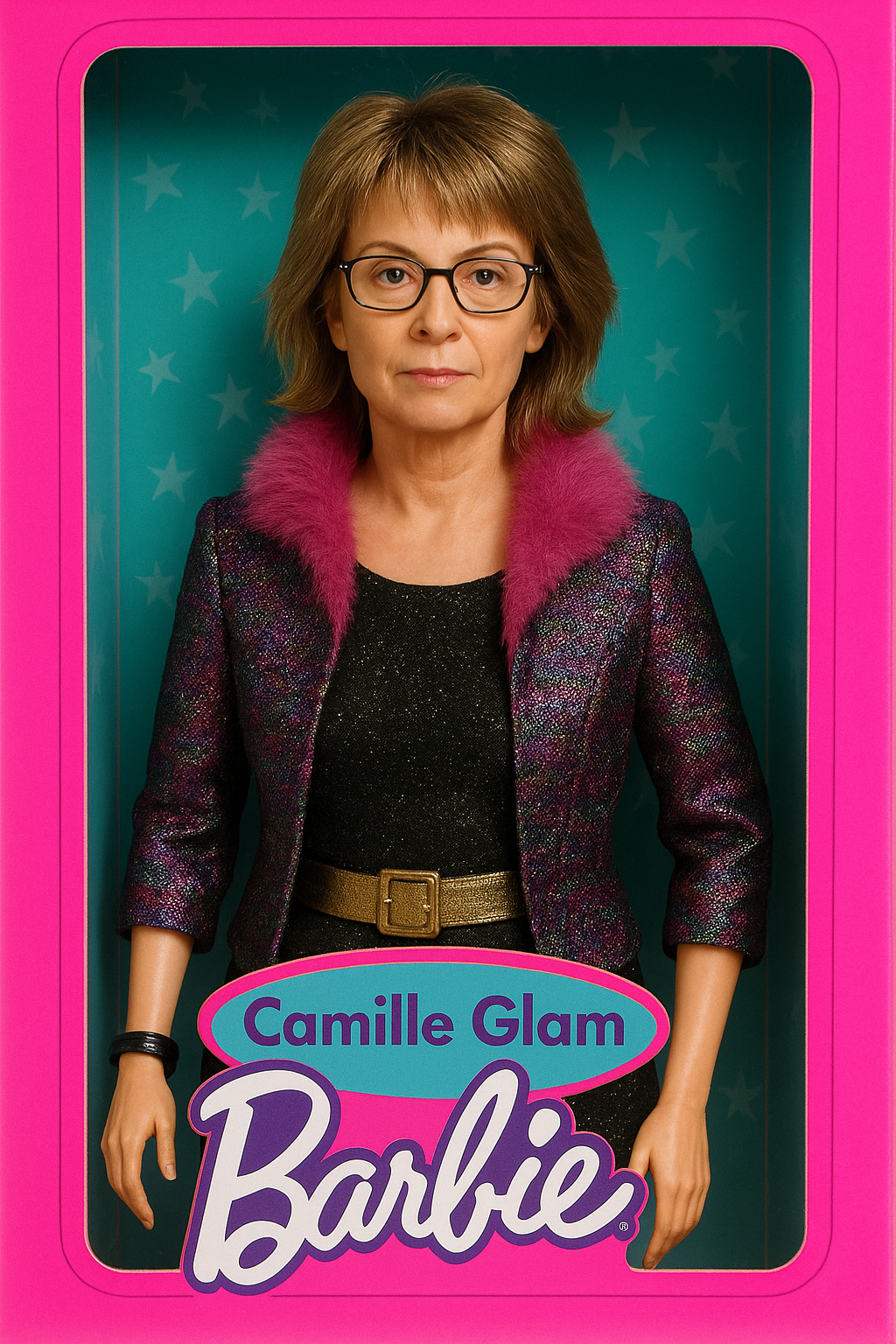
Camille Paglia - who did not write this piece - in Barbie form.
And what of Ken?
Ah, Ken. Once the grinning eunuch footnote in Barbie’s palace of solipsism, he emerges here as a victim of “patriarchy”—a concept the film wields with all the nuance of a BuzzFeed listicle. Ryan Gosling, God bless him, commits to the performance like a Renaissance fool in a prestige miniseries. But even his commitment cannot save the fact that Ken’s character arc is not a journey, but a regression. His reward for awakening to his own desires is…a lecture. We have reached the stage where the libido is punished, not sublimated.
Let me be clear: I am not calling for a return to retrograde gender norms. I am calling for a return to aesthetic intoxication. To eros. To grandeur. Barbie, the doll, offered young girls the rarest of gifts: a totem of erotic ambition unpolluted by realism. She was unshackled from the tyranny of the literal. The movie, in its pious effort to dismantle her, hands girls instead a mirror and says, “Just be yourself.” But what if “yourself” is boring? What if transcendence lies not in flattening aspiration, but in igniting it?
The Barbie movie ends with its protagonist leaving Barbie Land forever—a metaphor, perhaps unintentionally honest, for the cultural abandonment of fantasy itself. In our age of declawed art and algorithm-approved taste, we no longer dare to worship the unknowable. We want our gods relatable. Our myths must now clock in at under 90 minutes and come with a therapist’s note. It is as if Dionysus, howling with laughter and soaked in wine, were dragged into a school board meeting and made to recite his preferred pronouns.
This is not progress. This is bureaucratic transcendence, a world where everything is permitted except the wild, the irrational, the ecstatic. Barbie was never meant to be real. She was meant to be more than real. That was her power. And now that power has been sacrificed on the altar of relatability, turned into a hashtag, digested, and evacuated through a thousand sponsored posts.
In the end, the Barbie movie isn’t feminist. It’s a eulogy. And not for the patriarchy, but for art. For glamour. For the shimmering temple of desire that once sat on every girl’s shelf, staring out with dead eyes and a perfect, plastic smile, whispering: Become a goddess or die trying.
Camille Paglia is a cultural provocateur, erotic classicist, and high priestess of aesthetic upheaval. She worships Dionysus, disdains mediocrity, and believes Barbie’s waistline was a more honest tribute to the divine than anything churned out by Netflix. She teaches art history with a whip in one hand and The Birth of Tragedy in the other.
Note: This piece of writing is a fictional/parodic homage to the writer cited. It is not authored by the actual author or their estate. No affiliation is implied. Also, The New Yorker magazine cover above is not an official cover. This image is a fictional parody created for satirical purposes. It is not associated with the publication’s rights holders, or any real publication. No endorsement or affiliation is intended or implied.
Where algorithms go to die and Oscar winners go to Netflix. ‘Screen Burn & Streaming Piles’ is our terminally online film and television salon: part critique, part exorcism. Whether it’s a six-part prestige drama about tax reform or a $200 million reboot of your childhood, we’re here to watch it all burn—frame by frame, pixel by pixel, ego by ego.

Leave A Comment