
“Kangaroos are such noble creatures; human beings are beasts.”
Mick’s voice wavered, more to himself than the others in the circle. He shifted in the creaky chair, nervously tugging at his shirt’s hem. “Look,” he said, “I get that sentiment. I’m sure I’m not alone. All I can say is that the world’s sure changed a lot in recent decades.”
The therapy room reeked of stale coffee and cheap disinfectant. Five others sat around him, their faces a mix of curiosity and judgment. Dr. Wattle, the group facilitator, nodded, her spectacles catching the fluorescent glare. Mick wasn’t sure why he’d come—guilt, maybe, or the nightmares that left him gasping in the dark. But he had to talk. He had to make them see.
“Overpopulation,” he continued, his voice firming. “That’s what it’s all about. Too many of the creatures, and they’ve got to be culled. It’s humane. They starve otherwise, or they strip the land bare. Farmers lose crops, stations go under. It’s ugly, but it’s necessary.”
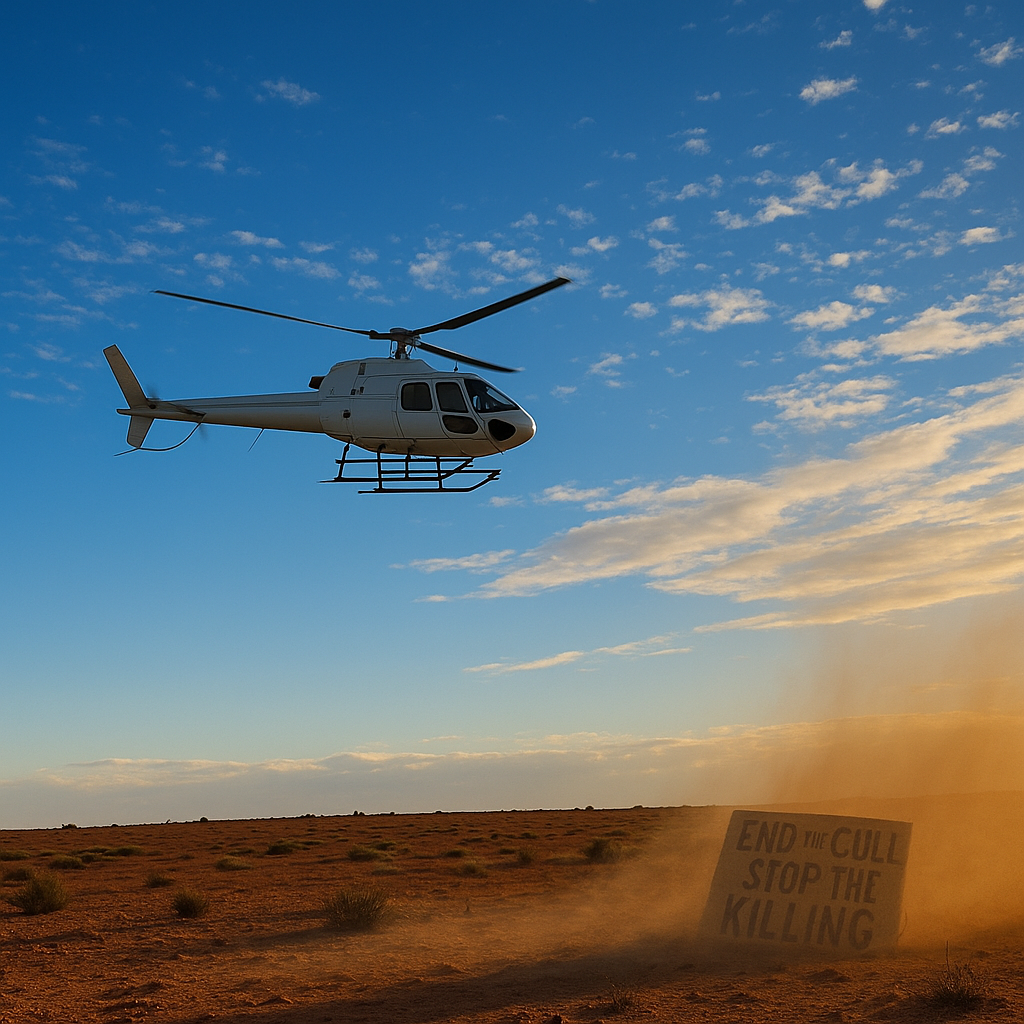
Mick was a cull shooter, one of those blokes who climbed into a helicopter with a rifle, flew over some sprawling farm or backcountry station, and took out whatever creatures had bred out of control. Fifteen years he’d been at it, since he was a spotty-faced teen with a keen eye and a steady grip. The job fitted him—solitude, precision, purpose.
Not everyone agreed, though.
“I know it’s not everyone’s cup of tea,” he said, glancing around. A wiry sort named Clara leaned forward, her expression hard to read. “I’m not trying to offend, but some of these activists—well, it’s like a religion to them. Mother Earth, sacred life, and all that. Chaining themselves to gates, shouting about ‘rights.’ I respect their passion, but they miss the bigger picture.”
The trouble started three years back, Mick explained. A group of activists, led by a fierce, self-styled ‘eco-warrior’ named Marjorie Talbot, decided culling was murder, pure and simple. Marjorie was a lean, wild-eyed figure with green hair and a megaphone and a gift for grabbing attention. She called Mick’s industry ‘a killing machine’ and swore to dismantle it. It began with protests outside the airfield where Mick’s company stored their choppers. Signs read STOP THE SLAUGHTER and LIFE ISN’T TARGET PRACTICE and a dozen others. Mick didn’t care much at first. Free country, let them yell.
But Marjorie’s crew didn’t stop there. One night, they slipped onto the airfield and splashed red paint across the tarmac—buckets of it, gleaming like blood under the floodlights. A week later, they poured honey into the fuel tanks of two helicopters. ‘Eco-sabotage,’ they called it. Repairs cost a fortune, and the farmers paying the bills were livid. Mick’s boss, a gruff old fella named Trev, hired security guards, which drove up the cost of every cull. The media loved it. ‘GREEN CRUSADERS VS. SKY SNIPERS,’ was the constant refrain. Marjorie’s face was inescapable—snarling, defiant, unstoppable.
“Tensions ran hot,” Mick admitted, scratching his knee even though it wasn’t itchy. “But the culls kept going. We had work to do.” The activists raised the stakes. They chained themselves to the airfield gates, padlocks glinting in the morning sun. Mick and the pilots were stuck until police arrived with bolt cutters. One dawn, they found three protesters shackled to a chopper’s landing gear, singing folk songs. The cops dragged them off, but not before news cameras caught every second. Marjorie was on every channel, branding Mick a ‘soulless gun nut.’
The group listened closely. Dr. Wattle scribbled on her notepad. Mick’s chest tightened. He hadn’t reached the worst part. Yet.
“Then they got smart,” he said. “They hacked our systems. Got hold of cull schedules—dates, locations, the lot. They started showing up at the sites, way out in the bush, forming ‘shields’ to protect the targets. They’d stand in groups, waving signs, daring us to shoot. It was reckless. Dangerous for them, dangerous for us.”
Mick’s voice faltered. He remembered the day it all went wrong. A major cull, out on a station near the Flinders Ranges. Hundreds of creatures, grazing mindlessly, wrecking the land. The chopper’s roar filled his ears, the rifle heavy in his grasp. He saw the activists below—twenty or so, Marjorie at the front, her green hair whipping in the wind. They were shouting, holding banners. Mick’s pilot, a guy named Bluey, yelled through the headset: “They’re too close, mate! We might as well head home!”
But Mick wasn’t having it. He was furious—at the sabotage, the delays, the constant attacks. He was an expert sharpshooter, wasn’t he? “Hold it steady,” he ordered Bluey, who had little choice when Mick leaned out, adopting the cull position. Mick took aim, fired, and kept firing. The targets dropped, one after another. The activists scattered, but Marjorie stood firm, yelling something Mick couldn’t hear.
Then it happened. A stray bullet—his bullet—hit Marjorie in the chest. She fell, and the world stopped.
“I knew I’d messed up,” Mick said, his voice a whisper. “It was a split-second thing. I didn’t think twice. I figured I could do my job, shoot around them. I was wrong.”
The room went quiet. Clara’s eyes narrowed. Dr. Wattle set her pen down. Mick fidgeted, the memory searing his mind. The aftermath was chaos. Police swarmed, then reporters. The trial was a national circus. ‘CULL SHOOTER KILLS ACTIVIST,’ the headlines screamed. Mick’s lawyer, a sharp city type paid by agricultural heavyweights, painted him as a stressed worker, a victim of circumstance, someone just doing their job. The jury—mostly folks from rural towns—bought it.
Mick walked free.
But freedom didn’t stop the nightmares. Marjorie’s face haunted him, her eyes wide with shock. He saw her every night, falling in slow motion. His friends told him to move on—“She was just one of them, mate”—but Mick couldn’t. He started drinking, stopped sleeping. His boss pushed him towards therapy, and now here he was, baring his soul to strangers.
“I carry it every day,” he said. “The guilt, the PTSD. I’m trying to understand why I snapped. I just want to be okay.”
Dr. Wattle leaned forward. “Mick, thank you for sharing. That was brave. How do you feel right now?”
Mick exhaled, shoulders slumping. “Like there’s a weight on my chest. Like I’ll never shake it.”
Clara spoke, her voice sharp. “You said you were an expert. How does an expert make that kind of mistake?”
Mick flinched. “I don’t know. It was hectic. The chopper was moving, the targets were running, the activists were everywhere. I thought I had it handled.”
Another group member, a quiet bloke named Reg, tilted his head. “You’re wearing your company shirt. Still proud of the work?”
Mick glanced at his chest, at the faded logo stitched in red. He hadn’t thought twice about putting it on. “Proud? No. It’s just…it’s what I did. Who I was.”
Dr. Wattle nodded. “Let’s dig into that. You’ve called your work necessary, even noble. And the creatures you culled. They were simply ‘targets’. Can you unpack that?”
Mick paused. He’d said it offhand, but now the word felt heavy. “They’re…feral. They breed too fast, ruin the land, destroy everything. They don’t think, they’re not like us, are they? Culling them keeps things in balance. It’s not personal.”
Clara’s jaw tightened. “Not personal? You killed Marjorie Talbot.”
“I didn’t mean to!” Mick snapped, then caught himself. “I’m sorry. I’m just trying to explain. It’s not about hate. It’s about nature and land management.”
Silence settled over the room. Dr. Wattle adjusted her glasses. “Mick, you’ve given us a lot to process. Let’s pause and reflect. Does anyone else want to share?”
But no one did.
Mick stared at the floor, the weight of his words pressing down. He thought of the bush, the chopper’s drone, the rifle’s kick. He thought of Marjorie, and the life he’d ended with one bullet.
**
Later, as the group left, Mick hung back by the door. Dr. Wattle approached, her expression kind but firm. “Mick, you’re making progress, but there’s more to unpack. Same time next week?”
He didn’t want to return—ever again. But his boss left him no choice.
“Yeah,” he mumbled. “I’ll be here.”
He stepped into the evening, the city buzzing with noise—car horns, chatter, the hum of life. A newsstand caught his eye, its headline bold: ‘HUMAN RIGHTS ACTIVISTS VOW TO CARRY ON TALBOT’S FIGHT.’ Mick’s eyes lingered on the words for a minute or so.
He looked down at his paws. The paws of a killer.
Then he gazed at his t-shirt and focused on the company logo: South Austroolian Hu Shooters.
Yep, that’s who he was alright. You had to take the bad with the good.
He turned away, paws shoved into pockets, the cold biting.
Out in the bush, the humans were still breeding, still tearing up the land. The culls would go on, with or without him. He wasn’t sure he could go back to that line of work, not after everything. But as he hopped off into the night, his shirt flapping in the breeze, one thing was clear: in this world, kangaroos ruled, noble and proud, while humans were feral pests. No one was going to convince him otherwise, especially not a doe with green hair.
After all, Mick, the expert hu shooter, had proven it.
With a single, deadly shot.
© Anton Verma, 2025

Leave A Comment