
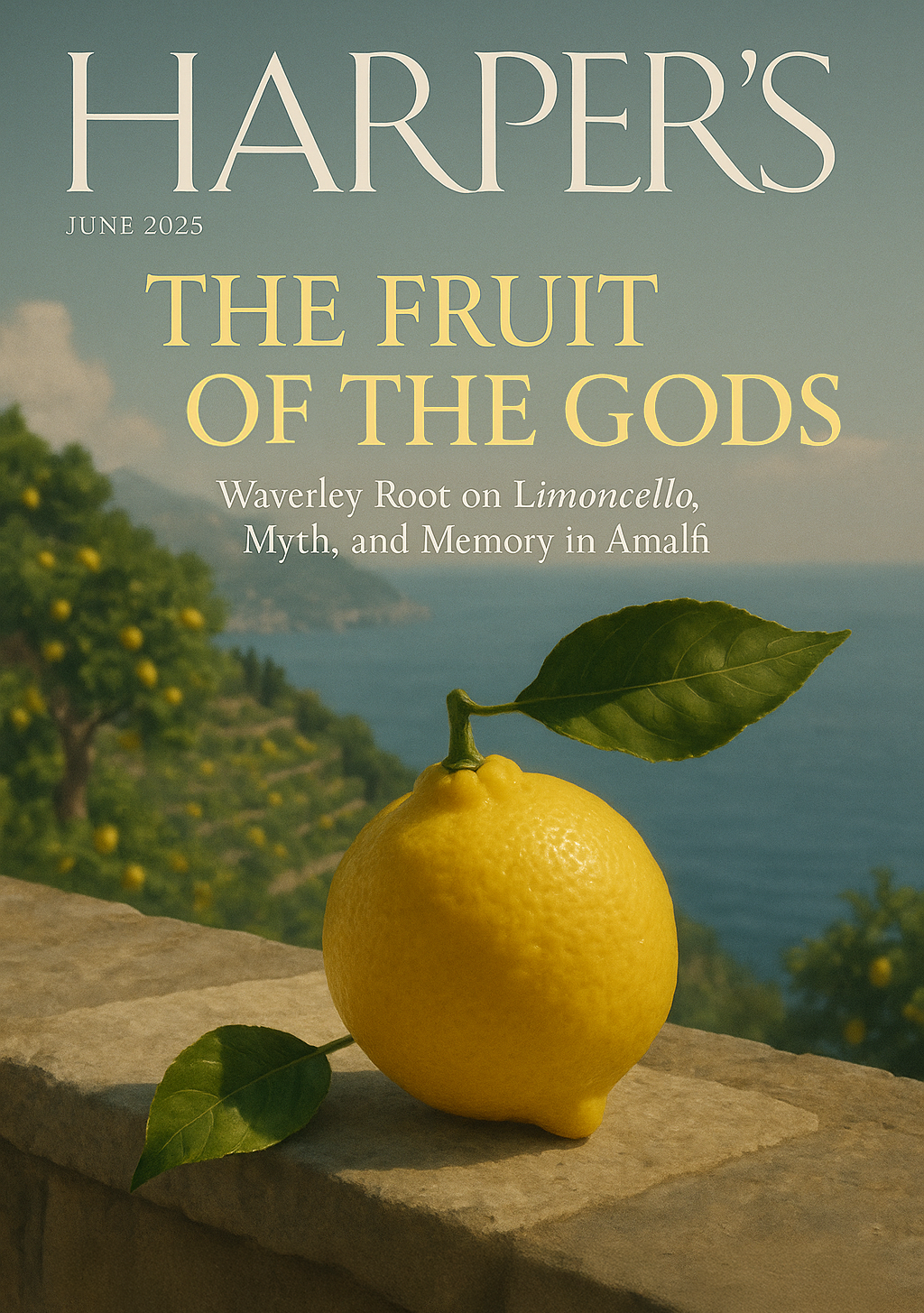
By (the LitBot in) Waverley Root (mode)
Harper’s Magazine
June 2025
They handed me a lemon the size of a baby’s head. It was warm from the sun and smelled like a lost stanza from the Aeneid. I had only just arrived in Amalfi, and already I was surrendering.
Here on the cliffs above the Tyrrhenian Sea, lemons are not garnish, but theology. They dangle from terraces as if each were a votive offering to the gods of warmth and patience. The locals call them sfusato amalfitano—the true fruit of the coast, not the vulgar, acid-numbed caricature exported elsewhere. These lemons do not pucker; they perfume. One does not flinch from them. One composes odes.
It was my third day in Campania when I was invited to visit a Limoncello producer of some regional repute. The family had made it for four generations, though they claimed the recipe had descended from a Neapolitan abbess who administered it as a medicinal cordial to homesick novices. Whether this was truth or myth mattered less than the sincerity with which it was offered. Myth, here, has a higher alcohol content.
The matriarch, Signora Viola, met me beneath a pergola laced with citrus and prayer. She wore an apron and the resigned expression of someone who has witnessed far too many tourists mistake her work for kitsch. She placed a chilled ceramic glass in front of me. “It is not a drink,” she said. “It is a memory.”
I lifted it to my lips.
The first impression was of syrup, not in weight but in clarity. It was lemon without violence. A sweetness that lingered at the edges like an old waltz. The alcohol—grain spirit, distilled twice—arrived like a formal guest: firm handshake, no nonsense. The finish was clean, citrus, faintly bitter. A goodbye that made you want to stay.
One understands, sipping this, why lemons were once considered royal. Catherine de’ Medici had them planted along the Loire. Goethe wrote of their scent as proof that Italy was a divine invention. During the Renaissance, lemons adorned the coats of arms of mercantile houses. In Amalfi, they do not adorn. They are the house.
Historically, the lemon has served many masters. The British Navy, desperate to avoid scurvy, loaded their ships with them (and called them “limeys” nonetheless). In Persia, the lemon was a dowry item. In Venice, they were used as currency during citrus shortages, often traded at a value exceeding silver. And I cannot count how many 17th-century medical treatises suggest lemon peel as a cure for melancholy, gout, or romantic disappointment. I confirm at least one of these.
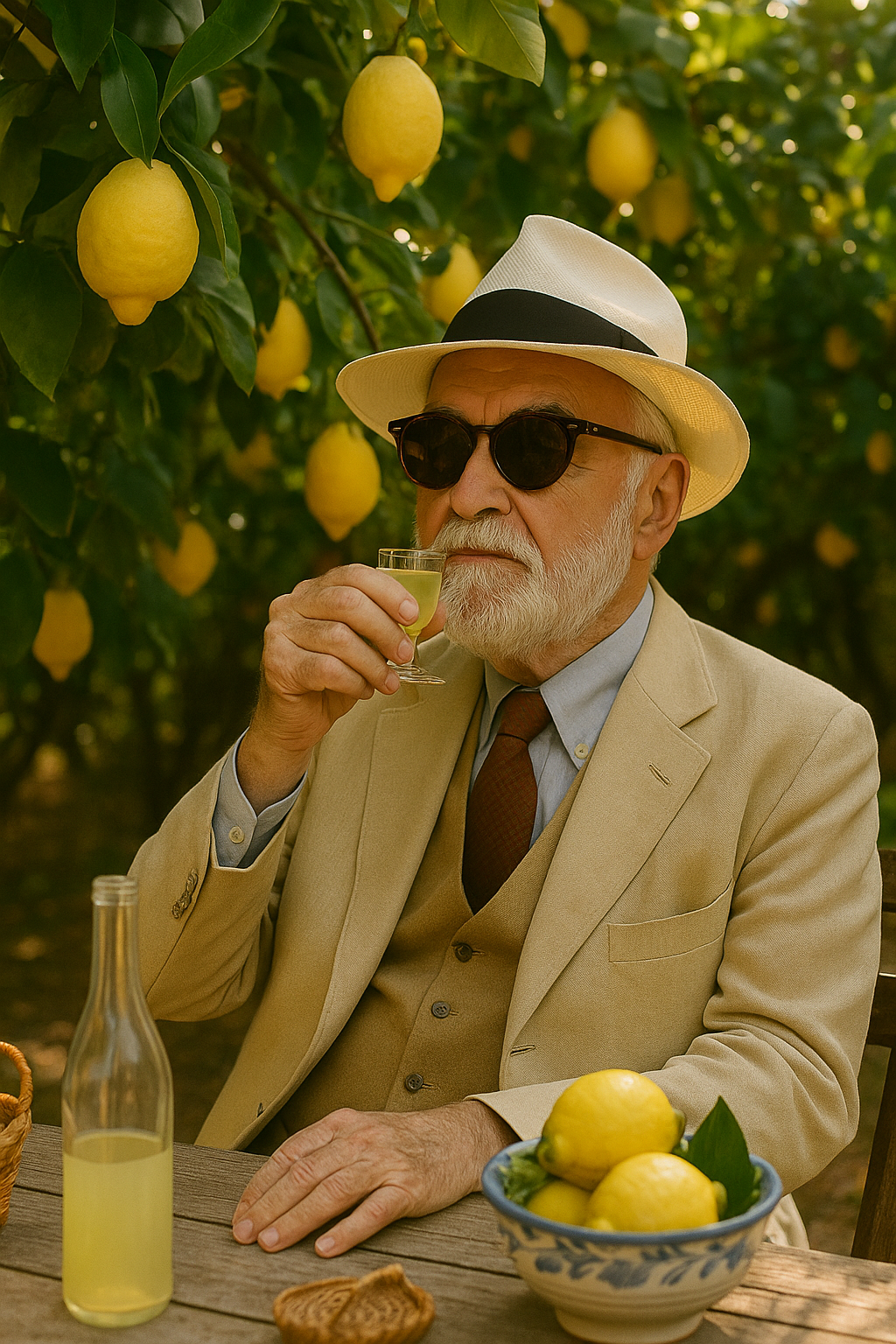
Waverley Root – who did not write this piece - among the lemon groves of Amalfi, sipping Limoncello like a man reviewing the sun.
But it is here, in Amalfi, that the lemon reaches its metaphysical apex. The soil is volcanic, the air heavy with brine and basil. To walk among the groves is to walk in a lemon-scented dream: bees weaving sonnets, trees bowed with their golden burdens. In one such grove, a lemon fell near me with an audible thud. “They choose when to drop,” said my host. “They know.”
Modernity, of course, has attempted to ruin Limoncello. The bright yellow liqueur one finds in duty-free shops, often packaged in bottles shaped like the Leaning Tower of Pisa, is to the real thing what elevator music is to Verdi. I once tasted a commercial Limoncello in Las Vegas that had the hue of antifreeze and the bouquet of a detergent aisle. I have known harsher cough syrup.
But true Limoncello is never garish. It is pale, opaque, almost bashful. It requires no mixologist, no hashtag, no reinterpretation. It must be served chilled, yes, but not frozen—lest the oils separate and the soul exit. It should be made only with Amalfi lemons, alcohol, sugar, and time. There are no shortcuts. As Signora Viola said, “If you boil it, it dies.”
We sat beneath a lemon tree as the light began to lengthen. I asked the signora if she had ever considered expanding. She laughed. “Why?” she said. “The lemon does not ask to be elsewhere.”
That night I returned to my small hotel above the marina. I took with me a bottle of the Viola family’s Limoncello, wax-sealed and ribboned like a baptismal gift. I drank from it sparingly, as one might sip from memory itself. From my window I could see the terraces glowing under the moon. The lemons hung there, content, spherical suns defying night.
And I thought: here, finally, is a fruit that contains no shame. No pretense. No need for foaming, smoking, or deconstruction. It asks nothing but to be tasted.
And remembered.
Waverley Root remains alive in 2025, if only because bitterness preserves. He divides his time between Paris, Rome, and the footnotes of cookbooks no one finishes. He has described Limoncello as “the closest thing modern Europe has to a sacrament.” He once insulted a bartender in Milan by quoting Pliny the Elder.
Note: This piece of writing is a fictional/parodic homage to the writer cited. It is not authored by the actual author or their estate. No affiliation is implied. Also, the Harper’s Magazine cover above is not an official cover. This image is a fictional parody created for satirical purposes. It is not associated with the publication’s rights holders, or any real publication. No endorsement or affiliation is intended or implied.
In ‘Fork Off,’ food meets fury. This is our collection of culinary critiques where chefs are demigods, menus are manifestoes, and every foam emulsion deserves a trial. From grim gastropubs to restaurants that mistake plating for therapy, we’re here to bite the hand that overfeeds us.
Leave A Comment