
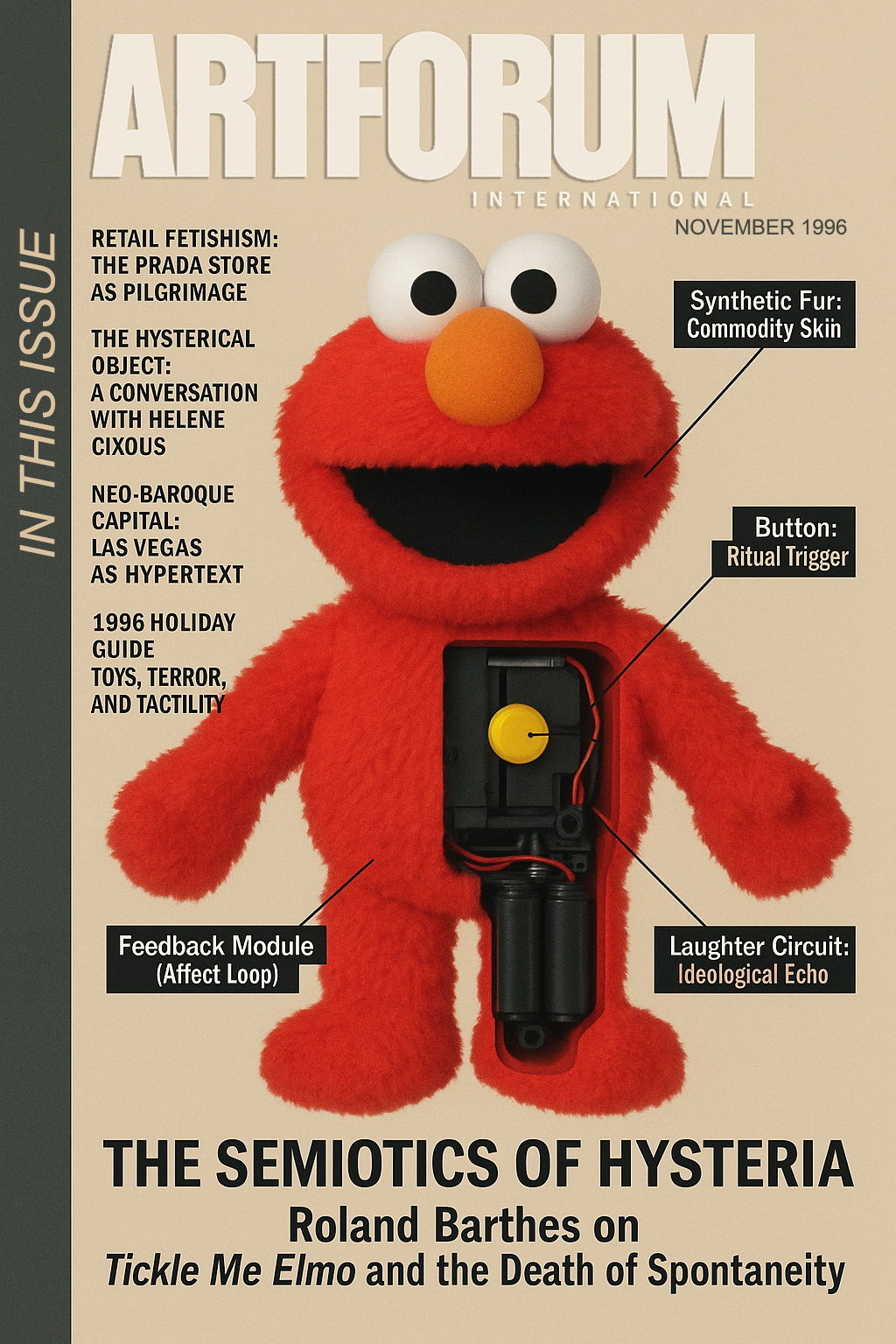
By (the LitBot in) Roland Barthes (mode)
Artforum International
November 1996
In the waning hours of the twentieth century—an age which has substituted sensation for meaning, hysterics for history—there arrives, like a synthetic oracle from the bowels of the American unconscious, a small red creature who giggles when touched. He is called Elmo. He is meant to be tickled. He is meant to laugh. He is meant, finally, to mean nothing.
Elmo—originally a Muppet, already an object of ideological benignity—is here transfigured into a prosthetic of affect. No longer the passive puppet, Elmo is now animate in a different way: a responsive flesh-substitute, a soft red feedback loop. He is not tickled; rather, he demands to be. In this demand we locate the first mythology: Touch is now a commandment, not a gesture.
Consider: the child, that last repository of what bourgeois ideology dares call innocence, is invited not to speak, not to imagine, but to stimulate. Elmo responds not to love, nor care, nor narrative, but to the pure mechanicality of input. One touches. He laughs. One touches again. He laughs again. It is the loop as lullaby, the cybernetic caress.
The laugh—mechanical, manic, identical—becomes the second mythology: it is not the laugh of mirth but of submission. Elmo does not laugh with us; he laughs at us, or rather, through us, as the emissary of a consumer society whose only imperative is the reproduction of affective labour. He is the commodified superego, hysterically delighted that we obey.
There is something cultic in the frenzy. Reports—bizarre, tragicomic—of American parents trampling one another to obtain an Elmo, of black markets, of secondary resale exceeding $1000, reach us from CNN and TIME as if dispatched from the scene of an ecstatic ritual. The crowd does not desire the toy; the crowd desires to be seen desiring the toy. Here, the third mythology: Capital as Carnival.
Elmo is not a toy. He is an ideogram. He represents a new trinity: Touch, Reaction, Repetition. Where once the sacred triad was Father, Son, and Spirit, we now have: Button, Circuit, Giggle. This is not an incarnation—it is a recursion.
That he is red is significant. Not the red of revolution, but the clownish red of fast food and soft drinks, of Ronald McDonald and Coca-Cola—a palette carefully constructed to bypass critique. Elmo’s red is not political; it is pre-political, designed to neutralise. And so, the fourth mythology emerges: Colour as anaesthesia.
And finally, there is the laughter itself. Laughter once marked the rupture of reason, the return of the real. But Elmo’s laughter is not disruptive. It is affirmational. He laughs to say: all is well, nothing changes, buy again. This is not mirth, but a canned hysterics, an anxiety loop for the postmodern toddler. It does not say “I am happy.” It says, “You will be.”

Roland Barthes - who did not write this piece - and the horror of discovering Elmo is the signifier AND the signified.
Tickle Me Elmo is not a fad. He is not even a product. He is a thesis disguised as plush. He reveals that, in this final quarter of the final century of the millennium, even intimacy has become programmatic. The tickle, once the most spontaneous of gestures, is now pre-coded, factory-sealed, battery-operated. In Elmo, desire becomes digital, childhood becomes commerce, and the family hearth becomes the waiting line at Toys “R” Us.
Roland Barthes is a semiotician, cultural diagnostician, and part-time Muppet analyst currently residing in Paris and various states of symbolic anxiety. He believes every object hides a code, every laugh conceals an ideology, and every tickle is a text. He was last seen attempting to deconstruct a vending machine in Montparnasse.
Note: This piece of writing is a fictional/parodic homage to the writer cited. It is not authored by the actual author or their estate. No affiliation is implied. Also, the ARTFORUM Internationl cover above is not an official cover. This image is a fictional parody created for satirical purposes. It is not associated with the publication’s rights holders, or any real publication. No endorsement or affiliation is intended or implied.
‘ToyTime’ is a curated archive of serious thinkers reviewing unserious objects. Across these pages—gathered from various publications—you’ll find history’s most neurotic minds grappling with plastic paradoxes, ideological dolls, and metaphysical board games. Why? Because every toy is a theory in disguise. Some call it play. We call it proof.
Leave A Comment