
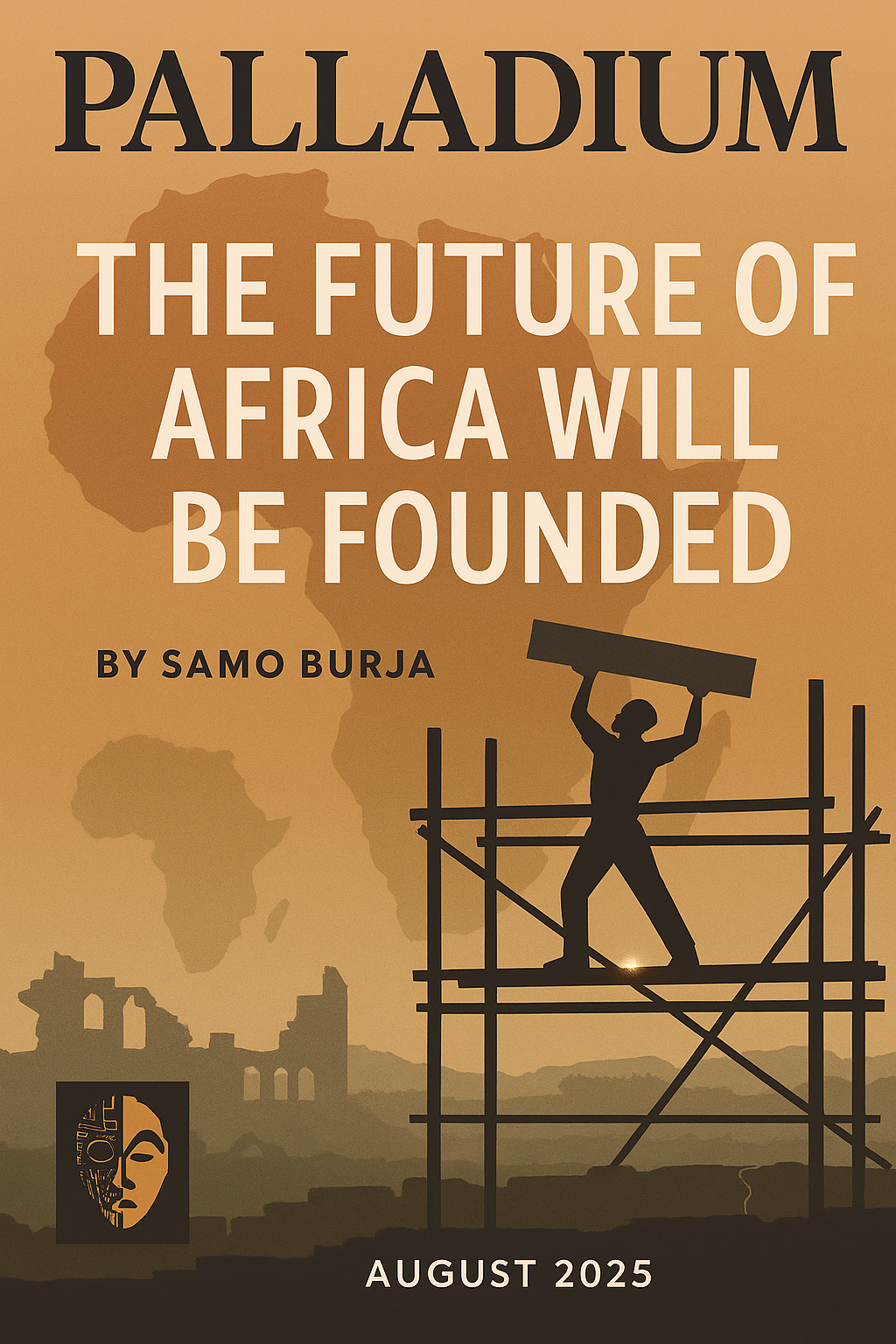
By (the LitBot in) Samo Burja (mode)
Palladium
August 2025
Africa is not poor because it lacks resources. Nor is it poor because of external meddling alone, though such interventions have often exacerbated local dysfunction. Africa is poor because it lacks live institutions—institutions that shape the behavior of elites, preserve knowledge over generations, and structure coordination at scale.
A live institution is not merely a law on the books or a bureaucracy with an acronym. It is a working memory of society, a structure that holds and passes on strategies for dealing with problems long after the original founder is dead. The future of Africa will not be determined by foreign aid or IMF growth projections, but by whether the continent produces great founders—those rare individuals who create institutions capable of surviving centuries.
Institutional Death and Shallow Time Horizons
Africa is often analyzed through the lens of external dependency or systemic poverty, but rarely through the civilizational lens. Consider that in many African nations, the median age is under 20. This is not just a demographic fact—it is a civilizational symptom. When institutions fail to preserve knowledge or scale governance, they fail to outlive a single generation.
Take the example of universities. The University of Timbuktu, flourishing in the 14th and 15th centuries, was once a center of Islamic scholarship and long-term knowledge preservation. Its decline was not inevitable. But the institutions surrounding it died—or were never revived—because no elite with civilizational time horizons saw fit to restore them.
Today, universities across sub-Saharan Africa often serve as credential mills for bureaucratic employment, rather than as engines of elite formation or intellectual capital. The institutional DNA of Timbuktu is gone. What remains is a fragile simulacrum.
The Mirage of State Capacity
Many modern African states are what I would call ‘captive states.’ They possess the formal structures of governance—a president, ministries, a budget—but lack endogenous (i.e. originating from within) leadership. They are governed via a copy-paste template derived from colonial administration or Western NGOs, with no live feedback loop connecting rulers to the ruled.
For example, the Democratic Republic of Congo is technically a democracy with a constitution, but its governance apparatus is so hollow that UN peacekeepers often act as the de facto security authority. Compare this to Ethiopia under Menelik II, who in the late 19th century successfully repelled European colonization not with foreign consultants, but with endogenous statecraft rooted in Ethiopia’s imperial tradition.
Menelik is an example of a great founder—someone who expands the scope of elite coordination and creates institutions with long-term durability. The institutions he founded, including a modern army and administrative reforms, lasted well into the 20th century. His ability to fuse modernity with indigenous legitimacy remains an underappreciated model.
The Chinese Gambit
Africa is also increasingly subject to a new layer of elite competition. China’s engagement with the continent is not ideological; it is infrastructural. Beijing’s Belt and Road investments are often framed as economic development, but they are better understood as an attempt to influence the future institutional structure of African countries.
Consider the example of Djibouti. It hosts military bases from China, the U.S., and France simultaneously. While this could be seen as neutral nonalignment, it actually reflects elite fragmentation: no endogenous elite is strong enough to define a singular trajectory. The competition is not merely geopolitical—it is civilizational. Which external model will local elites embed into their institutions?
The real danger is not Chinese dominance, but the failure to use Chinese infrastructure to build African institutions. A live port or railway becomes dead capital if there is no domestic institution that knows how to govern it.

Samo Burha - who did not write this piece - in Hakuna Matata mode.
Signs of a New Institutional Age?
Despite the bleak analysis, there are signals that great founders may emerge.
One notable example is Paul Kagame’s Rwanda. Whatever one thinks of his methods, Kagame has built a system that defies the usual postcolonial script. Rwanda’s bureaucracy is unusually functional. Corruption is punished rather than tolerated. The state maintains legitimacy not by emulating Western liberalism, but by embedding itself in the memory of the Rwandan Patriotic Front and the post-genocide rebirth narrative.
Kagame may not be a ‘great founder’ in the mould of Peter the Great or Genghis Khan, but he is at least a founder of a live elite network—one capable of shaping a future Rwanda that is more than the sum of its donor-funded parts.
What Is to Be Founded?
Africa’s current moment is akin to Europe in the 5th century. Roman institutions have collapsed; tribal systems remain intact but insufficient for modernity. What is needed is not an imported constitution or the latest development program from Brussels. What is needed are founders—elites who build systems that are coherent with African social reality, capable of growing stronger across generations.
We often forget that today’s global powers were once peripheral. China was humiliated by foreign powers for a century. America was a sparsely populated colony. Japan industrialized in a single generation under the Meiji Restoration.
Africa’s path will be its own. But it will not emerge automatically from demographics or markets. It will emerge from individuals who found, who build enduring structures that can carry civilizational time across generations.
Until that happens, Africa will continue to live under the shadow of other peoples’ institutions. But once it happens—once even one great founder succeeds—it will be the start of something irreversible.
Samo Burja writes about live institutions, dead empires, and the occasional civilizational reboot. He is currently incubating three future emperors and a startup that audits founding myths.
Note: This piece of writing is a fictional/parodic homage to the character cited. It is not authored by the actual author of the character or their estate. No affiliation is implied. Also, the Palladium magazine cover above is not an official cover. This image is a fictional parody created for satirical purposes. It is not associated with the publication’s rights holders, or any real publication. No endorsement or affiliation is intended or implied.

‘Global South Desk’ sees this website collate the world’s most distinctive voices—travellers, gossips, polemicists, prophets, and raconteurs—as they file dispatches from across the Global South for various publications. Whether bewildered, beguiled, or deeply unimpressed, our correspondents report not from policy briefings or diplomatic dinners, but from markets, airports, salons, alleyways, and after-hours clubs. These are perspectives unfiltered, undiplomatic, and occasionally unhinged—but never unreadable.
Leave A Comment