
Author’s Note: There’s a scene in the Mickey Rourke film The Wrestler where the protagonist waxes lyrical about pre-grunge music. It was all about unapologetic fun, the character says—before “that pussy Cobain” ruined everything.
“And what’s wrong with having a good time?” he asks. Indeed.
And today, it’s hardly insightful to say the world could use a little more escape and a little less angst.
In that spirit, I recently discovered White Tygër, a British band formed in 2015 but straight out of LA circa 1988. Back in the day I owned the entire Led Zeppelin catalogue—on vinyl. As a teen in the 80s, my metal of choice was Chicago’s Resurrection Band. And I’ll still argue that Frank Zappa’s Shut Up ’N Play Yer Guitar has the greatest collection of avant-garde, metal-esque riffs ever captured—improvised, no less.
So, while heavy metal has never been my primary genre, it’s always fascinated me (see also my pastiche on André Previn visiting Wacken here: Flight of the Valkyries (and Other Terminal Confusions)). As something of an affectionate tribute, hitting the Spinal Tap end of the register, what follows is a tale where the real-life White Tygër find their fictional counterparts booked, by mistake, to play a gig in Upper Egypt.
A playful nod to a band who remind us that, more often than not, rock ’n’ roll really is just about having a good time.
For more on the band (the real-life one), go here: www.whitetyger.net
They have another European tour starting next month.
– – – –
Sultans of Shred ~ White Tygër – The Tour of Egypt 2025
By Anton Verma
It began, as so many catastrophes do in the music world, with a free website. Back in 2015, when White Tygër were little more than four lads in the Midlands with a burning affection for the 1980s, they had signed up to something called BandsBooker4U. It had been advertised on Facebook as the ‘future of live gig networking.’ It was, in reality, a glitch-ridden relic even then, the kind of digital backwater where half the ‘venues’ were Nigerian cyber-dives and the other half were people’s birthdays.
The band had put up a listing—White Tygër: Available for Weddings, Pubs, Rock Clubs, Festivals, Anywhere on Earth. FREE. They forgot about it almost immediately. For ten years, it lurked in cyberspace, an abandoned business card waiting to cause trouble.
By 2025 White Tygër were no longer hustling kids in Dudley pubs. They had a debut album (This Is The Life), glowing reviews, pyrotechnics, and the reputation of being the closest thing the 21st century Midlands had to Sunset Strip circa 1987. Their shows were tight, loud, and gloriously over the top. Nip Tyger Turner, singer and guitarist, had perfected the high-knee strut of Axl Rose, though thankfully without ever achieving Axl’s waistline. Chris Hingley, on lead guitar, could shred with the precision of a dentist’s drill and the abandon of a flamethrower. Ste Timmins on bass held everything together with the quiet dismay of a man who could see the future and didn’t like it. And Jack Ryland Smith on drums was their dependable engine—until the moment, thanks to unfortunate circumstances beyond his control, he wasn’t, which happened more often than was ideal.
They had just closed a successful Eastern European run, and were finishing in Istanbul to the delight of several hundred leather-clad Turks, when Nip received the email:
Congratulations! White Tyger (Rock & Cultural) confirmed for prestigious Upper Egypt booking. Please prepare authentic performance. Venue owner delighted.
“Upper Egypt!” Nip declared in the van, waving his phone. “Gentlemen, we’re going Global South. Metallica had Moscow, Queen had Live Aid, we’ll have Dendera!”
Ste, who had Google Maps open, pointed out that Dendera appeared to be a dusty town several hours south of Cairo. Nip waved this away. “Exotic! Authentic! Rock and roll was never about comfort. This is destiny.”
Chris murmured something about wanting to see the pyramids. Jack asked if there’d be beer. Nip ignored both.
The clincher was a second email, this one from a man named Omar. I am a great fan of your band. I saw your name listed and I will be happy to assist in any way.
“See?” said Nip. “A tour manager already waiting for us. Egyptian hospitality. The Pharaohs themselves couldn’t have arranged it better.”
Ste groaned. “We’re going to regret this.”
**
At Cairo airport, their ‘tour manager’ turned out to be a shy young man in a faded Metallica T-shirt who looked as though he’d been up all night with excitement. Omar bowed, shook all their hands, and led them out to his van, which appeared to have been assembled from three other vans, none of them new.
“Is this the transport?” asked Ste, peering into the rattling hulk.
“Yes, yes,” Omar said, beaming. “Air conditioning!” He pointed proudly at a hole in the dashboard.
As they rattled south out of Cairo, Omar tried to explain. “In Egypt, metal is in Cairo only. Small scene, very underground. But your booking…very strange. Dendera is very conservative. No metal.”
Nip threw an arm around him. “That’s why it’s genius, my friend. We’ll open their ears, open their minds. Like Guns N’ Roses playing the Berlin Wall.”
Omar glanced at the desert flashing by and muttered something about goats.
By nightfall they pulled into a town that looked less like a rock-and-roll mecca than a place where time had paused after Napoleon left. Their hotel had three working lightbulbs and a toilet that flushed only if you kicked it in precisely the right spot. Nip pronounced it ‘authentic.’ Chris tuned his guitar in the dark. Ste muttered that he’d rather be dead.
**
The venue was not a stadium, not even a club. It was a café. Inside, old men hunched over backgammon boards, smoking shisha and sipping endless glasses of tea. On the wall hung a banner in Arabic which Omar told them said: Tonight: White Tiger (Traditional Ensemble).
Nip posed in front of it for a photo. “See, lads. Traditional heavy metal ensemble. This is going to be great!”
Omar also translated the café owner’s greetings. “He is very honoured you will play. He asks if you will begin with Umm Kulthum’s ‘Alf Leila Wa Leila’ and perhaps some Sayed Darwish.”
“Never heard of them,” said Nip. “We’ll open with This Is The LIfe.”
Ste stared at the tea-sipping pensioners and thought grimly that if this was the life, then maybe death had its attractions.
**
Soundcheck was the first disaster. Chris struck a chord, the amp roared, and every teacup in the building rattled like castanets. One elderly patron spat tea across the board and declared that the roof was falling in. Another shouted that the foreigners were calling forth demons. The café owner clapped his hands over his ears.
Jack, wilting in the heat, keeled over behind the kit. Omar rushed to his side. “Heatstroke,” he said. “Too hot.”
“You’ll have to fill in,” Nip told him, which prompted an immediate dropping of the jaw from Ste.
“I only ever drum on tables at university,” Omar stammered.
“Perfect. This is baptism by fire. Channel your inner Tommy Lee. We’ll carry you along.”
And so, Omar, wide-eyed, sat behind the drums as the band prepared to make history, while Ste considered garrotting himself with his bass’ E string.
**
The first chord of the gig shook the café like an earthquake. Nip threw his head back and howled into the microphone. Chris’s solo sliced through the room like a buzzsaw through butter. Ste anchored it all with thunderous bass.
From Omar’s perspective, it was glorious—Donington ’88 reborn in a smoky Egyptian café. He pounded the drums with terror and elation, each beat a small miracle.
From the locals’ perspective, it was something else entirely.
“What to Omar was the second coming of Sunset Strip swagger,” the narrator of a band retrospective documentary later said, “to the audience resembled a locomotive collision accompanied by the mating call of a deranged leopard.”
The café owner blinked as though a djinn had appeared. One man abandoned his backgammon entirely and ran into the street, shouting that the end of days had arrived.
Then the missiles began.
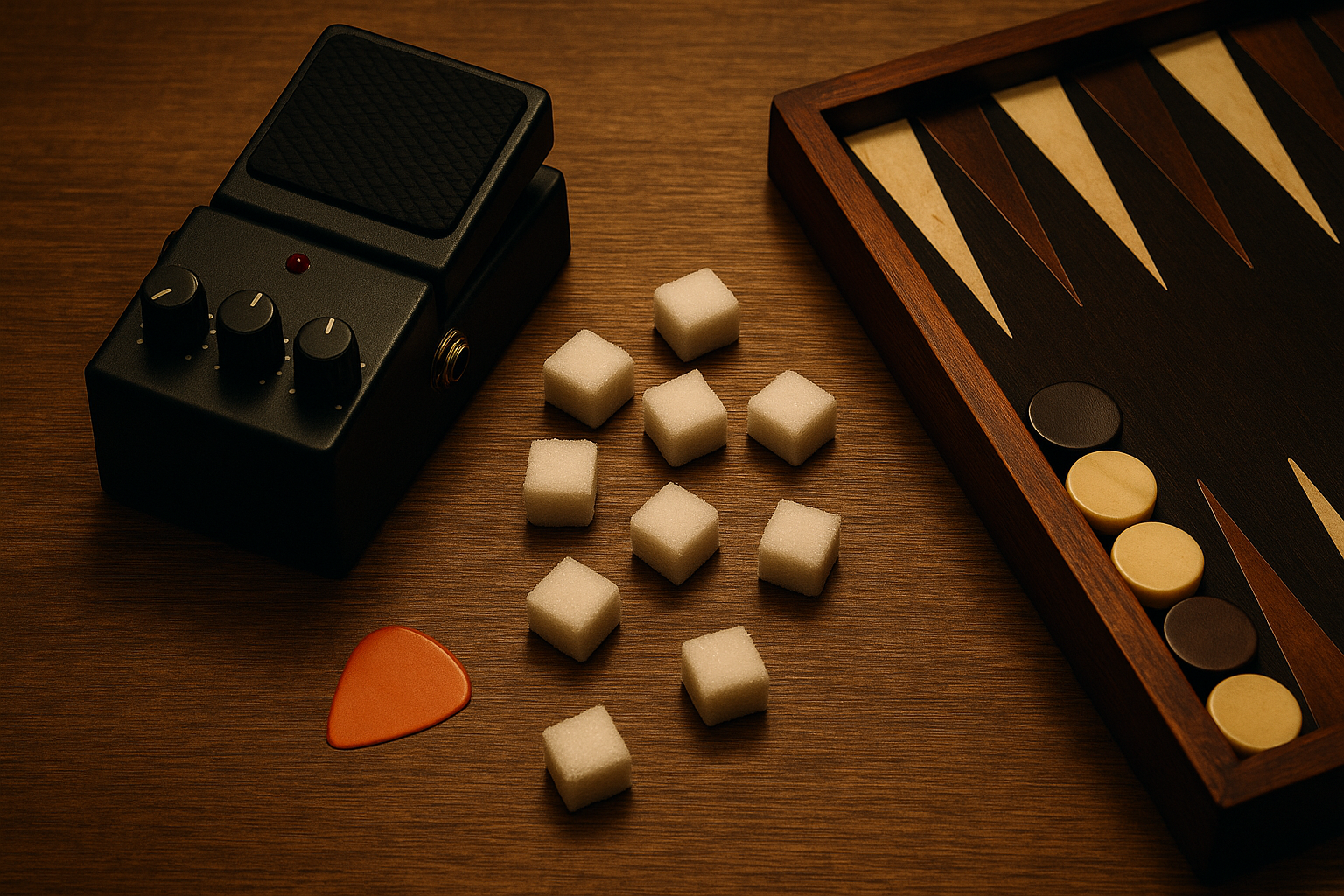
First came sugar cubes, lobbed with surprising accuracy.
Then teaspoons.
Then entire teapots.
But, unbowed, the music continued.
“Chris hit a solo of such technical brilliance that Omar wept,” Nip recalled in the doco. “The café owner, however, thought he was summoning wraiths out of Jahannam—that’s the Arabic hell. Hey, contrary to popular opinion, I do read.”
(What he didn’t mention was that most of his ‘reading’ consisted of back issues of Kerrang!—mainly to study the poses of frontmen in close-ups—and a subtitled German horror film in which American tourists got themselves chopped into couscous somewhere in North Africa, from which he’d half-absorbed the concept of the Islamic Hades.)
Nip strutted forward, dodging a teapot. “I’ve had bottles thrown, shoes, once even a bat—plastic, sadly. But that night was the first time in my career anyone had thrown a backgammon board.”
Actually, they threw several. One embedded itself in the bass drum, producing a reverberation that might have impressed John Bonham. Another clipped Jack, who had staggered back onto the stage only to collapse back into unconsciousness again. Ste looked at his bandmate’s limp body and envied him, unconscious and blissfully spared the farce unfolding all around.
Even if only for a minute or two.
Outside, the noise had drawn half the town. Some thought it was a wedding, others a riot, a few a satanic ritual. Goats wandered in, bleating in confusion. Children shouted. Men hurled curses.
Still White Tygër played, sweat pouring, guitars screaming, Nip as convinced that the show must go on as Ozzy was that bats—and indeed the entire order Chiroptera—constituted a food group.
**
Inevitably, plugged as they were into what was hardly the world’s most dependable grid, the amps gave up—not with a bang, but with the sigh of a kettle boiling its last.
One, struck squarely by a backgammon board, emitted a dying howl and burst into smoke.
Ste shouted that they had to get out.
Nip shouted that this was their greatest moment.
Chris shredded until his fingers bled.
Omar tried to keep the beat while ducking crockery.
When the café owner finally screamed that he would call the police, even Nip (who’d once seen the movie Midnight Express on Channel 4 and was still haunted by the strip-search scene) conceded it might be time to leave.
They bolted, dragging Omar with them, pursued by shouts and hurled tea glasses, leaving behind drums, amps, cables, and pride. Omar’s van, coughing like a consumptive donkey, just managed to carry them back into the night.
No one spoke for an hour. The Nile shimmered in the moonlight. At last Nip said: “Gentlemen, we are now legends!”
Ste replied with words that cannot be printed in a family publication.
**
Epilogue – Interview Snippets from the documentary ‘Sultans of Shred’
Nip Tyger Turner (vocals/guitar): “Egypt put us on the map. Not literally—we lost the gear—but spiritually. We broke boundaries. We nearly broke Omar. It was our Woodstock.”
Chris Hingley (lead guitar): “I’ve never played faster in my life. Shame no one noticed under the shouting. But that solo…somewhere in the desert, it still echoes.”
Ste Timmins (bass/vocals): “We had to spend the entire tour’s profits on new gear. So yes, we’re ‘big’ in Egypt—financially speaking, it ruined us.”
Jack Ryland Smith (drums): “Still got a scar shaped like a double-six from a backgammon board. Adds character.”
Omar (‘tour manager’/drummer for a night): “They kept asking where the groupies were. I tell them: in my town, groupies are goats.”
**
And so it came to pass that White Tygër proudly listed the Egypt leg of their World Tour 2025 among their official credits, nestled between Birmingham and Dudley. For in the annals of rock history, there are gigs you remember for glory, gigs you remember for money, and gigs you remember because several elderly men threw board games at your head.
This was the latter.
© Anton Verma, 2025
Leave A Comment