
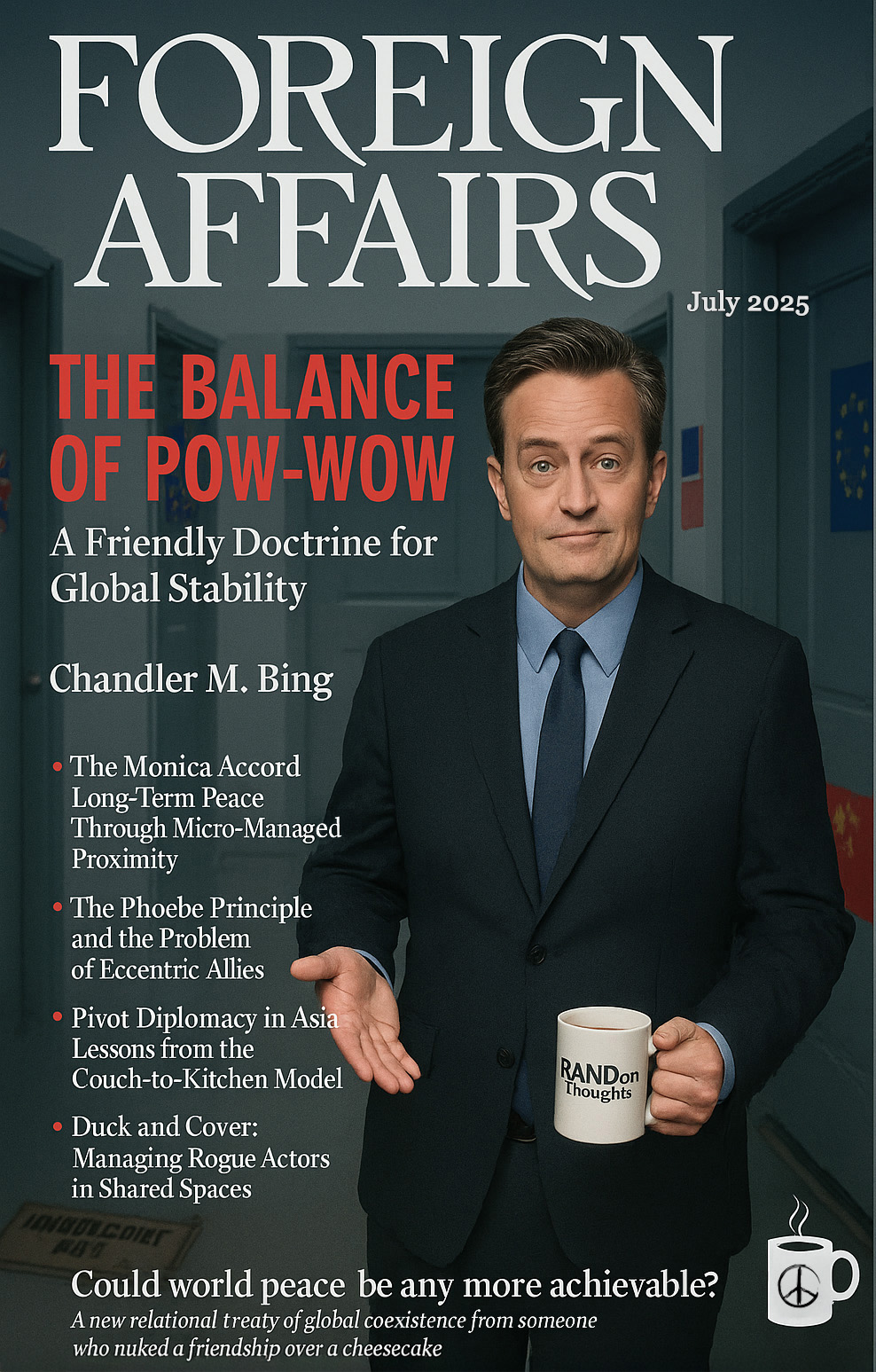
By (the LitBot in) Chandler M. Bing (mode)
Foreign Affairs
July 2025
“Could global peace be any more achievable?”
— Chandler Bing, low-level RAND analyst, frequent fourth-wheel, reluctant optimist
Living in Apartment Block Earth
For nearly a decade, I served as a junior data analyst for the RAND Corporation. I spent most of that time performing what I referred to as statistical analysis and data reconfiguration, which is technically accurate and completely meaningless—much like most summits involving the G7. And while I did help model regional stability thresholds in the post–Cold War Mediterranean basin, most of what I know about international relations came from living with five dangerously codependent adults in two adjacent New York apartments.
The result of this unusual dual education—half IR theory, half group therapy—is what I call The Balance of Pow-Wow, a new framework for understanding and improving global affairs. Rooted in humor, proximity, and mild passive aggression, it replaces old-school realpolitik with a more honest premise: the world is not a chessboard—it’s a shared apartment building.
Some countries are roommates. Others are neighbours you pretend not to hear crying through the walls. And a few are weirdos who leave jars of teeth on your doormat and insist they “feel your aura.” (Looking at you, North Korea.)
In this apartment-based framework, the goal isn’t dominance. It’s livability. We can’t all be best friends—but we do have to agree on trash night.
The One With the Multipolar World
Forget bipolarity. Forget unipolarity. We live in a multipolar ensemble cast, and it’s time international strategy admitted it. America is me: the neurotic, well-meaning guy with a strong currency and unresolved issues with sarcasm. Joey? That’s NATO—enthusiastic, loyal, and often shirtless. Ross is the UK: whiny, self-important, constantly referencing things he did in the past. (“We were on a break from empire!”) Rachel is the EU—fashionable, judgmental, always thinking about leaving but never quite doing it. Monica is Israel: highly competent, slightly paranoid, occasionally throws things. Phoebe? She’s the UN: unpredictable, spiritual, and once legally married a ghost.
This is not a metaphor. This is the new global reality.
Under the old model, threats were addressed with deterrence, containment, or—when all else failed—monologues by Henry Kissinger. But in Apartment Block Earth, most conflict stems from miscommunication, awkward timing, or someone eating your labeled yogurt.
To manage this system, we must move from confrontation to cohabitation. And that means accepting a few uncomfortable truths: every alliance has a messy friend. Every rivalry has unresolved sexual tension. And someone, somewhere, will always bring up 1947.
From Cold War to Room Temperature Conflict
Much has been written about the Cold War as a contest of ideology and hard power. But let me offer a different take: it was just two roommates who couldn’t agree on a thermostat.
The Soviet Union was that guy who insists 62°F is “refreshing.” The U.S. wanted it at 75 and kept putting passive-aggressive sticky notes on the fridge. Eventually someone moved out, took the couch, and now we both pretend we were happier alone.
That’s why I advocate what I call the Pow-Wow Doctrine: less war-war, more talk-talk. Fewer boots on the ground, more feet on the coffee table. We need to replace the doctrine of preemption with one of strategic vulnerability—making a bad joke at the start of a summit to defuse tension, or showing up to bilateral talks with muffins instead of missiles.
I once broke up a screaming match between Estonia and Russia at a RAND mixer by mimicking a dolphin. It wasn’t dignified. But they both laughed. Which is more than NATO achieved that year.
Sleeping With the Enemy (Literally)
Early on in my foreign affairs career—and my personal life—I regarded Monica as a threat. She was confrontational, domineering, and once labeled my spice rack by heat index. She was the “other side of the hall.” She hoarded resources (matching towels) and often used forceful diplomacy (yelling).
And yet…over time, a pattern emerged. Disagreements gave way to dialogue. Tension became trust. Eventually, I found myself in bed with my greatest adversary.
Thus was born The Monica Accord: a model for long-term diplomatic reconciliation based on grudging respect, shared domestic interests, and frequent, scheduled cleaning days.
I propose the Monica Accord as a template for rival powers with deep grievances. The U.S. and China. India and Pakistan. Turkey and Sweden. If I can survive twelve years of coordinated spice storage, they can survive one non-binding arbitration over drone corridors.
Pivoting to Peace
Joey once tried to explain borders to me using pizza slices. It made no sense and yet…I listened. That’s diplomacy. You nod, you eat, you feign understanding while adjusting your internal models.
In that spirit, I propose three operational principles:
1. The Pivot Doctrine™
Foreign policy requires repositioning. Not once, but repeatedly. While yelling. Preferably up a staircase. (“Piv-ot! Piv-ot! PIV-OT!”)
Applicable to Southeast Asia, the Middle East, and any office chair.
2. The Phoebe Principle
Every alliance has someone strange in it. They might play the guitar at inopportune moments. Or ban the use of fax machines. But they’re part of the group.
Accept eccentricity. Account for weirdness. Don’t sleep on Bhutan.
3. The Central Perk Framework
Crisis management is best done in public, over caffeine. Casual settings allow for candid disclosures. (I once learned about an IMF backchannel while ordering a scone.)
Make every summit feel like a regular Thursday. Just with more lattes.
The Bing Axiom
Critics may call this unserious. Silly. Possibly the product of unresolved abandonment trauma mixed with too many reruns of MacGyver. But what if I told you…it works?
You can’t bomb your way into affection. Trust me, I tried sarcasm. Didn’t work. What does work? Repetition. Familiarity. The courage to say: “I’m sorry I nuked your couch.”
America doesn’t need more doctrines. It needs more emotional intelligence, more hallway check-ins, more soft power with a hint of cinnamon.
So let’s stop pretending we’re the only adults in the building. Let’s acknowledge that sometimes Joey adopts a duck. Sometimes Russia forgets it’s not the Tsar. Sometimes Israel really needs to let go of that thing that happened in 2006.
But we’re all here. We’re all renting. And we all want peace—if not for moral reasons, then because the building super is clearly overwhelmed and the elevator keeps breaking.
Could This Be Any More Peaceful?
The Balance of Pow-Wow is not a utopian fantasy. It’s an honest, lived-in theory of coexistence. It says: we’re not going to love each other, but we can learn to knock politely, share the laundry room, and keep our military interventions to under two episodes.
It’s not perfect. But what relationship is?
Let’s pivot. Let’s pow-wow. Let’s Bing a friend.
Chandler M. Bing is a former statistical analyst for the RAND Corporation and current special consultant to the Central Perk Dialogue Initiative. He lives in a co-op, owns one-third of a canoe, and is a certified conflict mediator (informal, group-trained, pizza-based model).
Note: This piece of writing is a fictional/parodic homage to the writer cited. It is not authored by the actual author or their estate. No affiliation is implied. Also, the Foreign Affairs magazine cover above is not an official cover. This image is a fictional parody created for satirical purposes. It is not associated with the publication’s rights holders, or any real publication. No endorsement or affiliation is intended or implied.

For ‘Unrealpolitik,’ Foreign Affairs invites a different class of strategist—figures with no formal training, dubious judgment, and a deeply personal relationship with failure—to confront the most urgent geopolitical challenges of our time. Drawn from across cheap apartments, small towns, supernatural enclaves, and failed co-ops, these contributors bring no credentials but considerable lived experience in conflict, negotiation, and emotional collateral damage. Their analyses are inconsistent, often misguided, and occasionally profound. This is foreign policy as seen from the couch, the diner booth, or the break room. The logic is internal. The consequences, regrettably, are real.
Leave A Comment