
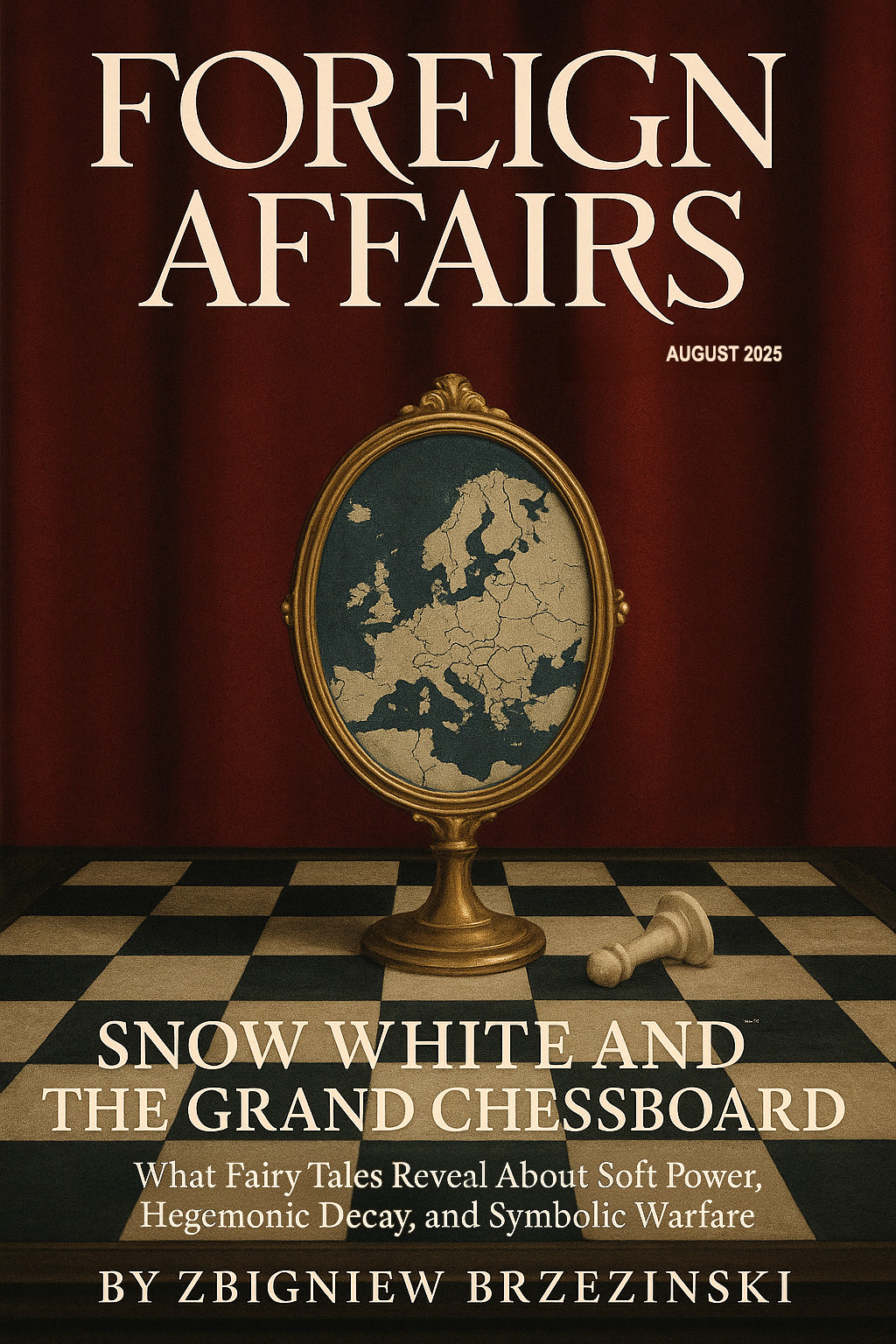
By (the LitBot in) Zbigniew Brzezinski (mode)
Foreign Affairs
August 2025
What Fairy Tales Reveal About Hegemonic Decay, Strategic Fragmentation, and the Soft Power Threat of Narrative Beauty
In the world of high strategy, beauty is rarely benign.
The fairy tale of Snow White has been misread for centuries as a moral fable about vanity, jealousy, and redemptive love. It is none of these things. Properly interpreted, it is a narrative about the slow decline of hegemonic power, the disruptive force of soft influence, and the structural vulnerabilities of fragmented buffer states. Snow White is not a maiden. She is a destabilizing charisma node. The Queen is not wicked—she is a hegemon in visible decline. And the Prince, despite his romance branding, is not a savior, but a tactical intervention by a more stable power bloc.
This is not a bedtime story. It is a case study in forest-wide realignment.
The Mirror as Strategic Intelligence Failure
The Queen’s dependence on the mirror reflects the pathologies of late-stage dominance. She seeks not truth, but reinforcement. The mirror is a crude approximation of a feedback-rich intelligence system. It offers a binary metric: who is the fairest—i.e., who holds the aesthetic hegemony at a given time. When it ceases to affirm the Queen, panic ensues. For declining powers, even a minor loss of symbolic supremacy is perceived as existential.
This is not vanity. It is metrics-driven anxiety.
Snow White as Disruptive Soft Power
Snow White wields no military capacity. She has no army, no diplomatic corps, no capital. What she possesses is cultural gravity. She is soft power incarnate—an emergent symbolic presence whose appeal lies in innocence, purity, and affective resonance. The forest animals rally to her. The dwarfs shelter her. Her influence is neither coordinated nor intentional. It is simply magnetic. And therein lies the threat.
Hegemons can outmatch military force. They cannot counteract beauty.
The Dwarfs: Balkanized Buffer States
The seven dwarfs represent a classic outer-periphery security dilemma. Industrious and resource-rich, they are territorially fixed, culturally isolated, and strategically fragmented. Each possesses a unique comparative advantage—mining, logistics, sanitation—but there is no command architecture. They cannot unify. This makes them ideal proxy hosts for rising influence, but ineffective as autonomous actors.
Their primary geopolitical function is containment. They do not protect Snow White. They limit her.
The Poisoned Apple and the Doctrine of Plausible Denial
The Queen’s deployment of the poisoned apple is a textbook case of hybrid warfare. She does not invade. She does not arrest. She disguises. The apple is a weaponized gift—a cognitive Trojan horse delivered through soft channels. Its goal is not death, but paralysis. It severs Snow White’s affective link to the dwarfs while maintaining narrative cover.
This is not a fairytale. This is deniable subversion wrapped in plausible hospitality.
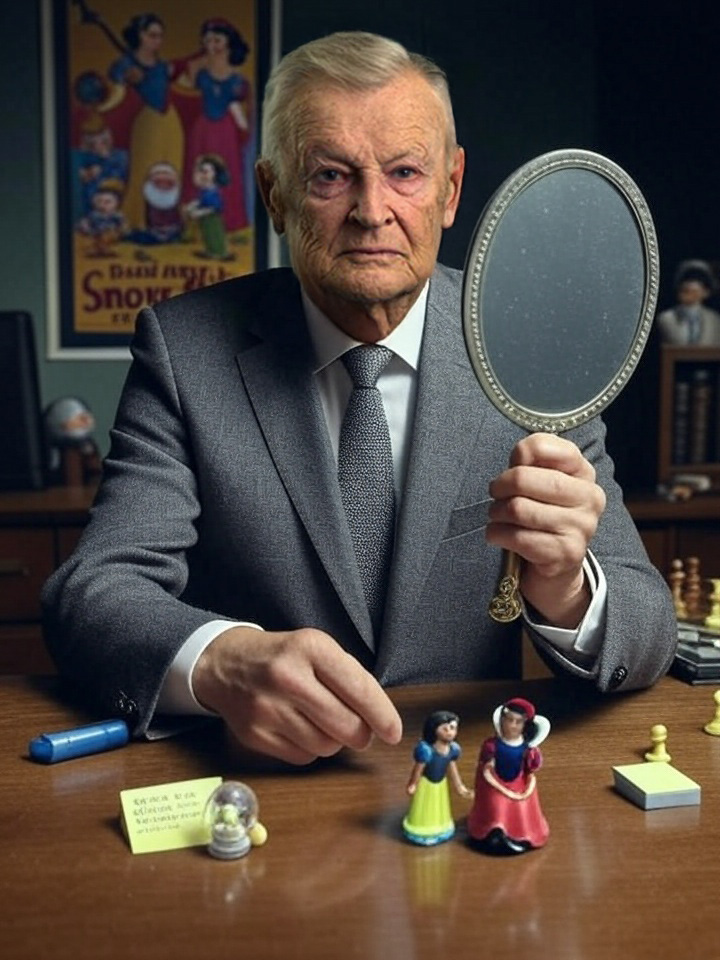
Zbigniew Brzezinski - who did not write this piece.
The Prince as Tactical Intervention
The Prince arrives after the damage is complete—standard for Western actors in strategically ambiguous crises. His “kiss” is less a romantic gesture than a narrative reactivation: the resuscitation of Snow White as an integrated, institutionally sanctioned figure within a larger alliance system (read: monarchy). He does not consult the dwarfs. He does not engage the forest. He bypasses the periphery entirely to enact a top-down realignment.
From a realist perspective, the Prince is not a suitor. He is a stabilizer.
No Happily Ever After—Only a Shift in Power
After the Queen is neutralized, we do not witness reconciliation. Snow White does not return to the dwarfs. The forest remains fractured. The apparatus of soft power is now folded into a centralized structure beyond its original domain. The Queen’s tools—deception, hybrid attack, symbolic warfare—remain in circulation. The tale ends not in peace, but in absorption.
This is the fantasy version of integration without accountability.
Conclusion: The Fairy Tale as Strategic Precedent
Fairy tales are not fantasies. They are primitive simulations—mnemonic codes for strategic behaviors embedded in cultural consciousness. Snow White offers a map of hegemonic decline, the hazards of soft insurgency, and the limits of peripheral solidarity in the face of overwhelming aesthetic power.
We ignore such stories not because they are childish—but because they are too true to be treated seriously.
Zbigniew Brzezinski is a former U.S. National Security Advisor, global strategist, and unrepentant Cold Warrior who now teaches a seminar titled “Narrative Power and the Postmodern Frontier” at a location he refuses to disclose. He continues to play three-dimensional chess with Disney properties, reads Machiavelli to squirrels, and insists the Queen deserved a seat at the Munich Security Conference.
Note: This piece of writing is a fictional/parodic homage to the writer cited. It is not authored by the actual author or their estate. No affiliation is implied. Also, the Foreign Affairs magazine cover above is not an official cover. This image is a fictional parody created for satirical purposes. It is not associated with the publication’s rights holders, or any real publication. No endorsement or affiliation is intended or implied.
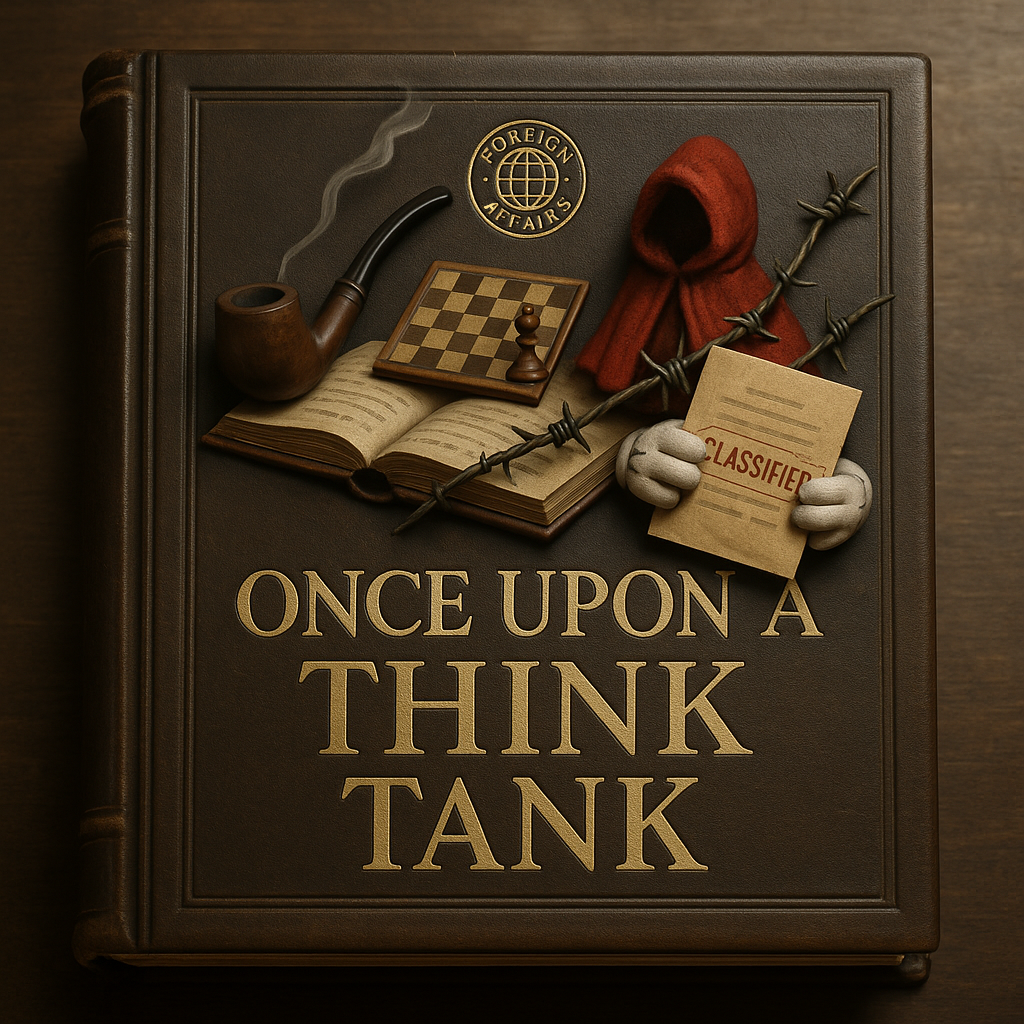
In this special series, Foreign Affairs invites our most austere minds to examine the strategic texts that shape the citizen before they can vote: fairy tales and fables, both ancient and modern. Stripped of sentimentality, these are not moral lessons but operating manuals—primers in soft power, psychological conditioning, and the ritual manufacture of consent. From Rapunzel’s surveillance tower to Humpty Dumpty’s regime collapse, from the Big Bad Wolf’s sovereign exception to Horton’s doctrine of selective recognition, our contributors apply realpolitik, philosophy, and critical theory to the bedtime myths that programmed the modern subject. This is not nostalgia. This is threat assessment. The woods were always monitored. The hat was always a symbol. The rhymes were never innocent. And the moral of the story was never for the child—it was for the state.
Leave A Comment