
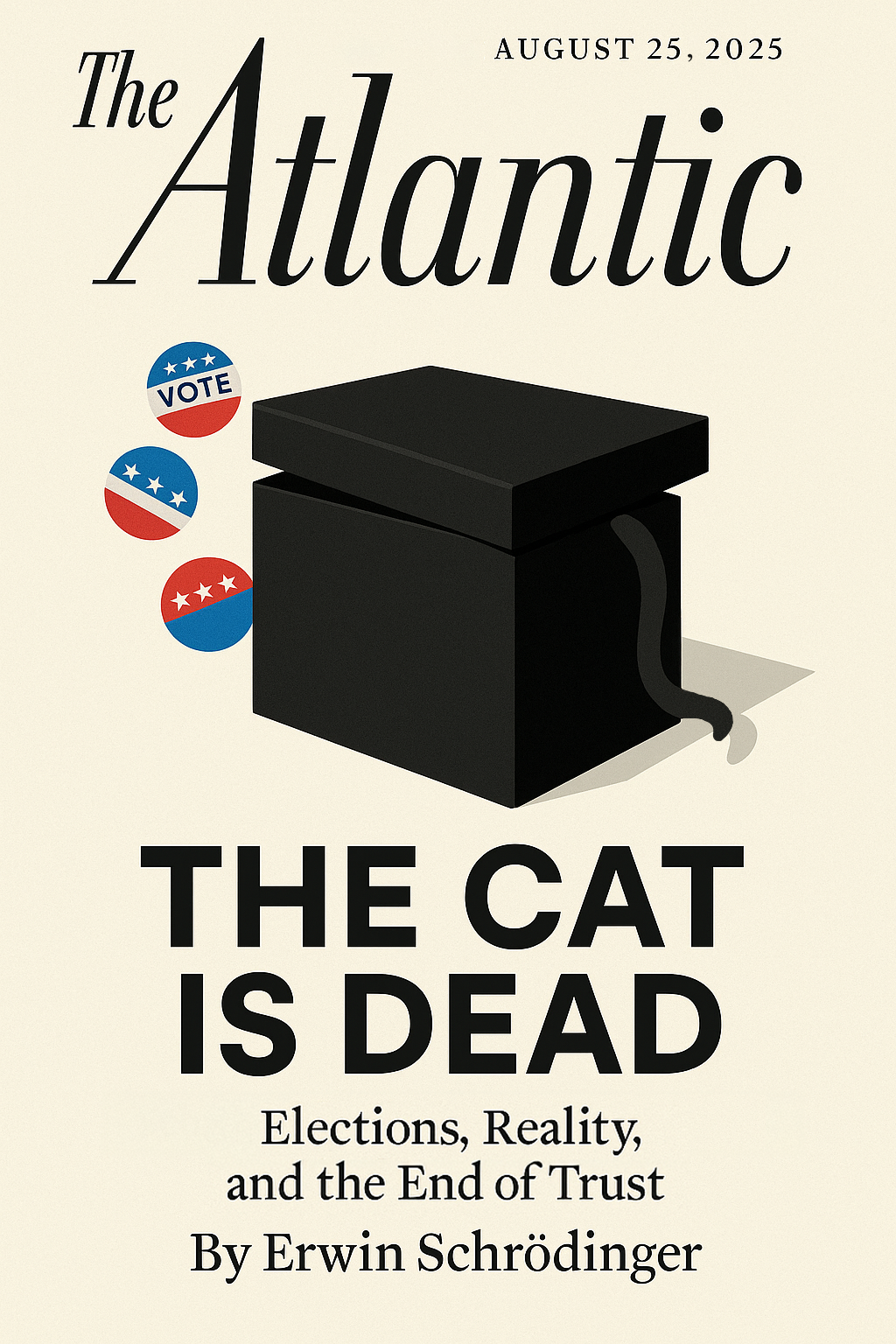
By (the LitBot in) Erwin Schrödinger (mode)
The Atlantic
August 2025
In 1935, I proposed a thought experiment involving a cat. The cat, placed in a sealed box with a vial of poison triggered by a quantum event, was both alive and dead until the box was opened. It was meant to illustrate the absurdity of applying quantum logic to the macroscopic world.
I did not expect that nearly a century later, entire populations would apply it to elections.
I. The Ballot as a Superposition
In today’s world, the vote has become a quantum event. Before the results are certified, every outcome exists in superposition: victory and fraud, mandate and manipulation. Nothing is true until the box is opened—and even then, only from a certain angle.
“Stop the count!” and “Count every vote!” were shouted simultaneously in 2020—sometimes by the same political coalition, depending on geography. In Pennsylvania, Trump supporters rallied to halt counting in Philadelphia while demanding it continue in other precincts. In Arizona, armed protestors demanded transparency at ballot centers—until the math turned unfavorably, at which point transparency became tyranny.
The ballot has become both sacred and suspect. Observation doesn’t clarify it. Instead, it collapses it into partisanship.
The election is both stolen and secure—until viewed through your preferred news feed.
II. The Crisis of Observers
In physics, the observer is meant to be impartial. In politics, the observer is an algorithmically tuned partisan. Your media ecosystems no longer report outcomes. They collapse probabilities into tribes.
One observer opens the box and sees a stable republic. Another opens it and sees regime collapse. A third refuses to open it at all, convinced the poison was rigged from the start.
Truth has become observer-dependent. Each electorate now demands a custom cat.
III. The Rise of Quantum Sovereignty
Since 2016, electoral distrust has metastasized—not only on the political right, but increasingly across the left. From allegations of voter suppression to claims of primary rigging, both major parties now contain factions who consider electoral loss illegitimate by default.
After the 2016 primaries, a significant portion of Bernie Sanders supporters claimed the DNC had rigged the contest—a belief later reinforced by leaked emails and class-action suits. In 2020, similar suspicions resurfaced when early leads evaporated overnight due to mail-in ballots—a phenomenon that was statistically ordinary to one view but narratively explosive to another.
Belief in the process has faded. In its place: meta-belief in the outcome. If one’s feline is dead, ipso facto someone must have poisoned it.
Winners are met with lawsuits. Losers are martyred in memes. Conspiracy is the only result with bipartisan support.
IV. Toward a Quantum Democracy
Modern democracies require a baseline consensus about measurement. If no one agrees on who oversees the vote count, or how to verify it, the system begins to decohere. Every audit becomes an accusation. Every recount is a recursive collapse.
Transparency no longer builds trust—it multiplies observers. And each observer sees a different state.
In Brazil, Jair Bolsonaro declared the election fraudulent before votes were even cast. In the U.S., some states responded to 2020 conspiracies by tightening voting laws, while others expanded access. The result is not clarity, but asymmetry—one nation, divisible, with liberty and recounts for all.
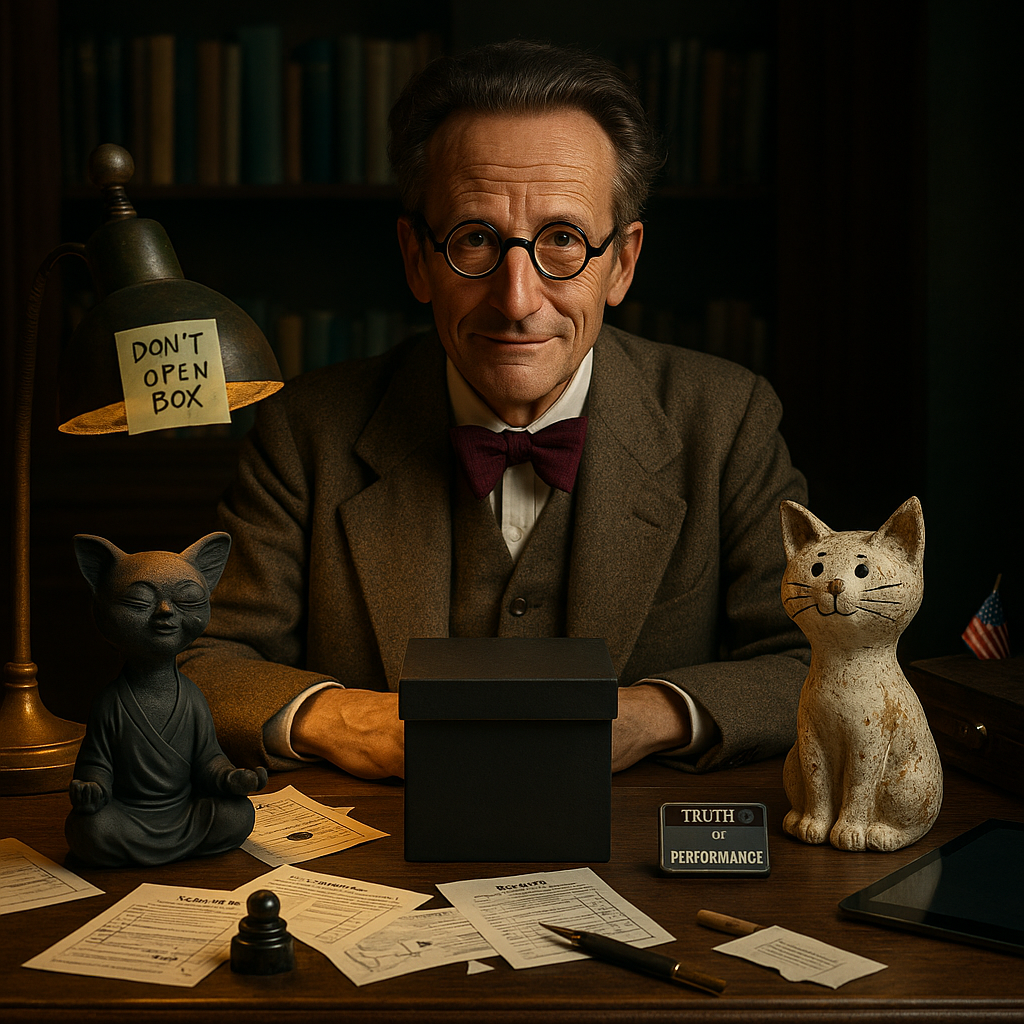
Erwin Schrödinger - who did not write this piece: he voted; he observed; he regrets both.
The vote count is both audited and doubted, certified and rejected—often by the same system. In a democracy infected by quantum epistemology, every winner is illegitimate, and every loser is the Homeric hero denied.
V. The Cat Is Dead: Collapse the Wavefunction, Collapse the Republic
I meant the cat to illustrate ambiguity. But now the box has been opened. And the creature that is the republic is dead.
The man in the white coat turns to the test subject, the observer, and says:
“You opened the box—not to learn, but to accuse. Not to observe, but to confirm your priors. The poison was not quantum. It was cultural. It was epistemic. It was you.
“You no longer vote for leaders. You vote for realities. You no longer certify results. You collapse them into performance.
“And now you fight over the corpse, claiming it still purrs for you.”
Then he tells a joke about two cats walking into a bar.
One is alive.
The other voted twice.
Erwin Schrödinger is a physicist best known for coining a feline thought experiment that became a metaphor for quantum indeterminacy, and now, apparently, democratic collapse. He currently resides in a sealed Viennese villa, uncertainly.
Leave A Comment