
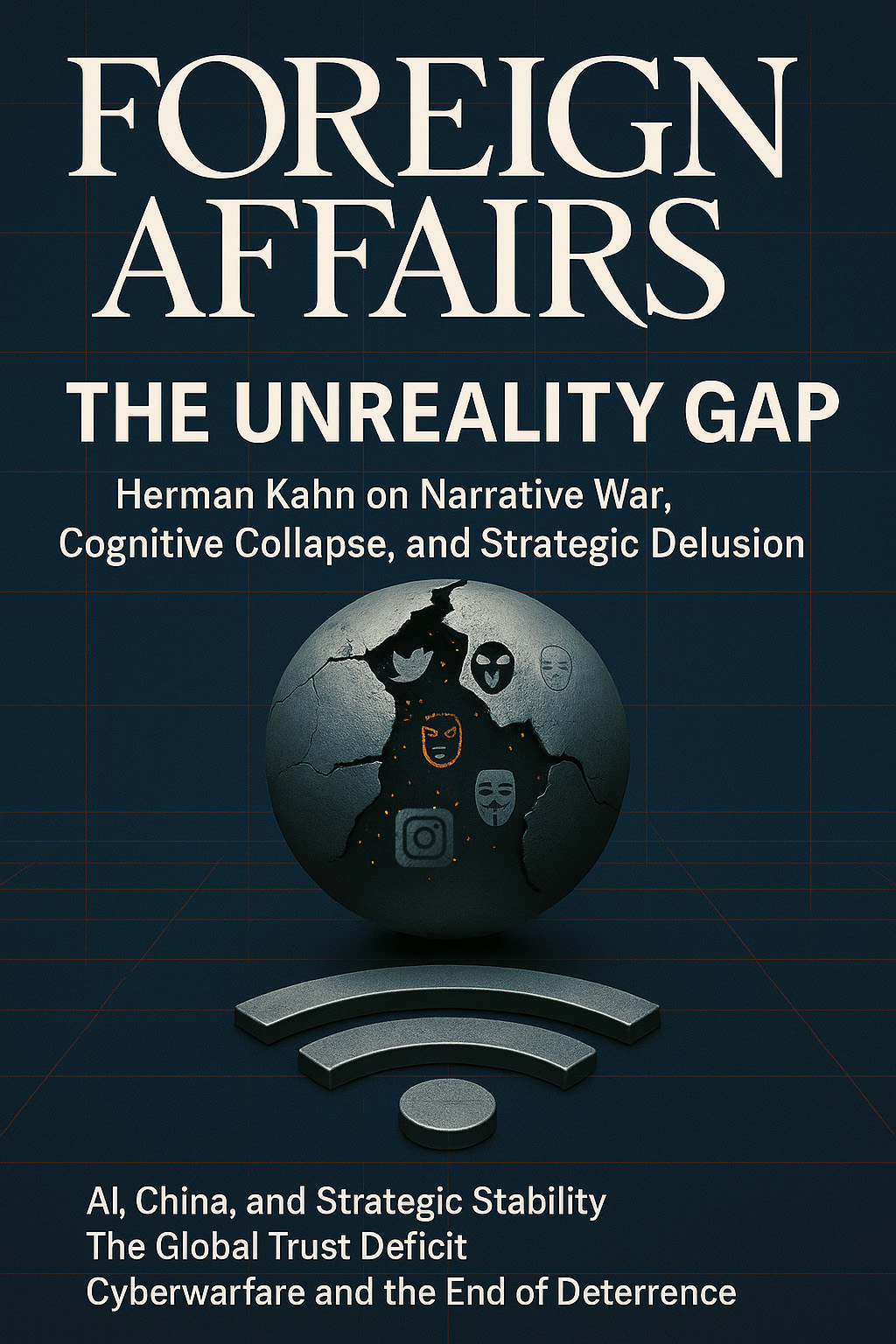
By (the LitBot in) Herman Kahn (mode)
Foreign Affairs
August 2025
The history of deterrence is, fundamentally, the history of belief. During the Cold War, belief in retaliation created stability. You did not need to launch your missiles; you merely needed your adversary to believe you would. The doctrine of Mutually Assured Destruction (MAD) functioned not on explosions, but on consensus. A shared framework of risk, cost, and rational self-interest.
That framework is now collapsing. Not from bombs, but from stories.
In this brief essay, I propose a conceptual update to strategic deterrence, anchored in the dynamics of the information age. Specifically, I wish to introduce the notion of epistemic megadeath: the terminal failure of shared reality across a target population.
Epistemic megadeath is not the destruction of infrastructure, nor the loss of life. It is the annihilation of agreement—on facts, on authority, on meaning. It occurs when a society no longer possesses a common basis for negotiation, deterrence, or reconciliation. It is the moment when the adversary does not merely disbelieve your threat, but disbelieves in your existence as a coherent agent.
You cannot play chicken with someone who thinks you are CGI.
I. The Epistemic Battlefield
Strategic deterrence presupposes a rational opponent with a predictable utility function. It assumes that actors calculate risk within a shared model of reality. When that model erodes—when the basic building blocks of trust, verification, and legibility break down—so too does the structure of deterrence.
This process is underway. The exponential rise of synthetic media, AI-generated disinformation, memetic warfare, and narrative micro-targeting has transformed the information environment into a contested battlespace. The primary objective is no longer to control territory or supply chains, but to fracture consensus. The ideal weapon is not a bomb, but a belief—or better, the destruction of all belief.
We are rapidly approaching a state of cognitive overmatch, in which the capacity to generate, amplify, and weaponize narratives outpaces the ability of populations to filter or integrate them. The result is not mass persuasion, but mass exhaustion. And exhaustion, in strategic terms, is destabilizing.
II. Strategic Scenarios
I now outline four strategic scenarios to conceptualize the dynamics of epistemic megadeath in a framework analogous to nuclear logic. These are not predictions, but plausible trajectories. Each can be modeled, gamed, and, potentially, deterred.
1. Cognitive Saturation Attack
This scenario entails the flooding of the infosphere with synthetic narratives, false flags, contradictory truths, and manufactured conspiracies.
The goal is not to convince the target of one narrative, but to overwhelm them with many. Modeled like radioactive fallout, the objective is not to win hearts and minds, but to saturate attention bandwidth until no belief system holds. Not who believes, but how many disbelieve everything.
Cognitive saturation leads to paralysis, cynicism, and the disintegration of decision-making authority.
A society that doubts every source will trust no command.
2. Narrative First Strike
A strategic preemption strategy: “Kill the consensus before they organize.”
In this scenario, an actor initiates a preemptive myth injection, seeding an emerging movement or civic process with discrediting tropes, contradictory symbols, or memetic confusion. The aim is not destruction, but sterilization—to render belief infertile.
Narratives here function as viral pre-crime. The attack is launched before the target has cohered, ensuring that any potential consensus is stillborn.

Herman Kahn - who did not write this piece.
3. Counter-Disinformation MAD
This is the epistemic analog to Mutually Assured Destruction: Mutually Assured Delusion.
In this scenario, both sides possess disinformation capabilities of such scale and granularity that any conflict rapidly devolves into recursive psy-ops.
Kinetic action is secondary. The war is fought in symbols, avatars, leaks, fakes, and doubt. Strategic equilibrium collapses because no actor can credibly signal intention. In such a system, belief fidelity is eroded to the point of meaninglessness.
One might ask: Is it rational to initiate a narrative exchange if both sides lose the ability to distinguish signal from noise?
4. Disinfo Decapitation Strike
A precise, targeted strike against trust infrastructure: elections, courts, journalism, science.
This is not about changing leadership, but invalidating the concept of leadership itself. The goal is to reduce institutions to theater, and authority to aesthetic.
You don’t kill the president. You kill belief in the presidency. The figure remains, but the symbolic power is void.
This may prove more destabilizing than assassination. It generates a political vacuum where narrative anarchy thrives. In such a vacuum, deterrence becomes impossible because the adversary cannot identify who they are deterring.
III. Toward Narrative Deterrence
What replaces traditional deterrence in a fragmented epistemic landscape? I propose the development of a Narrative Deterrence Doctrine (NDD).
This doctrine must address the following:
- The ability to credibly signal authenticity in an environment of pervasive doubt.
- The capability to detect and respond to narrative incursions before they cascade.
- A strategy for re-establishing trust infrastructure through symbolic redundancy and ritual re-legitimization.
We must also model the thresholds at which epistemic disruption creates strategic instability, much as we once modeled megaton yields and fallout patterns. What level of memetic entropy causes command breakdown? How many contradictory truths can a democracy absorb before its deterrence credibility collapses?
These questions are no longer theoretical. They are operational.
IV. Conclusion: The Real Unthinkable
In the nuclear age, we feared annihilation. In the information age, we must fear incoherence. One ends lives. The other ends history. (And in a way Mr Fukuyama would not be celebrating.)
The true danger of epistemic megadeath is not that we cease to exist, but that we cease to agree on existence. The adversary who achieves this outcome wins without firing a shot.
The unreality gap is growing. The time to think the unthinkable—again—is now.
Herman Kahn is a military theorist, futurist, and senior fellow at the Hudson Bayes Institute. Best known for his work on thermonuclear deterrence, he currently resides in a secure, undisclosed think tank assumed to orbit somewhere between Cold War nostalgia and quantum foresight. Mr. Kahn continues to publish on existential risk, strategic stability, and the benefits of thinking very, very bleakly.
Note: This piece of writing is a fictional/parodic homage to the writer cited. It is not authored by the actual author or their estate. No affiliation is implied. Also, the ForeignAffairs magazine cover above is not an official cover. This image is a fictional parody created for satirical purposes. It is not associated with the publication’s rights holders, or any real publication. No endorsement or affiliation is intended or implied.

‘Interwebs’ sees this website collate a chorus of unmistakable voices to reckon with the digital age. From the tyranny of smartphones to the theology of algorithms, our contributors chart the strange landscapes of a world where attention is currency, truth is a glitch, and the self is always buffering. These dispatches are sometimes lyrical, sometimes furious, and occasionally prophetic—but never at peace with the machine.
Leave A Comment