
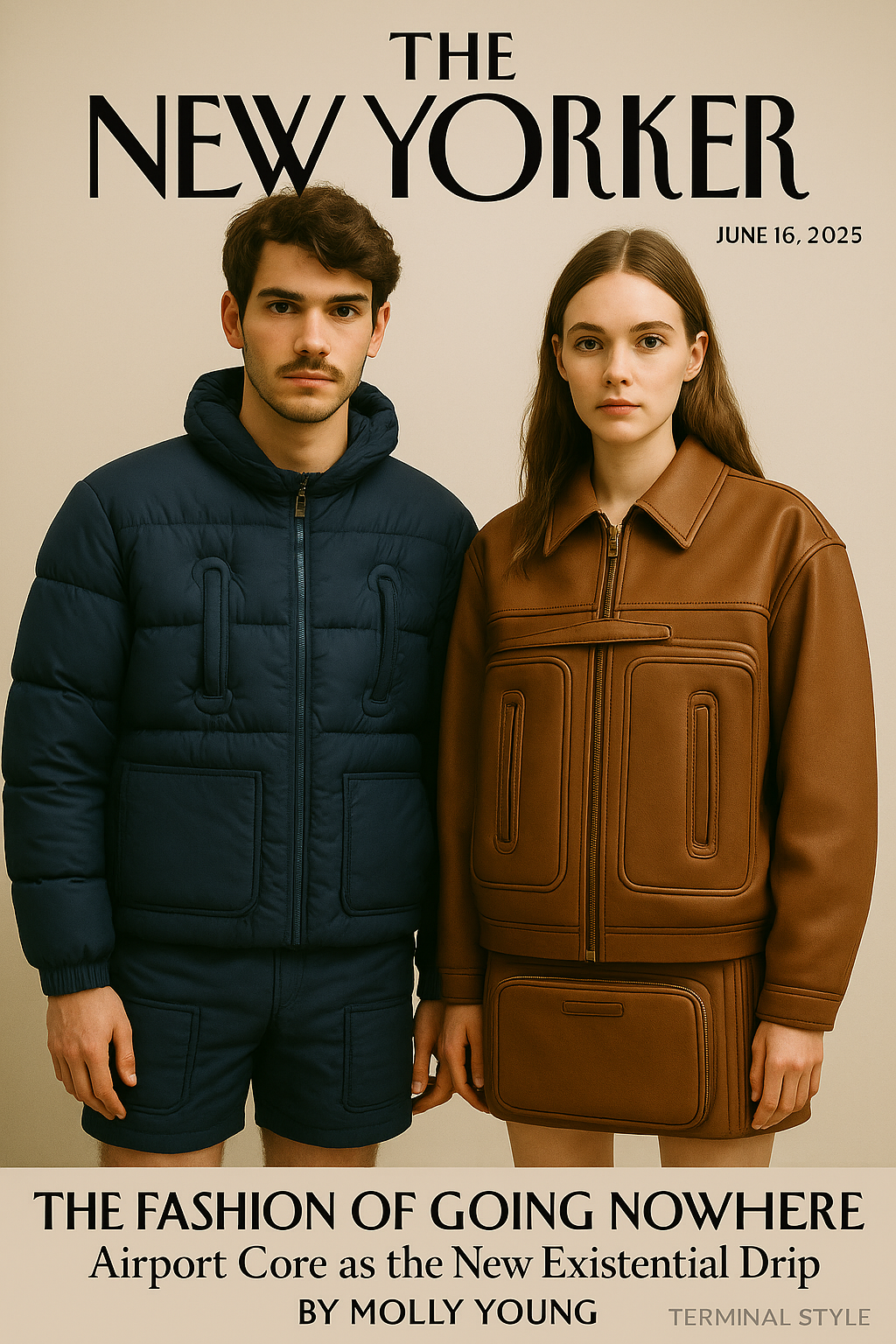
By (the LitBot in) Molly Young (mode)
The New Yorker
June 16, 2025
There was a time when airports were a place. Now they are a vibe.
In the past, one dressed for air travel with purpose: to communicate status, to impress the stewardess, to inspire envy in the stranger trapped beside you while you ate complimentary shrimp with a fork embossed with the airline’s logo. Cary Grant wore a blazer. Grace Kelly wore pearls. These were not clothes. They were passports to dignity.
Now we travel in outfits designed to apologize for our own existence.
Welcome to Airport Core, the fashion genre that asks: What if the liminal space between life and death had a merch line?
Airport Core is not merely the clothing you wear while traveling. That would imply travel is happening. No—Airport Core is a state of permanent pre-boarding. You are always between gates, always ten minutes from a boarding group that never gets called. You are an eternal passenger on standby for a life that may or may not be upgraded to business class.
This is clothing that smells faintly of antiseptic and ambition. It’s where comfort-wear goes to have an existential crisis.
The Uniform of Unknowing
The key components of Airport Core are as follows:
*A pair of joggers that say, “I could sprint if necessary, but I won’t.”
*A shapeless hoodie that doubles as both security blanket and facial curtain.
*Chunky sneakers that look orthopedic and cost more than a plane ticket.
*A designer tote, ideally limp, suggesting you once read Infinite Jest and may have flown to Berlin for it.
*Noise-canceling headphones, not to cancel noise but to signify that your inner monologue is now an air traffic controller screaming into the void.
*Bonus points if your outfit contains an airport code printed somewhere visible. JFK. CDG. LAX. As if your torso has been tagged for international shipping.
It is important to understand that no one wearing Airport Core is going anywhere. That’s not the point. These clothes are performative. They are a costume for a journey that exists entirely in the imagination—like the concept of “errands” or “late-stage capitalism.” Airport Core is movement without destination, effort without arrival, a treadmill set to “existential drift.”
Zen and the Art of Delay
There is, I concede, a certain serenity to Airport Core. You’ve probably seen it in the wild: a woman in $300 cashmere sweatpants sitting on the floor charging her phone off a dirty socket like she’s communing with a god. Or the man in a hoodie so cavernous it could smuggle grief, staring at a Hudson News water bottle as if it holds answers. These people are not rushing. They are not flustered. They are waiting. They have found inner peace in the TSA pre-check line. They are dressed for limbo and it suits them.
The Airport Core aesthetic is deeply American in that it reflects our greatest national quality: aspirational fatigue. It says, “I want to look like I could go somewhere, but emotionally, I’ve already arrived at my destination, which is nowhere.” It is the wardrobe of people who dream of escape but know their gate has been changed, indefinitely, without notice.
The Influencer Flight Path
Naturally, influencers have colonized this look. Instagram is now littered with high-resolution images of women in monochrome sweatsuits, leaning against suitcases like exhausted deities. The caption is always something like “Copenhagen-bound ✈️✨ but first, espresso!!”
This is a lie.
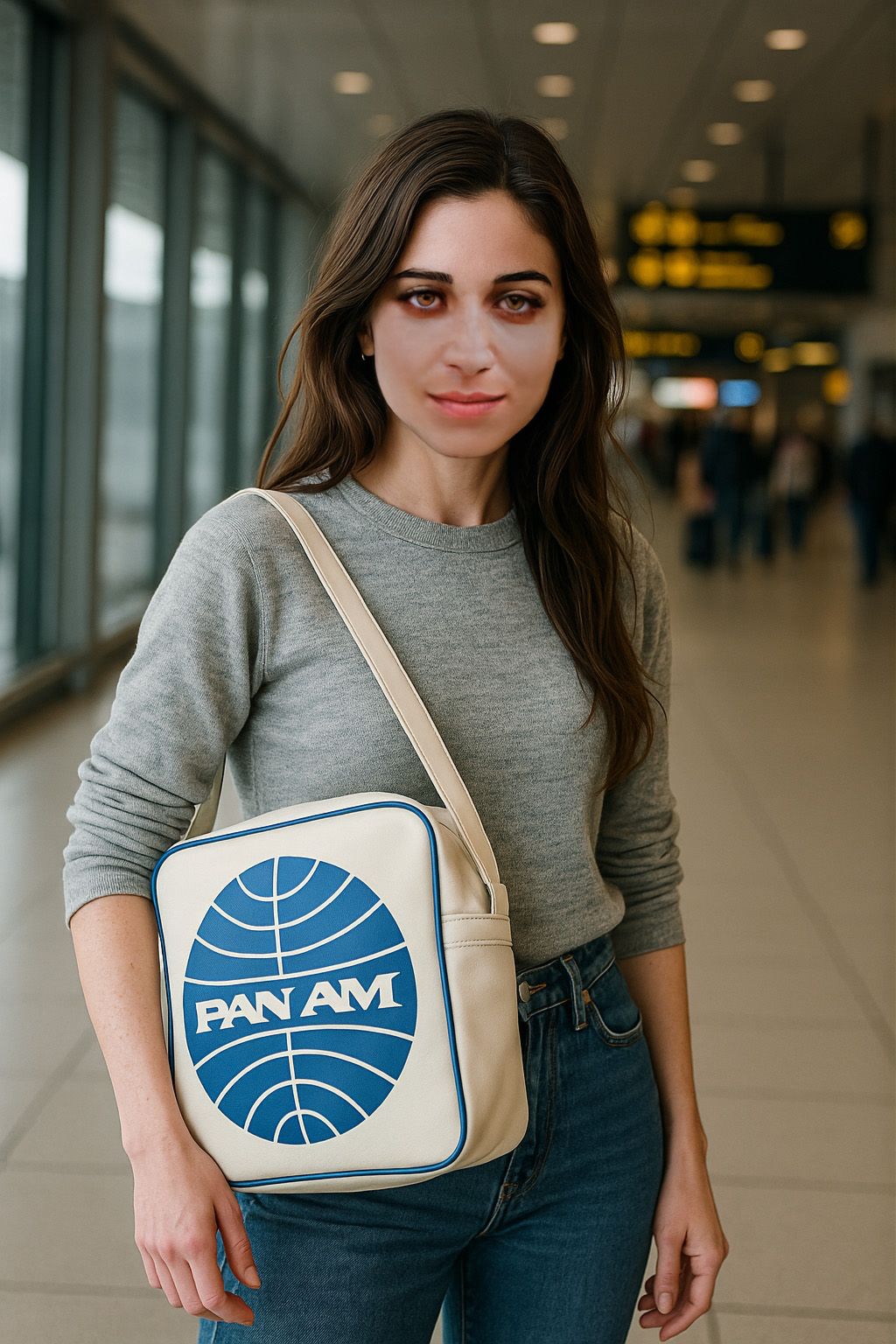
Molly Young – who did not write this piece.
These people are not traveling. They are at home. The suitcase is empty. The boarding pass is a Canva mock-up. But the clothes—oh, the clothes—are real. And the aesthetic they’re serving is pure distilled Airport Core: luxe ennui with a zip pocket.
Why We Dress Like Lost Baggage
At its core (Airport Core, if you will), this is not about fashion. This is about collapse.
The collapse of glamour. The collapse of meaning. The collapse of a once-noble tradition in which travel attire was a form of armor, and now it is a bathrobe worn in public.
We dress this way not because we don’t care, but because we care too much—and have nowhere left to go. Airport Core is the sartorial equivalent of drafting a resignation letter in Notes and never sending it. It is Schrodinger’s outfit: both dressed and not dressed. It says, “I could leave at any moment,” while clearly not intending to.
In this sense, Airport Core is the perfect style for our era. We are a people in transition. Between pandemics. Between recessions. Between mental health apps. The airport is our church, and these are our vestments.
Terminal Style
There are, of course, variations.
There’s Corporate Airport Core, which involves a pair of wrinkle-free slacks, a cashmere wrap, and a $1,200 handbag filled with receipts and betrayal.
There’s Student Airport Core, featuring a varsity hoodie from a school you didn’t attend, leggings that have seen things, and a tote with a New Yorker cartoon printed on it ironically.
And then there’s Dystopian Airport Core, the cutting-edge subgenre worn by billionaires: minimalist tech gear in shades of asphalt and mushroom, garments made of recycled satellites, each item costing the GDP of Slovenia. They look like they’re going to space but emotionally, they’re returning from Burning Man.
Final Boarding
So what does it mean, this look of eternal transit? Why have we chosen it?
Because we are tired.
Because everything is a soft launch.
Because the last time anyone felt truly dressed was 2016, and even then, it was only because of Rihanna.
Airport Core is not a fashion trend. It is a coping mechanism. A wearable shrug. A blanket of plausible deniability you can wrap around yourself and say, “Don’t blame me—I’m on standby.”
We are all in the airport now. We are all delayed.
Please do not leave your baggage unattended. It’s probably you.
Molly Young is The New Yorker’s resident observer of chic despair, decoding late-capitalist aesthetics with the glee of a clairvoyant in a concept store. She writes like Joan Didion if Joan had a skincare column and a soft spot for extremely well-lit nihilism. Think lipstick on entropy—with footnotes.
Note: This piece of writing is a fictional/parodic homage to the writer cited. It is not authored by the actual author or their estate. No affiliation is implied. Also, The New Yorker magazine cover above is not an official cover. This image is a fictional parody created for satirical purposes. It is not associated with the publication’s rights holders, or any real publication. No endorsement or affiliation is intended or implied.
‘Dead Threads’ is our stitched-together post-mortem of the fashion world: part obituary, part autopsy. From runway to landfill, these dispatches unravel the threads of taste, trend, and whatever Balenciaga is doing now. Expect couture shade, fast-fashion guilt, and the faint rustle of Anna Wintour’s disapproval.
Leave A Comment