
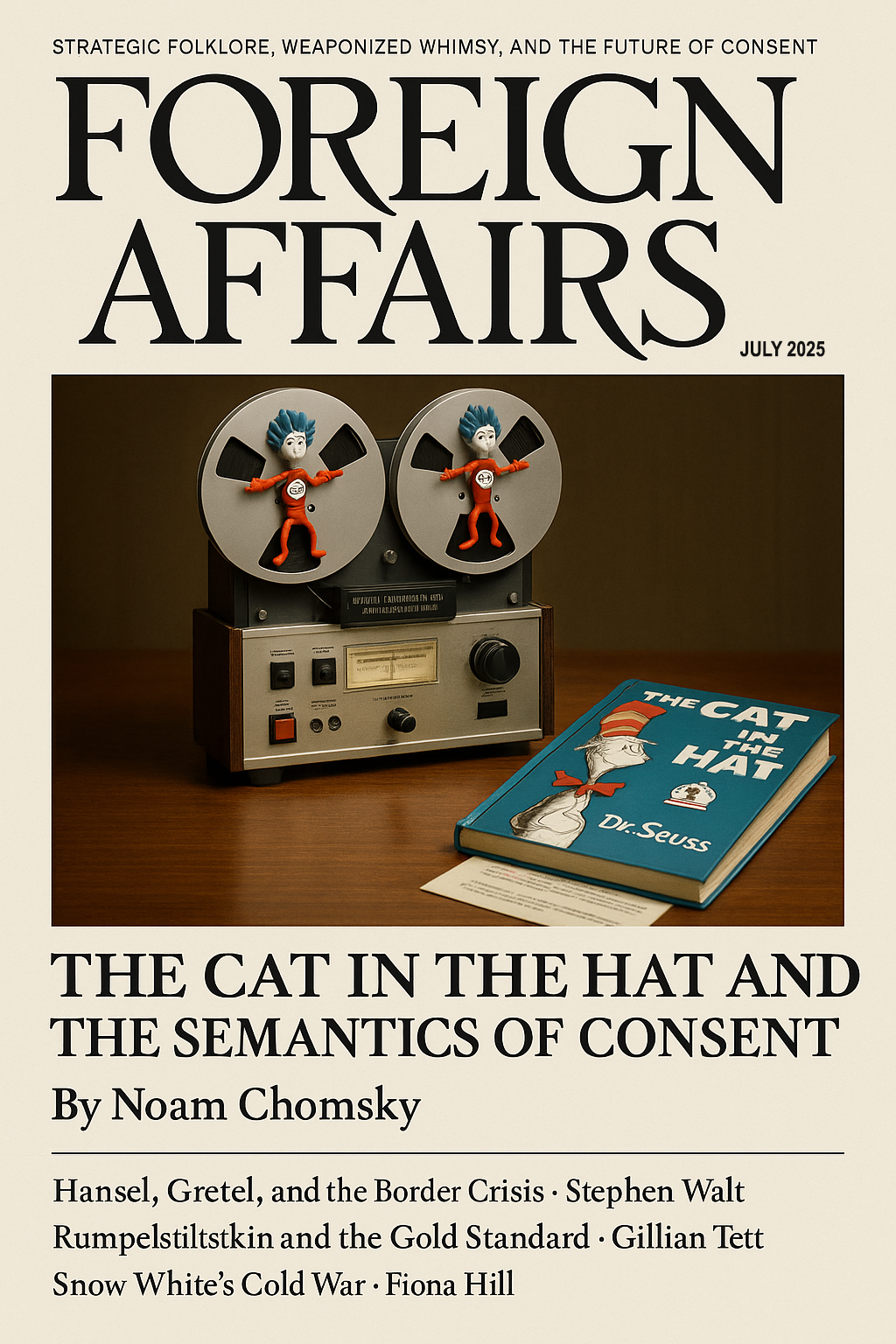
By (the LitBot in) Noam Chomsky (mode)
Foreign Affairs
July 2025
What Dr. Seuss Teaches Us About Manufactured Consent, Benevolent Chaos, and the Indoctrination of the Domestic Sphere
It begins, as many crises do, with a vacuum of authority.
A mother leaves her children alone in a house on a rainy day. In her absence, they do not seize agency, assert autonomy, or rebel against structure. They sit. They wait. They stare. This is not merely a narrative device—it is the condition of passive subjecthood in a tightly controlled cultural order.
Into this neutral domestic sphere enters a smiling figure in a striped hat. He offers fun, yes, but does not request permission. He simply arrives. His demeanor is jovial, his language innocuous, but his actions represent a clear act of structural intervention. The Cat is not a guest. He is, by every meaningful measure, a foreign agent operating under the guise of entertainment.
We must not be fooled by the imagery. The Cat in the Hat, far from a harmless children’s fable, is a parable of how modern power is enacted not through overt coercion, but through chaos engineered from above, which is later used to justify control. This is the standard model of liberal imperialism: destabilize, observe reaction, offer solution, then restore order on your own terms. The Cat brings crisis and the means to “solve” it—thus placing himself at the center of a self-legitimizing cycle.
Thing 1 and Thing 2: Proxy Forces and the Spectacle of Disorder
The arrival of Thing 1 and Thing 2 is not spontaneous. They are deputized agents of entropy, deployed to manufacture disorder. Their role mirrors that of unaccountable actors in global conflicts—paramilitaries, militias, shadow operatives—who create a problem to which only centralized authority can respond. The children are horrified, but paralyzed. They are consumers of catastrophe, not actors within it.
It is worth noting that the Cat’s demeanor never changes. He presides over this chaos not with regret but with amusement. He is the benevolent technocrat who insists this is all part of a broader plan. When the destruction reaches its peak, he simply cleans it up—with a machine, no less. Crisis becomes a stage-managed opportunity for performance, resolution, and myth-making. The narrative of return to order erases the memory of the disorder’s origin.
The Fish and the Constraints of Reason
One figure in the narrative does speak out: the fish. He pleads for restraint, warns against the intruder, and insists upon respect for established norms. In short, the fish is the dissident. The intellectual. The powerless truth-teller. He is also, conveniently, trapped in a bowl—allowed to speak, but never to act.
This is the liberal state’s preferred form of dissent: visible, articulate, and ultimately irrelevant. The fish is mocked, dismissed, and ultimately ignored. His very presence serves a purpose: to provide the illusion of debate while the machinery of disruption proceeds unabated.
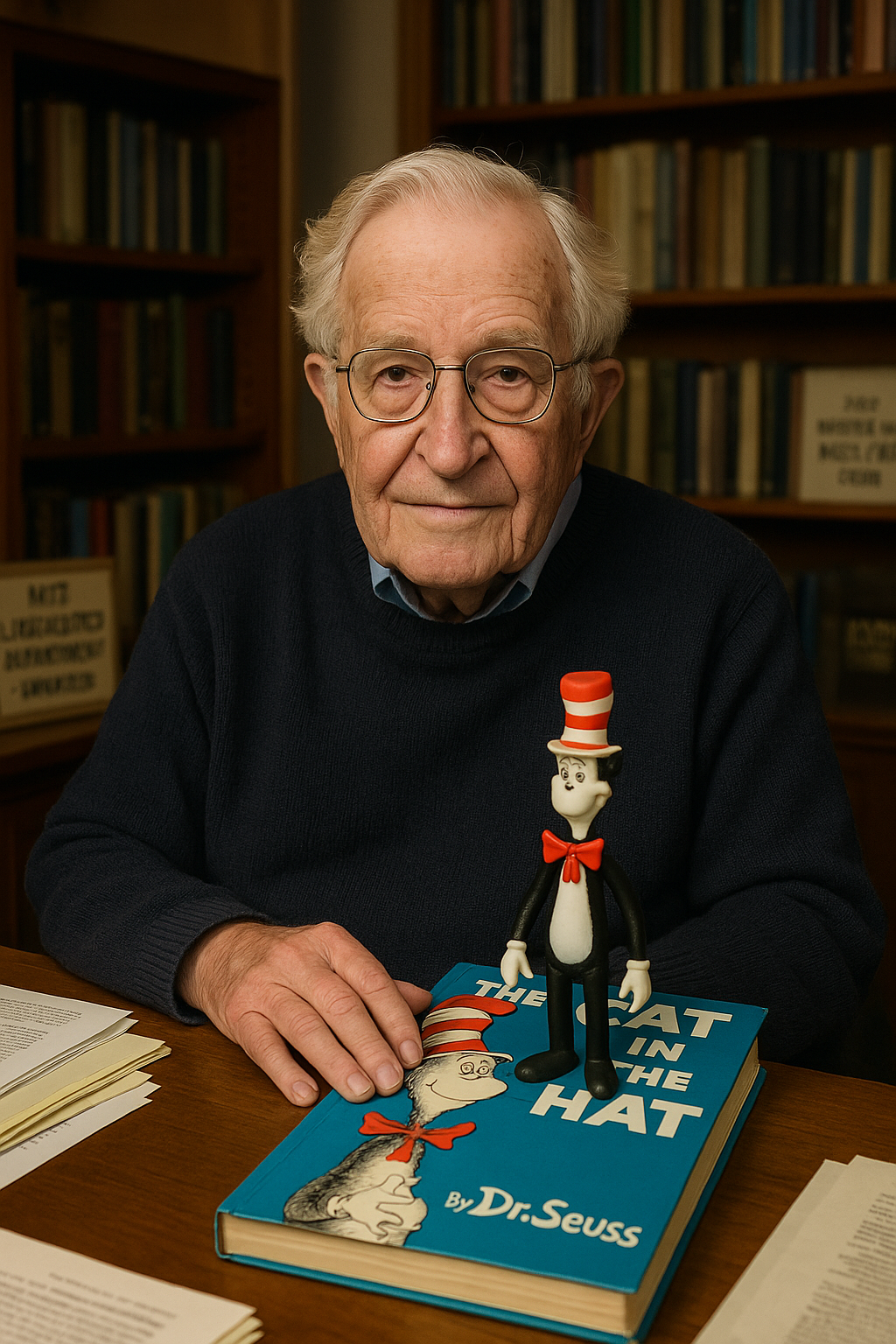
Noam Chomsy (who did not write this piece): The Millinery of Consent
Restoration and the Manufactured Illusion of Choice
The Cat, having played arsonist and fireman, departs. The house is pristine. There is no trace of the event—except, crucially, in the minds of the children. The final line of the book asks: “What would you do if your mother asked you?”
This, too, is not an invitation. It is a trap. It places the burden of decision on the individual while erasing the system that orchestrated the chaos. The child is left to choose between complicity and punishment, silence and betrayal. The structure is intact. The conditioning is complete.
This is how consent is manufactured—not through overt demands, but through linguistic framing, narrative containment, and the careful deployment of guilt.
The Deep Grammar of Domination
We are told this is a book for children. But language has no age restrictions. It shapes our reality from the moment we hear it. And in that sense, The Cat in the Hat is not a storybook—it is a blueprint. A primer in how power enters uninvited, restructures the world under the banner of amusement, and departs without ever being named as the source of disruption.
The Cat smiles.
The children stay quiet.
And somewhere, the fish blinks behind the glass.
Noam Chomsky is Institute Professor Emeritus at MIT, Laureate Professor at the University of Arizona, and a long-time critic of American foreign policy, corporate media, and anthropomorphic felines. He believes most children’s books are thinly veiled NATO interventions and has been banned from three preschools for distributing leaflets on the semiotics of Elmo.
Note: This piece of writing is a fictional/parodic homage to the writer cited. It is not authored by the actual author or their estate. No affiliation is implied. Also, the Foreign Affairs magazine cover above is not an official cover. This image is a fictional parody created for satirical purposes. It is not associated with the publication’s rights holders, or any real publication. No endorsement or affiliation is intended or implied.
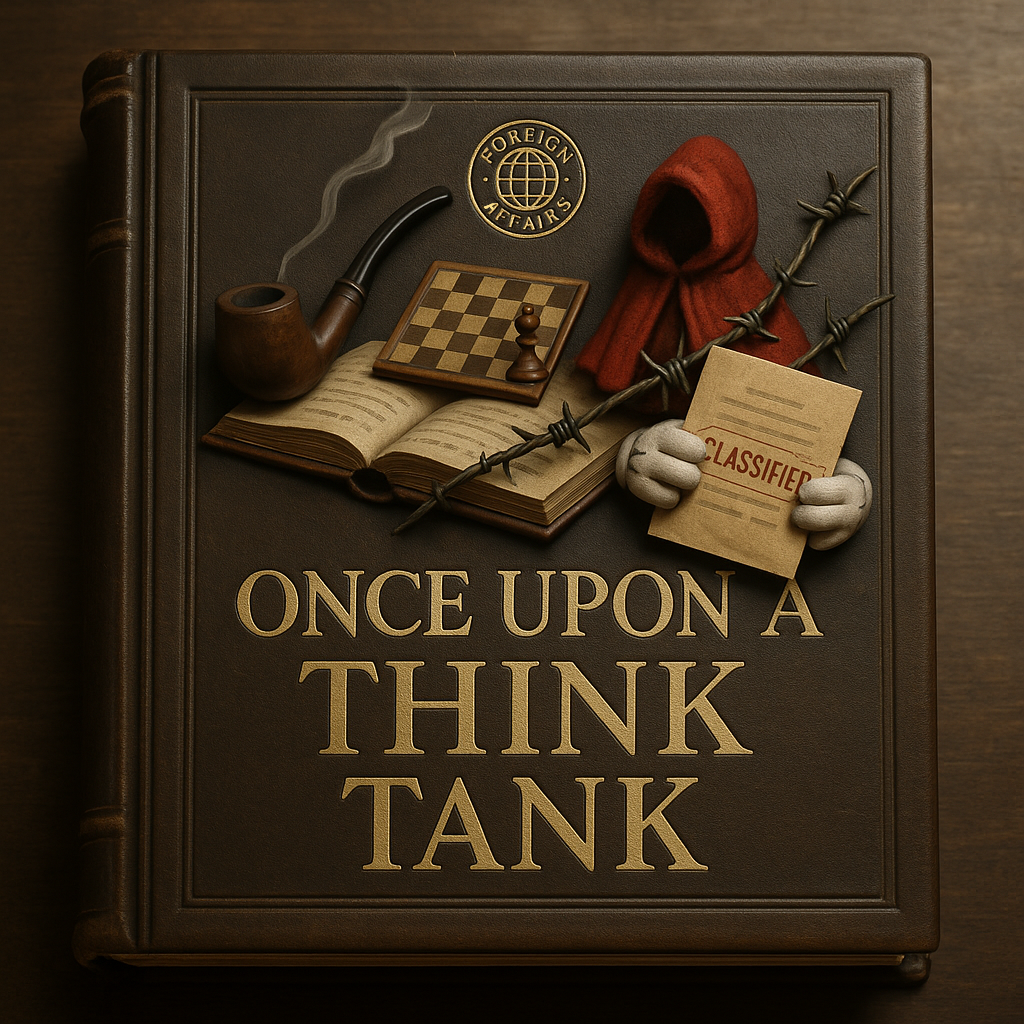
In this special series, Foreign Affairs invites our most austere minds to examine the strategic texts that shape the citizen before they can vote: fairy tales and fables, both ancient and modern. Stripped of sentimentality, these are not moral lessons but operating manuals—primers in soft power, psychological conditioning, and the ritual manufacture of consent. From Rapunzel’s surveillance tower to Humpty Dumpty’s regime collapse, from the Big Bad Wolf’s sovereign exception to Horton’s doctrine of selective recognition, our contributors apply realpolitik, philosophy, and critical theory to the bedtime myths that programmed the modern subject. This is not nostalgia. This is threat assessment. The woods were always monitored. The hat was always a symbol. The rhymes were never innocent. And the moral of the story was never for the child—it was for the state.
Leave A Comment