
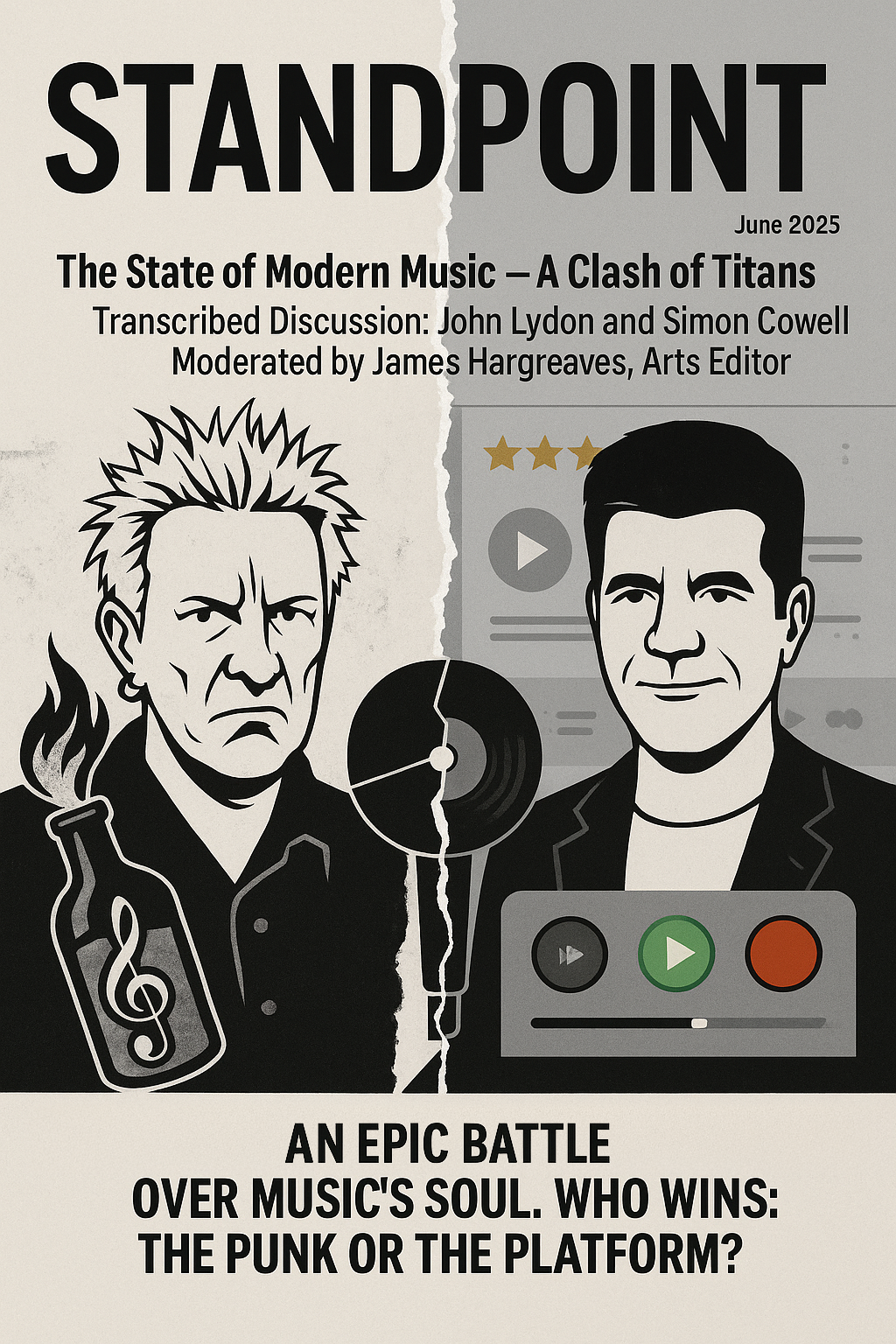
Transcribed Discussion: (the LitBot in) John Lydon (mode) and (the LitBot in) Simon Cowell (mode); Moderated by James Hargreaves, Arts Editor
Standpoint Magazine
June 2025
James Hargreaves: Welcome, gentlemen, to this Standpoint discussion. John Lydon, punk icon, and Simon Cowell, architect of pop’s modern landscape, you’ve both shaped music in wildly different ways. Today, we’re here to dissect the state of modern music. Where do we start?
John Lydon: Right, let’s cut the fluff. Music’s in a right mess, innit? It’s been gutted, turned into a soulless machine churning out bland, predictable pap for the masses. No rebellion, no danger, no ideas. It’s all algorithms and karaoke. Simon, you’ve got a lot to answer for, mate, with your telly talent shows and manufactured drivel.
Simon Cowell: Oh, please, John. Spare me the punk sermon. You’re living in 1977, waving your anarchist flag while the world’s moved on. Music’s a business, not a revolution. People want entertainment, not some sweaty bloke screaming about chaos. My shows—Pop Idol, X Factor—gave ordinary people a shot, democratised music. You can’t deny the talent we’ve found: Leona Lewis, One Direction. They sell because people love them.
Lydon: Talent? You call that talent? It’s polished mediocrity! You take raw voices, strip ‘em of character, and shove ‘em into a box—your box, Simon. It’s not about music; it’s about control. You’re the establishment, mate, worse than the suits we spat at in the ‘70s. Punk was about tearing that down, giving kids a voice to say, “Sod this!” What’s your X Factor winner saying? “Buy my single”?
Cowell: You’re so romantic about punk, John, but let’s be real. It was a flash, a tantrum. Three chords and a snarl don’t change the world. Most punk bands fizzled out or sold out—yes, even you, with your Public Image Ltd experiments. I give people what they want: melodies, hooks, stories. Look at streaming numbers—Ed Sheeran, Adele. That’s what connects. Your “voice” is just noise to most ears.
Hargreaves: Let’s focus on connection. John, you’ve always championed authenticity, from the Sex Pistols’ raw energy to PiL’s avant-garde edge. Simon, you prioritize marketability. Is there a middle ground where music can be both authentic and popular?
Lydon: Authenticity ain’t negotiable. It’s blood, sweat, and truth. When I wrote “Anarchy in the UK,” it wasn’t a pose—it was rage against a rotten system. Today’s music? It’s fake tears, auto-tuned to death. Simon’s lot churn out plastic dolls who mime emotions they don’t feel. You can’t manufacture soul, no matter how many sob stories you stick on telly.
Cowell: Soul? Come off it. People don’t want your version of soul—they want escapism. My artists tell stories through their songs, whether it’s a ballad or a banger. Take Little Mix: working-class girls, real struggles, massive hits. That’s authentic to millions. You’re just elitist in reverse, John, gatekeeping what “real” music is. The charts don’t lie—people vote with their wallets.
Lydon: Charts? That’s your Bible, innit? A rigged game. Your machine—labels, TV, streaming—decides who gets heard. Back in ’76, we had to fight to get “God Save the Queen” played; it was banned, still hit number one. That was people defying your system. Now, kids are spoon-fed playlists curated by suits. Where’s the fight? Where’s the art?
Cowell: Art? Most people don’t want art—they want a song to sing in the car. You’re out of touch, John. Streaming’s levelled the playing field. Anyone can upload a track, go viral, bypass the old gatekeepers. Look at Billie Eilish—bedroom pop, no TV show needed. That’s the new punk, if you want to use your tired term. You’re just shouting at clouds.
Hargreaves: Technology’s a key point. Streaming, social media, and AI are reshaping music. Simon, you’ve embraced digital platforms; John, you’ve criticized them. How do they impact creativity?
Lydon: It’s a bloody disaster. Algorithms dictate what you hear, flattening everything into a beige mush. Creativity’s choked by data—labels want songs that fit Spotify’s “chill vibes” playlist. And AI? Don’t get me started. It’s not music; it’s a computer faking it. I’d rather hear a kid with a battered guitar and something to say than a bot spitting out generic beats.
Cowell: You’re such a Luddite. Streaming’s a tool, not the enemy. It’s given artists direct access to fans, no middleman. AI’s just another instrument—producers have used tech forever. The creativity’s in how you use it. My team’s experimenting with AI to scout sounds, predict trends. It’s not replacing artists; it’s enhancing them. You’d know this if you didn’t fetishise the past.
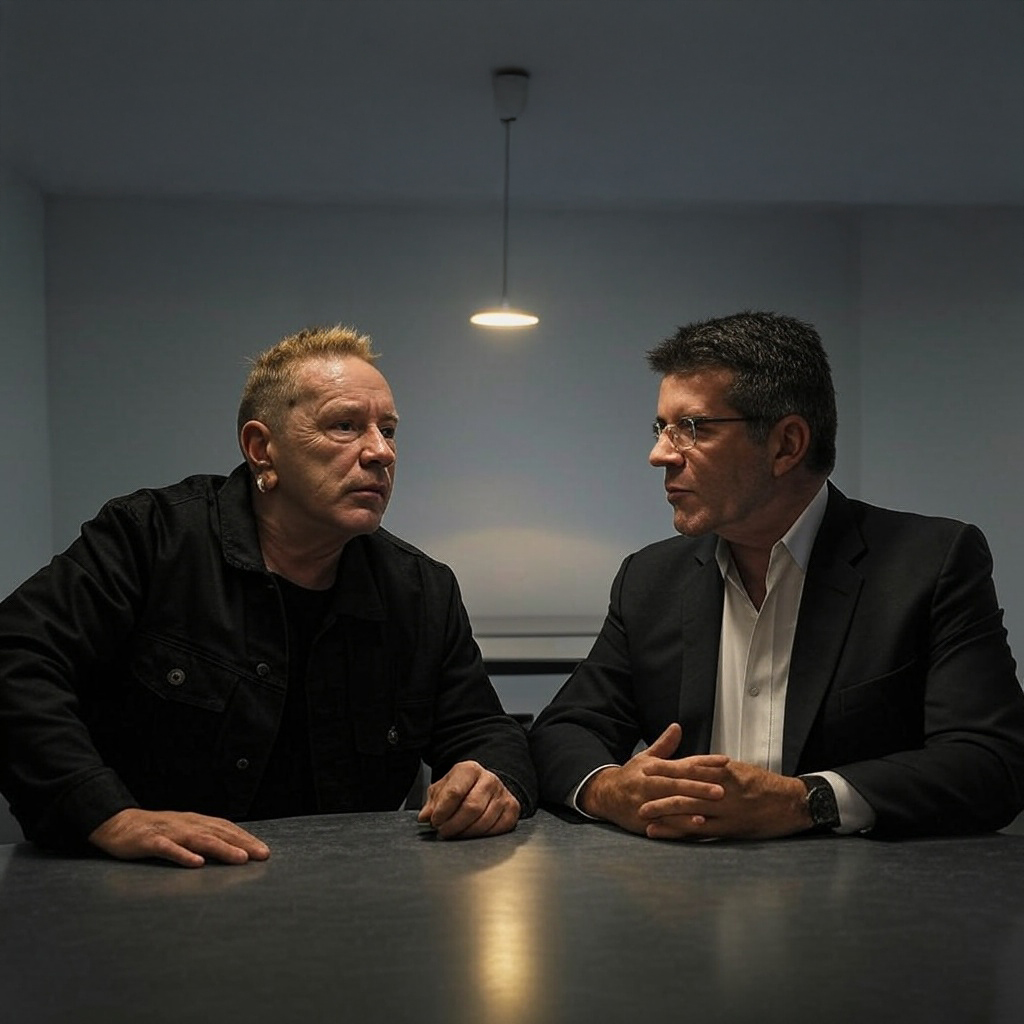
The Punk & The Platform ~ Messrs. Lydon & Powell, Esq.
Lydon: Enhancing? It’s embalming! You’re turning music into a science experiment. When I did PiL, we pushed boundaries—dub, noise, chaos—because we felt it, not because some algorithm said, “This’ll trend.” Today’s kids are slaves to TikTok, making 15-second snippets for likes. That’s not freedom; it’s a cage.
Cowell: You keep banging on about freedom, but your music’s niche, John. PiL’s great for artsy types, but it’s not filling stadiums. I’m about scale—reaching billions. TikTok’s a platform for discovery. Artists like Doja Cat broke through there, not some grimy pub. You’re stuck in this purist bubble, ignoring how people actually consume music.
Hargreaves: Let’s talk legacy. John, punk’s influence is undeniable—grunge, indie, even hip-hop owe it a debt. Simon, your talent shows have launched global stars. What’s the future of music, and what role will your approaches play?
Lydon: Punk’s not a style; it’s a mindset. It’s about questioning, disrupting. The future needs that more than ever—kids who’ll smash the system, not beg for Simon’s approval. But I’m worried. Music’s too safe, too corporate. If we don’t get angry again, we’ll drown in this sea of blandness. I’d tell any kid: pick up an instrument, say something real, and don’t trust anyone in a suit.
Cowell: And I’d tell them: work hard, know your audience, and seize the moment. The future’s bright—tech’s opening doors, and talent always rises. My approach—finding raw potential, shaping it for the masses—will keep evolving. John, you’re a relic, preaching to a shrinking choir. Music’s bigger than your rebellion. It’s about connection, not destruction.
Lydon: Connection? You’re selling conformity, Simon. Music’s not a product; it’s a weapon. Always has been. If we lose that, we lose everything.
Cowell: And if we ignore what people want, we’re just shouting into the void. I’ll take the hits over the tantrums any day.
Hargreaves: Gentlemen, we’ll have to leave it there—a true clash of visions. Thank you for this spirited debate.
John Lydon is a cultural arsonist emeritus, punk’s permanently dishevelled prophet, and the last man alive who still thinks sneering is a form of political action. He once screamed at the monarchy, now he screams at Spotify. Still allergic to polish and suspicious of anything that sells in Tesco. Simon Cowell is a music mogul, TV judge, and high priest of the pop-industrial complex. He believes hits are holy, talent is marketable, and emotional authenticity can be mass-produced with the right lighting. Once wore a black T-shirt to a funeral and called it branding.
Note: This piece of writing is a fictional/parodic homage to the personalities cited. It is not authored by them or their estates. No affiliation is implied. Also, the Standpoint magazine cover above is not an official cover. This image is a fictional parody created for satirical purposes. It is not associated with the publication’s rights holders, or any real publication. No endorsement or affiliation is intended or implied.
From Auto-Tune to algorithmic jazz, ‘Earwax’ filters the soundscape so you don’t have to. This is our noise-soaked corner of musical commentary, where critics, fans, and the occasional ghost of Elvis Presley weigh in on the tragic comedy of modern audio. Not all bangers slap. Some just bruise.
Leave A Comment