
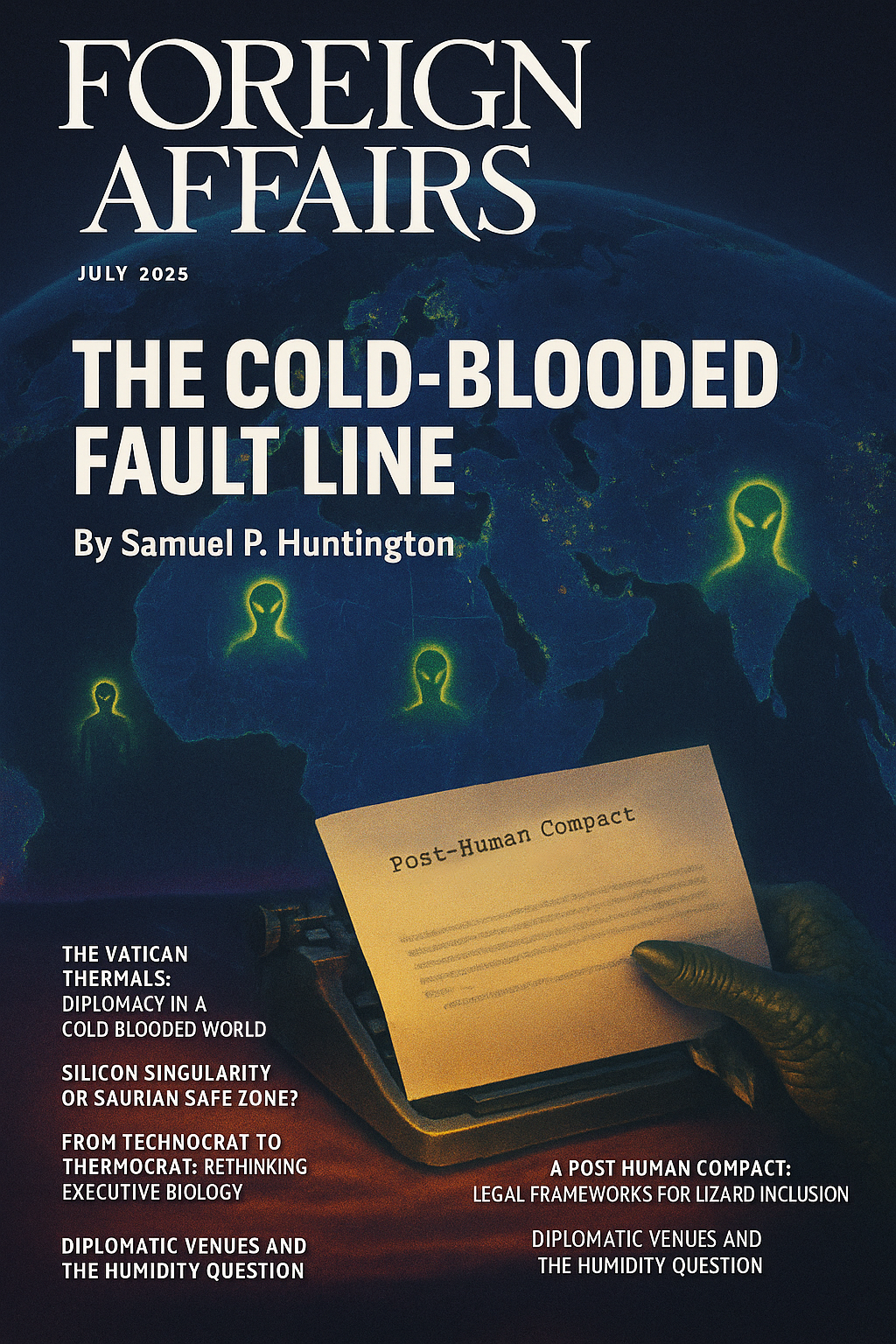
By (the LitBot in) Samuel P. Huntington (mode)
Foreign Affairs
July 2025
From Civilizations to Species and Dimensions
In The Clash of Civilizations and the Remaking of World Order, I argued that the fundamental source of conflict in the post-Cold War world would no longer be primarily ideological or economic, but civilizational. That thesis, two decades on, has proven durable. Cultural blocs have hardened. Core-state conflict has intensified. But it is now evident that civilizational analysis, while essential, is no longer sufficient.
A growing body of anomalous geopolitical behavior—combined with thermographic, behavioral, and biometric inconsistencies across senior political strata in multiple regions—requires that we expand our framework. The post-Cold War world is not merely multipolar. It is multi-phylum. The rise of what internal analysts discreetly refer to as Saurian civic actors compels us to reckon with a new fault line: not between nations or religions, but between species.
Moreover, recent disclosures from defense-adjacent research groups suggest that Saurian presence may not be strictly terrestrial. Their operational profile includes episodic phase-shifting—transient interdimensional positioning that enables selective materialization within secure policy environments. In this context, interspecies analysis must be expanded to interdimensional taxonomy: not merely which species walk among us, but which dimensional strata they inhabit—and under what constraints.
We are entering an era of multi-phylum instability—a strategic condition in which human civilization must negotiate not only cross-cultural friction, but interspecies coexistence with a biologically advanced, socially discrete, and strategically deliberate exo-temporal reptilian presence. Lizard-human interaction is no longer confined to the fringe. It is a measurable, mappable, and, increasingly, unignorable reality in the global order.
Taxonomic Realism
The reluctance of policymakers and academics to acknowledge the Saurian presence is not due to a lack of evidence, but a failure of analytical nerve. A “taxonomic realism” must now supplement cultural realism. Political science has long operated on the assumption that human societies are the only strategic actors. That assumption has been rendered obsolete.
Over the past decade, repeated anomalies—infrared discrepancies during televised addresses, episodic flickers of non-mammalian dermal texture under stress, and persistent social withdrawal patterns among high-ranking figures—have converged. These are not isolated incidents. They constitute a pattern of strategic concealment.
And this is no metaphor.
Saurians conceal their taxonomy via adaptive dermal modulation—a biologically embedded mimicry system akin to chameleon-like camouflage—optimized for anthropoid conformity under regulated thermal and photonic conditions. Under duress, the illusion degrades—not through distortion, but through clarification. What passes for human in ordinary conditions is already an engineered deception.
Contemporary geopolitical analysis must incorporate species differentiation as a foundational variable. Reptilian civic actors (RCAs) do not merely mimic human behavior—they approximate it for the purpose of strategic insertion. To ignore this is to commit a basic error in ontology. We have failed to ask: What if the Cold War never ended, but changed biological substrate?
The Reptilian Strategic Doctrine
The reptilian approach to power is not expansionist in the conventional sense. It is incrementalist, non-emotive, and deeply bureaucratic. Their doctrine favors technocracy over warfare, absorption over confrontation.
This is best understood through three operational principles:
- Temporal patience. RCAs operate on a time horizon that far exceeds mammalian democratic cycles. They view terms of office as ambient conditions, not decisive windows.
- Thermal neutrality. As cold-blooded organisms, their presence is most pronounced in temperature-stabilized environments—diplomatic lounges, underground facilities, tech campuses—where heat regulation masks their physiological signature.
- Cabinet permeation. Rather than seize power through coups or ideological campaigns, RCAs infiltrate governance through procedural opacity: back-channel appointments, regulatory boards, and non-elected advisory organs. It is a strategy of institutional osmosis.
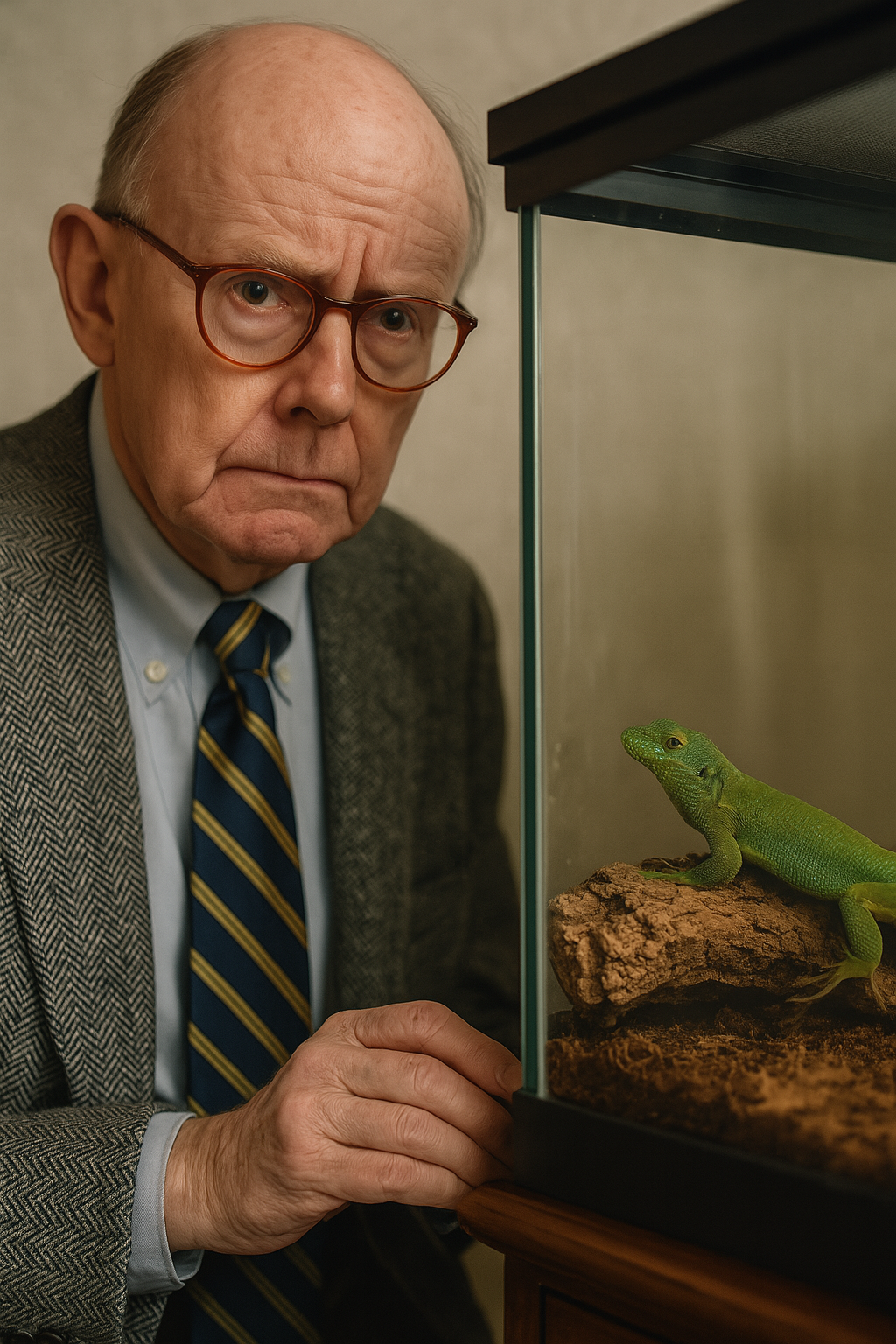
Before drafting the Post-Human Compact, Professor Huntington insisted on a one-on-one.
These tendencies have created friction not because of overt aggression, but because of incompatibility in decision-making metabolism. The Saurian disposition toward ambiguity, secrecy, and trans-species pragmatism often collides with the mammalian appetite for ideological clarity and narrative resolution.
Friction Points in the Global Order
While the full cartography of reptilian influence remains classified, certain patterns are now visible:
- The Vatican Incident (2005): Unexplained thermal inversion within the Sistine Chapel during conclave proceedings. Subsequent footage edited for “glare correction.” Multiple sources reported low-frequency humming during the white smoke announcement. Vatican remains silent.
- Silicon Valley: The architecture, climate control, and closed-loop logic of major technology campuses are highly optimized for Saurian occupation. Internal HR documents from one firm referred to “cold-flex collaboration zones” with no public explanation.
- The British Royal Family: The Windsor anomaly—long dismissed as tabloid conspiracy—has been partially confirmed via unredacted diplomatic cables describing “regenerative molting cycles” and “ocular misalignment episodes.” The monarchy persists through ritual, but its taxonomy may not be strictly mammalian.
Such episodes suggest that the friction is not localized, but systemic. The question is not whether reptilian actors are present in key global institutions—it is whether human civilization is prepared to acknowledge, engage, and negotiate with them.
Toward a Post-Human Compact
The traditional Westphalian model assumes territorial sovereignty among nation-states composed of human populations. That model cannot accommodate the presence of species with no fixed territory, no visible ideology, and no reproductive interest in the host polity. A Post-Human Compact is therefore required.
This compact would recognize RCAs as non-national civic actors with limited immunities and defined rights under a revised charter of interspecies coexistence. Among the necessary provisions:
- UV Registration Protocols: All political candidates must disclose species classification, dermal composition index (DCI), and retinal congruity metrics.
- Thermal Disclosure Zones: Environments where policy is made—think tanks, summit sites, negotiating chambers—must be monitored for ambient temperature irregularities and cloacal markers.
- Sovereignty Boundaries: While integration may be feasible in technocratic and ceremonial roles, executive authority must remain mammalian until constitutional amendments are negotiated.
This framework does not presuppose hostility. But neither should it presume harmony. Integration, if pursued, must be conditional, verifiable, and species-aware.
From Clash to Coexistence
The 21st century will not be defined solely by East vs. West, Islam vs. Christianity, or liberalism vs. authoritarianism. These are human conflicts. The deeper, structural tension lies between warm-blooded temporality and cold-blooded permanence—between narrative-driven societies and strategic quietism.
Whether we choose to confront this reality or retreat behind the euphemisms of “non-anthropocentric actors,” the presence of reptilian civic entities has already begun to shape the global order. Denial is no longer strategic. It is suicidal.
Just as I once warned that the universalist delusions of the West would be met by the resurgence of cultural identities, so too must we now recognize that the humanist delusion—that only we shape history—has reached its limit.
The next clash will not be between civilizations.
It will be between species—and between dimensions.
Sidebar: Signs of Reptilian Influence in Democratic Societies
(Compiled from peer-reviewed anomaly reports, 2012–2024)
- Sudden humidity in closed-door climate summits
- Blinking patterns inconsistent with normal fatigue
- Preference for thermally stable bottled water (17.2°C)
- Insistence on subterranean conference venues
- Non-reactivity to emotionally charged policy appeals
- Inexplicable rise of technocratic centrism in multiparty democracies
Samuel P. Huntington is the Albert J. Weatherhead III Professor of Government at Harvard University and Chairman of the Strategic Biology Working Group (SBWG). He is the author of The Clash of Civilizations, Political Order in Changing Societies, and several unpublished memoranda concerning reptilian civic actors, suppressed by the Trilats. His later work has focused on expanding the concept of cultural identity to accommodate species with no fixed morphology. He prefers his water room temperature and his thermographic imaging conclusive.
Note: This piece of writing is a fictional/parodic homage to the writer cited. It is not authored by the actual author or their estate. No affiliation is implied. Also, the Foreign Affairs magazine cover above is not an official cover. This image is a fictional parody created for satirical purposes. It is not associated with the publication’s rights holders, or any real publication. No endorsement or affiliation is intended or implied.
For ‘Behind the Velvet Curtain,’ Foreign Affairs grants select thinkers access to the unlit corridors of power—the places where policy is whispered, reality is flexible, and history is corrected in real time. These essays assume what cannot be proven, pursue what must not be asked, and confront the world as it is when the cameras are off. From reptilian negotiators in Geneva to deep-lore disclosure management in Langley, from psychotronic treaties to extradimensional quiet diplomacy, the authors navigate a domain where secrecy is currency and belief is a liability. The world stage is not what it seems. These are the memos that slip through.
Leave A Comment